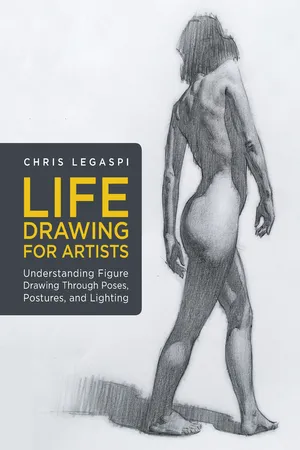
Life Drawing for Artists
eBook - ePub

Life Drawing for Artists

Understanding Figure Drawing Through Poses, Postures, and Lighting

  1. 176 pages
  2. English
  3. ePUB (mobile friendly)
  4. Available on iOS & Android
eBook - ePub

Life Drawing for Artists

Understanding Figure Drawing Through Poses, Postures, and Lighting

About this book

Life Drawing for Artists teaches a contemporary approach to figure drawing that includes both the familiar poses—standing, sitting, lying down—but also how to capture figures in movement and in more dynamic and engaging positions.

Author Chris Legaspi is a dedicated, life-long artist and admired instructor who is known for his dynamic figurative drawings and paintings, and as a successful illustrator in the entertainment industry. Whether you are an aspiring illustrator, art student, or a professional artist looking to develop your abilities, Life Drawing for Artists shows how to build your skills by combining fundamental building blocks, such as gesture lines, shape and design, structure, value control, and edge or line control.

You'll focus on different skills while working on both quick timed drawings and longer detailed drawings. The book covers important topics, such as drawing different views, understanding perspective, foreshortening strategies, and how to deal with various lighting conditions. The examples and tutorials explore virtually every pose scenario, as well as many active and dynamic movements.

Breathe drama into your figures as you master the fundamentals with this fresh approach to life drawing.

The For Artists series expertly guides and instructs artists at all skill levels who want to develop their classical drawing and painting skills and create realistic and representational art.

Frequently asked questions

Yes, you can cancel anytime from the Subscription tab in your account settings on the Perlego website. Your subscription will stay active until the end of your current billing period. Learn how to cancel your subscription.
No, books cannot be downloaded as external files, such as PDFs, for use outside of Perlego. However, you can download books within the Perlego app for offline reading on mobile or tablet. Learn more here.
Perlego offers two plans: Essential and Complete
  • Essential is ideal for learners and professionals who enjoy exploring a wide range of subjects. Access the Essential Library with 800,000+ trusted titles and best-sellers across business, personal growth, and the humanities. Includes unlimited reading time and Standard Read Aloud voice.
  • Complete: Perfect for advanced learners and researchers needing full, unrestricted access. Unlock 1.4M+ books across hundreds of subjects, including academic and specialized titles. The Complete Plan also includes advanced features like Premium Read Aloud and Research Assistant.
Both plans are available with monthly, semester, or annual billing cycles.
We are an online textbook subscription service, where you can get access to an entire online library for less than the price of a single book per month. With over 1 million books across 1000+ topics, we’ve got you covered! Learn more here.
Look out for the read-aloud symbol on your next book to see if you can listen to it. The read-aloud tool reads text aloud for you, highlighting the text as it is being read. You can pause it, speed it up and slow it down. Learn more here.
Yes! You can use the Perlego app on both iOS or Android devices to read anytime, anywhere — even offline. Perfect for commutes or when you’re on the go.
Please note we cannot support devices running on iOS 13 and Android 7 or earlier. Learn more about using the app.
Yes, you can access Life Drawing for Artists by Chris Legaspi in PDF and/or ePUB format, as well as other popular books in Art & Art General. We have over one million books available in our catalogue for you to explore.

Information

eBook ISBN
9781631598029
Topic
Art
Subtopic
Art General

CHAPTER 1
FOUNDATION

The Purpose of Figure Drawing

Life drawing, or drawing from life, is the practice of drawing a living, breathing human being, live, in person, and in real time. Generally when a live model is drawn from life in an academic classroom or art studio setting, it is known as a life drawing session.
Image

WHY DRAW THE FIGURE AT ALL?

The figure is merely a subject to study, but it is such an incredibly deep and complex subject. Because of this depth and complexity, every core fundamental of drawing, and of art itself, can be learned from studying and drawing the figure. Everything, from making quality lines to lighting to composition, is a necessary part of the figure drawing process. So, in short, if you want to become a better artist, drawing the figure can be a path to get there. This has been true for me and for many of the great artists throughout time.

WHY DRAW FROM LIFE?

The main benefit of drawing from life versus drawing from a photo, or even memory, is that the figure can be studied and observed in its natural state and in the round. This means that you can physically see the figure in all three dimensions. In a life drawing session, the poses are arranged with a time limit, which has many benefits for the art student.
The first benefit, and why it is so important, is that timed poses create a structure to the artist’s practice. Having structure in any serious practice has many advantages. Setting a time limit forces the artist to fully concentrate on the model and the task at hand. For example, if I know I have only three hours to draw from a live model, then I will focus on and appreciate each pose in the time I have with the model. If each pose is limited in time (e.g., a one-minute pose), then I will be even more focused. If I want to make a meaningful drawing, I know I have to put maximum thought and concentration into each and every mark.
The second benefit is repetition. To learn any skill, especially a new motor skill that involves muscle and neural patterns (such as drawing with a pencil), many repeated attempts are required. In a three-hour life drawing session with timed poses, especially short times such as one, two, or five minutes, the model can make more than one hundred unique poses. Each pose is a new and fresh opportunity to practice a drawing skill.
Because there are so many unique opportunities (sometimes one hundred or more poses) in a typical three-hour life drawing session, there is less pressure or expectation to finish a drawing, or to make a good drawing. This frees up the mind to either focus on a specific skill or experiment and take risks because no matter how the drawing turns out, eventually there will be a fresh new pose, and there will be many new opportunities to try and try again.
The third benefit, and what I enjoy most, is the time pressure. With unlimited time for a drawing or a pose (or any task), the mind can easily become distracted and lose focus. When the artist has limited time, and knows that the pose will soon change, there is pressure, or a sense of urgency to accomplish the task. This sense of urgency imposes more focus on the pose and on every mark the artist makes, which makes each drawing, and the practice session as a whole, much more productive.
The purpose of life drawing is to study the human figure and learn as much as possible about the figure and the drawing process. The main goal of timed life drawing is practice and repetition. Like the gym or exercise, it is in a life drawing session where we get our “reps.” The goal is not to make a finished drawing, a perfect drawing, or even a good drawing. In fact, the goal is to try to fail as many times as possible. This is especially true if you are new to life drawing, or if you are experienced and trying something new, experimenting, taking risks, or generally trying to improve.
In short, don’t put any expectations or pressure on yourself when you are in front of a model. Instead, focus on the moment, focus on th...

Table of contents

  1. Cover
  2. Title Page
  3. Contents
  4. Preface
  5. Chapter 1 | Foundation
  6. Chapter 2 | Fundamentals of Life Drawing
  7. Chapter 3 | The Drawing Process
  8. Chapter 4 | Side View and Perspective
  9. Chapter 5 | Exercises and Self-Study
  10. Acknowledgments
  11. About the Author
  12. Index
  13. Dedication
  14. Copyright