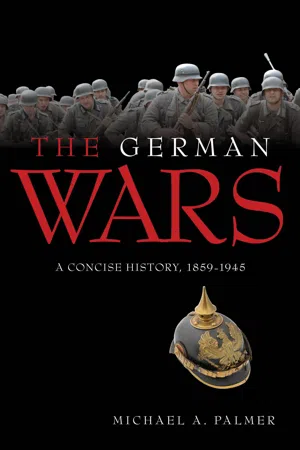
The German Wars: A Concise History, 1859-1945 outlines the history of European warfare from the Wars of German Unification to the end of the World War II. The title aside, the book is not be another history of the German military; it takes a much broader approach looking at political, social, economic, and military developments across Europe, and the United States during the period. The “German War” part of the title is there because Germany plays the central part in the story. But the key element threading its way through this volume is the Industrial Revolution.
DURING THE MID-NINETEENTH CENTURY, the industrializing world struggled with innumerable problems—rapid industrialization, population expansion, growth of the state, and political turmoil. The United States descended into a bloody civil war. In Europe, the principal political factor undermining stability was not the issue of slavery, but the question of nationalism. The rise of nationalistic sentiments undermined the legitimacy of the old dynastic regimes, many of which—most notably the Ottoman, Romanov, and Hapsburg empires—were multinational in character. National forces ultimately shattered the European empires at the close of the 1914–1918 war, and nationalism as a political force continues to play a major role in European, and non-European, politics to the present day.
In 1859, only one of the major continental European powers could be termed a true nation-state—France. Its population was overwhelmingly French, and the majority of French-speaking Europeans found themselves within the borders of their state. Prussia could be termed a nation-state, but only to a degree because its population included a sizeable minority of Poles. Moreover, millions of German-speaking Europeans found themselves living as members of other states, both small and large. The Austrian Empire was a polyglot realm, ruled by German-Austrians (primarily) and Hungarians, but containing millions of Czechs, Poles, Slovaks, Ukrainians, and assorted other Slavic peoples in the Balkans. Other Christian Slavs in the Balkans still lived under the heel of the Ottoman Turks. To the east, the Russian Empire was an enormous multinational operation, containing within its European borders Finns, Latvians, Estonians, Lithuanians, Poles, Byelorussians, Ukrainians, and other minorities.
The increasing tendency of European peoples to identify themselves, and often to organize themselves, politically along ethnic lines threatened the stability of the existing European order. Nationalism had come to the fore during the period following the French Revolution, and it had played a significant role in the revolutions that had swept across the continent in 1848. The political reaction that followed only temporarily squelched the forces at work. A decade later, stronger nationalistic forces emerged. These forces triggered a series of wars in central and eastern Europe that continued until the very eve of the Great War in 1914 that remapped the boundaries of the continent. The most significant of the national struggles centered on the question of the leadership and national political organization of the German-speaking people of central Europe. Would they be united? And if so, would it be under the banner of the Prussian or Austrian empires?
The first of the national wars began in 1859 when the Italian kingdom of Piedmont and Sardinia began its ultimately successful attempt to unify the states of the Italian peninsula. The Piedmontese undertook their efforts with the support of the French Empire of Napoleon III. The emperor, a nephew of Napoleon I, had pretensions of imperial greatness, but lacked virtually all of his uncle’s talents. Italy had been the scene of General Bonaparte’s early triumphs over the Austrians, who still dominated northern Italy. In June 1859, at the battles of Magenta and Solferino, the French and their Italian allies defeated the Austrians and set in motion the convoluted and prolonged process that led to the unification of Italy under Piedmontese rule.
The campaign in northern Italy revealed that the two major European powers involved had thus far not only failed to grasp the realities of warfare in the middle of the nineteenth century, but also had forgotten far too many of the lessons learned more than a half century earlier on the bloody battlefields of Europe. The poorly prepared French army moved into northern Italy without its supply trains. Initially, little effort was made to exploit the logistical advantages offered by railroads. Staff work was shoddy. Despite the forethought given to French policy, the military campaign was one of improvisation, at which the French at least proved themselves superior to the Austrians. The battle of Solferino, one of the first to be fought by two armies equipped with rifled muskets, was a contest in mutual butchery that shocked even the vainglorious Napoleon III.
As the Austrians and French bludgeoned each other south of the Alps, to the north the Prussians carefully observed the progress of the campaign. The Prussian military had just completed a round of reorganization overseen by its then acting chief of the general staff, General Helmuth von Moltke. As a cautionary response to the French victories, the Prussians mobilized troops along the Rhine, employing for the first time their railroad net for that purpose. The result was less than spectacular, but Moltke and the Prussian general staff learned innumerable and invaluable lessons from the exercise.
The Prussians had established a general staff as one element of a series of military reforms in the aftermath of their defeat at the hands of Napoleon in 1806–1807. The purpose of the general staff was to compensate for the military talents that army commanders, be they of royal blood or not, might lack. A general staff was, as one historian termed it, an attempt to “institutionalize” in a collective body the brilliance, or something approximating it, of a commander such as Napoleon. The various divisions of the general staff spent their time preparing the army and themselves for war. They planned, they mapped, they studied, and they wrote.
Military Medicine in the Mid-Nineteenth Century
The technological and scientific advances of the Industrial Revolution that made the battlefield so lethal an arena initially failed to produce comparable advances in the area of military medicine. The major breakthroughs of the nineteenth century came later and primarily from scientists, not doctors. Concepts such as “germ theory,” developed separately by the German Robert Koch and Frenchman Louis Pasteur, had yet to achieve full scientific acceptance, let alone be applied by military surgeons. The latter remained mostly amateurs (though often very caring and conscientious) in their approach to their craft, for they were as yet only on the threshold of true professionalism.
Military surgeons trained in medical schools of uneven quality. The typical school term might last only a few months, usually during the winter when the cold weather allowed study and practice on cadavers that would otherwise rot.
The good military surgeon would work with commanding officers to insist on hygiene within the camp. Cleanliness was a boon to healthiness, even if the intent was to prevent “bad air” from infecting the men. Nevertheless, infectious diseases could, and on occasion did, sweep through armies, especially in the tropics.
For the wounded soldier, treatment remained limited. Flesh wounds would be cleaned and dressed, and, if the job were done well and infection did not set in, there was a good chance the soldier would survive. Major wounds to the head or torso usually resulted in death, if not immediately, then in a matter of hours or, if the soldier were particularly unlucky, days. Survival after a wound to a limb was problematic. The large-caliber, soft lead bullets of the day would shatter the bones of an arm or leg. Surgical techniques were not advanced enough to repair such damage, and the usual practice was to amputate.
Fortunately for the soldiers of the mid-nineteenth century, surgeons did rely on anesthesia when it was available. A generation earlier, amputees were restrained and, if they were fortunate, plied with alcohol as they suffered through the brutal operation that could take between five and fifteen minutes, depending on the limb in question and the skill of the surgeon. Amputees in the mid-century wars were often (though not always) anesthetized with ether or chloroform. Such practices eased the already difficult tasks of the surgeon and lessened the chance that the amputee would succumb to shock. In the American Civil War, men whose limbs were amputated within twenty-four hours of their wounding had a survival rate of better than 50 percent.
A major development in the area of military medicine followed the June 1859 battle at Solferino, the bloodiest engagement fought in Europe since Waterloo. Among the civilian observers was the Swiss Jean Henri Dunant, who organized help for French and Austrian wounded. Dunant was so shocked and moved by the suffering of the wounded after the battle that he published A Memory of Solferino (1862), recounting his experiences and calling for the establishment of voluntary relief societies in all countries. The book’s publication led, the following year, to the establishment of the International Committee for the Relief of the Wounded (subsequently called the International Red Cross) and in 1864 to the first Geneva Convention, at which the signatory states agreed to care for wounded soldiers, both friendly and enemy.
Moltke, who after December 1859 became the formal chief of the general staff, was a reflective man who studied the Italian campaign closely and even published his own account of the Franco-Austrian war. He drew several lessons from the campaign, among them the need for rapid mobilization, improved coordination of the large armies taking the field, the development of comprehensive doctrine reinforced by training, and the promotion of aggressiveness and initiative at all levels of command.
As Moltke and the Prussian general staff prepared their army for war, Otto von Bismarck became the central political figure in the Prussian state in 1862. Over the next decade, he adroitly handled Prussia’s diplomacy in a manner that allowed the state to unify most Germans under the Prussian crown through a series of short and localized wars.
Central to Bismarck’s diplomacy was his effort to keep his most likely opponents diplomatically isolated. When revolution erupted in the Polish lands of the Russian Empire in 1863, the French and British attempted to convince the Austrians to intervene on behalf of the Poles. Bismarck countered by supporting the Russians and mobilizing an army to prevent the movements of Polish rebels across the border. This policy of aid to the tsar assured the Prussians of Russian neutrality during the coming decade.
By the 1860s, German nationalists had recovered from the shock of 1848 and were clamoring for political reform along nationalist lines. The first crisis came in Denmark, where two duchies, Schleswig and Holstein, became the focus of a dynastic struggle with international complications. The people of neither province wished to become part of Denmark proper, a development that seemed to be in the offing. And the fact that Holstein, along with Prussia and Austria, was a member of the German Confederation made war likely. Bismarck demonstrated his diplomatic dexterity, using the theme of pan-Germanism, to maneuver Austria into an alliance against Denmark—moreover, one powerful enough to deter other European powers from intervening on the Danes’ behalf. The conflict thus remained isolated. In January 1864, the allies struck, and in six months the war was over. It mattered little to Bismarck that Prussia had to share the spoils with Austria. The latter controlled Holstein, while the Prussians took Schleswig. Bismarck knew that this Austrian prize would fall to Prussia during the course of the war that would soon follow the triumph over tiny Denmark.
Bismarck was already hard at work in his efforts to isolate the Austrians, as a preliminary move to a new war. In October 1865, the Prussian leader met the French emperor Napoleon III at Biarritz. Bismarck may have suggested possible territorial gains along the Rhine or elsewhere if the French remained neutral in the event of war between Prussia and Austria. Bismarck next turned his attention to the Piedmontese, who had yet to drive the Austrians out of Venetia in northeastern Italy. Prussia concluded an offensive-defensive military alliance with Piedmont in April 1866.
No sooner had the ink dried on the agreement with the Piedmontese than Bismarck began a series of political maneuvers within the German Diet to provoke a war with Austria. By June 1866, the die was cast. While the Austrians were able to gain the support of several of the larger independent German states, most notably Hanover, Bavaria, and Saxony, France and Russia would stand by while the Prussians struck. The stage was set for the Austro-Prussian War, or Seven Weeks’ War, of June-August 1866.
Even with the enemy isolated, the Prussians were outnumbered. The Austrians could mobilize nearly 250,000 men in Bohemia, while their German allies could put another 200,000 in the field. Almost another 300,000 troops were spread about in garrisons or in Italy. The Prussians could mobilize 400,000 men, although garrisons would consume about a quarter of these and another 50,000 were required to take the field against Hanover in the northwest. Moltke could hope, then, to mobilize about 250,000 men in the south against the Austrians and their Saxon allies. Despite the arithmetic, Moltke was confident of victory.
Moltke was perhaps the first truly modern—that is to say, nineteenth-century—military commander. He grasped the realities of the mid-century battlefield, if not completely, then certainly more deeply than most of his contemporaries. The advent of the modern industrial state meant that armies were larger and their firepower more deadly than heretofore. These two factors raised the risk that wars could easily become prolonged attritional struggles of the type that Prussia could not afford. To avoid such an outcome, which had been evident in the course of the American Civil War, he sought to use the fruits of the Industrial Revolution, namely the railroads and telegraph, to mobilize his armies quickly along the frontier. Those forces would then advance aggressively to engage the enemy army along its front, but always seeking its flanks and rear in an effort to encircle and destroy it.
Naval Warfare in the Age of Steam and Steel
By the late 1850s, the impact of the Industrial Revolution on navies and naval warfare brought the age of fighting sail to a close, albeit slowly. Steam propulsion, the screw propeller, armoring, shell guns, rifling, and iron and steel construction transformed the ship of war. Steam freed the warship from dependence on the wind, at first only in battle, but then gradually at the operational and strategic levels. The French launched their first armored steam warship—the la Gloire—in 1859. The British countered in 1861 with the Warrior, an iron-hulled, 400-foot-long, steam-driven man-of-war capable of fourteen knots and mounting thirty-eight 68-pounder naval guns.
During the American Civil War, the navies of the North and the South reflected the revolutionary changes overtaking naval establishments. The Federal navy continued to employ wooden sailing men-of-war, albeit outfitted with auxiliary steam power. The infamous Confederate raiders, such as the Alabama, likewise relied on their sails for cruising and steam as a combat auxiliary. The principle armament of these raiders, and the ships that hunted them, was massive, centrally mounted, rifled pivot guns capable of firing to port or starboard. For coastal defense, the South clad many of its wooden ships, such as the Virginia, with iron and dispensed with sails. The North countered with its own ironclads, as well as several classes of iron-constructed and -armored “monitors” that mounted heavy, muzzle-loading cannon in powered turrets.
This contest between the gun and armor placed a premium on penetration, not explosive power. To defeat armor, navies adopted ever-larger rifled cannon capable of hurling shot, increasingly designed to pierce armor plate, with greater range, accuracy, and penetrating ability. Rifling, in turn, led to longer barrels, which promoted a shift to breech-loading mechanisms in the 1860s.
During the decade after the American Civil War, the “modern” warship began to emerge. In 1872, the Italians launched the Duilio with armored decks and echeloned turrets. The following year, the British commissioned the Devastation, which established the basic pattern followed into the twentieth century.
As engagement ranges increased, sighting naval guns of different size became next to impossible. The chaotic patterns of splashes made the correction of individually sighted guns impractical. The solution involved salvo firing by batteries of uniform type, a development that led inexorably to the all-big-gun battleship—the most famous of which was the Royal Navy’s Dreadnought, launched in February 1906. The 17,900-ton ship mounted ten twelve-inch guns in its main battery and was the first man-of-war powered by steam turbines. The Dreadnought pattern remained unchanged for forty years.
The industrial age also wrought a revolution in ship types and tactics. Dreadnoughts replaced the wooden ship of the line; protected and armored cruisers took up the frigate’s role as commerce raider and scout. New types of light, fast, but deadly smaller ships milled about the battle line, waiting for the opportunity to disrupt and to weaken the enemy’s formation.
Central to this revolution was the self-propelled, or “automotive,” torpedo. In the late 1860s, the Englishmen Robert Whitehead refined an Austrian design and manufactured the first automotive torpedo. Until the development of effective internal combustion engines later in the century, the preferred means of delivering the new automotive torpedo was small, steam-powered surface craft termed “torpedo boats.” The ability of these smallish ships to sink a ship of the line, a capability lesser sailing-age warships had never possessed, added a new dimension to naval tactics. To screen the battle line, navies developed “torpedo-boat destroyers” and “light” cruisers, whose job was to counter the destroyers and which, armed with their own torpedoes, eventually supplanted the torpedo boats.
By the beginning of the Great War in 1914, navies had assumed a new pattern. Warships were steel constructed and steam driven. Dreadnoughts mounted long-ranged, rifled breechloaders, while new classes of smaller ships screened and scouted for the fleet.
The Industrial Revolution also dramatically changed strategic geography. Steam power shortened cruising radii: gone were the days of the six-month cruise under sail. Navies now needed overseas bases, particularly coaling stations, and this factor had a regressive impact on strategy and planning, and accelerated the centuries-old trend toward European imperialism. Because the new ships were more expensive, fleets became smaller. The Industrial Revolution also spawned a new European challenger to British naval supremacy, Germany, and two non-European centers of naval power—the United States and Japan.
At the tactical level, technology offered solutions to old problems while simultaneously presenting new threats. Dreadnoughts could cover their vulnerable bows and sterns and apply a substantial portion of their fighting power forward and aft, although commanders still arranged their fleets in a line-ahead formation to maximize firepower. Steam power eased the problem of maneuvering a fleet. Wider arcs of fire made crossing the enemy’s T a favored fleet tactic—one permitting a deadly concentration of firepower against the head of an enemy column in a manner impossible during the age of sail. But an enemy fleet armed with big guns, once within visible range, posed an immediate, rather than a pote...
Table of contents
Cover
Title Page
Dedication
Contents
Introduction
Chapter I: The Wars of Italian and German Unification
Chapter II: The Road to Sarajevo
Chapter III: The Great War
Chapter IV: The Interwar Years, 1918–1937
Chapter V: World War II, 1937–1945
Conclusions
Acknowledgments
Bibliography
Index
Copyright Page
Footnote
Trusted by 375,005 students
Access to over 1.5 million titles for a fair monthly price.
Study more efficiently using our study tools.
Frequently asked questions
Yes, you can cancel anytime from the Subscription tab in your account settings on the Perlego website. Your subscription will stay active until the end of your current billing period. Learn how to cancel your subscription
No, books cannot be downloaded as external files, such as PDFs, for use outside of Perlego. However, you can download books within the Perlego app for offline reading on mobile or tablet. Learn how to download books offline
Perlego offers two plans: Essential and Complete
Essential is ideal for learners and professionals who enjoy exploring a wide range of subjects. Access the Essential Library with 800,000+ trusted titles and best-sellers across business, personal growth, and the humanities. Includes unlimited reading time and Standard Read Aloud voice.
Complete: Perfect for advanced learners and researchers needing full, unrestricted access. Unlock 1.5M+ books across hundreds of subjects, including academic and specialized titles. The Complete Plan also includes advanced features like Premium Read Aloud and Research Assistant.
Both plans are available with monthly, semester, or annual billing cycles.
We are an online textbook subscription service, where you can get access to an entire online library for less than the price of a single book per month. With over 1.5 million books across 990+ topics, we’ve got you covered! Learn about our mission
Look out for the read-aloud symbol on your next book to see if you can listen to it. The read-aloud tool reads text aloud for you, highlighting the text as it is being read. You can pause it, speed it up and slow it down. Learn more about Read Aloud
Yes! You can use the Perlego app on both iOS and Android devices to read anytime, anywhere — even offline. Perfect for commutes or when you’re on the go. Please note we cannot support devices running on iOS 13 and Android 7 or earlier. Learn more about using the app
Yes, you can access The German Wars by Michael Palmer in PDF and/or ePUB format, as well as other popular books in History & 19th Century History. We have over 1.5 million books available in our catalogue for you to explore.