The pilot of the F-16 Viper, which is the U.S. Air Force’s frontline fighter and attack aircraft, is at the pinnacle of combat aviation. Viper Force tells the story of what it takes to become an F-16 pilot and what it’s like to fly and fight the Viper in combat. Because the F-16 is a dual-purpose combat aircraft, its pilot must master two widely divergent disciplines: air-to-air flying against enemy fighters to maintain control of the air over the battle field and air-to-ground flying in support of ground forces, soldiers, and marines, in contact. The crucible for creation of the Viper pilot is the air force’s 56th Fighter Wing, the successor to World War II’s 56th Fighter Group, the legendary Zemke’s Wolpack, which also flew a fighter/attack aircraft, the P-47 Thunderbolt. Viper Force also provides an up-close and personal look at the F-16 Viper squadron at war with information on its missions, command and control in the air, and the crucially important but often overlooked maintenance and ordnance ground crew.
eBook - ePub
Viper Force
56th Fighter Wing--To Fly and Fight the F-16
- 192 pages
- English
- ePUB (mobile friendly)
- Available on iOS & Android
eBook - ePub
Viper Force
56th Fighter Wing--To Fly and Fight the F-16
About this book
Information
Chapter 1 THE MAKING OF A VIPER DRIVER

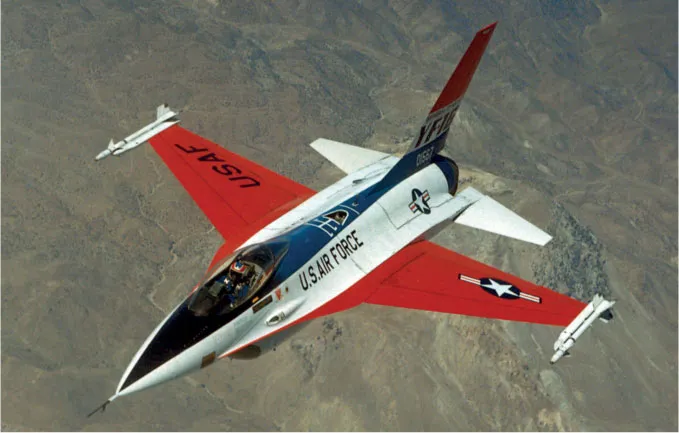
The first two YF-16s flew in a special paint scheme during their flight testing at Edwards AFB, California. the official first flight was on February 2, 1974. The actual first flight was on January 20, 1974, however, when the test pilot decided to take off during a high-speed taxi test when the aircraft experienced roll oscillations.
“I just did what I was trained to do. . . . Anybody could have done the same or better. I just happened to be the lucky one there at the time.”
—Captain Bob “Wilbur” Wright, Viper Driver with three Serbian J-1 Jastrebs kills, 28 February 1994
“Fighter Pilot” is a term that evokes many things to people. To some, it suggests images of the movie Top Gun and the cocky “Maverick” character (played by Tom Cruise), who wrote checks his body couldn’t cash, repeatedly broke the rules with unauthorized flybys, chased women and drank beer with reckless abandon, and was more concerned with being in first place than being on a winning team. He bristled when others debriefed his errors or offered him techniques to become more effective at shooting down the enemy. His arrogance caused trouble on the ground and in the air, and the subsequent aircraft crash took the life of his best friend and back-s eater.
To others, a fighter pilot is anyone who flies a fighter aircraft. But simply filling a seat and actuating the stick and throttle in a high-performance aircraft doesn’t make one a fighter pilot. In the fighter community, there’s a saying: “There are those who have a thousand hours in the jet, and there are those who have one hour a thousand times.” This differentiation goes much deeper than just the ability to successfully and safely fly the jet to its limits. It also describes the attitude fighter pilots develop that, in the words of the U.S. Air Force Weapons School, is succinctly described as “humble, approachable, and credible.” Young fighter pilots in a squadron (known generically as the LPA, for Lieutenants Protection Agency, or “punks” in the Viper community) are typically said to be “all mach and no vector,” meaning they have loads of energy but need lots of direction and mentoring to mature into steely-eyed killers. More-experienced fighter pilots (the majors and lieutenant colonels, known as the “silverbacks,” in reference to the mature leaders of a gorilla troop) take their job seriously to train the next generation of fighter pilots. Lieutenant Colonel Michael “Brillo” Brill, the world’s only Viper Driver with over six thousand flying hours in the jet, believes, “The opportunity to pass along my ideas and philosophy is profound.
The energy new pilots have fires me up too. It’s very synergistic.” Indeed, punks who don’t grow out of their self-centered ways normally don’t last long enough to make it into the ranks of the silverbacks. Instead, they normally find another line of work . . . or someone finds it for them.
Fighter pilots must be self-assured in order to daily hurtle their bodies into the vast reaches of the sky in the small, enclosed enclaves of Viper cockpits. Those who lack the appropriate amount of confidence don’t last long, as the dangerous realities of the job begin to haunt them. Indeed, even the more mundane aspects of flying a fighter can be dangerous, as numerous accidents have occurred during seemingly routine, administrative portions of the flight. Most don’t make it through a twenty-year career without having at least one friend who’s perished in a fighter crash. So, what then is a fighter pilot? And, is flying fighters just another job? Far from it—flying high-performance fighters like the F-16 cannot be labeled a “job”—it is a calling and an honorable profession.
Brigadier General Robin Olds, legendary triple ace from World War II and Vietnam, summed it up best when he said:
Fighter pilot is an attitude. It is cockiness. It is aggressiveness. It is self-confidence. It is a streak of rebelliousness, and it is competitiveness. But there’s something else—there’s a spark. There’s a desire to be good. To do well; in the eyes of your peers, and in your own mind.
I think it is love of that blue vault of sky that becomes your playground if, and only if, you are a fighter pilot. You don’t understand it if you fly from A to B in straight and level, and merely climb and descend. You’re moving through the basement of that bolt of blue.
A fighter pilot is a man in love with flying. A fighter pilot sees not a cloud, but beauty. Not the ground but something remote from him, something that he doesn’t belong to as long as he is airborne. He’s a man who wants to be second best to no one.1
At Luke Air Force Base, just west of Phoenix, Arizona, the 56th Fighter Wing of the United States Air Force’s Air Education and Training Command exemplifies General Olds’s words. The base’s motto is “Training Fighter Pilots Second to None,” and it is here that a pilot gets turned into a fighter pilot. The Viper training organization is known as the Formal Training Unit, or FTU, and Luke AFB became the home of the Viper FTU in 1994. Since the first Vipers arrived, Luke has trained over 16,350 pilots to fly and fight the F-16, with 418 new Viper Drivers created in 2009 alone. With a continually busy schedule, the FTU runs several types of Viper courses at Luke.
First, the B-Course (for Basic Course) is a six-month-long conversion course for the recent pilot training graduates, or FAIPs (First Assignment Instructor Pilots). FAIP is a four-letter f-word describing the newly created pilots who are “selected” (or, more accurately, forced) to stay behind in training command for another three years to teach pilot training. (Being an IP in training command, while necessary, is something most fighter pilots try to avoid like the plague.) The Viper B-Course takes the student pilots through many hours of systems academics and emergency procedures simulators, transitions them into flying the Viper, and then trains them to use the Viper as a lethal weapon. The end result is a Viper Driver who joins an operational fighter squadron and who, with just a few local area sorties and top-off missions, will be a combat mission–ready wingman. Lieutenant Colonel David “Spock” Youtsey, the Deputy Operations Group Commander at Misawa Air Base, Japan, said the FTU of today puts out a “good and predictable product with much more experience and basic flying capability than when I went through the B-Course” over twenty years ago.
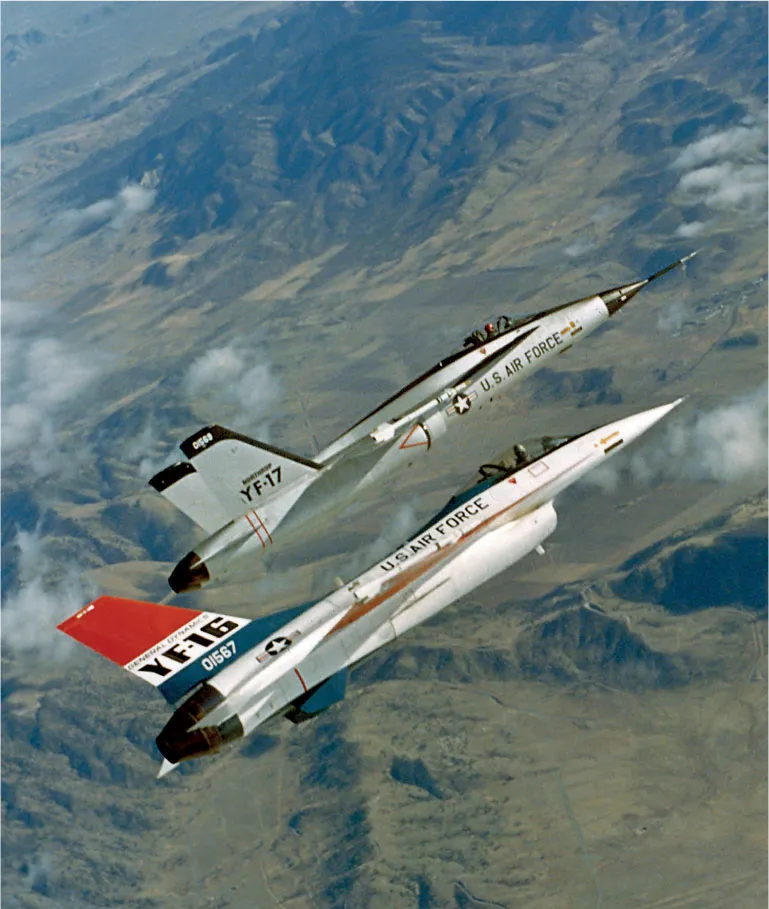
The prototype YF-16 flying with its competitor in the lightweight fighter program, the prototype Northrop YF-17. Despite losing out to the YF-16, the YF-17 was ultimately developed into the McDonnell Douglas F/A-18 Hornet for the U.S. navy.
Luke also conducts different types of TX courses (TX is short for transition). One of these is for the Viper Driver who’s coming off a non-flying staff job and needs to get requalified in the jet. Another type of TX course is for a fighter pilot from a different jet (such as the F-15 Eagle or F-22 Raptor) to convert to the F-16. Normally, these pilots are converting to the Viper in order to fly as an Aggressor pilot (professional adversaries, or “red air”) or on the Thunderbird aerial demonstration team. The TX courses are tailored to the pilots’ experience and range from a one-month “senior officer” course (for colonels) to a four-month conversion course.
In addition to learning the Viper, an essential skill the young Viper Driver learns in the B-Course is how to be a good wingman. Lieutenant Colonel Francis S. “Gabby” Gabreski, an ace with 28 victories in the 56th Fighter Group in World War II and an additional 6.5 victories in Korea, believed, “The wingman is absolutely indispensable. I look after the wingman. The wingman looks after me. It’s another set of eyes protecting you. That’s the defensive part. Offensively, it gives you a lot more firepower. We work together. We fight together. The wingman knows what his responsibilities are, and knows what mine are. Wars are not won by individuals. They’re won by teams.” Although tactics have changed significantly since “Gabby” flew and fought in P-47s and F-86s, the wingman’s job as part of a fighting team has not changed. In fact, with today’s lethal advanced technology, the wingman is even more integral to successful modern fighter tactics than in “Gabby’s” day.
From the beginning of the course at Luke, new Viper Drivers feel they are a vital part of this team. The comparison of a fighter squadron to a professional sports team is a common analogy amongst fighter pilots. No squadron performs well that does not work well together as a team. No squadron can rely on any “superstar” in order to fulfill its combat tasking. While even the lowest-paid professional sports stars are paid many times more than the highest-paid fighter pilot, the fighter pilot’s devotion to his team, his job, his calling, and his teammates is unmatched by any Super Bowl or World Series athlete. Captain Patrick “Cletis” Pearson now flies F-22 Raptors in Alaska, but his first tour was as a Viper Driver. “At Luke [as a student],” he said, “I honestly felt like their wingman, and I was going to go to combat with them. There was a high standard because, [the instructor’s attitude was] ‘Dude, you’re my bro and we’re going to go to war. The team wants to succeed, and you’re the guy off the bench. We’re going to teach you to do this right. Work with us, and we’ll show you how it’s done.’”
Earlier in his flying training, Capt. Jonathan “Dixon” Kuntz (another ex–Viper Driver who now flies F-22s) felt there was an adversarial relationship between the students and the IPs. At Luke, however, he describes the mentality as, “There’s a war o...
Table of contents
- Cover
- Title Page
- Dedication
- Contents
- Foreword
- Acknowledgments
- Introduction
- Chapter 1: The Making of a Viper Driver
- Chapter 2: Fight’s on: Air-to-Air in the Viper
- Chapter 3: Mud Movin’: Dropping Bombs in the Viper
- Chapter 4: Wild Weasels: Sead and the Viper
- Chapter 5: Viper at War
- Appendix A: Viper Blocks and Stats
- Appendix B: Thunderbirds and Aggressors
- Notes
- Glossary
- Bibliography
- Index
- Copyright Page
Trusted by 375,005 students
Access to over 1.5 million titles for a fair monthly price.
Study more efficiently using our study tools.
Frequently asked questions
Yes, you can cancel anytime from the Subscription tab in your account settings on the Perlego website. Your subscription will stay active until the end of your current billing period. Learn how to cancel your subscription
No, books cannot be downloaded as external files, such as PDFs, for use outside of Perlego. However, you can download books within the Perlego app for offline reading on mobile or tablet. Learn how to download books offline
Perlego offers two plans: Essential and Complete
- Essential is ideal for learners and professionals who enjoy exploring a wide range of subjects. Access the Essential Library with 800,000+ trusted titles and best-sellers across business, personal growth, and the humanities. Includes unlimited reading time and Standard Read Aloud voice.
- Complete: Perfect for advanced learners and researchers needing full, unrestricted access. Unlock 1.5M+ books across hundreds of subjects, including academic and specialized titles. The Complete Plan also includes advanced features like Premium Read Aloud and Research Assistant.
We are an online textbook subscription service, where you can get access to an entire online library for less than the price of a single book per month. With over 1.5 million books across 990+ topics, we’ve got you covered! Learn about our mission
Look out for the read-aloud symbol on your next book to see if you can listen to it. The read-aloud tool reads text aloud for you, highlighting the text as it is being read. You can pause it, speed it up and slow it down. Learn more about Read Aloud
Yes! You can use the Perlego app on both iOS and Android devices to read anytime, anywhere — even offline. Perfect for commutes or when you’re on the go.
Please note we cannot support devices running on iOS 13 and Android 7 or earlier. Learn more about using the app
Please note we cannot support devices running on iOS 13 and Android 7 or earlier. Learn more about using the app
Yes, you can access Viper Force by Robert "Cricket" Renner, USAF (Ret.),Robert “Cricket” Renner, USAF (Ret.) in PDF and/or ePUB format, as well as other popular books in History & Military & Maritime History. We have over 1.5 million books available in our catalogue for you to explore.