eBook - ePub
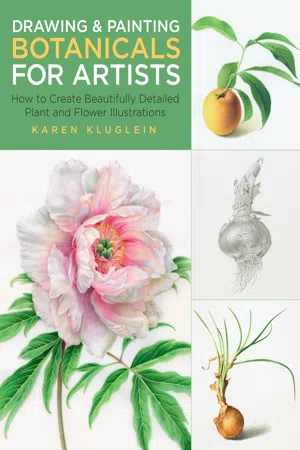
Drawing and Painting Botanicals for Artists
How to Create Beautifully Detailed Plant and Flower Illustrations
- 160 pages
- English
- ePUB (mobile friendly)
- Available on iOS & Android
eBook - ePub
Drawing and Painting Botanicals for Artists
How to Create Beautifully Detailed Plant and Flower Illustrations
About this book
Originally developed in the 18th century as a visual supplement to botanical nomenclature, botanical illustration and art uniquely fuse art and science by documenting the parts, details, and life cycles of plant species. In Drawing and Painting Botanicals for Artists, eminent botanical artist and veteran workshop instructor Karen Kluglein reveals her secrets for rendering leaves, flowers, berries, and branches both accurately and beautifully.
The book begins with a brief history of the art form, followed by guidance on developing observational skills for this genre, key botanical terms and concepts, and the differences among botanical illustration, botanical art, and flower painting. The chapters that follow offer detailed guidance and demonstrations for drawing and painting botanicals in a variety of mediums:
The For Artists series expertly guides and instructs artists at all skill levels who want to develop their classical drawing and painting skills and create realistic and representational art.
The book begins with a brief history of the art form, followed by guidance on developing observational skills for this genre, key botanical terms and concepts, and the differences among botanical illustration, botanical art, and flower painting. The chapters that follow offer detailed guidance and demonstrations for drawing and painting botanicals in a variety of mediums:
- Drawing. Explore loose gestural drawing, precise measuring and rendering, and working from photographs with graphite, colored pencil, finepoint markers, pen and ink, and silverpoint.
- Painting. Master color mixing, washes, layering, gradations, values, and adding details in watercolor, gouache, and acrylic, plus guidance on adding “personality” to your work and knowing when a painting is done.
The For Artists series expertly guides and instructs artists at all skill levels who want to develop their classical drawing and painting skills and create realistic and representational art.
Frequently asked questions
Yes, you can cancel anytime from the Subscription tab in your account settings on the Perlego website. Your subscription will stay active until the end of your current billing period. Learn how to cancel your subscription.
No, books cannot be downloaded as external files, such as PDFs, for use outside of Perlego. However, you can download books within the Perlego app for offline reading on mobile or tablet. Learn more here.
Perlego offers two plans: Essential and Complete
- Essential is ideal for learners and professionals who enjoy exploring a wide range of subjects. Access the Essential Library with 800,000+ trusted titles and best-sellers across business, personal growth, and the humanities. Includes unlimited reading time and Standard Read Aloud voice.
- Complete: Perfect for advanced learners and researchers needing full, unrestricted access. Unlock 1.4M+ books across hundreds of subjects, including academic and specialized titles. The Complete Plan also includes advanced features like Premium Read Aloud and Research Assistant.
We are an online textbook subscription service, where you can get access to an entire online library for less than the price of a single book per month. With over 1 million books across 1000+ topics, we’ve got you covered! Learn more here.
Look out for the read-aloud symbol on your next book to see if you can listen to it. The read-aloud tool reads text aloud for you, highlighting the text as it is being read. You can pause it, speed it up and slow it down. Learn more here.
Yes! You can use the Perlego app on both iOS or Android devices to read anytime, anywhere — even offline. Perfect for commutes or when you’re on the go.
Please note we cannot support devices running on iOS 13 and Android 7 or earlier. Learn more about using the app.
Yes, you can access Drawing and Painting Botanicals for Artists by Karen Kluglein in PDF and/or ePUB format, as well as other popular books in Art & Art général. We have over one million books available in our catalogue for you to explore.
Information
1
DRAWING
Botanicals
Proficiency in drawing is by far the most important quality needed in creating traditional botanicals. Hours spent observing and drawing what you see will be of enormous benefit later when you work with the added complexities of applying paint.
With drawing, we can eliminate those questions and concerns and focus on what we see in the specimen before us. Choose a simply shaped flower or leaf that appeals to you. You’re going to be looking at it for a long time. Look through your garden; have your eyes open during a walk in the woods or even in the produce aisle at the grocery store. You never know when you’ll find that perfect peach to draw!

MEDIUMS AND SUPPLIES
What’s nice about drawing is that the supplies are simple, inexpensive, and easy to transport.


H pencils are hard, B pencils are soft, and an HB pencil is in the middle.
GRAPHITE PENCILS
Graphite pencils are graded numerically to identify their hardness or softness and how they will respond on your paper. Soft pencils have a lower clay content and appear darker, while hard pencils will leave a lighter mark. For this reason, soft pencils will need to be sharpened more often, whereas with a hard pencil, you can obtain a very sharp point that will last a long time. The letter H indicates a hard pencil, and the letter B designates the blackness of the pencil’s mark and is a softer lead. The higher the number indicated on the pencil, the harder it is. For example, a 2H pencil will leave a light mark, whereas a 9H pencil will be significantly harder and lighter. A 2B pencil is soft and will leave a dark mark; an 8B pencil will be much softer and leave a significantly darker mark. An HB pencil is the same as a standard No. 2 pencil and is in the middle of the hard and soft pencils range on the scale.
For the purposes of botanical drawing, a softer pencil like an HB or B can be used for a more gestural loose sketch. When more precise lines are needed, a harder pencil such as a number 2H can be used. Generally, I only use a select few pencils: an HB, a 2H, a 6H, and an F. Each is used for a different purpose.

Peony (Paeonia) was drawn with a single graphite pencil #F which can produce darks and lights and makes a sharp point.
COLORED PENCILS
Colored pencils have a core of colored pigment and an outer wood casing. They may be made of wax, pigments, binding agents, and additives. They may be oil-based or water-soluble. Artist-grade pencils have a higher co...
Table of contents
- Cover
- Title Page
- Contents
- Introduction
- 1 Drawing Botanicals
- 2 Painting Botanicals
- Final Thoughts
- Resources
- Acknowledgments
- About the Author
- Index
- Dedication
- Copyright