A follow-up to Rockport Publishers' best-selling Universal Principles of Design, a new volume will present one hundred principles, fundamental ideas and approaches to making art, that will guide, challenge and inspire any artist to make better, more focused art.Universal Principles of Art serves as a wealth of prompts, hints, insights and roadmaps that will open a world of possibilities and provide invaluable keys to both understanding art works and generating new ones. Respected artist John A. Parks will explore principles that involve both techniques and concepts in art-making, covering everything from the idea of beauty to glazing techniques to geometric ideas in composition to minimalist ideology. Techniques are simple, direct and easily followed by any artist at any level. This incredibly detailed reference book is the standard for artists, historians, educators, professionals and students who seek to broaden and improve their art expertise.
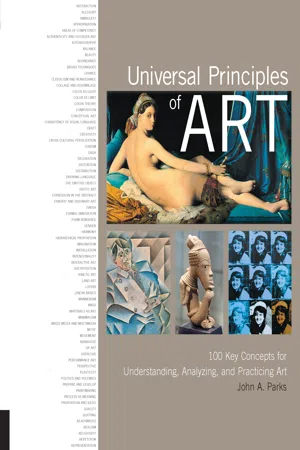
eBook - ePub
Universal Principles of Art
100 Key Concepts for Understanding, Analyzing, and Practicing Art
- 208 pages
- English
- ePUB (mobile friendly)
- Available on iOS & Android
eBook - ePub
Universal Principles of Art
100 Key Concepts for Understanding, Analyzing, and Practicing Art
About this book
Information
Topic
ArtSubtopic
Art General1 ABSTRACTION
THE DISTANCING OF AN IDEA FROM OBJECTIVE REFERENTS
Abstract, or nonrepresentational art, emerged in the early twentieth century as a radical idea. When used in philosophy, the word refers to the distancing of an idea from objective referents so that it becomes a distillation of thought. Abstraction came about in art through a similar process of distancing, as various artists began to present simplified, or distilled, notions of the objective world.
A series of art movements—starting with Impressionism in the 1870s and continuing through Postimpressionism to Cubism in the 1920s—gradually shifted the focus in art away from the task of representation and toward the making of artworks that were entirely autonomous. As early as 1907, the Fauvist artists of Paris were producing works in which the representational subject matter was little more than a motif on which to hang adventurous explorations of non-natural color. By 1910, the Cubists were making paintings in which classical space had been replaced by a shallow pictorial space that suggested multiple viewpoints. During World War I, Dadaist artists in Zurich began making artworks that challenged cultural expectations on all fronts; works by Hans Arp (1886–1966), for example, featured nonobjective sculpted reliefs. Exactly who was the first artist to do entirely abstract works is open to some question. The most popular candidate is Wassily Kandinsky (1866–1944), whose paintings moved away from simplified and flattened allusions to figurative subjects to become compositions of autonomous floating forms by 1912.
Today, abstract art covers a huge range of different kinds of artworks in both two and three dimensions. Some of the abstract or nonobjective qualities that can be manipulated by artists are color, form, space, volume, geometry, texture, weight, balance, presence, scale, decoration, rhythm, and movement.

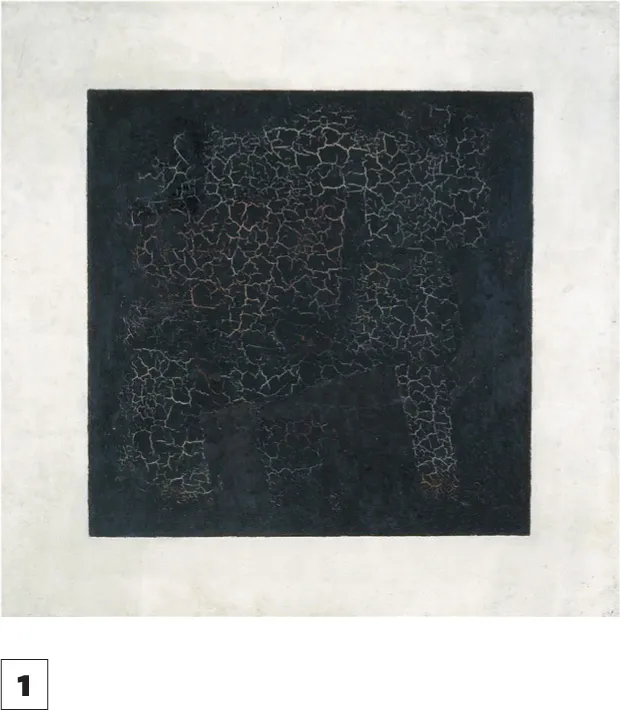
Black Square on White Ground, 1915, Oil on linen, 31 5/16 × 31 5/16 in (79.5 × 79.5 cm)
In Russia, the Constructivists, led by Malevich, began to make abstract art of great geometric austerity by 1915.

Improvisation 27 (Garden of Love II), 1912, Oil on canvas, 47 3/8 × 55 1/4 in (120.3 × 140.3 cm)
Kandinsky was amongst the first artists to make purely abstract works. This painting was shown at the famous Armory Show in New York in 1913, where new ideas in European art were seen in the Americas for the first time.

2 ALLEGORY
ABSTRACT IDEAS COMMUNICATED WITH CONCRETE IMAGES
Allegory is a device whereby abstract ideas can be communicated using images of the concrete world. Elements, whether figures or objects, in a painting or sculpture are endowed with symbolic meaning. Their relationships and interactions combine to create more complex meanings.
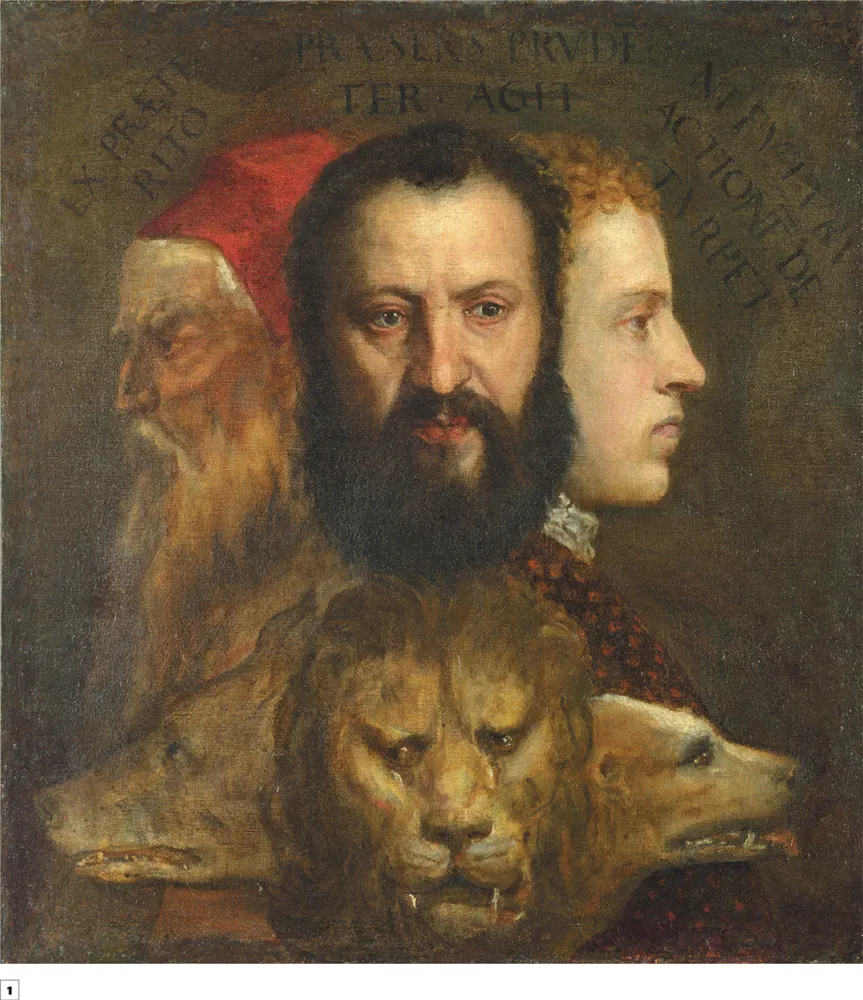
The success of an allegorical work naturally depends on the audience’s ability to recognize the identities and corresponding symbolic meanings of each of the elements within the work. A famous example is Titian’s Allegory of Age Governed by Prudence. Here, the three human heads represent the past, present, and future. They also represent the three ages of man: youth, maturity, and old age. Beneath them three animal heads symbolize the three stages of life and give us new information about them. The head beneath the young man is an eager puppy. Beneath the middle-aged man is a powerful lion, while beneath the old man a large and aging wolf stands with its ears back. Above the figures is an inscription in Latin: EX PRAETERITO/PRAESENS PRUDENTER AGIT/NE FUTURA ACTIONE DETURPET (“From [the experience of] the past, the present acts prudently, lest it spoil future actions”).
As in most allegorical paintings, the meaning offered here is complex and open to a number of interpretations. Part of the pleasure of contemplating such a work involves reflecting on the possible multiplicity of meanings. For instance, we know that in this painting the old man is a self-portrait of Titian (c. 1488–1576), while the middle-aged man is his son, and the youth is his nephew. The painting might be seen as a cautionary image in which the artist is telling his family not to make the same mistakes that he did. On the other hand, the painting might just be a general observation about the increase of wisdom and circumspection that so often comes with age. Or again, the painting may refer to the more narrow idea that artistic judgment and discrimination become better with age.
Although allegory was a popular form of painting during the Renaissance and Baroque periods, it has long fallen out of favor and played little role in the development of modern art. This is no doubt because the moderns, with their interest in abstraction and visual purity, found allegory to be too literary.
See also: Symbols on page 186
Allegory of Age Governed by Prudence, 1565–70, Oil on canvas, 30 × 27 in (76.2 × 68.6 cm)
3 AMBIGUITY
LEAVING THE WORK OPEN TO DIVERSE INTERPRETATION
Sometimes a work of art acquires strength by projecting a structure or meaning that is ambiguous.
VARIETIES
• Perceptual ambiguity
A representation of a three-dimensional formation that can be interpreted in alternative ways. The classic example is the Necker cube, a drawing of a cube that can be seen as occupying space in two alternative ways. The most notable artist to explore perceptual ambiguity was M. C. Escher (1898–1972). In many of his works, ambiguities of both recognition and spatial construction are presented in endlessly playful and provocative ways.
• Ambiguity of recognition
A representational element has more than one interpretation due to inadequate or confusing cues. A shadowy shape might be a human head or an apple, for instance. The surrealist artist Yves Tanguy (1900–1955) made many paintings in which he rendered forms that had ambiguous and confusing identities, deliberately presenting the viewer with a sense of puzzlement and mystery.
• Ambiguity of meaning
The sense or import of the artwork is ambiguous. The viewer is presented with an ongoing conundrum because symbols, narrative action, or other cues do not coalesce around a clear idea. This was a favorite strategy of the French artist Balthus (1908–2001) whose paintings often present narrative scenarios of indeterm...
Table of contents
- Cover
- Title Page
- Preface
- Contents
- Introduction
- 1 Abstraction
- 2 Allegory
- 3 Ambiguity
- 4 Appropriation
- 5 Areas of Competence
- 6 Authenticity and Outsider Art
- 7 Autobiography
- 8 Balance
- 9 Beauty
- 10 Boundaries
- 11 Brush Techniques
- 12 Chance
- 13 Classicism and Renaissance
- 14 Collage and Assemblage
- 15 Color as Light
- 16 Color as Limit
- 17 Color Theory
- 18 Composition
- 19 Conceptual Art
- 20 Consistency of Visual Language
- 21 Craft
- 22 Creativity
- 23 Cross-Cultural Fertilization
- 24 Cubism
- 25 Dada
- 26 Decoration
- 27 Distortion
- 28 Distribution
- 29 Drawing Language
- 30 The Emotive Object
- 31 Erotic Art
- 32 Expression in the Abstract
- 33 Fantasy and Visionary Art
- 34 Finish
- 35 Formal Innovation
- 36 Form Rendered
- 37 Gender
- 38 Harmony
- 39 Hierarchical Proportion
- 40 Imagination
- 41 Installation
- 42 Intentionality
- 43 Interactive Art
- 44 Juxtaposition
- 45 Kinetic Art
- 46 Land Art
- 47 Layers
- 48 Linear Basics
- 49 Mannerism
- 50 Mass
- 51 Materials as Art
- 52 Minimalism
- 53 Mixed Media and Multimedia
- 54 Motif
- 55 Movement
- 56 Narrative
- 57 Op Art
- 58 Overload
- 59 Performance Art
- 60 Perspective
- 61 Plasticity
- 62 Politics and Polemics
- 63 Prepare and Develop
- 64 Printmaking
- 65 Process as Meaning
- 66 Proportion and Ratio
- 67 Quality
- 68 Quoting
- 69 Readymades
- 70 Realism
- 71 Religiosity
- 72 Repetition
- 73 Representation
- 74 Restraint
- 75 Rhythm
- 76 Romanticism
- 77 Scale
- 78 Semiotics
- 79 Semiotics 2: Deconstruction
- 80 Sensitivity and Sensibility
- 81 Shape
- 82 Shock
- 83 Simplification
- 84 Space and Volume
- 85 Spectacle
- 86 Style and Stylishness
- 87 Successive Approximation
- 88 Sufficiency of Means
- 89 Surrealism
- 90 Symbols
- 91 Symmetry
- 92 Temporary Art
- 93 Texture
- 94 Theme
- 95 Tone as Structure
- 96 Touch Communicates
- 97 Tribal Art
- 98 Trompe l’Oeil
- 99 Underpainting
- 100 Video Art
- Credits
- About the Author
- Acknowledgments
- Copyright
Trusted by 375,005 students
Access to over 1.5 million titles for a fair monthly price.
Study more efficiently using our study tools.
Frequently asked questions
Yes, you can cancel anytime from the Subscription tab in your account settings on the Perlego website. Your subscription will stay active until the end of your current billing period. Learn how to cancel your subscription
No, books cannot be downloaded as external files, such as PDFs, for use outside of Perlego. However, you can download books within the Perlego app for offline reading on mobile or tablet. Learn how to download books offline
Perlego offers two plans: Essential and Complete
- Essential is ideal for learners and professionals who enjoy exploring a wide range of subjects. Access the Essential Library with 800,000+ trusted titles and best-sellers across business, personal growth, and the humanities. Includes unlimited reading time and Standard Read Aloud voice.
- Complete: Perfect for advanced learners and researchers needing full, unrestricted access. Unlock 1.5M+ books across hundreds of subjects, including academic and specialized titles. The Complete Plan also includes advanced features like Premium Read Aloud and Research Assistant.
We are an online textbook subscription service, where you can get access to an entire online library for less than the price of a single book per month. With over 1.5 million books across 990+ topics, we’ve got you covered! Learn about our mission
Look out for the read-aloud symbol on your next book to see if you can listen to it. The read-aloud tool reads text aloud for you, highlighting the text as it is being read. You can pause it, speed it up and slow it down. Learn more about Read Aloud
Yes! You can use the Perlego app on both iOS and Android devices to read anytime, anywhere — even offline. Perfect for commutes or when you’re on the go.
Please note we cannot support devices running on iOS 13 and Android 7 or earlier. Learn more about using the app
Please note we cannot support devices running on iOS 13 and Android 7 or earlier. Learn more about using the app
Yes, you can access Universal Principles of Art by John A Parks in PDF and/or ePUB format, as well as other popular books in Art & Art General. We have over 1.5 million books available in our catalogue for you to explore.