Now gardeners can bring an exotic flair to their gardens by introducing the color, textures, and fabulous foliage of tropical plants. Not just for hot climates anymore, bromeliads, orchids, bananas, palms, birds of paradise, elephant ears, canna, and more can bring a touch of the tropics to any garden. Gardener's can choose from more than 150 plants featured in this book, each chosen for the visual impact it adds to any landscape or container garden. Plants are organized by a range of clearly defined zones, making it easy for gardeners to find the plants that will succeed in their landscape. Author Nellie Neal explains how to best use tropical plants both indoors and out. To make this book a universally useful guide, it is organized to explain how to grow tropical plants in a wide range of clearly defined zones. Further, the book illustrates how to best use these plants in landscapes and containers, indoors and out, no matter where you live. It is a practical, user-friendly celebration of tropical plants.
eBook - ePub
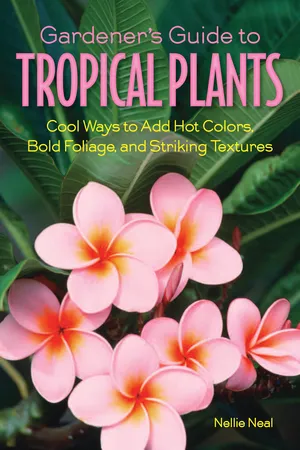
Gardener's Guide to Tropical Plants
Cool Ways to Add Hot Colors, Bold Foliage, and Striking Textures
- 240 pages
- English
- ePUB (mobile friendly)
- Available on iOS & Android
eBook - ePub
Gardener's Guide to Tropical Plants
Cool Ways to Add Hot Colors, Bold Foliage, and Striking Textures
About this book
Trusted by 375,005 students
Access to over 1.5 million titles for a fair monthly price.
Study more efficiently using our study tools.
Information
Herbaceous Tropicals

African Mask
Alocasia × amazonica

African mask is beloved for dark green, deep V-shaped leaves with ribs and edges marked in bright creamy white. Jaunty and full of attitude, it laughs off legendary arguments about its parentage and lack of official standing by many in the scientific community. This colorful plant is neither a species nor found in any rainforest, including those in Southeast Asia where its relatives are native. Experts have traced its family tree back to Amazon Nursery, which was owned by Miami postman Salvatore Mauro in the 1950s. Whether it is a hybrid or a stable offspring of another Alocasia matters less than its ability to deliver distinctive tropical flair. Outdoors, African mask haunts the shade while indoors, any bright room will do for this long-lived plant. Aroids, as plants in this family are called, display rowdy, outrageous leaves, especially this rogue member.
Plant Family
Araceae
Other Common Name
Alligator plant
Bloom Period and Seasonal Color
Yellow flowers appear sporadically amid boldly patterned leaves on older plants
Mature Height × Spread
Up to 3 ft. × 2 ft.
When, Where, and How to Plant
Outdoors, select a site that offers light but is shaded from direct sun all day. A tabletop near a bright window amid a group of other plants will provide ample light and humidity inside a home or office. Prepare the garden soil or a container growing mix that is richly organic yet well drained. Use ground bark, compost, or compost/manure to enrich soils. Grow African masks away from wind and salt spray to avoid shredded and pocked leaves. Plant clumps 1 to 2 feet apart in beds. Repot when roots are visible in the drain hole, when water rushes through without percolating into the soil, or if the pot tips easily.
Growing Tips
African mask plants that are allowed to dry out will go dormant. Reservoir pots can be filled on your schedule, and drip irrigation or garden bed soakers can be automated to ensure good hydration. Fertilize moderately using a granular formula three or four times annually, or use a soluble fertilizer mixed at half strength every other month. Keep organic mulch around plants in beds and pots. Its leaf tips may brown if the humidity is too low or if your tap water is unsuitable.
Care and Propagation
Keep an eye out for spider mites, mealybugs, and scale insects. To propagate, divide rhizomes while they’re dormant or separate offsets from the mother plant. See “Propagation” (page 36) for details.
Companion Planting and Design
African masks can hold center stage alone or surrounded by a bed of nerve plants. Pair it with striped blushing bromeliads, golden brush gingers, or ruffle ferns for a bold tropical vignette.
Try These
Dwarf varieties and selections have confusing names too. For example, Alocasia ‘Poly’ is also known as ‘Polly’.
African Milk Bush
Euphorbia umbellata

African milk bush adapts well to a variety of environments in the tropics and subtropics and in sunny indoor spaces worldwide. Indeed, its other common name, chameleon plant, might refer to its habitat flexibility. Native to East Africa, it is named for the white latex sap exuded by its stems and leaves when they are broken. Like many other Euphorbia species, the sap can sometimes be a skin irritant. The leaves jut out stiffly from chunky stems like stacks of bright green helicopter rotors. Their veins are a network of darker stripes on each leaf. Red stems spring from the top of each stem, slick, stocky, and exposed like latticework. Each forked stem holds a bright red flower that looks like a fancy summer straw hat hung in a milliner’s display window. There are dozens of flowers atop each stem, the perfect crown for such a beautiful succulent shrub.
Plant Family
Euphorbiaceae
Other Common Name
Chameleon plant
Bloom Period and Seasonal Color
Red flowers in the spring and summer
Mature Height × Spread
Up to 12 ft. × 2 ft.; up to 6 ft. x1 ft. in containers
When, Where, and How to Plant
Choose or create a sunny, dry site for these plants, such as areas appropriate for cacti or succulent gardens. Plant it near walls or other plants that can act as a warming windbreak, especially in the temperate zones. African milk bushes thrive in very well-drained, fertile soil and an environment of low humidity. Outdoors, prepare a bed of existing garden soil amended with sand and organic matter to meet these needs. This plant grows well in containers with potting mix that has ground bark or sand mixed into it to ensure excellent drainage. Avoid mixes with water-holding polymers that can keep the root zone too wet. Space plants for excellent air circulation in beds or grow one in a standard 10- to 12-inch clay pot. Do not mulch these plants.
Growing Tips
Allow African milk bush plants to dry out thoroughly between waterings when not in bloom. When flowers appear, water the plants regularly but not excessively. Keep plants groomed by removing old leaves and flowers once they have dried. Fertilize four to six times annually. Use a granular or soluble complete garden fertilizer. Repot annually to provide ample room for growing roots. Move pots into a sunny, warm room for the winter.
Care and Propagation
It has few pests. Propagate African milk bush by taking cuttings.
Companion Planting and Design
Grow African milk bush plants with other Euphorbia plants such as crown of thorns and succulents such as desert rose and Cape aloes. Let one take center stage surrounded by devil’s backbone, gazanias, and bushy hibiscus.
Try These
‘Rubra’ is widely planted for its red stems and leaves, as well as its flowers.
Angel Wing Begonia
Begonia hybrids

As easy to grow as it is to love, angel wing begonia lives up to its name. The leaves are wing-shaped, sometimes elongated almost ridiculously to climax in deep points. The rounded top leaf edges are elegantly draped, sometimes cupped or serrated along the edges, and often splattered with accent colors. They look slightly bizarre but effortlessly charming. Angel wing begonia leaves are many shades of green but also bronze, and shades of red spread warmly on the undersides. Clusters of red, white, and pink flowers are borne in the leaf axils on waxy stems to match. Each inflorescence has a pendant-shaped bract that opens like a locket to reveal tiny white flowers. Soon the seedpod forms and hangs below the bract in a stunning display. Native to Brazil, this begonia is at home in the shady tropics and subtropics everywhere and can summer outdoors each year in temperate climes.
Plant Family
Begoniaceae
Other Common Name
Cane begonia
Bloom Period and Seasonal Color
Red, pink, or white flowers off and on through the year
Mature Height × Spread
1 ft.–4 ft. × 1 ft.–4 ft.
When, Where, and How to Plant
Grow angel wings in shade or part shade outdoors or in a bright, humid indoor space. The angels grow best in richly organic, well-drained soil in garden beds, containers, or window boxes. Amend garden soils and potting mixes with a combination of organic matter such as compost and ground bark. Test a pot of the mixed soil by watering it well to be certain it will drain promptly. If it does not, add more ground bark. Plant angel wing begonias in pots 6 to 8 inches wide and deep, or space them 8 inches apart in garden beds. Pot up garden plants and move the containers indoors for the winter. Angel wing begonias may drop their leaves indoors in the winter, indicating their need for more light and warmth.
Growing Tips
The jointed, bamboo-looking canes of angel wing begonias will collapse if subjected to drought. Water regularly and fertilize monthly with a complete, balanced formula product. If the flowers are few, even in part shade, use a flower formula fertilizer in the winter and spring. Deadhead flower clusters when they fade to stimulate new growth and more flowers. Take cuttings in the fall from garden beds and grow the young plants indoors during the winter.
Care and Propagation
Watch for mealybugs and aphids on potted plants, and snails in the landscape. It can be propagated very easily by stem and tip cuttings. See “Propagation” (page 36) for details.
Companion Planting and Design
Fill a shady bed with angel wing begonias instead of impatiens or New Guinea impatiens. Combine it in pots with caladiums, rattlesnake plants, and bird’s nest ferns.
Try These
Try ‘Airy Fairy’ for its dainty cut leaves and ‘Avalanche’ for its white arty splotches.
Bamboo Orchid
Arundina graminifolia

Imagine what might happen if a bamboo plant seduced a classic orchid. Their o...
Table of contents
- Cover
- Title Page
- Contents
- Welcome to Growing Tropical Plants
- In Your Garden Where and How Tropicals Grow
- Controlling Pests and Diseases Tips and Techniques
- Propagation The More the Merrier
- Design and Garden Uses Why We Love Tropicals
- Container Gardening Tropicals in Pots, Baskets, and Boards
- Bringing Tropical Plants Indoors Breathe Easier
- Featured Tropicals
- Plants for Special Sites
- Plants for Special Features
- Resources
- Photo Credits
- USDA Hardiness Zone Map
- Plant Index
- Meet Nellie Neal
- Dedication
- Acknowledgments
- Copyright Page
Frequently asked questions
Yes, you can cancel anytime from the Subscription tab in your account settings on the Perlego website. Your subscription will stay active until the end of your current billing period. Learn how to cancel your subscription
No, books cannot be downloaded as external files, such as PDFs, for use outside of Perlego. However, you can download books within the Perlego app for offline reading on mobile or tablet. Learn how to download books offline
Perlego offers two plans: Essential and Complete
- Essential is ideal for learners and professionals who enjoy exploring a wide range of subjects. Access the Essential Library with 800,000+ trusted titles and best-sellers across business, personal growth, and the humanities. Includes unlimited reading time and Standard Read Aloud voice.
- Complete: Perfect for advanced learners and researchers needing full, unrestricted access. Unlock 1.5M+ books across hundreds of subjects, including academic and specialized titles. The Complete Plan also includes advanced features like Premium Read Aloud and Research Assistant.
We are an online textbook subscription service, where you can get access to an entire online library for less than the price of a single book per month. With over 1.5 million books across 990+ topics, we’ve got you covered! Learn about our mission
Look out for the read-aloud symbol on your next book to see if you can listen to it. The read-aloud tool reads text aloud for you, highlighting the text as it is being read. You can pause it, speed it up and slow it down. Learn more about Read Aloud
Yes! You can use the Perlego app on both iOS and Android devices to read anytime, anywhere — even offline. Perfect for commutes or when you’re on the go.
Please note we cannot support devices running on iOS 13 and Android 7 or earlier. Learn more about using the app
Please note we cannot support devices running on iOS 13 and Android 7 or earlier. Learn more about using the app
Yes, you can access Gardener's Guide to Tropical Plants by Nellie Neal in PDF and/or ePUB format, as well as other popular books in Biological Sciences & Horticulture. We have over 1.5 million books available in our catalogue for you to explore.