From hand-held, dedicated units to software that turns PCs and Palm Pilots into powerful diagnostic scanners, auto enthusiasts today have a variety of methods available to make use of on-board diagnostic systems. And not only can they be used to diagnose operational faults, they can be used as low-budget data acquistion systems and dynamometers, so you can maximize your vehicle's performance.
Beginning with why scanners are needed to work effectively on modern cars, this book teaches you how to choose the right scanner for your application, how to use the tool, and what each code means. "How To Use Automotive Diagnostic Scanners" is illustrated with photos and diagrams to help you understand OBD-I and OBD-II systems (including CAN) and the scanners that read the information they record. Also included is a comprehensive list of codes and what they mean. From catalytic converters and O2 sensors to emissions and automotive detective work, this is the complete reference for keeping your vehicle EPA-compliant and on the road!
- 200 pages
- English
- ePUB (mobile friendly)
- Available on iOS & Android
eBook - ePub
How To Use Automotive Diagnostic Scanners
About this book
Information

Chapter 1
On-Board Diagnostics, a Brief History
INTRODUCTION
Why We Have Scanners, Code Readers, and On-Board Diagnostics in the First Place
What exactly are automotive scanners, and why do we need them anyway? For years, it seemed, vehicles, vehicle owners, and mechanics got along quite well without them. Where did the need for these tools arise, and do they really do anything, and more importantly, what jobs do they perform, and are they really necessary when repairing an automobile today? If they are now an essential component of vehicle diagnostics (and they are!), how is the automotive do-it-yourself technician, or even automobile owners with only a passing interest in why the “Check Engine” light is on, supposed to understand or even read the computer trouble codes and data streams these diagnostic tools produce? These questions, and others like them, much like most peoples’ impressions of automotive scanners, code readers, and on-board diagnostic computers themselves, frequently leave automotive hobbyists and even some professional repair technicians perplexed and without a clue as to the right answers or what direction to take when it comes to high-tech auto repairs.
It is important when discussing automotive scanners, code readers, and on-board diagnostic systems to provide some background and a little history about the birth and development of these electronic devices. Then we can embark on an exploration of how they operate and what they do in a practical, hands-on manner, and how to use them to make repairs. Let’s start with the basics—a brief description of scanners, code readers, and the vehicle diagnostic computer systems with which they interface.
Both scanners and code readers allow a user to receive and view information from a vehicle’s on-board engine management computer system. The difference between code readers and scanners is one of quantitative capability: code readers are very limited in the automotive diagnostic information they can provide, while scanners can provide the same information as a code reader, but can also provide additional diagnostic information as well as perform functional testing. By contrast, on-board diagnostic engine management systems perform a number of tasks, including managing fuel-injection and ignition systems, shifting automatic transmissions, managing climate control systems, and controlling vehicle security, navigation, communication, lighting and other computer-related systems. However, by far the most important function on-board computer systems perform in conjunction with the code readers and scanners that work with them (and why these tools are the focus of this book) is to monitor the performance of emission controls, components, and systems, and make the driver aware when vehicle exhaust is polluting the air.
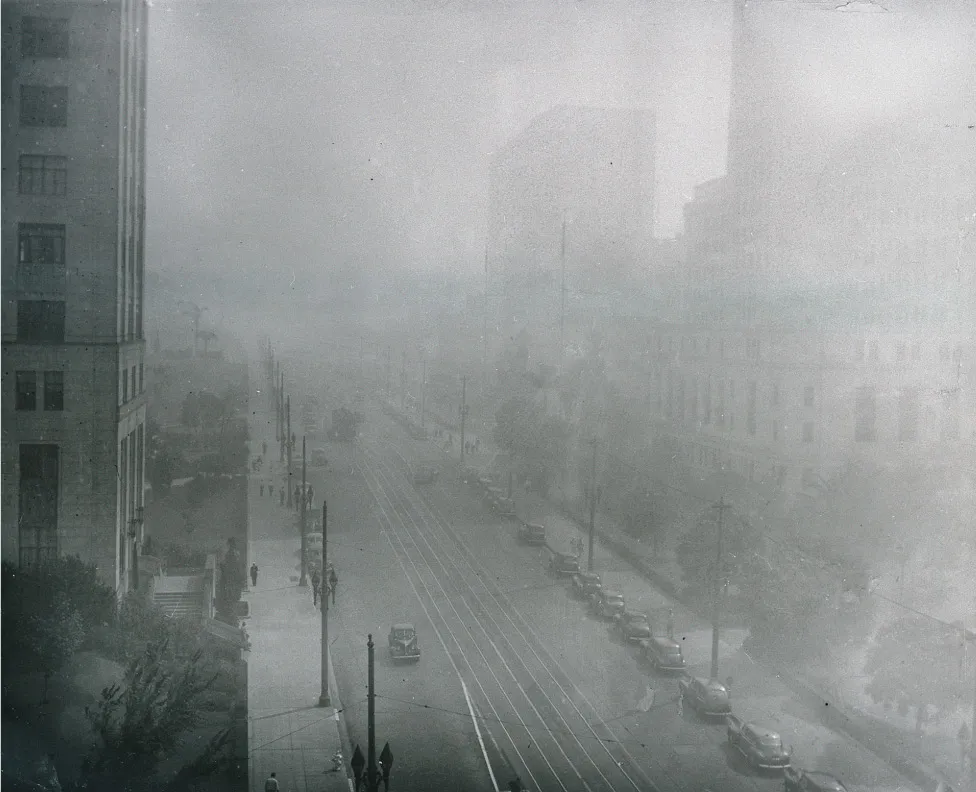
Not a pretty sight of downtown Los Angeles in 1948 as smog obscures the view down this city street. The term “smog” was borrowed from the British, who originated the use of the word in 1905 as a contraction of the words smoke and fog. The first officially recognized “gas” attack (of smog) happened in Los Angeles in 1943. Photo courtesy UCLA Library Department of Special Collection, Los Angeles Times Collection
Scanners and code readers are technically only capable of reading the information on-board vehicle engine management computer systems generate. The on-board computer systems themselves actually monitor all of the engine emissions controls and systems during vehicle operation. Complicating things a bit is the fact that two generations of on-board computer systems exist—known as OBD-I and OBD-II. Originally, on-board computer systems were designed into vehicles by various automobile manufacturers. This first generation of On-Board Diagnostics (OBD-I) was developed in the early 1980s and was an attempt by vehicle manufacturers to provide a system that warned a driver/owner whenever there was a malfunction in the emissions control system. Originally quite expensive, OBD-I systems were designed for use by professional technicians, and each operated uniquely. The information and tests that OBD-I systems provided was not standardized among auto manufacturers, and frequently even varied within a single automaker’s model years or engine families.
The majority of the first wave of automotive scanners ever produced were manufactured in the United States around 1980. As originally designed, 1980s scan tools for retrieving basic diagnostic information from OBD-I systems used various cables and adapters to plug into myriad types of data connectors found on automobiles that were often specific to vehicle year, make, and model. This complexity made these tools expensive to own—many costing thousands of dollars. In addition, they were designed for use only by professional automotive technicians. As a result, because of the cost and difficulty of use, consumers were largely unaware of their existence. In fact, many car and light truck owners at the time (and subsequently, for years afterward) did not even know their vehicle(s) were equipped with an on-board computer.
Around 1989, the first code readers were sold in automotive parts stores, finally enabling consumers to tap into some of the information their automobiles had been generating and using for almost a decade. However, it wasn’t until 1996 that the automotive industry’s exclusivity over vehicle on-board diagnostics changed significantly: stricter federal emissions regulations led to standardization of on-board diagnostic systems across manufacturers. Thus, generation two of on-board diagnostics, or OBD-II, was born, and standardized, enabling aftermarket scanners and code readers to read any 1996 or later vehicle’s on-board computer information. As more and more consumers purchased these tools, and demand increased, the price naturally dropped. Today, the average cost range for code readers is between $100 and $200, and for scan tools, around $200 to $800.
We will cover the details about OBD-II systems in significantly greater depth as we continue with the remainder of this book, as our primary focus is on modern OBD-II computer diagnostic systems in use today. However, before we continue with our in-depth exploration of modern-day OBD-II systems, we will provide in this first chapter a brief overview of the development of scanners, code readers, and OBD-I and OBD-II systems. Later in the chapter, we will provide actual testing instructions for OBD-I diagnostics. OBD-II systems will be covered in the second chapter, electronic fuel injection and catalytic converters in the third chapter, code readers in the third chapter, and finally, scanners in the fourth chapter. The remaining chapters deal with how electronic fuel injection and catalytic converters operate, how to perform basic automotive detective work on mechanical engine conditions, and the proper use of scan tools to diagnose OBD-II-related problems.
However, before we get into too much detail, it is appropriate at this point to provide a brief history lesson as well, as it will prove useful to understanding how automotive on-board computer systems, and the scan tools and code readers they interface with, came into being, and how and why they developed as they did. In order to clearly understand the evolution and development of diagnostic scan tools, it is useful to start in the 1980s and work backwards in time.
All automotive scanners, code readers, and OBD-I and OBD-II systems were gradually developed for broad consumer use as a direct result of auto emissions problems from the past. Scan tools, like so much other 1980s automotive and related technology, including electronic carburetors and fuel-injection systems, only came into being as a result of auto manufacturers being forced by Congress to clean up the exhaust emissions billowing from America’s tailpipes.
Manufacturers’ initial efforts to control auto pollution followed a “band-aid” approach, which proved to be unpredictable and unreliable, and in many cases, made the cars and trucks equipped with them “undrivable” as well. Manufacturers simply did not have compelling economic impetus or significant legislative arm-twisting to force them to develop the engineering technology to control automotive emissions in an effective or standardized manner. As a result, and by way of example, many carburetor-equipped cars from the 1970s would simply stall out at idle when engine temperature got too hot, or the engine would surge at part throttle because of lean (lack of fuel) carburetor settings that were required to meet emission standards of the day. After much reluctant trial-and-error engineering, auto manufacturers discovered the only consistent and reliable means to effectively reduce automotive tailpipe emissions was to utilize computer systems and related technology that could address and deal with all the variables of engine performance. Once automotive engineers discovered and confirmed the viability and attractiveness of on-board computer systems as a means of controlling vehicular emissions, a new set of unanticipated problems emerged. They dealt primarily with an inherent lack of communication with, and understanding about, the vehicle’s on-board-computer by the owner/driver or automotive technician.
With the introduction of automotive on-board computers, technicians had to have a means of communicating with these devices. Early computer systems used a “Check Engine” light that simply blinked on or off; or in more sophisticated models, the on-board computer used the light to “flash” out diagnostic trouble codes (specific code numbers assigned by manufacturers to specific malfunctions in the emissions control system). With the necessary skills, a trained technician could read the trouble codes based on the sequence displayed by the flashing light on the instrument panel. Initially, the only computer scan tools available to interface with a vehicle’s on-board computer system were brand-specific tools that automakers provided exclusively to their own dealership network. This was a great marketing tool—only new car dealerships were able to repair whatever went wrong with emission controls systems on their brand of cars and trucks. Fortunately for the automotive aftermarket, and eventually for the rest of us, Congress declared this monopolistic practice to be illegal.
In the aftermath of the congressional legislation, several electronic tool manufacturers introduced professional-grade scanners in the early 1980s designed for use by independent repair shops. Today, with the ever-growing number of do-it-yourself technicians working under the hoods of their own vehicles, the availability of inexpensive scanners and code readers provides automobile owners with the freedom to choose. They are no longer dependent upon a repair shop or automotive dealership to get their “Check Engine” light to turn off, or to read and understand the diagnostic trouble codes generated by their vehicle’s on-board computer.
However, long before the commonplace availability of scanners, code readers, and on-board diagnostic systems, there was smog. As we shall see, smog has played an integral part in the need for, and mandatory development and widespread use of, these tools.
AIR POLLUTION—A HISTORICAL PERSPECTIVE
As briefly mentioned, the need for on-board diagnostics, scanners, and code readers came into being due to a dramatic increase in the number of vehicles on the road, starting in the late 1940s. This inevitably led to an increasing amount of automotive emissions, which, unfortunately, led in a direct and unstoppable chain of cause-and-effect to the all-too-familiar problem of air pollution (and most educated people would argue, subsequent global warming). As a result, two generations of on-board diagnostics (OBD-I and OBD-II) exist, along with automotive scanners and code readers that communicate with these systems. Consequently, how all of these developments relate to, and evolved from, our interaction with vehicles and the air we breathe is worth a closer look.
In the summer of 1943, while the United States waged war in Europe and Asia, Los Angeles experienced what it officially recognized as its first attack of extreme air pollution, which, borrowing on the term originally coined by the British, was termed smog. According to the Los Angeles Times: “A pall of smoke and fumes descended on downtown, cutting visibility to three blocks.” Striking in the midst of a heat wave, the “gas attack” was nearly unbearable, gripping workers and residents with an eye-stinging sensation and leaving them suffering with respiratory discomfort, nausea, and vomiting.
The day after the smog attack, the local municipal government blamed the Southern California Gas Company’s Aliso Street plant, and the plant’s manufacture of butadiene, an ingredient found in synthetic rubber. The plant was temporarily closed for several months, but in the following years the problem persisted, even after the company spent $1.5 million (a lot of money in those days) to eliminate nearly all of its chemical fumes by completely enclosing the manufacturing process. What local politicians failed to mention, or it appears even thoroughly investigate, was the fact that Los Angeles had had problems with air pollution long before 1943. In fact, as early as 1903, city records reveal that industrial smoke and fumes were so thick that many residents mistook the conditions for a solar eclipse.
Table of contents
- Cover
- Title
- Contents
- Preface
- Chapter 1 On-Board Diagnostics, a Brief History
- Chapter 2 OBD-II On-Board Emissions Monitor
- Chapter 3 Catalytic Converters, Oxygen Sensors, and Electronic Fuel Delivery
- Chapter 4 Professional Scanners and Code Readers
- Chapter 5 Scan Tools
- Chapter 6 Automotive Detective Work
- Chapter 7 Scanner Operation
- Sources
- Appendices
- Glossary
- Index
- About the Author
- Dedication
- Copyright
Trusted by 375,005 students
Access to over 1.5 million titles for a fair monthly price.
Study more efficiently using our study tools.
Frequently asked questions
Yes, you can cancel anytime from the Subscription tab in your account settings on the Perlego website. Your subscription will stay active until the end of your current billing period. Learn how to cancel your subscription
No, books cannot be downloaded as external files, such as PDFs, for use outside of Perlego. However, you can download books within the Perlego app for offline reading on mobile or tablet. Learn how to download books offline
Perlego offers two plans: Essential and Complete
- Essential is ideal for learners and professionals who enjoy exploring a wide range of subjects. Access the Essential Library with 800,000+ trusted titles and best-sellers across business, personal growth, and the humanities. Includes unlimited reading time and Standard Read Aloud voice.
- Complete: Perfect for advanced learners and researchers needing full, unrestricted access. Unlock 1.5M+ books across hundreds of subjects, including academic and specialized titles. The Complete Plan also includes advanced features like Premium Read Aloud and Research Assistant.
We are an online textbook subscription service, where you can get access to an entire online library for less than the price of a single book per month. With over 1.5 million books across 990+ topics, we’ve got you covered! Learn about our mission
Look out for the read-aloud symbol on your next book to see if you can listen to it. The read-aloud tool reads text aloud for you, highlighting the text as it is being read. You can pause it, speed it up and slow it down. Learn more about Read Aloud
Yes! You can use the Perlego app on both iOS and Android devices to read anytime, anywhere — even offline. Perfect for commutes or when you’re on the go.
Please note we cannot support devices running on iOS 13 and Android 7 or earlier. Learn more about using the app
Please note we cannot support devices running on iOS 13 and Android 7 or earlier. Learn more about using the app
Yes, you can access How To Use Automotive Diagnostic Scanners by Tracy Martin in PDF and/or ePUB format, as well as other popular books in Technology & Engineering & Automotive Transportation & Engineering. We have over 1.5 million books available in our catalogue for you to explore.