After food rationing was introduced in 1940, and German U-boats began threatening merchant shipping bringing in essential foodstuffs, the Ministry of Agriculture decided something had to be done to make the kitchens of Britain more self-sufficient.
The result was one of Britain’s most successful propaganda campaigns – Dig for Victory – encouraging every man and woman to turn their garden, or even the grass verge in their street, over to cultivating vegetables. By 1942 half the population were taking part, and even the Royal Family had sacrificed their rose beds for growing onions.
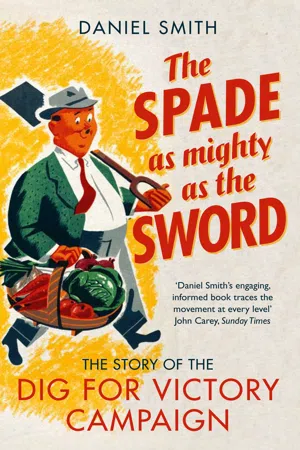
Now, Daniel Smith tells the full story of this remarkable wartime episode when spades, forks and bean canes became weapons the ordinary citizen could take up against the enemy. It had tangible benefits for the war effort in that shipping could be reallocated for munitions instead of food imports, as well as for the health of the nation in encouraging a diet of fresh fruit and veg. The campaign threw up unexpected celebrities like C.H. Middleton, whose wartime BBC radio talks on gardening reached a vast audience, and it even sowed the seeds for the modern allotment movement.
Ultimately it is a war story without fighting or killing, one that shows how even The Little Man with the Spade, in the words of the Minister for Agriculture at the time, did his bit for Victory.
eBook - ePub
The Spade as Mighty as the Sword
The Story of World War Two's ‘Dig for Victory’ Campaign
- 256 pages
- English
- ePUB (mobile friendly)
- Available on iOS & Android
eBook - ePub
The Spade as Mighty as the Sword
The Story of World War Two's ‘Dig for Victory’ Campaign
About this book
Information
1. ‘He that Tilleth …’
On 19 March 1941, a woman by the name of Joan Strange updated her personal diary (subsequently published as Despatches from the Home Front). ‘Help! I’ve
not written this old diary for nearly a week,’ she wrote. ‘It’s the allotment’s fault! The weather has been so good that I’ve gone up most evenings and get too tired
digging to write the diary.’
Joan was a member of one of the British nation’s essential fighting forces, waging a daily battle on what was to become known as the ‘Garden Front’. Through dint of hard work,
frugality and inventiveness, Joan and millions of others like her ensured the nation remained sated during the Second World War. No longer able to guarantee the international imports on which the
nation had for too long relied for its food, the British government had set about persuading its people to live off the fat of its own land. Those not fighting on the front lines took up the
challenge with gusto, joining an army of growers united by the clarion call ‘Dig for Victory’. The authorities hoped the campaign would help the United Kingdom avoid the food shortages
that almost proved so catastrophic during the First World War, while boosting levels of nutrition and morale amongst the public, and freeing up shipping for other vital
supplies instead.
Joan herself had grown up in Worthing during the First World War and was a most eager horticulturalist by the time of the Second World War. But even as hardy a grower as she occasionally felt
the strain. On 3 May 1941 she noted: ‘For four weeks I have had acute neuritis in my right arm thanks to “digging for victory” in the north-east wind in the evening!’
However, as any good gardener will attest to, there are always rewards for the pain and toil. A mere month later, her joy was apparent as the first crops emerged: ‘The allotment is looking
wonderful and I cut 2 lb of spinach today – the first fruits!’ Through such efforts the Diggers for Victory would harvest a million tons of produce per year at the campaign’s
peak.
Within the space of eighteen months at the start of the war, the campaign helped reconfigure the national landscape and the lives of its citizens. In villages and towns up and down the country,
every available scrap of spare land was given over to the cause. Lawns, flower beds, parks and playing fields, tennis courts, railway sidings, window boxes, even the grass verges at the side of the
road – all were turned over to food production. In a 2006 Royal Horticultural Society documentary on the campaign, one contributor called Fred Ferebee remembered returning to his family home
in Southwark after a period in the country as an evacuee:
I got back home and noticed some amazing changes … The biggest change was in the small back garden … Dad had changed everything bar one rose over a trellis
which he loved … And everywhere was planted with runner beans and peas and tomatoes, lettuce, everything you could imagine.
The government reported in 1942 that over half of all households were growing at least some of their own veg. Men, women and children of all backgrounds pooled their
efforts. Sunday afternoon was a particularly popular time to get the veg patch straight, though many more hours besides were spent cultivating and nurturing. Even the church got in on the act,
delivering messages of encouragement to the amateur grower from the pulpit. Oft used as the starting point of such sermons was Proverbs 28:19: ‘He that tilleth his land shall have plenty of
bread’. Bread and much more, in fact! One Kent schoolboy reminisced on the ‘excitement of digging small carrots on the allotment, selecting one, cleaning it on my sleeve and biting into
its fresh crispness!’
The pleasure in success was only heightened by the physical dangers under which growers laboured. Herbert Brush of Forest Hill reported in his diary on 26 October 1940 (quoted in Our Longest
Days by Sandra Koa Wing) on the impact of a German bombing raid: ‘… I went round to look at the allotment, but it was a case of looking for the allotment. Four perches
out of five are one enormous hole and all my potatoes and cabbages have vanished.’
With food supplies growing ever shorter as the war progressed, a few fresh veg could turn an otherwise dull dish into a veritable feast. As such, produce became increasingly valued. An organised
barter market sprung up in Croydon, where growers could exchange surplus produce for vouchers to buy clothes and other goods. Elsewhere, there were village raffles offering first prize of a giant
onion or some other such delicacy. In innumerable villages and towns, growers armed with shovels and buckets could be seen sprinting down the street after the coalman’s cart, hopeful of
winning the race for priceless horse manure to spread on their crops. People proudly displayed signs on their garden gates proclaiming, ‘This is a Victory
Garden.’
Remarkable acts of cooperation became commonplace, from the Gloucestershire village that united to grow potatoes in commercial volumes to the north London dustmen who recycled the waste they
collected to feed the pigs they had started to keep. Perhaps most remarkable of all were the residents of Bethnal Green who, pummelled by Nazi air raids, took the land where bombed-out homes and
schools once stood and turned it into fertile ground for growing.
Yet more people took on the challenges of animal husbandry for the first time. Rabbit hutches and chicken coops appeared in countless back gardens. Houses were filled with the mysterious aroma
attached to the cooking of chicken feed. Others kept beehives to produce their own honey, or joined pig clubs in the hope of feasting upon choice cuts while others had to make do with their minimal
bacon rations. On street corners in every major town and city there were ‘pig bins’ into which citizens were encouraged to deposit their food scraps for porcine sustenance. All this
from a nation that, before the war, had looked abroad for its food.
Now among the most fondly remembered of any government initiative in history, the success of the Dig for Victory campaign relied on remarkable feats of organisation, inspired publicity campaigns
and a will among the people to undertake whatever they could to ‘do their bit’. In an address on the BBC on 27 April 1941, Winston Churchill gave his own typically stirring assessment
of the desire on the Home Front to contribute:
Old men, little children, the crippled veterans of former wars, aged women, the ordinary hard-pressed citizen or subject of the King … are
proud to feel that they stand in the line together with our fighting men, when one of the greatest of causes is being fought out, as fought out it will be, to the end. This is indeed the grand
heroic period of our history, and the light of glory shines on all.
On 12 June 1940, an article appeared in the Manchester Guardian, headlined ‘Half an Acre’. The writer, identified only as ‘D.’, described the new experience of
‘growing your own’. In an understated tone, it speaks of a new way of life and tells a story repeated throughout the country:
Now the potatoes are coming along in eighteen rows, the beetroot is showing strongly, and although the carrots are a mystery and the first two rows of scarlet runners, sown
against the weight of local advice, were nipped by a May morning frost the townsmen never heard of, their successors are already running an exciting race with the peas. We are eating our own
radishes and spring onions and shortly the infuriating experience of paying four pence for a lettuce will be no more. The celery and the marrows are in. It has all been good fun and good
exercise and we are getting proud of it. In fact we now refer to the cottage as The Farm.
Gwen Wild, another contributor to the RHS’s documentary on the campaign, recalled fondly:
You’d go home after a Sunday on the allotment and you’d feel really good … You could go home, sit on the sofa and really relax. Have a nice cup of tea.
There is no better feeling in the world … Dig for Victory was the nub of our existence then. It was our fight. It was the only way we could fight.
Yet while we may today look back upon the Dig for Victory campaign as an unprecedentedly successful example of mass mobilisation, there was, in truth, little to suggest
such an outcome at the start of the war. Instead, there was a sense that the nation was rather less prepared than it ought to have been. Plans to meet the nation’s food requirements had been
slow and tentative, and Dig for Victory was started more in hope than in anticipation.
2. A Lesson Not Learned
The Second World War could hardly be said to have come as a surprise, with German Chancellor Adolf Hitler having spent the best part of the 1930s flexing his muscles in the face of international consternation. Yet as conflict had grown inevitable, barely twenty years had passed since the horror of the ‘war to end all wars’ that cost the lives of a generation. The United Kingdom was stooping beneath the weight of economic meltdown and the prospect of another bloody struggle was a nightmarish spectre for the population at large.
In September 1938, Prime Minister Neville Chamberlain had stood on the tarmac at London’s Heston Aerodrome. He was returning from talks with Hitler at the Munich Conference, where Czechoslovakia had been sold down the river in return for a piece of paper that Chamberlain hoped represented ‘peace for our time’. It was an episode that brought permanent ignominy down upon him. Winston Churchill reportedly commented: ‘England has been offered a choice between war and shame. She has chosen shame, and will get war.’ The Munich Agreement, though, encapsulated the dreadful conundrum that the government faced: what do you do in the face of a warmonger when your own people have been all but broken by cataclysmic fighting only a generation before?
Chamberlain’s route was soon proved to be misguided and ultimately hopeless. Others, not least Churchill, were sure of that much at the time, and Chamberlain’s refusal to heed their warnings has left him open to the withering criticism of hindsight. Yet, to watch footage of his speech at the aerodrome is to witness a leader who could not contemplate another fight, however much cold intellectual analysis suggested it was unavoidable. In this climate, the government of Chamberlain and of Stanley Baldwin before him had only reluctantly made preparations lest they should be drawn once more into military engagement.
For the nation’s food situation, this was especially unfortunate. Gearing the nation up to food self-sufficiency was not a project that could be achieved in a matter of weeks or even months. It was a task that demanded years of preparation. Whatever apprehension the prospect of war induced, Westminster and Whitehall were surely obligated to consider how the nation would survive in a worst-case scenario. Nor was there a lack of recent experience upon which to call. A large part of the British population could remember in vivid detail the parlous state of the county’s food situation in the 1914–18 War. Yet the government seemed to have learned precious little.
Many of Westminster’s big beasts of the time – Churchill and First World War premier David Lloyd George among them – knew first-hand just how perilously close Britain had come to being starved into submission in the latter stages of that conflict. The nation had entered into the war in August 1914 with a widely held belief that fighting would be short and sharp. Few had envisaged the years of debilitating onslaught that lay ahead and, in such an environment, precious little had been done in preparation on the food front, even though home produce then met only around a third of the national requirement. A quarter of a century later and international conflict loomed again, with the UK once more unable to feed herself without relying on foreign imports. The echo through that short span of history was audible yet the authorities seemed caught in stasis. In 1914 and 1915, reasonable harvests and relatively stable food imports had lulled the government into a false sense of security. The Chamberlain government was threatening to adopt a similar position of complacency, neglecting the evidence of damage such a posture might cause.
During the First World War it was only in 1916, when crops failed not only in the United Kingdom but among many of her trade partners too, that there had been a concerted effort to rectify the situation. In December that year, the first Ministry of Food came into being (it would run until 1921) with Lord Devonport as Food Controller, responsible for not only increasing levels of food production but also regulating supply and consumption.
A few months later, a separate Food Production Department was installed at the Board of Agriculture to assist commercial farming operations in obtaining essential equipment, feed, fertilisers and workers. Towards that latter aim, the first version of the Women’s Land Army (WLA) was established. At the First World War’s end there were over 200,000 women working the land, alongside 30,000 prisoners of war and large numbers of school children as well.
The food situation had become critical from February 1917 when the U-boat blockade of Britain got underway in earnest, with Berlin hoping to starve the United Kingdom out of the war. In that first month alone, 230 vessels were sunk. More than 1.25 million gross tons of shipping were lost to German submarines between April and June. In food terms, this equated to 52,000 tons of lost fruit and vegetable imports per month, and a further 77,000 tons of other foodstuffs. From 1914 to 1917, something approaching 6 million tons of food disappeared beneath the waves en route to the United Kingdom. At one critical point there were only enough food reserves in the country to see out a further three weeks of fighting.
In a final analysis of how Britain saved herself from impending starvation, there were three main factors involved: first, the adoption of the convoy system from 1917 that, against the expectations of many, neutralised the threat of the German U-boats; second, the introduction, albeit tardily, of rationing in 1918; and third, rapid improvements in the domestic commercial agricultural situation. The latter was somewhat fortuitous, considering the awful yields of 1916, but a vastly improved harvest in 1917 staved off the very real prospect of immediate national disaster. According to the calculations of the agricultural economist, Sir Henry Rew, an additional 2 million acres of permanent pasture and 1.25 million acres of temporary pasture were ploughed up in the United Kingdom between June 1916 and June 1918.
While all might have been lost had the commercial farmers not upped their game, their efforts were consolidated by those of an army of amateur growers. The allotment movement as it was then could trace its origins back to the Allotments Act of 1887, which obliged local councils to provide plots in those areas where there was sufficient demand. Further legislation followed in 1890, 1907 and 1908. By 1914, it is estimated that there were between 450,000 and 600,000 allotment plots available in England alone, leased by a mixture of private landowners, local councils and the church. However, much of the population still regarded allotments in the same manner as their Victorian predecessors had – as a means to occupy the lower classes, keep them from less sociable enterprises, and provide them with a means of bolstering their meagre diets while getting some fresh air away from the stench of their overcrowded neighbourhoods.
Although there was increased uptake of allotments in the early stages of the Great War, it was only as the food crisis worsened – with its accompanying price rises and industrial unrest – that things started to take off. From December 1916, local councils had the legal right to turn over unoccupied land to domestic cultivation. A Cultivation of Land Order the following year empowered them to seize any unused land for the purpose of food production. In addition, there was evidence that the class snobbery regarding allotments was beginning to be challenged. George V made a point of insisting that where there were once picturesque geraniums dotted around the Queen Victoria Memorial close to Buckingham Palace, food crops should be planted instead. It was a strategy taken up by all the Royal Parks.
Meanwhile, the Prime Minister, David Lloyd George was pictured in the press tending veg in the garden of his Walton Heath home; though not, it should be noted, on the greens of his beloved golf club just up the road. With the average man in the street required to hold down his usual job during the week, most allotment tending was done at the weekends, so Randall Davidson, the Ar...
Table of contents
- Cover
- Title page
- Dedication
- Epigraph
- Contents
- 1. ‘He that Tilleth …’
- 2. A Lesson not Learned
- 3. Preparing the Ground
- 4. War Arrives
- 5. Foot and Mouthpiece
- 6. Breaking the Ground
- 7. Blood, Toil, Tears and Sweat
- 8. New Brooms
- 9. The Trade, the Town and the Country
- 10. Step on It!
- 11. Propagation
- 12. Mr Middleton and Friends
- 13. Nothing So Good as Digging
- 14. Pulling Together
- 15. Grow Your Own!
- 16. Do Not Rest on Your Spades
- 17. A Lasting Legacy?
- Bibliography and Further Reading
- Acknowledgements
- Index
- Copyright
Trusted by 375,005 students
Access to over 1.5 million titles for a fair monthly price.
Study more efficiently using our study tools.
Frequently asked questions
Yes, you can cancel anytime from the Subscription tab in your account settings on the Perlego website. Your subscription will stay active until the end of your current billing period. Learn how to cancel your subscription
No, books cannot be downloaded as external files, such as PDFs, for use outside of Perlego. However, you can download books within the Perlego app for offline reading on mobile or tablet. Learn how to download books offline
Perlego offers two plans: Essential and Complete
- Essential is ideal for learners and professionals who enjoy exploring a wide range of subjects. Access the Essential Library with 800,000+ trusted titles and best-sellers across business, personal growth, and the humanities. Includes unlimited reading time and Standard Read Aloud voice.
- Complete: Perfect for advanced learners and researchers needing full, unrestricted access. Unlock 1.5M+ books across hundreds of subjects, including academic and specialized titles. The Complete Plan also includes advanced features like Premium Read Aloud and Research Assistant.
We are an online textbook subscription service, where you can get access to an entire online library for less than the price of a single book per month. With over 1.5 million books across 990+ topics, we’ve got you covered! Learn about our mission
Look out for the read-aloud symbol on your next book to see if you can listen to it. The read-aloud tool reads text aloud for you, highlighting the text as it is being read. You can pause it, speed it up and slow it down. Learn more about Read Aloud
Yes! You can use the Perlego app on both iOS and Android devices to read anytime, anywhere — even offline. Perfect for commutes or when you’re on the go.
Please note we cannot support devices running on iOS 13 and Android 7 or earlier. Learn more about using the app
Please note we cannot support devices running on iOS 13 and Android 7 or earlier. Learn more about using the app
Yes, you can access The Spade as Mighty as the Sword by Daniel Smith in PDF and/or ePUB format, as well as other popular books in History & British History. We have over 1.5 million books available in our catalogue for you to explore.