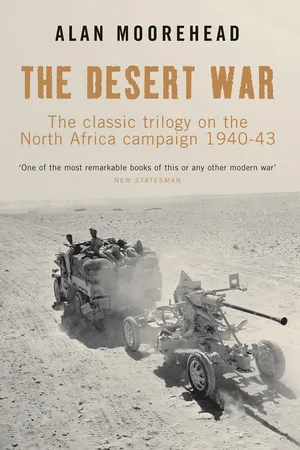
The seminal account of the battle between Montgomery’s Eighth Army and Rommel’s Afrika Corps, amidst the endless harsh wastes of the Western Desert.
In 1940, Alan Moorehead was sent to cover the North Africa campaign by the Daily Express, and he followed its dramatic course all the way to 1943. The three books he subsequently wrote about the Desert War – later collected as his ‘African Trilogy’ – were swiftly acclaimed as a classic account of the tussle between Montgomery’s Eighth Army and Rommel’s Afrika Corps, under the beating sun of the Egyptian Sahara's Western Desert.
Moorehead was responsible for the celebrated insight that tank battles in the desert are like battles at sea, the lumbering tanks like ships lost in a vast ocean of sand. The New Statesman could not have put it better when it described his achievement with this riveting book:
‘There is something of genius in the breadth and penetration of his vision, which encompasses the whole panorama of war and then narrows it down to the particular: the soldier stubbing out his cigarette before going into action, the expression on a tank commander’s face as he is hit… The story of the African campaigns will go down in history as one of the great epics of mankind, largely thanks to Mr Moorehead’s account.’
- 656 pages
- English
- ePUB (mobile friendly)
- Available on iOS & Android
eBook - ePub
About this book
Information
Topic
HistoireSubtopic
Biographies militairesBOOK TWO
A Year of Battle:
The Year of Auchinleck 1941–42
One
August 1941 in Cairo
I THINK we first began to realise it was all over for the time being at the end of July. There seems to come this moment of anticlimax at the end of every campaign. The excitement and enthusiasm abruptly die away. Overnight the roads become half deserted, and you find the troops making camp in the fields. Tents begin to spring up, and at their doorways you see men shaving and taking baths in the open. The steel helmets have vanished.
Some of the local people come out of hiding and begin to sell fruit and eggs along the roadside and then you see the most definite sign of all—red-capped security police. They begin to appear in every village. They mean that law and order have returned. They mean that the fighting is done, that the banks can reopen their doors and the shopkeepers pull down their shutters. Peace, plenty and profit and loss have come back into the world again.
It was like this in Syria. I was far up in the north on the Turkish border where the road runs across to Antioch, and we were resting briefly by a ruin with the improbable name of Chateau des Dames. Without my being aware of it at first a thought suddenly jumped into my mind: ‘What are we doing here? How many hundreds of weary miles is it back to Cairo?’ Everyone appeared to have the same idea at once and we all began talking about going home. The Syrian campaign was done.
Yet we had never had this feeling of anticlimax so strongly before. As we drove back through Aleppo and Homs and across the Lebanon Mountains to Beyrout we began to see that this was more than a single campaign that was finishing—it was a whole cycle of the war. First there had been the collapse of France, then the air battle of Britain, and now the long untidy series of Middle Eastern campaigns was ending on this hot midsummer day in the deserts of Syria.
Russia had taken over the struggle: cycle number four. As we drew near Cairo we were arguing hotly, not about the Middle East, but Russia. Some thought she would hold out only a couple of months.
As I crossed the Nile in Cairo to my flat on Gezira Island, I decided to use the inevitable lull ahead by writing a book. I remember I was full of the idea at the time and could scarcely wait to unpack my typewriter and make a start. It was not quite so easy as I expected. I got out of bed at six o’clock and set the typewriter up in the front room without waiting to dress. At 7.30 the telephone rang in the hall and I answered it. Then it rang again. Then a third time. Hassan the suffragi came in and swept the floor until I drove him out.
Outside the street vendors came by, and the cries of the Cairo street vendors are just what you would expect them to be—entertaining and romantic in the evening and merely damnable in the early morning when you are trying to work. There was one man who brought such nameless pain and misery into voice that I was forced to the open window to listen. He was selling bath mats.
In the nursery at the far end of the flat I could hear my son John rising like a bombshell from his twelve hours’ sleep. The nurse was battling with him against that inevitable moment when he would elude her and go thundering through the flat in search of amusement. The telephone rang again.
Lucy at that time had a job in General Staff Intelligence at G.H.Q. and she had to be at work at 8.15. I could hear the shower going in the bathroom. Alexander Clifford rose heavily from his bed in the front room and put his head in my door.
‘Are you writing a story at this time of the morning?’
‘No,’ I said. ‘A book.’
‘Good God!’
I could hear him telling Lucy the news through the bathroom door and I shouted at them, ‘Will somebody answer this damn telephone?’
By eight o’clock the noise of my typewriter was getting on everybody’s nerves and we had a sultry and irritable breakfast. The heat glared fiercely outside. Most of this August went by like that.
Yet it was a nice flat and a pleasant place to live when one was in Cairo. Looking across the green lawns of Gezira Club we had often admired these two tall modern blocks in the Sharia El Gezira. They were known as the Elephant and Castle. Most officers in G.H.Q. had tried to get a flat there at some time or other. It was just by chance one day that we saw the notice go up ‘appartement à loyer’ and the following week we moved into number three on the rear and shady side of the Elephant’s first floor.
General Catroux of the Free French, a lean, quiet, leathery man with a deft sense of humour, lived on the top floor. Directly above us was the Japanese legation full of bland little men in striped trousers who kept tumbling out of the lift into Packard motor cars. The Hares and Williamson Napier of the British Embassy were our neighbours on the same floor. Just across in the Castle lived John Shearer, known as the Cairo military spokesman. Colonel Philip Astley, who controlled the war correspondents in the Middle East, lived there too, and many red-capped brigadiers and generals came and went. The club lawns were convenient for my baby and nurse. We were, in fact, in the right spot.
So then it was an additional irritation this August when we received word that our lease was finished and that we must find another flat at a time when Cairo was doubling its population and flats were wellnigh impossible to find.
I wrote quickly because I did not know how long the lull in the news would last. Each day we half expected some new front to develop, and then Clifford and I would have to pack our bedding rolls and make off. It had happened so often in the past year. There had been Wavell’s campaign in the desert; Ethiopia and East Africa, Greece, Crete, Iraq and Syria. Even when Damascus fell and the Russians entered the war, we could not grow used to the idea that the long series of campaigns was done and that for the moment there was nothing of any real importance to report in the Middle East.
The lull in the Middle East was, of course, no lull. The two opponents had simply drawn off from one another in order to re-equip and fling themselves forward again more violently than ever before. There was tremendous activity behind the lines. Wavell had gone to India and his place had been taken by Auchinleck. Stemming from this, immense changes were taking place right through the Army of the Nile. The Army became three armies—one the Eighth in the Western Desert, another the Ninth in Syria and Palestine, and the third the Tenth based on Baghdad and territories to the east.
A spate of new people came in from England and India, bringing with them new machines, new tanks and guns, and one or two fresh ideas. Air Marshal Longmore had gone, and his place at the head of the Middle Eastern air force was taken by Arthur Tedder who had been second in command. Under Tedder the R.A.F. was doubling and tripling itself with Beaufighters and Bostons, Wellingtons, Hurricanes, Marylands, Tomahawks.
At sea Andrew Cunningham still had command, and new warships were sailed to him from England to replace those he had lost in his great actions off Crete and in the Ionian Sea. The time of the big naval sweeps through the Mediterranean was finished now. Against increasing and unremitting opposition from the Luftwaffe, the navy was getting supplies into Tobruk and Malta and sinking the Axis convoys that slipped out of Naples on dark nights and made for Tripoli by way of the Tunisian coast.
From England to Australia, fourteen thousand miles away, our chain of naval bases was still holding—Gibraltar, Malta, Alexandria, the Suez Canal, Bombay, Colombo, Singapore. The route around the Cape of Good Hope was being developed by both belligerent and neutral vessels. Possibly because of the Russian campaign, U-boats and German raiders were less active through this summer, and most of our convoys were getting through.
Only the isolated garrison of Tobruk was seeing real fighting and this was for the most part a matter of shelling, offensive patrols and bombing. This book is partly concerned with the story of Tobruk and it is good to remember the garrison as it was this August during the great days of the Tobruk tradition. The town and its thirty-five-mile perimeter were manned by British tanks, artillery and infantry, and by the Ninth Australian Division, all under the command of Major-General Morshead. German and Italian forces were encamped right under the perimeter and several divisions of enemy troops lay on the Egyptian frontier. Although the main part of our desert army was little more than a hundred miles away from Tobruk, it was impossible to send fighter support to the garrison or maintain British aircraft there. An experiment was made in landing Hurricanes on Tobruk airfield, but they were sighted at once and shot up within a few minutes of landing. No flares could be lit to bring in aircraft at night. Morshead had to rely solely upon anti-aircraft fire to hold off the German bombers that were coming over every day on their five minutes’ run from El Adem field just across the perimeter. Our men holding the perimeter could actually hear the German aircraft warming up to take off from El Adem.
Tobruk itself was a maze of broken, tottering buildings though still they gleamed white and clear in the sun. Shells fell constantly among the wrecks in the harbour. All that dusty and ravished plain reaching up to the minefields, trenches and barbed wire of the perimeter was under enemy fire, so that reliefs on the front had to be carried out at night. Even the food of the front-line men had to be cooked near the town and taken up to the trenches in the starlight. The men who had lain all day in the sun facing the enemy would crawl through the trenches to the dugouts where the bully stew and brackish tea was served out. And they would relax there for an hour or two at night to smoke, talk and read. Before the morning came they would walk back to their posts. By any standard they were very fine troops. They were the Rats of Tobruk,
All these men—some twenty-five thousand—were maintained solely by the navy and the merchant fleet. Destroyers crammed with men and stores would steam out of Alexandria and Matruh and make the quick dash through the night into the treacherous darkness of Tobruk harbour. Only a narrow channel was kept open through the sunken ships and the entrances to the harbour were mined.
Landing crews—and these included a little band of picked Indian troops—would be waiting on the improvised docks and lighters. They worked feverishly through the midnight hours getting ashore the shells, tanks, spare parts and boxes of food. The reinforcements came off silently and under the spasmodic glare of bombs and gun-flashes they marched off somewhere into the darkness. Then the wounded were carried down to the ships and borne off into the open sea before the morning broke. At sea the ships were often followed and bombed by the enemy until they reached port in Egypt.
In all this there was none of the stir and excitement of battle action. There was no thrill of closing with the enemy, of seeing the torpedoes go out and the big guns straddle their targets on the horizon. Seldom, if ever, were the men on the Tobruk run able to see that most terrible and exhilarating sight on the ocean—an enemy warship that billows suddenly into flame and casts up its stern for the long dive to the seabed.
All this was stealth, speed and essentially defence. Yet still I carry a photographic picture in my mind of the dark harbour of Tobruk. Over on the right somewhere lies the wreck of the Italian liner Marco Polo and another vessel that by some freak of the weather or high explosive had edged a good twenty feet of its bows onto the yellow cliffs on the southern side of the harbour. On the left lie the broken buildings of the town rising tier on tier up to the crest of the promontory which binds the harbour on its northern side. In between is the heavy darkness of the harbour itself. All around is the noise and sharp light of gunfire.
The dockside labourers straining their eyes can just make out the low hulk of a moving ship. It is probably no more than a triangular shadow weaving in and out of the wrecks, until it comes alongside. The decks are crowded with men in full kit. No one smokes. There is an exchange of shouted orders from the destroyer’s bridgehead and answers from the quay and then the men begin filing off. The winches are moving before the gangways are down.
Thousands of men have stood on Tobruk quays watching this scene while they, too, waited in full marching kit for the order to go aboard... to go aboard and leave Tobruk and get a spell of rest and quietness and good food back in Egypt or Palestine. While they pondered on cool beer and how it would be to see women again and trees and gardens, many have thought, ‘Will there be room for me?’ There always was room.
It is a notable thing in seafaring that through this period I have called a lull, nearly the whole of the Ninth Australian Division was taken off Tobruk and replaced by two English brigades and a brigade of fighting Poles. The casualties in the changeover were almost nil. The Australians left their trucks and guns behind and the new troops simply moved into the perimeter and took up the struggle. It was done so secretly and quickly the enemy never knew of the changeover until it was completed. Even if this manoeuvre lacked the excitement of a battle, it had the importance of a victory.
Meanwhile on the frontier Rommel was doing little more than digging in. He was mounting entire turrets he had taken off captured British infantry tanks. They were embedded in concrete on the high points of Halfaya Pass, overlooking the British forces that were sprawled across the Egyptian desert below, and down across the road to the sea. There was shelling, minelaying, patrolling. But not much else. Rommel had his plans for the winter and so had we.
We suspected but did not know definitely that Rommel was consolidating this frontier so that he could assault Tobruk unmolested by the rest of the Eighth Army. On one side we were filling the Western Desert with such numbers of guns, tanks and vehicles as had never been seen there before. We planned to go around his frontier positions and relieve Tobruk before the enemy could launch his attack on the perimeter.
There was no great concern at this point about the rest of our Mediterranean bases. The heavy raids on Malta had not yet begun and the island was holding strongly. The middle arm of the Nazi Drang Nach Osten had stopped at Crete so that the island of Cyprus and newly occupied Syria were secure and fairly heavily garrisoned. From Persia there was an ominous rumble of Axis activity at our back door, but it was no more than political intrigue and underground sabotage.
In the south the East African war was finished. Haile Selassie sat on his old throne in Addis Ababa. The disposal of thousands of Italian settlers there was proving a first-class problem, but they were showing no desire to make trouble. British Somaliland was again ours. Italian Somaliland and Eritrea, with its valuable Red Sea base at Massawa, had been added to our war-time empire. Vichy French still clung to the flyblown waste about Jibuti and were supplied to some extent by submarine from Madagascar. But this was a minor problem. Three-quarters of Africa was now behind the British. Vichy and the Axis still held the north-west corner reaching from Dakar to Sollum. Two valuable and large South African Divisions, with their attendant aircraft, were released for service in Egypt.
Until now the British dispositions in the Middle East had resembled a huge wheel with Cairo at the hub. One spoke of the wheel had reached south to Addis Ababa, another west to Tobruk and Malta, a third north to Greece and Crete and a fourth eastward toward Baghdad. But now all this was changing. The northern spoke of the wheel had been removed by our expulsion from Greece and Crete and our conquest of Italian East Africa had made the southern spoke unnecessary. The wheel was a wheel no longer. It had been shaped into a huge shallow V, one arm of which stretched toward Baghdad and the countries of the east; the other arm reached toward Tobruk and the central Mediterranean. Cairo stood at the angle of the V.
It required no great foresight or knowledge to see what were the British plans for the winter or to understand that, despite our losses, our grand strategy had passed from the defensive to the offensive stage. We had to guarantee the Mediterranean and somehow re-establish a footing in Europe. The way to do that was by the conquest of Libya. Holding Benghazi and Tripoli we could give land-based fighter protection to our ships; we could supply Malta and send air raids deep into Sicily and Italy; we could mount an expedition to land on Italy itself. This was the long-range hope for the western arm.
In the east there was still a little plugging and filling to do. In neutral Persia, with its all-important oilwells in the south, German technicians and agents were steadily white-anting British interests. The Turkish government, temperamentally democratic but anxious to offend no one, poised itself on an awkward triangular foreign policy. The Turks took arms from Britain and America, barter agreements from the Axis and fair words from Russia. To Turkey it seemed that she would be swamped overnight if one of the great powers decided to invade. She feared that her great wastes might suddenly be turned again into a battlefield. She believed that the only logical object of her foreign policy was this—to keep out of the war until she was invaded and then invoke the aid of the other belligerents. In the meantime, Turkey was a weakness in the chain of our eastern positions, for she would accept no allied troops on her soil lest she offend the Nazis.
The position of India—so closely linked with the Middle East—I deal with later. At this moment, before Japan and the United States had entered the war, India was chiefly a great workshop and emporium for the Middle East. She was an immense reservoir of men, ships, guns, clothing and food, and she was committed to the rôle of supplying Auchinleck’s armies wherever they went—into Europe if need be.
The situation generally was not bad so long as Russia held. But there was an immense job of coordination and supply to be done in the Middle East, and the War Cabinet sent out Mr Oliver Lyttleton as its minister of state and highest authority.
I saw Lyttleton only half a dozen times while he was in the Middle East, and then at semi-public meetings. He worked hard, travelled a good deal, held many private conferences, and those things he did achieve were kept secret. Very possibly we had an unfortunate view of him. His press conferences were so appallingly dull, his words so banal and evasive that it was impossible to put him before the public as a leader; when he came to leave Cairo he was scarcely known. I remember once when we had spent months following a campaign in the desert and were temporarily back in Cairo, Lyttleton summoned us to a conference. He then revealed to us that he himself had made a short visit to the desert, and he proceeded to describe in some detail the geography of the places we had been visiting all winter. However, he appeared to hold a good balance between the generals and the diplomats, and those who dealt directly with the minister spoke highly of him.
There was through this quiet time something definitely and deeply wrong with the mental attitude of the British forces in the Middle East. Not since Mr Eden’s visit just before the disasters in Greece and Crete had we heard words of such optimism and confidence. The complacency was contagious. Everywhere you went the men were ‘in good heart’—or so their officers told you. Probably this was true enough, but it was largely the good heart of ignorance. Apart from Greece and Crete we had not seriously met the Germans anywhere, and Crete and Greece were sliding comfortably into the background. Everyone looked forward to the coming winter campaign in the desert with enthusiasm and dangerously b...
Table of contents
- Cover
- Title Page
- Contents
- Preface
- Book One: Mediterranean Front: The Year of Wavell 1940–41
- Book Two: A Year of Battle: The Year of Auchinleck 1941–42
- Book Three: The End in Africa: The Year of Eisenhower, Alexander and Montgomery 1942–43
- Endnotes
- Index
- Copyright Page
Trusted by 375,005 students
Access to over 1.5 million titles for a fair monthly price.
Study more efficiently using our study tools.
Frequently asked questions
Yes, you can cancel anytime from the Subscription tab in your account settings on the Perlego website. Your subscription will stay active until the end of your current billing period. Learn how to cancel your subscription
No, books cannot be downloaded as external files, such as PDFs, for use outside of Perlego. However, you can download books within the Perlego app for offline reading on mobile or tablet. Learn how to download books offline
Perlego offers two plans: Essential and Complete
- Essential is ideal for learners and professionals who enjoy exploring a wide range of subjects. Access the Essential Library with 800,000+ trusted titles and best-sellers across business, personal growth, and the humanities. Includes unlimited reading time and Standard Read Aloud voice.
- Complete: Perfect for advanced learners and researchers needing full, unrestricted access. Unlock 1.5M+ books across hundreds of subjects, including academic and specialized titles. The Complete Plan also includes advanced features like Premium Read Aloud and Research Assistant.
We are an online textbook subscription service, where you can get access to an entire online library for less than the price of a single book per month. With over 1.5 million books across 990+ topics, we’ve got you covered! Learn about our mission
Look out for the read-aloud symbol on your next book to see if you can listen to it. The read-aloud tool reads text aloud for you, highlighting the text as it is being read. You can pause it, speed it up and slow it down. Learn more about Read Aloud
Yes! You can use the Perlego app on both iOS and Android devices to read anytime, anywhere — even offline. Perfect for commutes or when you’re on the go.
Please note we cannot support devices running on iOS 13 and Android 7 or earlier. Learn more about using the app
Please note we cannot support devices running on iOS 13 and Android 7 or earlier. Learn more about using the app
Yes, you can access The Desert War by Alan Moorehead in PDF and/or ePUB format, as well as other popular books in Histoire & Biographies militaires. We have over 1.5 million books available in our catalogue for you to explore.