eBook - ePub
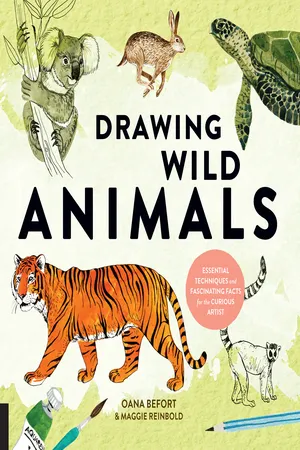
Drawing Wild Animals
Essential Techniques and Fascinating Facts for the Curious Artist
- 144 pages
- English
- ePUB (mobile friendly)
- Available on iOS & Android
eBook - ePub
Drawing Wild Animals
Essential Techniques and Fascinating Facts for the Curious Artist
About this book
Featuring the delightful and informative illustrations of artist Oana Befort and the inspiring expertise of conservation educator Maggie Reinbold, Drawing Wild Animals guides artists at all skill levels as they learn to draw—and learn about—a diverse array of mammals, amphibians, and reptiles from around the world.
To feed your curiosity, you’ll learn the characteristics, behaviors, and habitats of animals from categories like predators, burrowers, grazers, marsupials, frogs and toads, and lizards and snakes. To nurture the artist, you'll get more than 25 step-by-step instructions that show how to develop each animal from simple shapes into richly detailed drawings. Armed with a deeper understanding of animals, you’ll be better able to capture their stunning beauty and enchanting attributes in your artwork.
Some of the intriguing animals you'll encounter:
To feed your curiosity, you’ll learn the characteristics, behaviors, and habitats of animals from categories like predators, burrowers, grazers, marsupials, frogs and toads, and lizards and snakes. To nurture the artist, you'll get more than 25 step-by-step instructions that show how to develop each animal from simple shapes into richly detailed drawings. Armed with a deeper understanding of animals, you’ll be better able to capture their stunning beauty and enchanting attributes in your artwork.
Some of the intriguing animals you'll encounter:
- Bengal tiger
- Yellow mongoose
- African bush elephant
- European hedgehog
- Black flying fox
- Ring-tailed lemur
- Blue poison frog
- Gold dust day gecko
- Russian tortoise
With Drawing Wild Animals, you'll learn to see—and draw—animals in a whole new light!
Frequently asked questions
Yes, you can cancel anytime from the Subscription tab in your account settings on the Perlego website. Your subscription will stay active until the end of your current billing period. Learn how to cancel your subscription.
At the moment all of our mobile-responsive ePub books are available to download via the app. Most of our PDFs are also available to download and we're working on making the final remaining ones downloadable now. Learn more here.
Perlego offers two plans: Essential and Complete
- Essential is ideal for learners and professionals who enjoy exploring a wide range of subjects. Access the Essential Library with 800,000+ trusted titles and best-sellers across business, personal growth, and the humanities. Includes unlimited reading time and Standard Read Aloud voice.
- Complete: Perfect for advanced learners and researchers needing full, unrestricted access. Unlock 1.4M+ books across hundreds of subjects, including academic and specialized titles. The Complete Plan also includes advanced features like Premium Read Aloud and Research Assistant.
We are an online textbook subscription service, where you can get access to an entire online library for less than the price of a single book per month. With over 1 million books across 1000+ topics, we’ve got you covered! Learn more here.
Look out for the read-aloud symbol on your next book to see if you can listen to it. The read-aloud tool reads text aloud for you, highlighting the text as it is being read. You can pause it, speed it up and slow it down. Learn more here.
Yes! You can use the Perlego app on both iOS or Android devices to read anytime, anywhere — even offline. Perfect for commutes or when you’re on the go.
Please note we cannot support devices running on iOS 13 and Android 7 or earlier. Learn more about using the app.
Yes, you can access Drawing Wild Animals by Oana Befort,Maggie Reinbold in PDF and/or ePUB format, as well as other popular books in Art & Art General. We have over one million books available in our catalogue for you to explore.
Information
MAMMALS

REPRESENTING the smallest class of vertebrate animals, with roughly 5,400 described species across multiple orders, mammals are an incredibly diverse and fascinating group. They range in size from tiny bats and mice to massive whales, united by the presence of hair, mammary glands, and unique brain and ear structures.
All mammals are endothermic, or “warm-blooded,” with the ability to regulate their own body temperature through internal processes instead of relying on the external environment. Endothermy allows species to thrive and survive in even the harshest environments; consequently, mammals are broadly distributed across all habitat types throughout the world.
Mammals display an incredible range of lifestyles and food preferences, from arboreal insectivores to aquatic carnivores to fossorial (burrowing) omnivores. They vary greatly in their external ornamentation, from color patterns such as stripes and spots to structures on the head like horns and antlers. They communicate in a variety of ways, using scent, sound, and movement to relay information and interact with each other under myriad community structures, from solitary living to strict hierarchies.
All mammals give birth to live young, except for a few egg-laying species such as the duck-billed platypus of Australia. The platypus and a handful of echidna species, collectively called monotremes, lay eggs like birds and reptiles, but most of the incubation occurs inside the mother’s body, with young drinking milk immediately after hatching. In contrast to the monotremes are the marsupials, a group of mammals that give birth to live young, but the offspring are born extremely small and undeveloped. Newborn marsupials are essentially still fetuses, and must make their way to the safety of the mother’s pouch, where they actively suckle milk and continue developing. Last, there are the eutherians, representing the majority of mammalian species, including well-known groups such as bears, cats, whales, rhinos, and monkeys. Eutherian mammals nourish their young inside a placenta, a specialized embryonic organ within the mother. They are born fully developed and, in many species, ready to compete and survive within a very short period of time.
One unifying mammalian feature that can be challenging to re-create is the presence of hair or fur on the body. Serving many purposes across species, from camouflage to thermoregulation, mammalian fur varies greatly in thickness, color, rigidity, and density. The way that sunlight falls on or through a lion’s mane on a ...
Table of contents
- Cover
- Title Page
- Contents
- Preface
- Drawing Tips and Tools
- Mammals
- Amphibians
- Reptiles
- Conservation and Value
- Resources
- About The Authors
- Index
- Dedication
- Acknowledgements
- Copyright