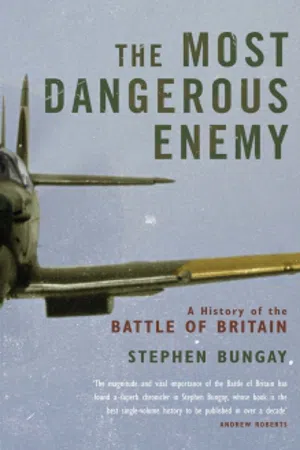
Stephen Bungay’s magisterial history is acclaimed as the account of the Battle of Britain.
Unrivalled for its synthesis of all previous historical accounts, for the quality of its strategic analysis and its truly compulsive narrative, this is a book ultimately distinguished by its conclusions – that it was the British in the Battle who displayed all the virtues of efficiency, organisation and even ruthlessness we habitually attribute to the Germans, and they who fell short in their amateurism, ill-preparedness, poor engineering and even in their old-fashioned notions of gallantry.
An engrossing read for the military scholar and the general reader alike, this is a classic of military history that looks beyond the mythology, to explore all the tragedy and comedy; the brutality and compassion of war.
- 509 pages
- English
- ePUB (mobile friendly)
- Available on iOS & Android
eBook - ePub
About this book
Information
PART I:
BUILD-UP

At half past four on the afternoon of 9 May 1940, the British Prime Minister, Neville Chamberlain, held a meeting with the leaders of the opposition Labour Party, Clement Attlee and Arthur Greenwood, his own Foreign Secretary, Lord Halifax, and his First Lord of the Admiralty, Winston Churchill.
Growing discontent in Parliament over the conduct of the war with Germany had culminated in a Commons debate on the Norway campaign on 7 May. The debate had been a disaster for the Prime Minister. His own speech failed to rouse much support and any military credibility his government may have had was destroyed by Admiral Sir Roger Keyes’ bitter attack on the conduct of the naval operations at Narvik. The government whips were finally brought to despair when Chamberlain’s old friend, Leo Amery, flung at him the words which Cromwell had levelled at the Long Parliament: ‘You have sat too long for any good you have been doing. Depart, I say, and let us have done with you. In the name of God, go!’
The following day the debate had continued. Britain’s previous wartime Prime Minister, Lloyd George, had risen to his feet and delivered a violent attack upon the government, singling out Chamberlain. ‘The Prime Minister should give an example of sacrifice,’ he said, ‘because there is nothing which can contribute more to victory in the war than that he should sacrifice the seals of office.’ Tension in the House was high when Churchill, who had had direct responsibility for the naval campaign so savaged by Keyes, gave a fifty-minute speech in the government’s defence, which some of his listeners found quite incoherent.1
The government had won the resulting division by 281 votes to 200. However, thirty-three Conservatives had voted against their government, and sixty had abstained, rendering the vote of confidence, though formally valid, practically indecisive. Chamberlain’s only real chance of remaining Prime Minister lay in forming a national government and persuading Labour to serve under him. The purpose of the meeting on 9 May was to see if this were possible.
The Prime Minister formally asked the two Labour leaders if they would join a national government under him or under someone else. He had understood that they favoured Halifax. Having made it clear that they would not serve under Chamberlain, Attlee and Greenwood left to consult with their Party Executive.
After they had gone, Chamberlain informed Halifax and Churchill that it was clear to him he would have to resign, but he had not yet decided who to suggest to the King to replace him. The Labour men had expressed no preference, and under Tory party rules it was the outgoing party leader’s responsibility to name a successor.
Churchill said nothing. After a pause, Halifax spoke of the difficulties involved in running a government from the House of Lords. That morning he had told Chamberlain that the idea of being Prime Minister had given him a bad stomach ache, and that Churchill would run the war anyway, whatever his formal office.2
The following morning, 10 May, the Germans opened an assault upon Holland and Belgium which was to result in the most rapid and complete victory in modern warfare. The French 2nd and 9th Armies and the British Expeditionary Force (BEF) began to move forward into Belgium, as planned in such an eventuality, thereby generously facilitating the German General Staff’s plans for their destruction, whilst the bulk of the French army waited on the Maginot Line. In Britain, the government was a lame duck without a leader.
That evening Chamberlain visited the King to resign. He suggested Churchill as his successor. The King was anxious to appoint the reliable and experienced Halifax, but was swayed by Chamberlain’s arguments and the fact that Halifax was reluctant to take office.* The King sent for Churchill at 6 p.m. and asked him to form a government. For his part, Halifax went to the dentist.3
Churchill later wrote of his feelings during these extraordinary few days:
During these last crowded days of the political crisis my pulse had not quickened at any moment. I took it all as it came. But … as I went to bed at about 3 a.m. I was conscious of a profound sense of relief. At last I had the authority to give directions over the whole scene. I felt as if I were walking with destiny, and that all my past life had been but a preparation for this hour and this trial.4
It was as well that he felt as he did, for the trial was to be severe. His Private Detective, Commander Thompson, reported that as he drove back from the Palace that night, Churchill said to him: ‘I hope it is not too late. I am very much afraid that it is.’5 His appointment itself was a clear enough message to some. ‘I didn’t realise that things were going to get tough until they sacked Chamberlain and Churchill took over,’ wrote one member of the civil defence services after the war. ‘We knew he was a tough one.’6
It is probably no exaggeration to say that had any other man held that office in the ensuing months, history would have been very different.
Perhaps the most remarkable thing about the Battle of Britain is that it took place at all.
It was a very near-run thing.* That it did take place was due to a single man: Winston Churchill. He gave the Battle its name – before it had begun – and convinced the world that it was inevitable. He claimed he would have been ‘torn from his place’ had he not led the country into it.7 This is almost certainly untrue. It was his roar that gave the lion heart. There is no evidence at all that the British nation would not have followed Halifax had he made peace with Hitler.
The government Churchill headed was deeply divided. After Dunkirk, his rival for office, Lord Halifax, made no bones about his belief that Britain had been defeated and had nothing to gain from continuing a hopeless struggle against a continental power with which she had no fundamental conflict of interest and should make peace. Halifax enjoyed support in many quarters, not least in the Conservative party.
Churchill on the other hand remained, in many ways, an outsider. In 1940 he was commonly regarded as a dangerous maverick and war-monger, and had many enemies within the party. Shortly after learning of Churchill’s appointment, Halifax’s deputy, ‘Rab’ Butler, spoke to Churchill’s Private Secretary, John Colville, in the Foreign Office:
Rab said he thought that the good clean tradition of English politics, that of Pitt as opposed to Fox, had been sold to the greatest adventurer of modern political history. He had tried earnestly and long to persuade Halifax to accept the premiership, but he had failed. He believed this sudden coup of Winston and his rabble was a serious disaster, but an unnecessary one: the ‘pass had been sold’ by Mr C., Lord Halifax and Oliver Stanley. They had weakly surrendered to a half-breed American whose main support was that of inefficient but talkative people of a similar type …8
There were, of course, those who had always opposed the war on political grounds. Sympathisers of Oswald Mosley (who himself claimed to support it on the grounds of patriotism) and other members of far-right movements had been identified as potential subversives early on. On 22 May the War Cabinet agreed upon a new ‘Defence of the Realm’ regulation which was vague enough to let them move against anyone suspected of being a ‘fifth columnist’, and Mosley was arrested the next day.
The Communist party had, from the first, denounced the war as a capitalist struggle in which workers ought not to participate. Party membership and sales of the Daily Worker increased between the outbreak of war and the spring of 1940.9 The ‘Right Club’, formed in mid-1939 by the Tory MP Captain Ramsey was an anti-Semitic anti-Bolshevist group which did not see any reason for a war with Germany.10 It included twelve MPs and a number of lords, and broadly reflected the views of the former King, the errant Duke of Windsor.
Desire for peace was not confined to dukes and politicians. After all, the whole country had sighed with relief after Munich and the cheers which greeted Chamberlain’s subsequently vilified ‘piece of paper’ were genuine enough. No cheering crowds danced in the streets when he announced ‘this country is at war with Germany’ eleven months later. There were many humanitarians who opposed war in general. The composers Benjamin Britten and Michael Tippett were pacifists, as was the philosopher Bertrand Russell.11 A negotiated peace had been consistently advocated by John Gielgud, Dame Sybil Thorndike and George Bernard Shaw. Lord Beaverbrook also supported negotiations with Germany until Churchill made him Minister of Aircraft Production.12
Once France fell, the case for peace became even stronger. Britain’s policy towards Europe had for centuries been that of holding the balance of power, ensuring that no single continental power became dominant. Now, however, the situation had changed. Quite simply, the Germans had won. With the fall of France, no continental allies were available, so the policy had to be abandoned. Britain’s reason for going to war had been clear: a guarantee to Poland. There was nothing Britain could do about that any more. She had no army left in Europe, possessed only a weak bomber force, and though the Royal Navy still commanded the oceans, it was useless as an offensive weapon against a continental foe. London, the largest ground target in the world, would be open to destruction from the air. Continuing the war would only bring pointless bloodshed and wreck the country’s shaky finances.
Immediately after the Dunkirk evacuation, Britain was defended on the ground by the rump of the BEF – thirteen or fourteen mauled divisions now armed mainly with rifles – fifteen infantry divisions at half their establishment strength and still in training, one partly-equipped Canadian armoured division and the Local Defence Volunteers (soon to be re-named the Home Guard),13 which were a gallant farce. At Dover, there were three anti-tank guns covering 5 miles of coast.14 The Germans had just defeated a combined Allied army of some 132 divisions. Their own victorious army consisted of about 130 divisions, 10 of them armoured. Further resistance, a rational man would have said, was at best pointless, and at worst risked turning into an appalling tragedy.
Halifax was just that rational man. He had no sympathy for Hitler, but he was a patriot, a humanist, a peace-lover and a professional politician who believed that it was his job to serve the best interests of his country and who k...
Table of contents
- Cover
- Title Page
- Dedication
- Table of Contents
- List of Illustrations
- Introduction
- Prologue
- PART I : BUILD-UP
- PART II : BATTLE
- PART III : AFTERMATH
- Epilogue
- Postscript
- Appendix I : LUFTWAFFE ORDER OF BATTLE, 13 AUGUST 1940
- Appendix II : FIGHTER COMMAND ORDER OF BATTLE, 1 JULY 1940
- Appendix III : FIGHTER COMMAND ORDER OF BATTLE, 1 SEPTEMBER 1940
- Sources
- Acknowledgements
- Bibliography
- Notes
- Index
- The Most Dangerous Enemy
- Copyright
- Plates Section
Trusted by 375,005 students
Access to over 1.5 million titles for a fair monthly price.
Study more efficiently using our study tools.
Frequently asked questions
Yes, you can cancel anytime from the Subscription tab in your account settings on the Perlego website. Your subscription will stay active until the end of your current billing period. Learn how to cancel your subscription
No, books cannot be downloaded as external files, such as PDFs, for use outside of Perlego. However, you can download books within the Perlego app for offline reading on mobile or tablet. Learn how to download books offline
Perlego offers two plans: Essential and Complete
- Essential is ideal for learners and professionals who enjoy exploring a wide range of subjects. Access the Essential Library with 800,000+ trusted titles and best-sellers across business, personal growth, and the humanities. Includes unlimited reading time and Standard Read Aloud voice.
- Complete: Perfect for advanced learners and researchers needing full, unrestricted access. Unlock 1.5M+ books across hundreds of subjects, including academic and specialized titles. The Complete Plan also includes advanced features like Premium Read Aloud and Research Assistant.
We are an online textbook subscription service, where you can get access to an entire online library for less than the price of a single book per month. With over 1.5 million books across 990+ topics, we’ve got you covered! Learn about our mission
Look out for the read-aloud symbol on your next book to see if you can listen to it. The read-aloud tool reads text aloud for you, highlighting the text as it is being read. You can pause it, speed it up and slow it down. Learn more about Read Aloud
Yes! You can use the Perlego app on both iOS and Android devices to read anytime, anywhere — even offline. Perfect for commutes or when you’re on the go.
Please note we cannot support devices running on iOS 13 and Android 7 or earlier. Learn more about using the app
Please note we cannot support devices running on iOS 13 and Android 7 or earlier. Learn more about using the app
Yes, you can access The Most Dangerous Enemy by Stephen Bungay in PDF and/or ePUB format, as well as other popular books in History & World War II. We have over 1.5 million books available in our catalogue for you to explore.