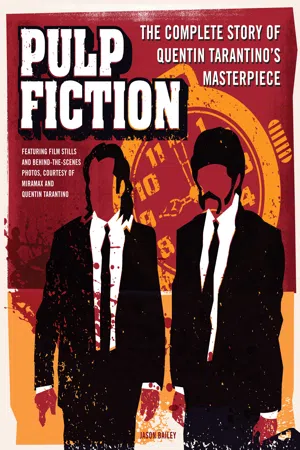
When Pulp Fiction was released in theaters in 1994, it was immediately hailed as a masterpiece. The New York Times called it a "triumphant, cleverly disorienting journey," and thirty-one-year-old Quentin Tarantino, with just three feature films to his name, became a sensation: the next great American director.
More than twenty years later, those who proclaimed Pulp Fiction an instant classic have been proven irrefutably right. In Pulp Fiction: The Complete Story of Quentin Tarantino's Masterpiece, film expert Jason Bailey explores why Pulp Fiction is such a brilliant and influential film.
He discusses how the movie was revolutionary in its use of dialogue ("You can get a steak here, daddy-o," "Correct-amundo"), time structure, and cinematography--and how it completely transformed the industry and artistry of independent cinema. He examines Tarantino's influences, illuminates the film's pop culture references, and describes its phenomenal legacy.
Unforgettable characters like Jules Winnfield (Samuel L. Jackson), Vincent Vega (John Travolta), Butch Coolidge (Bruce Willis), and Mia Wallace (Uma Thurman) are scrutinized from all-new angles, and memorable scenes--Christopher Walken's gold watch monologue, Vince's explanation of French cuisine--are analyzed and celebrated.
Much like the contents of Marcellus Wallace's briefcase, Pulp Fiction is mysterious and spectacular. Illustrated throughout with original art inspired by the film, with sidebars and special features on everything from casting close calls to deleted scenes, this is the most comprehensive, in-depth book on Pulp Fiction ever published.
- 200 pages
- English
- ePUB (mobile friendly)
- Available on iOS & Android
eBook - ePub
About this book
Information
Subtopic
Film Direction & ProductionPART I
The
Movie
Geek
Quentin Tarantino: The Early Years

One usually has to dig deep into the subtext of Tarantino’s films to find autobiography. He is, famously, an artist whose worldview is colored less by what he’s lived than by what he’s seen, and his films are often personal only inasmuch as they reflect the kinds of stories, imagery, and iconography that he likes. But there is one moment in Pulp Fiction that is very personal indeed. At the beginning of the film’s second story, “The Gold Watch,” we find young Butch watching television—an episode of the cheapo kiddie program Clutch Cargo, to be precise. But he’s not just watching television; that’s too passive a description. He’s sitting directly in front of it, right up close, inches from the screen, drinking in everything that pours out of it.
“When I saw Pulp Fiction,” said actor Steve Buscemi, who costarred in that film and Reservoir Dogs, “the little boy watching this big TV, being alone in the room, the TV being his friend—to me, that’s Quentin.”
Young Tarantino would spend much of his youth in that room, with his friend the television, consuming everything that appeared on the magic box, desperately wishing he could climb inside and go for a ride on the Partridge family’s bus or have an adventure with Emma Peel. The only child of a young single mother, he was often left to entertain himself, and as he grew older, he would attend movies with the same intensity. “I didn’t have any friends,” he would say, “other than the other people in the theater.”
Sixteen-year-old Connie Tarantino was living in Knoxville, Tennessee, when her son was born on March 27, 1963. His first name came from two sources: Quentin Compson, the central character of William Faulkner’s The Sound and the Fury (one of her favorite books), and Quint, the handsome cowhand played by young Burt Reynolds on Gunsmoke (one of her favorite TV shows). In other words, from the moment he left the womb, young Tarantino was a creature of popular culture.
Much of that came from Connie, who shared with her son a love of television, comic books, and Elvis Aaron Presley. The duo moved to California when he was two and a half, landing roughly forty-five minutes from Hollywood, home of an industry in the midst of an upheaval. With viewers like Connie eschewing the cinema to stay at home and watch television, the big-budget, big-star movie model was failing, and studios were casting about for fresh approaches and new hooks. As the sixties came to a close, the film industry began to take risks, hiring young directors who took on adult subject matter in candid and challenging ways, thanks to the newly implemented Motion Picture Association of America (MPAA) ratings system.
PULP FACT 1

Connie would later insist that the only film she ever had to take her son out of was Walt Disney’s Bambi; little Quentin couldn’t handle Bambi’s mom dying.
Not that Connie—or later, Quentin’s stepdad, Curt Zastoupil—paid much attention to ratings. They took Quentin to whatever movies they felt like seeing. At age eight, he saw Mike Nichols’ fierce sex comedy Carnal Knowledge, and the following year, Tarantino took in a double feature of Deliverance and The Wild Bunch. Echoes of that fateful double bill would show up throughout his early works. The macho male codes of both appear in Reservoir Dogs (whose iconic opening title shots, Variety’s Todd McCarthy points out, find the title characters “emerging from the restaurant like the Wild Bunch”), while the male rape of the former is explicitly recreated in Pulp Fiction. “Did I understand Ned Beatty being sodomized?” Quentin said later. “No. But I knew he wasn’t having any fun.”
From that early age, Tarantino was sowing something that went beyond a love for the cinema. It was an appetite, a voracious hunger for all that the movies had to offer. He was getting his cinematic education during one of the industry’s richest eras, the New Hollywood of the 1970s, in which a generation of “movie brats,” well-versed in movie history and fresh from hip film schools and apprenticeships with low-budget producers like Roger Corman, took over mainstream studio moviemaking with pictures that were both personal and popular.
Tarantino was no snob. He was as deeply enamored with the grindhouse as he was with the art house, and was as likely to become obsessed with a scuzzy exploitation cheapie as the latest from Francis Ford Coppola or William Friedkin. He would go to the cinema constantly, often by himself, which was his preference. The solitude of the experience allowed him to better focus on the movie, to memorize shots, dialogue, and names in the credits. It was all grist for the mill of his movie-mad mind.


[ Exploitation Movies ]
This catchall phrase describes low-budget films—usually genre pictures—that, lacking big stars or recognizable brands, have marketable or “exploitable” elements like sex, violence, drugs, rock music, or youth appeal. Though exploitation films date back to the thirties and forties (with cautionary tales like Mom and Dad and Reefer Madness), the golden age of exploitation movies was the mid-fifties through the seventies, when hucksters and showmen like William Castle, Samuel Z. Arkoff, and (most famously) Roger Corman churned out exploitation movies for the drive-in and grindhouse markets.

Roger Corman, king of the B movies and 2009 Honorary Academy Award recipient, on the set of X: The Man with the X-Ray Eyes, 1963.
Hulton Archive / Getty Images
Though his movie education was in full bloom, his conventional schooling was a bit more problematic. He was intellectually capable, with tests revealing an IQ near 160 (twice—he retook the test when school officials thought his high score was an error). But, as he later told Vanity Fair, “School completely bored me. I wanted to be an actor. Anything that I’m not good at, I don’t like, and I couldn’t focus at school.” Frustrated by her son’s aimlessness and truancy—he would frequently skip school to go to matinees—Connie ultimately granted his wish to drop out of school. Tarantino was sixteen.
He got his first real job, predictably enough, at a movie theater. Trouble was, the only operating cinema anywhere near his Torrance home was a rundown local franchise of the Pussycat, a California porno chain. “Most teenagers would think, ‘Cool, I’m in a porno theater,’” he said later. “But I didn’t like porno. I liked movies.” That said, his usher’s job at the Pussycat put him in contact with the kind of colorful characters that would later turn up in his scripts. And it paid for his classes at the James Best Acting School in Toluka Lake, where he met other movie-crazy would-be actors and formed his first close friendships.
Finally, at eighteen, he quit the Pussycat, moved into a one-bedroom apartment in Harbor City, and nabbed a nine-to-five, suit-and-tie job that paid for his first VCR. But his closest video store was poorly stocked and lacked the kind of treasures he desired. So Quentin got in his beat-up Honda hatchback and drove the twenty minutes to Hermosa Beach, to a little specialty video store he kept hearing about called Video Archives.
[ Grindhouses ]
The name grindhouse came from burlesque houses, whose performers would dance in a bump-and-grind style. In the 1970s, single-screen movie theaters and former burlesque houses in large urban hubs held on against multiplexes by booking increasingly extreme exploitation movies, often in daylong loops of several films in a row. The most famous concentration of grindhouse theaters in America was on 42nd Street in New York’s Times Square, a block of rundown houses dubbed The Deuce.
The term grindhouse would come into the mainstream, relatively speaking, in 2007, when Tarantino and Robert Rodriguez teamed up to make Grindhouse, a throwback exploitation double-feature tribute.

Grindhouse theaters along Times Square, 1969. © Bettmann / Corbis
PULP FACT 2
Tarantino’s first brush with crime came around this time: he was caught shoplifting a paperback of The Switch, the latest hard-boiled action/comedy from novelist Elmore Leonard. He was nabbed by a store detective and was taken home in cuffs. That novel’s central characters were Ordell Robbie and Louis Gara, whom Leonard would write into another novel, Rum Punch—a novel that Tarantino would ad...
Table of contents
- Cover
- Title Page
- Contents
- Prologue
- Part I: The Movie Geek
- Part II: The Script That Changed Everything
- Part III: Making Fiction
- Part IV: “Let’s Get Down to Brass Tacks, Gentlemen”
- Part V: The Release and Aftermath
- Part VI: The Tarantinoverse
- Bibliography
- Index
- Acknowledgments
- About the Author
- Dedication
- Copyright Page
Trusted by 375,005 students
Access to over 1.5 million titles for a fair monthly price.
Study more efficiently using our study tools.
Frequently asked questions
Yes, you can cancel anytime from the Subscription tab in your account settings on the Perlego website. Your subscription will stay active until the end of your current billing period. Learn how to cancel your subscription
No, books cannot be downloaded as external files, such as PDFs, for use outside of Perlego. However, you can download books within the Perlego app for offline reading on mobile or tablet. Learn how to download books offline
Perlego offers two plans: Essential and Complete
- Essential is ideal for learners and professionals who enjoy exploring a wide range of subjects. Access the Essential Library with 800,000+ trusted titles and best-sellers across business, personal growth, and the humanities. Includes unlimited reading time and Standard Read Aloud voice.
- Complete: Perfect for advanced learners and researchers needing full, unrestricted access. Unlock 1.5M+ books across hundreds of subjects, including academic and specialized titles. The Complete Plan also includes advanced features like Premium Read Aloud and Research Assistant.
We are an online textbook subscription service, where you can get access to an entire online library for less than the price of a single book per month. With over 1.5 million books across 990+ topics, we’ve got you covered! Learn about our mission
Look out for the read-aloud symbol on your next book to see if you can listen to it. The read-aloud tool reads text aloud for you, highlighting the text as it is being read. You can pause it, speed it up and slow it down. Learn more about Read Aloud
Yes! You can use the Perlego app on both iOS and Android devices to read anytime, anywhere — even offline. Perfect for commutes or when you’re on the go.
Please note we cannot support devices running on iOS 13 and Android 7 or earlier. Learn more about using the app
Please note we cannot support devices running on iOS 13 and Android 7 or earlier. Learn more about using the app
Yes, you can access Pulp Fiction by Jason Bailey in PDF and/or ePUB format, as well as other popular books in Media & Performing Arts & Film Direction & Production. We have over 1.5 million books available in our catalogue for you to explore.