![]()
Chapter 1
“FIERCE INDIVIDUALISTS”
“There can be no such animal as a typical parachutist. Every 82nd Airborne trooper is by the nature of his mode of warfare an individualist of the first rank. His deeds individually and collectively are legend in the annals of American courage and initiative. His personality is as unpredictable as his dependability in combat.”
—W. Forrest Dawson, Saga of the All American
Shortly after the Japanese attack on Pearl Harbor on December 7, 1941, young men from almost every background volunteered to join a new branch of the U.S. Army—the parachute forces. Private Ross S. Carter noted that “every level of society had its representation among us. Senators’ sons rubbed shoulders with ex-cowboys. Steelworkers chummed up with tough guys from city slums. Farm boys, millionaires’ spoiled brats, white-collar men, factory workers, ex-convicts, jailbirds, and hoboes joined for the thrill and adventure of parachute jumping. And so, the army’s largest collection of adventurous men congregated in the parachute troops.
“The thing that distinguished us from most other soldiers was our willingness to take chances and risks in a branch of the army that provided a great, new, almost unexplored frontier. In other days paratroopers would have been the type to sail with Columbus, or the first to seek out the West and fight the Indians.”
They underwent extremely tough physical training throughout the four weeks of jump school, during which many of the volunteers dropped out.
In February 1942, a division that had a legendary record for its actions in World War I was reactivated—the 82nd Infantry Division. The greatest hero of that war had been Sergeant Alvin York, who had served with the division and had been awarded the Congressional Medal of Honor. General Omar N. Bradley, the division commander, together with General Matthew B. Ridgway, the assistant division commander, instituted intensive physical training and instruction in weapons, tactics, and maneuver to build the division into a combat-ready force at Camp Claiborne, Louisiana.
The division’s progress was so impressive that General Bradley was transferred to command the troubled 28th Infantry Division. On June 26, 1942, General Ridgway assumed command of the 82nd Division. On August 15, 1942, while completing the last weeks of training at Camp Claiborne, General Ridgway announced that the division would be converted into an airborne division and would provide the cadre for a second airborne division—the 101st. The infantry, artillery, antiaircraft, engineer, and headquarters units began training to become glider-borne.
On October 1, 1942, the 82nd Airborne Division was moved to Fort Bragg, North Carolina, where it was joined by the newly assigned 504th Parachute Infantry Regiment (PIR), the 376th Parachute Field Artillery (PFA) Battalion, and Company C, 307th Airborne Engineer Battalion. On February 12, 1943, due to a shortage of gliders, the 326th Glider Infantry Regiment (GIR) was transferred to the newly formed 13th Airborne Division, and the 505th Parachute Infantry Regiment, under the command of Colonel James M. Gavin, joined the 82nd Airborne Division.
![]()
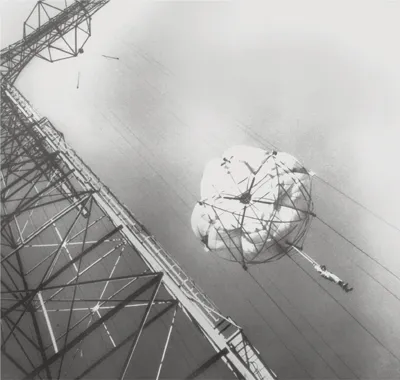
A parachutist in training descends from one of the 250-feet-high towers at the jump school at Fort Benning. U.S. Army photograph, courtesy of the 82nd Airborne Division War Memorial Museum
![]()
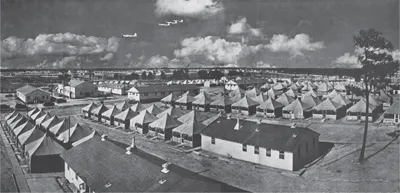
A small portion of the tents and barracks at Camp Claiborne, Louisiana. Photograph courtesy of www.campclaiborne.com
![]()
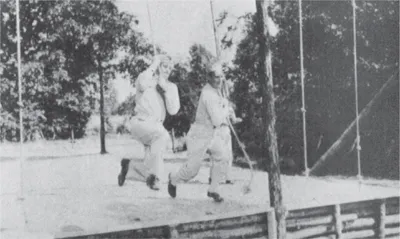
Generals Bradley (left) and Ridgway use the rope swing to cross a water obstacle. U.S. Army photograph, courtesy of the 82nd Airborne Division War Memorial Museum
![]()
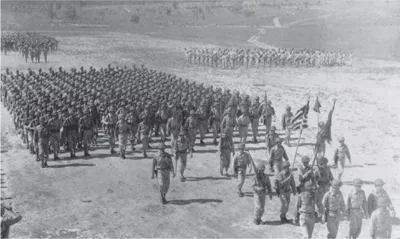
The 319th Field Artillery passes in review at Camp Claiborne. U.S. Army photograph, courtesy of the 82nd Airborne Division War Memorial Museum
![]()
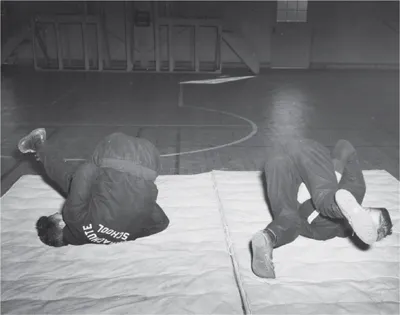
The Trainees at Fort Benning jump school perform left and right front tumbles in preparation for learning parachute landing falls (PLFs) during “B” Stage. U.S. Army photograph
![]()
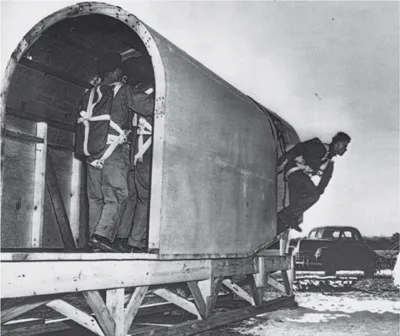
Trainees practice exiting from a mockup of a C-47 door during “B” Stage. U.S. Army photograph, courtesy of the 82nd Airborne Division War Memorial Museum
![]()
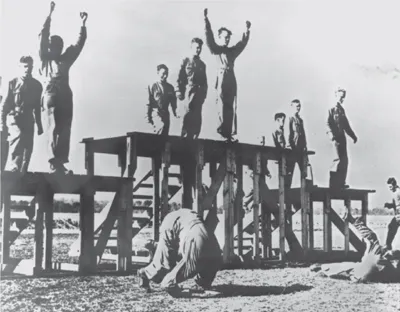
The platform where trainees learn to execute PLFs. U.S. Army photograph, courtesy of the 82nd Airborne Division War Memorial Museum
![]()
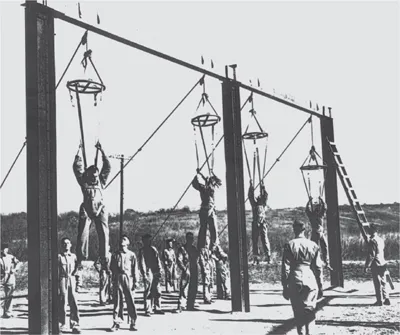
Trainees practice using risers to guide the parachute. U.S. Army photograph, courtesy of the 82nd Airborne Division War Memorial Museum
![]()
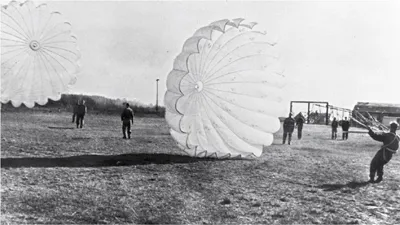
Trainees practice handling and collapsing parachute canopies. U.S. Army photograph, courtesy of the 82nd Airborne Division War Memorial Museum
![]()
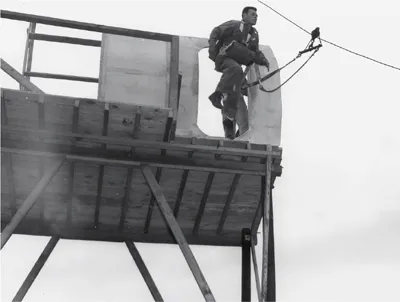
The dreaded thirty-four–foot tower during “C” Stage, where trainees exit from a mockup of a C-47 door and drop until their harness is caught by a cable, then guided to the ground. U.S. Army photograph, courtesy of the 82nd Airborne Division War Memorial Museum
![]()
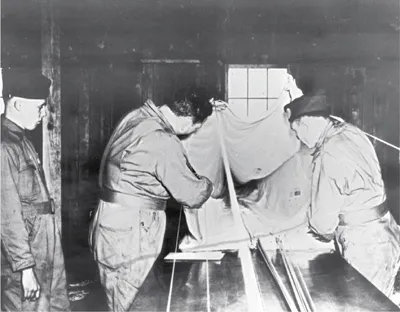
Trainees learn to pack their own parachutes on the last day of “C” Stage, for the qualifying jumps the following week. U.S. Army photograph, courtesy of the 82nd Airborne Division War Memoria...