![]()
SECTION 01
THE DESIGNER’S JOURNEY:
THE SPARK
The moment when you’re struck by an idea that you think might turn into something, but you don’t know where it will take you or how you will get there.
![]()
I MOSTLY GET MY INSPIRATION FROM THINGS UNRELATED TO WHAT I DO.
Inspiration can come from anywhere and at any time. There’s a difference between inspiration, influence, and reference. When I’m asked what inspires me, I think people expect the answer to be more about a particular reference. For instance, going to a book to see how a certain style looks, that’s reference material; going through books or magazines and picking up ideas, that’s influence.
For me, inspiration is a spark out of nowhere, a leap of the imagination, often from a surprising source. I mostly get my inspiration from things unrelated to what I do.
It’s that moment of juxtaposition when the familiar meets the unfamiliar, the known meets the unknown, and your brain has to connect these things. If we make these inspirational connections, we can create things that spark people’s imaginations.
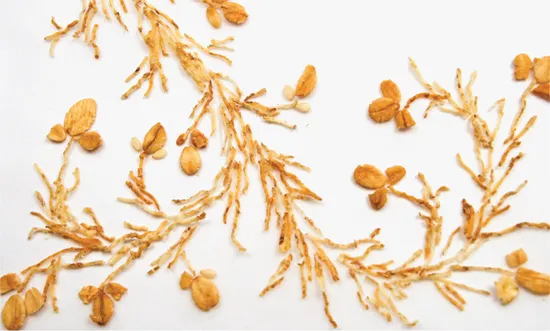
I love cereal. So, I guess I really took the line “play with your food” to heart when I made this piece. I haven’t used it yet. What can I say? I’m a huge cereal fan.
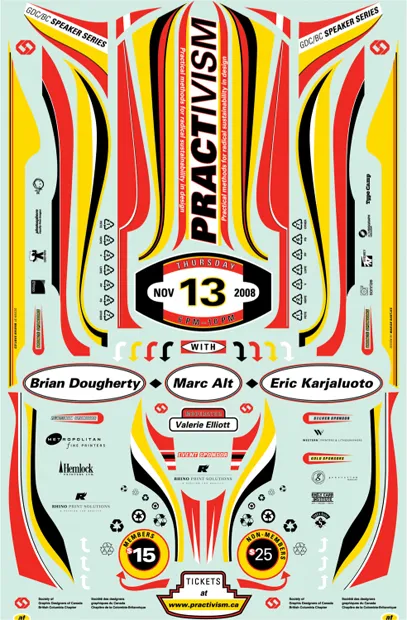
I was in Seattle in a toy store, and on the counter was a box with decal sheets for old model airplanes. I picked up a few and put them in an envelope for later reference. Doing something that referenced the decals was on my ideas list for probably seven years. Last year, the Society of Graphic Designers of Canada needed a poster for a sustainability event. They didn’t want it to be all green and leafy, so I looked at my list and decided it was time to use the decals.
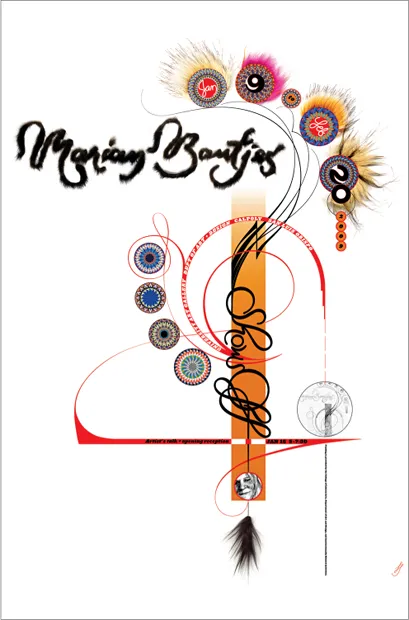
A lot of my ideas come from wanting to work with particular materials. I’m into fur now. It’s showing up in some of my work, like this CalPoly poster I did. The medium can help develop the creative. It kind of speaks to you and inspires you to create what it wants to be.
I’m getting ideas all the time. They come from walking down the street, from watching a movie, from reading. I get a lot of sparks from reading. I’ll be reading an article and I’ll leap up and write something down. I have more ideas than I can execute. I keep a long “ideas” list that I categorize: film, clothing, graphics, and so on. These vary from grand ideas to little graphic things like “make something with sugar.” I used to keep my list of ideas in little notebooks and scraps of paper all over, but now I usually enter them into a text file on my computer. Some of the ideas have been sitting there for years.
When I get a project, I usually have an idea right away or overnight. Sometimes if I’m desperate, I’ll hunt through my list for the idea. But it usually pops into my head from some kind of logical or illogical association.
I guess what I do is have this mental and physical storehouse full of thoughts, words, and materials—and I’m always adding to it. I have more ideas than I’ll be ever able to use.
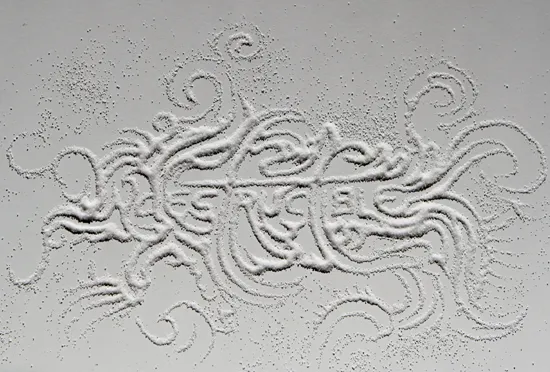
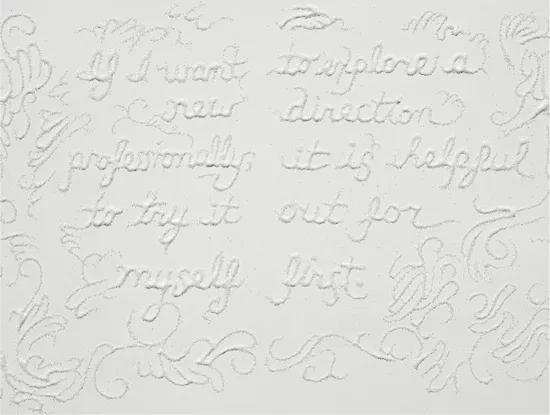
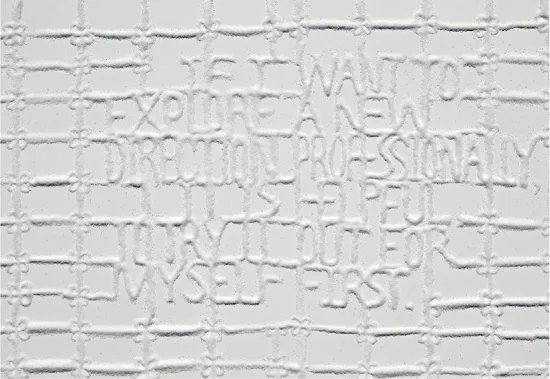
I always liked playing with sugar at the breakfast table when I was a kid. In fact, I still do it. I made a piece called “Indestructible” for Fox River Paper Company. I, of course, destroyed it by bumping into it. Stefan Sagmeister saw “Indestructible” and wanted something like it. That’s when I did “Things I have learned so far in my life.” I did six different versions of the same sentence in sugar. I did it without sketches, just freehand on white paper. I just let the sugar do what it wanted to do.
I spend a lot of time thinking. It’s really helpful for me. I was reading an article about the need for downtime and getting sleep. About how the time spent sitting around and staring at the sky is really important for people who need to be inspired, because they’re always scrambling for ideas. I’m what some would call kind of lazy. I like to just sit and stare at the forest, and that’s when I get some of my best ideas.
My best ideas come from the way I live my life. If I feed my life, it will give me ideas when I need them.
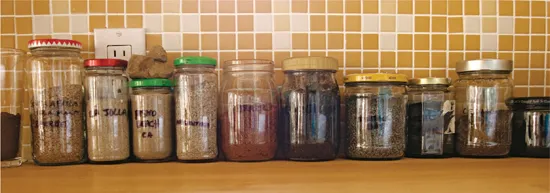
I have a number of materials sitting around waiting to be used. For example, I’m collecting dirt from all over the world: South Africa, Bali, Brazil, California. When the time comes, I’ll be ready to make something with the dirt. I have burgeoning collections of things that I can’t wait to use.
![]()
DO THAT WHICH IS CLOSE TO YOUR HEART. IT’S AN EXPRESSION OF WHAT YOU LOVE IN LIFE, AND OTHERS WILL RECOGNIZE THAT.
There are so many ways to get inspired; to feed yourself. No one is looking through design annuals ripping people off because they’re lazy or mean. It just feels comfortable. Designers, like all humans, want to run with the tribe on some level. You stick with the family by copying the behavior and work of others. You align yourself. You calibrate. You get comfortable and efficient. By looking at annuals, you figure out what you need to do to get into annuals, but if you want to evolve your own work, looking at annuals is a dead end, of course.
I don’t really switch off inspiration anymore. I’ve broken down the barrier between me and what surrounds me. Everything is editable. I crop my environment, looking at everything as a Photoshop source and a retouching opportunity. I take photos when I can, but there are times when I force myself not to take notes or photos, so I have to truly remember. Otherwise, I start remembering the photos and wipe out the memory of the experience in the process.
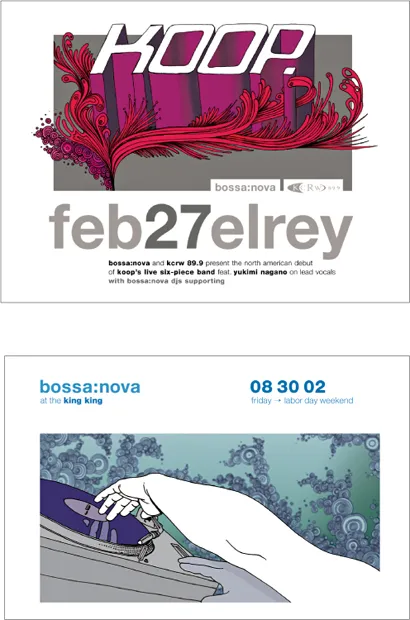
Back in 1999, I started designing and illustrating flyers for bossa:nova, Jason Bentley’s weekly club night here in Los Angeles. My friend Jennifer Stone was in charge of that, and handed me a flyer to one of the shows—Kruder & Dorfmeister. I said, “Could I please redo your fliers, just as kind of a humanitarian type gesture? They can’t stay like this.”
When it comes to pursuing new ideas in my work, I have a factory showroom model theory. No client wants to be the first to buy anything. They all want to be the second—after someone else already worked out the kinks. You have to have at least one produced example to show that it won’t blow up, that you know how to get it done.
Graphic design and illustration are all about taking control of a little piece of the world and making it look exactly as you would want it to be, and the fliers I created for bossa:nova were one of the first times I was really able to do that. I did dozens of them for about five years. Around the same time, I started making the flower posters for New Y...