Painting the Impressionistic Landscape
eBook - ePub

Painting the Impressionistic Landscape

Exploring Light and Color in Watercolor and Acrylic

  1. 144 pages
  2. English
  3. ePUB (mobile friendly)
  4. Available on iOS & Android
eBook - ePub

Painting the Impressionistic Landscape

Exploring Light and Color in Watercolor and Acrylic

About this book

Master the impressionist painting style with Painting the Impressionistic Landscape!

The Impressionist movement that began 130 years ago set artists free to experiment outdoors, capturing the fleeting effects and many moods of sunlight in their paintings by juxtaposing contrasting colors. Although those colors may not actually be apparent in nature, on canvas and paper they appear spontaneous and naturalistic. The skill is in knowing how to select and apply them. Impressionistic painting has not remained static over the decades. Artist Dustan Knight walks you through the techniques to achieving brilliant effects in a contemporary style. Using easy to work with watercolor and acrylic, she demonstrates through her own paintings, as well as others she has selected, the step-by-steps for dramatic atmospheric vistas and intimate garden landscapes.

Frequently asked questions

Yes, you can cancel anytime from the Subscription tab in your account settings on the Perlego website. Your subscription will stay active until the end of your current billing period. Learn how to cancel your subscription.
No, books cannot be downloaded as external files, such as PDFs, for use outside of Perlego. However, you can download books within the Perlego app for offline reading on mobile or tablet. Learn more here.
Perlego offers two plans: Essential and Complete
  • Essential is ideal for learners and professionals who enjoy exploring a wide range of subjects. Access the Essential Library with 800,000+ trusted titles and best-sellers across business, personal growth, and the humanities. Includes unlimited reading time and Standard Read Aloud voice.
  • Complete: Perfect for advanced learners and researchers needing full, unrestricted access. Unlock 1.4M+ books across hundreds of subjects, including academic and specialized titles. The Complete Plan also includes advanced features like Premium Read Aloud and Research Assistant.
Both plans are available with monthly, semester, or annual billing cycles.
We are an online textbook subscription service, where you can get access to an entire online library for less than the price of a single book per month. With over 1 million books across 1000+ topics, we’ve got you covered! Learn more here.
Look out for the read-aloud symbol on your next book to see if you can listen to it. The read-aloud tool reads text aloud for you, highlighting the text as it is being read. You can pause it, speed it up and slow it down. Learn more here.
Yes! You can use the Perlego app on both iOS or Android devices to read anytime, anywhere — even offline. Perfect for commutes or when you’re on the go.
Please note we cannot support devices running on iOS 13 and Android 7 or earlier. Learn more about using the app.
Yes, you can access Painting the Impressionistic Landscape by Dustan Knight in PDF and/or ePUB format, as well as other popular books in Kunst & Kunst Allgemein. We have over one million books available in our catalogue for you to explore.

Information

eBook ISBN
9781631593291
Topic
Kunst

PAINTING FLOWERS FROM THE GARDEN

WHO DOESN’T LOVE FLOWERS? Despite my training in New York City art schools in the 1980s where the emphasis was decidedly not floral, I love to paint flowers. I love their color, their patterns, their structure, their textures, and their design potential. I love their variations of shapes, edge qualities, and their fleeting ever-changingness. It’s reassuring to remind myself that flower painting is one of the great art traditions. The Impressionists share in that tradition.
While some artists consider flowers as unimportant and decorative, the Impressionists celebrated the very nature of flowers. Van Gogh, Monet, Pissarro, and Renoir painted fields of them—poppies, irises, dahlias, and sunflowers—as bright living color, nodding and bending under the sun. They painted orchards in bloom and single flowering sprigs. They brought armloads of flowers indoors, piled them in vases—irises, lilacs, roses, and tulips—and painted portraits of them, over and over again.
The Impressionists didn’t assign symbolic meanings to flowers. They didn’t try to make their paintings scientifically correct. They painted their impressions, capturing the fragility, the color, the crooked stems, and fading leaves of flowers. In doing so, they somehow caught the essence and even the scent of flowers and made them real. The public has never gotten tired of looking at Impressionist flower paintings. For many, in fact, flowers are the first thing that comes to mind when the word “Impressionism” is mentioned.
Image
Dancing Garden. Acrylic. 36" × 36" (91.5 × 91.5 cm).
Image
Floral inspiration in the studio
Image
Nasturtiums from my garden in my favorite yellow pitcher
My inspiration for painting flowers is all around me in the studio, on vintage fabrics, on postcards, on porcelain vases, and old tea cups. But of course my greatest inspiration is my own garden. It makes me glad when I read how Monet was intimately involved in every detail of his garden. I share his passion.
My garden is a lot like my paintings. It’s wild and tangled and creeps stealthily across the bit of what’s left of my lawn. Nasturtiums are a particular favorite because they have such a desire to grow, and their stems are so interesting and unexpected.
As a gardener, I continually edit. I move things if they look unhappy, I pull things out if I don’t like them, and I add a new plant when a friend gives me one or I happen by a garden store. This is exactly the way I paint, always in flux. Always changing.
Every flower has its own character and personality. Some are refined with excellent posture like the iris with its ruffled evening-wear edges. Some, like daisies are casual and exude a feeling of confidence. Nasturtiums are more like teenagers—unpredictable in their size and growth direction. My whimsical interpretations of flowers make painting them more fun. I like the idea of capturing the essence of flowers—what I love about them when I see them blooming. Perhaps it’s their color, or the way they nod in the breeze that attracts me.
Image
Nasturtium Impression. Watercolor. 14" × 10" (35.5 × 25.5 cm).
Image
On the Trellis. Watercolor. 22" × 10" (56 × 25.5 cm).
I think of flowers as falling into three basic shapes: the circle, the cup, and the clump. The circle silhouette can be dynamically shaped with deep cuts and irregular edges like the field daisy and sunflower, or folded in on itself like a rose. The cup silhouette is the tulip, magnolia, and lily, with a smooth bottom and an articulated top edge. The clump is the lilac, the hydrangea, the goldenrod, or ...
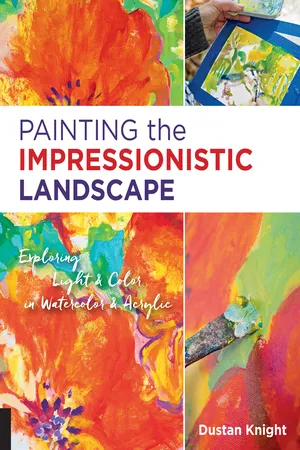
Table of contents

  1. Cover
  2. Title Page
  3. Contents
  4. Introduction
  5. Painting the Woods
  6. Painting Flowers from the Garden
  7. Painting the Rocks and Sea
  8. Conclusion
  9. Resources
  10. Acknowledgments
  11. About the Artist and Photographer
  12. Index
  13. Dedication
  14. Copyright