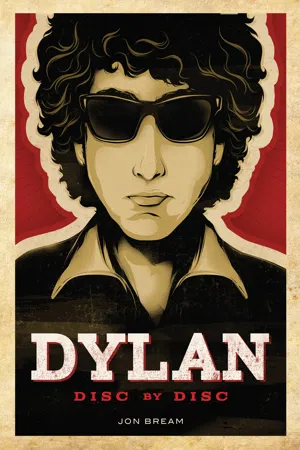
Dylan
eBook - ePub
Available until 23 Apr |Learn more

Dylan

Disc by Disc

  1. 240 pages
  2. English
  3. ePUB (mobile friendly)
  4. Available on iOS & Android
eBook - ePub
Available until 23 Apr |Learn more

Dylan

Disc by Disc

About this book

Dylan: Disc by Disc features each of Bob Dylan's studio LPs--thirty-six releases in all. Rock 'n' roll musicians, songwriters, and critics sound off about each release, bringing from the shadows not only Dylan's extraordinary musical accomplishments but the factors in his life that influenced his musical expressions. From The Freewheelin' Bob Dylan to Blonde on Blonde, from Blood on the Tracks to Shadows in the Night, Dylan: Disc by Disc rouses generations of Dylan fans with a unique, hip, stunning exposition spanning the music legend's storied career.

Few figures in American music have compiled a body of work as impressive as that created by Dylan. Winner of the Presidential Medal of Freedom, the Nobel Prize in Literature, eleven Grammys, and an Oscar, Dylan is one of the most honored musicians of our time. He has arguably done more to shape American music culture than any singer/songwriter. Beginning with his early acoustic folk releases, Dylan showed an early penchant for doing whatever he wanted with his music by electrifying his sound at the Newport Folk Festival in 1965, playing a leading role in the late 1960s protest culture, and playing with the Band. His long career far from over, he moved into his "Christian" period, his struggle for artistic identity in the 1980s, his return to critical success in 1997, and his release of an album of songs Frank Sinatra sang in 2015. The son of an appliance salesman from Hibbing, Minnesota, always accommodated his own muse, critics be damned.

Commentators include Questlove of the Roots and the Tonight Show with Jimmy Fallon, Rodney Crowell, Jason Isbell, Suzanne Vega, Ric Ocasek of the Cars, Wesley Stace (aka John Wesley Harding), longtime Dylan pal Eric Andersen and Minnesota musicians Tony Glover and Kevin Odegard, both of whom have been in the studio with Dylan. Other well-known voices in Dylan: Disc by Disc include Robert Christgau, Anthony DeCurtis, Alan Light, Joe Levy, Holly George-Warren, Joel Selvin, Jim Fusilli, Geoffrey Himes, Charles R. Cross, and David Browne.

Dylan: Disc by Disc is beautifully illustrated with LP art and period photography, as well as performance and candid backstage images. The book contains liner notes-like details about the recordings and session musicians, and provides context and perspective on Dylan's life, concerts, and career.

Dylan: Disc by Disc presents Dylan fans and all lovers of music with a compelling, handsome, one-of-a-kind retrospective of the life and music of an American legend.

Frequently asked questions

Yes, you can cancel anytime from the Subscription tab in your account settings on the Perlego website. Your subscription will stay active until the end of your current billing period. Learn how to cancel your subscription.
At the moment all of our mobile-responsive ePub books are available to download via the app. Most of our PDFs are also available to download and we're working on making the final remaining ones downloadable now. Learn more here.
Perlego offers two plans: Essential and Complete
  • Essential is ideal for learners and professionals who enjoy exploring a wide range of subjects. Access the Essential Library with 800,000+ trusted titles and best-sellers across business, personal growth, and the humanities. Includes unlimited reading time and Standard Read Aloud voice.
  • Complete: Perfect for advanced learners and researchers needing full, unrestricted access. Unlock 1.4M+ books across hundreds of subjects, including academic and specialized titles. The Complete Plan also includes advanced features like Premium Read Aloud and Research Assistant.
Both plans are available with monthly, semester, or annual billing cycles.
We are an online textbook subscription service, where you can get access to an entire online library for less than the price of a single book per month. With over 1 million books across 1000+ topics, we’ve got you covered! Learn more here.
Look out for the read-aloud symbol on your next book to see if you can listen to it. The read-aloud tool reads text aloud for you, highlighting the text as it is being read. You can pause it, speed it up and slow it down. Learn more here.
Yes! You can use the Perlego app on both iOS or Android devices to read anytime, anywhere — even offline. Perfect for commutes or when you’re on the go.
Please note we cannot support devices running on iOS 13 and Android 7 or earlier. Learn more about using the app.
Yes, you can access Dylan by Jon Bream in PDF and/or ePUB format, as well as other popular books in Mezzi di comunicazione e arti performative & Biografie in ambito musicale. We have over one million books available in our catalogue for you to explore.

CHAPTER 1

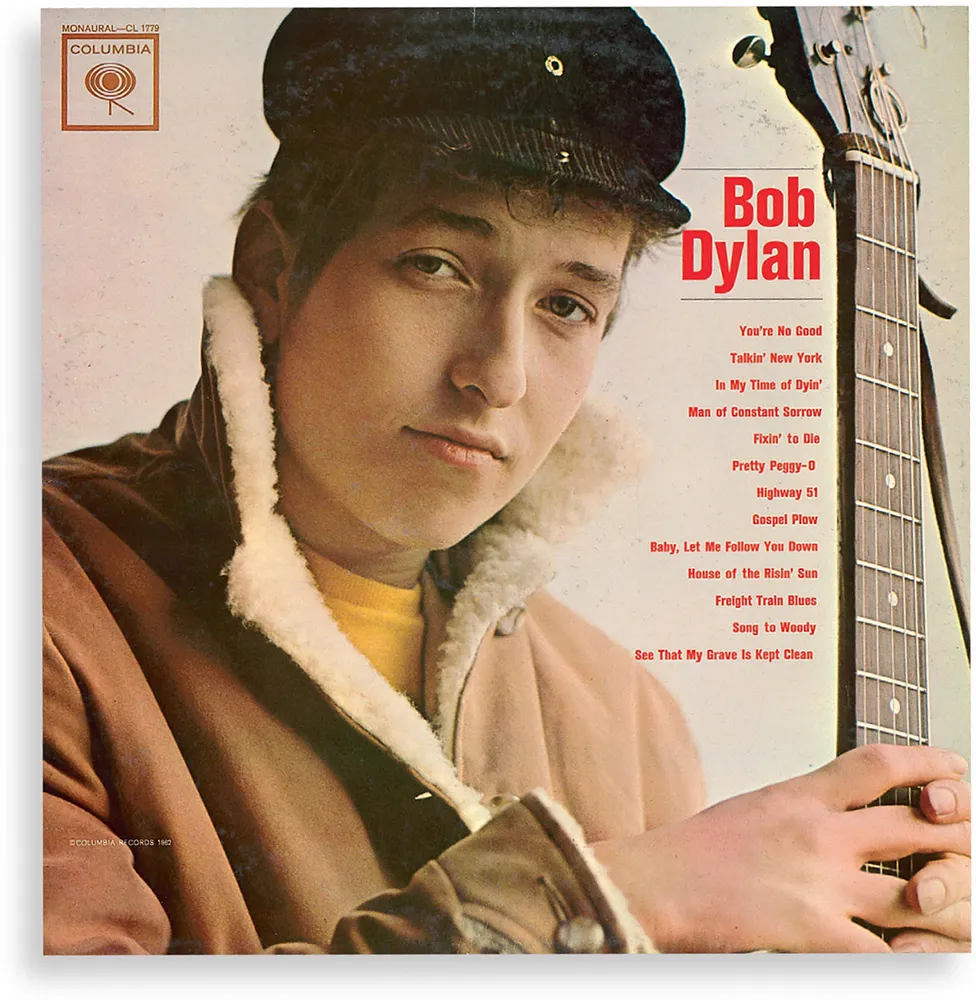
BOB DYLAN

Image
with Dennis McNally and Robert Santelli
1. You’re No Good (Jesse Fuller) 1:37
2. Talkin’ New York (Bob Dylan) 3:15
3. In My Time of Dyin’ (traditional, arranged by Bob Dylan) 2:37
4. Man of Constant Sorrow (traditional, arranged by Bob Dylan) 3:06
5. Fixin’ to Die (Bukka White) 2:17
6. Pretty Peggy-O (traditional, arranged by Bob Dylan) 3:22
7. Highway 51 (Curtis Jones) 2:49
8. Gospel Plow (traditional, arranged by Bob Dylan) 1:44
9. Baby, Let Me Follow You Down (traditional, arranged by Eric von Schmidt) 2:32
10. House of the Risin’ Sun (traditional, arranged by Dave Van Ronk) 5:15
11. Freight Train Blues (John Lair, arranged by Bob Dylan) 2:16
12. Song to Woody (Bob Dylan) 2:39
13. See That My Grave Is Kept Clean (Blind Lemon Jefferson) 2:40
Image
Released March 19, 1962
Producer: John Hammond
Recorded in Columbia Studio A, New York
When Bob Dylan arrived in New York in January 1961, he was an unknown teenager with few career prospects and no particular agenda besides a mission to meet his idol, Woody Guthrie. Little more than a year later, he issued his debut album on one of the biggest record labels in the world, the sessions produced by one of the music industry’s legendary figures. It was a remarkably rapid rise for a youngster who’d only been playing professionally for a year or two and was still known as Bob Zimmerman when he changed his focus from rock ’n’ roll to folk at the end of the 1950s.
Dylan would soon be hailed as the greatest songwriter of the folk movement, but at this point he was still primarily an interpreter rather than a composer. Over the previous couple years, he’d learned a remarkably wide variety of folk songs in an equally impressive range of styles, from blues and traditional ballads to material drawing from gospel, country, and ragtime. The Bob Dylan LP was a showcase of what he’d mastered, all but two of the tracks being interpretations of folk tunes rather than original songs.
Although Dylan had been making inroads into New York’s competitive folk circuit since his arrival in the city, it took a few fortunate breaks to get him into Columbia Records’ Studio A by late November 1961. On September 29, New York Times music critic Robert Shelton gave the still-unsigned singer a rave concert review. That same day, Dylan played harmonica at a Columbia session for fellow folk singer Carolyn Hester. Producing the session was John Hammond, a heavyweight known for his work with jazz greats such as Billie Holiday, Count Basie, and Benny Goodman. An impressed Hammond signed Dylan to Columbia as a solo artist, producing Dylan’s first LP in sessions on November 20 and November 22.
Thirteen tracks couldn’t hope to represent the depth of Dylan’s repertoire, as he was known to have performed more than one hundred traditional folk songs in the early 1960s. Still, the selections gave him the opportunity to display his keening, grainy voice; searing harmonica; and versatile acoustic guitar, combining to stamp such well-traveled standards as “Man of Constant Sorrow” and “House of the Rising Sun” with his own distinct personality. He also fit in two of his own compositions, though these—like much of the album—betrayed his enormous debt to his chief influence, Woody Guthrie.
Despite a Billboard review praising “one of the most interesting and most disciplined youngsters to appear on the pop-folk scene in a long time,” Bob Dylan was a commercial failure, selling just 5,000 copies in its first year of release. Hammond, according to Anthony Scaduto’s Bob Dylan: A Biography, was even told his protĂ©gĂ© would have to be dropped from the label. The producer’s reply: “Over my dead body.” Dylan stayed on Columbia, his next LP marking both his commercial breakthrough and his arrival as a major songwriter.
Dennis McNally, longtime publicist for the Grateful Dead and author of books about the Grateful Dead and On Highway 61: Music, Race, and the Evolution of Cultural Freedom (2014), debates the merits of Bob Dylan with Robert Santelli, CEO of the Grammy Museum and the author of The Bob Dylan Scrapbook 1956–1966 (2005). Author Jon Bream moderates the discussion.
Image
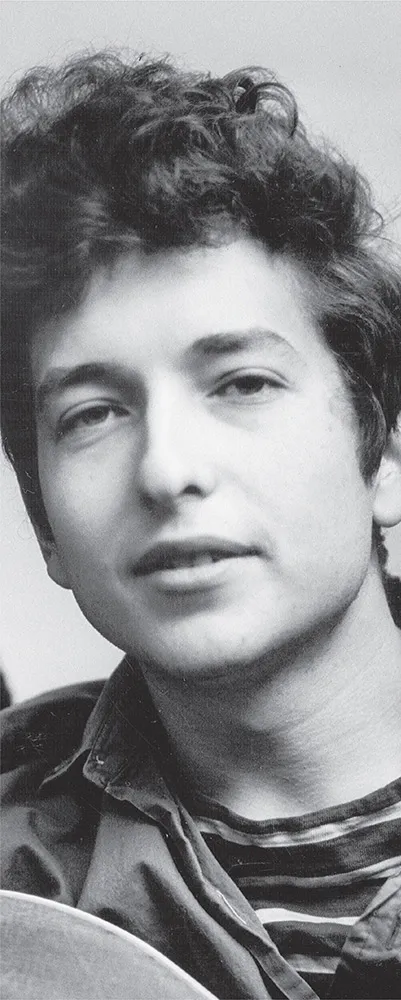
Heavyweight talent scout John Hammond discovered Dylan in September 1961. Michael Ochs Archives/Getty Images
Bream: Not many people heard this album when it was released in 1962. When did you first hear it?
McNally: I was aware of Dylan as early as the March on Washington [in 1963]. I was aware of “Blowin’ in the Wind” and the civil rights stuff. Otherwise, I didn’t know his work seriously until I got to college in the fall of ’67—I was a DJ on the college radio station and we had a rather nice library—and then I became a fan and worked back [through Dylan’s earlier releases].
Santelli: In January of ’64, when I was in seventh grade, a girl who had a crush on me got me that record. I didn’t get into that record [at the time] because two weeks later the Beatles were arriving. After the Beatles, I wanted to play guitar seriously. So that summer of ’64, I went back and listened to this record because of “Song to Woody.” We had learned in fifth grade the [Woody Guthrie] song “This Land Is Your Land.”
Bream: How has your impression of the album changed from the first time you heard it until now?
McNally: Dramatically over the years. In college, you see the first one as kind of a starter album. As I have studied it more recently, the more I listened to it, the more impressed I am. Part of it, you’re listening to a twenty-year-old man. He doesn’t sound at all like a twenty-year-old. The depth of it, the texture of it.
Santelli: It remains one of my favorite Bob Dylan albums. If this record was made by anyone other than Bob Dylan, we’d be calling it a classic now because it is a great interpretation of American roots music done by someone whose voice is fresh and clean and eager. Someone with a brand-new take on some very old songs. However, because it was done by Dylan, who went on to show great brilliance at songwriting, the album has a tendency to be kind of discarded a little bit. The most important thing is we get to see where he was coming from before he comes to New York, what was he listening to, the fact that he knew who Blind Lemon Jefferson was and Jesse Fuller—that tells a lot about it. The authenticity that he captures in the first album—and you can follow his love of the music—it’s done so well. Intimate, intuitive. It’s unfortunate that so many great records will follow it—absolutely monumental masterpieces. I’m not calling this a masterpiece. I’m just calling it a great record.
Bream: How much of this is imitation, and how much is interpretation?
Santelli: He was accused of literally ripping off people. That’s always been part of American folk music. There’s always been “borrowing” going on, whether it is: interpretations, lyrics, phrases, full-on melodies. It’s not negative or stealing. He was strictly following a tradition that was quickly coming to an end in the ’60s but was alive and well in the folk and blues world.
McNally: “House of the Risin’ Sun” was Dave Van Ronk’s arrangement. In general, other people’s arrangements are only starting points for Dylan. One of the interesting things about this album, very little of it was what he was doing on a regular basis [live]. Quite a lot of it, he only did for the record and stopped doing shortly thereafter.
The take-away from the material he chose is (A) a good deal of it is black music, and he resolves the division of American folk music into black and white spectrums by ignoring the divide, and (B) a lot of it is about death, which is not what you expect the average twenty-year-old to be singing about.
Image
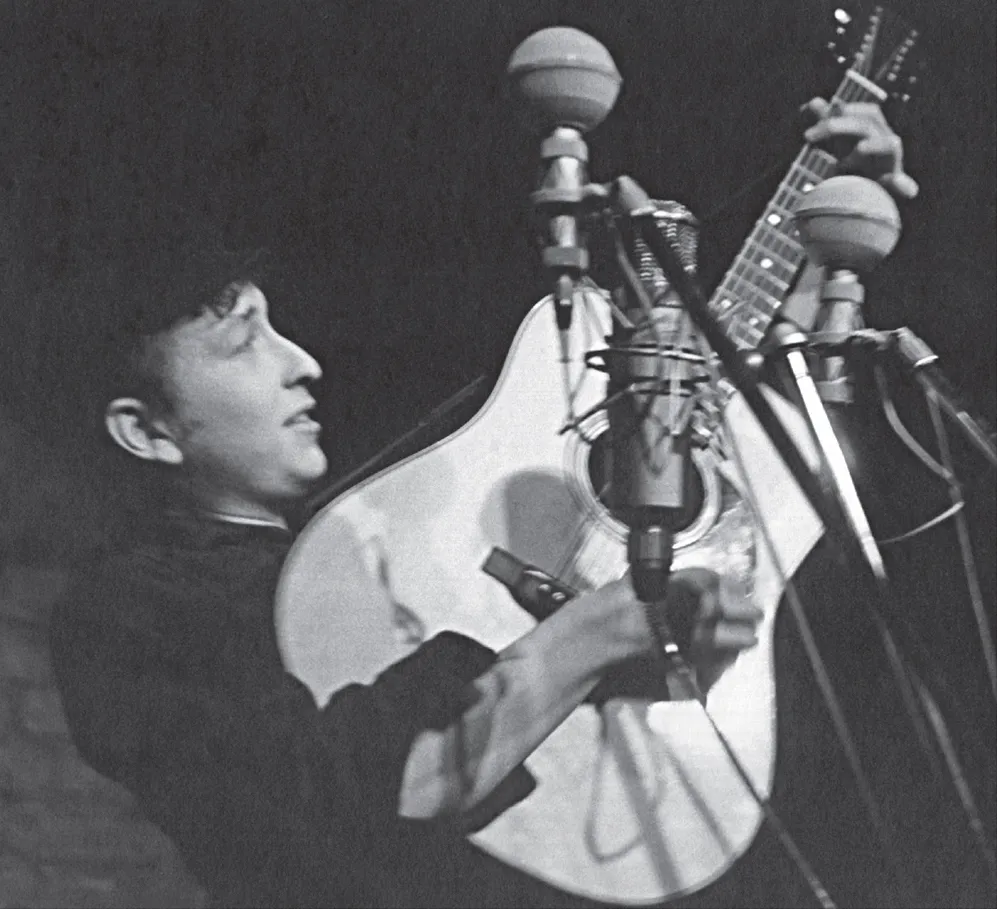
The new kid in town became a regular at the Bitter End folk club in Greenwich Village. Sigmund Goode/Michael Ochs Archive/Getty Images
Bream: Not only songs about death, but some are full of anger. I read a quote from Dylan saying about the first album: “Violent, angry emotions were running through me.”
Santelli: I’ve interviewed Bob a couple of times, and I take what he says with a grain of salt. I don’t know for sure that he was “angry” back then. He had a lot of reason to be happy. I think he was fascinated that these songs could carry such emotional intensity, especially when talking about something so profound as death.
He’s a songster, someone who can carry himself across the American music treasury—play a gospel song, play a blues song, a hillbilly song, a folk song, a traditional song. He does all of that. For being twenty and being up in Minneapolis for a year and a half [where he was introduced to folk and blues], he has a great memory. Before this, he was into Little Richard, Hank Williams, and pop stuff. This album is an indication how good a student he was. His knowledge of the American folk tradition and the ability to interpret in such a way—that is profound, that is the real beauty of this record.
Bream: What sets his singing style apart from other folk singers?
McNally: He sang folk music with a rock ’n’ roll attitude.
 In Chronicles [Dylan’s 2004 memoir], he eloquently describes hearing Robert Johnson for the first time. He had the biggest set of ears for all kinds of music. In Chronicles, he talks about when he first got to New York and went to gospel shows at Madison Square Garden, and he’s listening to Cecil Taylor and all of it. He heard it all, he remembered it all, and he integrated it all. That’s why he’s Dylan.
Santelli: No one at the time in Greenwich Village would have known about Woody Guthrie like Bob did, and no one had the balls to become a Woody Guthrie jukebox—to talk like him, to act like him, to sing like him, to have some of Woody’s idiosyncrasies. He doesn’t learn it from listening to Woody Guthrie records. According to what he told me, he becomes extremely fascinated with Woody Guthrie because of his lifestyle and his life because of reading Bound for Glory [1943]. I’ve seen Bob’s copy of Bound for Glory with notes in it. He read it like it was a textbook.
Image
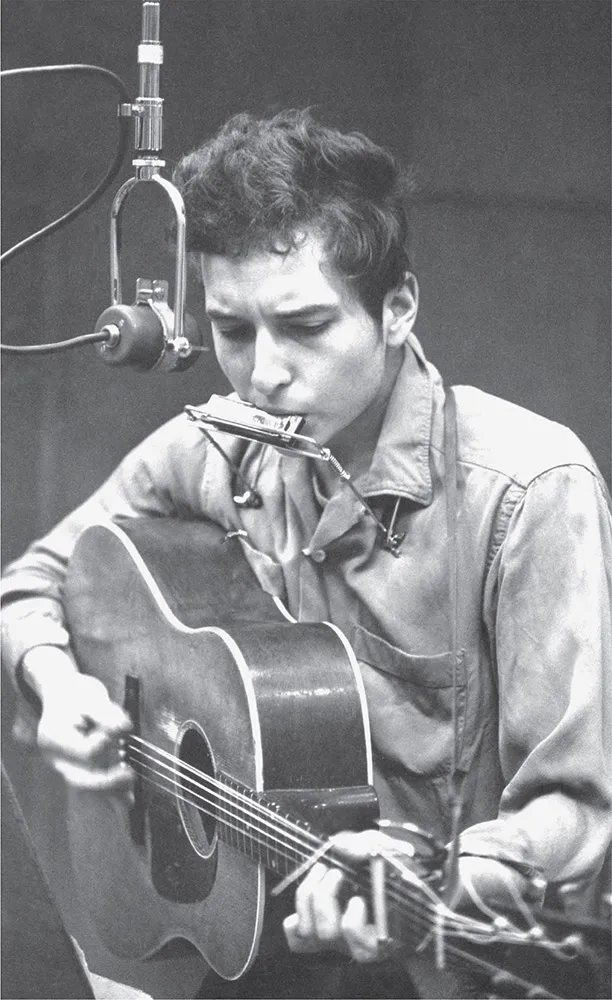
Dylan proved to be a serious student of folk and blues music during his first recording session in November 1961. Michael Ochs Archives/Getty Images
Bream: What do you think the two originals say about Dylan the songwriter?
Santelli: That he loved Woody Guthrie. Woody was a master of the talking blues. And the irony, the wordplay, the whole vibe of “Talkin’ New York” is Woody Guthrie.
McNally: Two things come out from ...

Table of contents

  1. Cover
  2. Title Page
  3. With Commentary By
  4. Contents
  5. Acknowledgments
  6. Introduction
  7. Chapter 1 Bob Dylan with Dennis Mcnally and Robert Santelli
  8. Chapter 2 The Freewheelin’ Bob Dylan with Anthony Decurtis and Suzanne Vega
  9. Chapter 3 The Times They are A-changin’ with Lin Brehmer and Jonatha Brooke
  10. Chapter 4 Another Side of Bob Dylan with Ric Ocasek and Ike Reilly
  11. Chapter 5 Bringing It All Back Home with Rodney Crowell and Anthony Decurtis
  12. Chapter 6 Highway 61 Revisited with Tony Glover and Joe Henry
  13. Chapter 7 Blonde on Blonde with Geoffrey Himes and Jason Isbell
  14. Chapter 8 John Wesley Harding with Geoffrey Green and Joe Levy
  15. Chapter 9 Nashville Skyline with Marshall Chapman and Holly George-warren
  16. Chapter 10 Self Portrait with Geoffrey Green and Kim Ruehl
  17. Chapter 11 New Morning with Robert Christgau and Colleen Sheehy
  18. Chapter 12 Pat Garrett & Billy the Kid with David Browne and Evelyn Mcdonnell
  19. Chapter 13 Dylan with Daniel Durchholz and George Varga
  20. Chapter 14 Planet Waves with Jim Beviglia and Joe Levy
  21. Chapter 15 Blood on the Tracks with Kevin Odegard and David Yaffe
  22. Chapter 16 The Basement Tapes with Charles R. Cross and Joe Henry
  23. Chapter 17 Desire with Nicole Atkins and Dan Wilson
  24. Chapter 18 Street-legal with Janet Gezari and Alan Light
  25. Chapter 19 Slow Train Coming with Kevin J. H. Dettmar and Paul Zollo
  26. Chapter 20 Saved with Wesley Stace and Ahmir “Questlove” Thompson
  27. Chapter 21 Shot of Love with Daniel Durchholz and Don Mcleese
  28. Chapter 22 Infidels with William Mckeen and Paul Zollo
  29. Chapter 23 Empire Burlesque with Alex Lubet and Don Mcleese
  30. Chapter 24 Knocked out Loaded with Gary Graff and Joel Selvin
  31. Chapter 25 Down in the Groove with Stephen Thomas Erlewine and Alan Light
  32. Chapter 26 Oh Mercy with Eric Andersen and Tom Moon
  33. Chapter 27 Under the Red Sky with Gary Graff and Paul Metsa
  34. Chapter 28 Good as I Been to You with Ron Loftus and George Varga
  35. Chapter 29 World Gone Wrong with Jim Fusilli and William Mckeen
  36. Chapter 30 Time out of Mind with Garland Jeffreys and David Yaffe
  37. Chapter 31 “Love and Theft” with John Schaefer and Wesley Stace
  38. Chapter 32 Modern times with Peter Jesperson and Bill Shapiro
  39. Chapter 33 Together Through Life with Kevin Barents and Alex Lubet
  40. Chapter 34 Christmas in the Heart with Stephen Thomas Erlewine and David Hinckley
  41. Chapter 35 Tempest with Frances Downing Hunter and Kevin Odegard
  42. Chapter 36 Shadows in the Night with Tom Moon and John Schaefer
  43. Appendix 1 Notable Bob Dylan Releases in Addition to His Studio Albums
  44. Appendix 2 About the Commentators
  45. Appendix 3 Commentators Rank the Albums
  46. Index
  47. About the Author
  48. Copyright