![]()
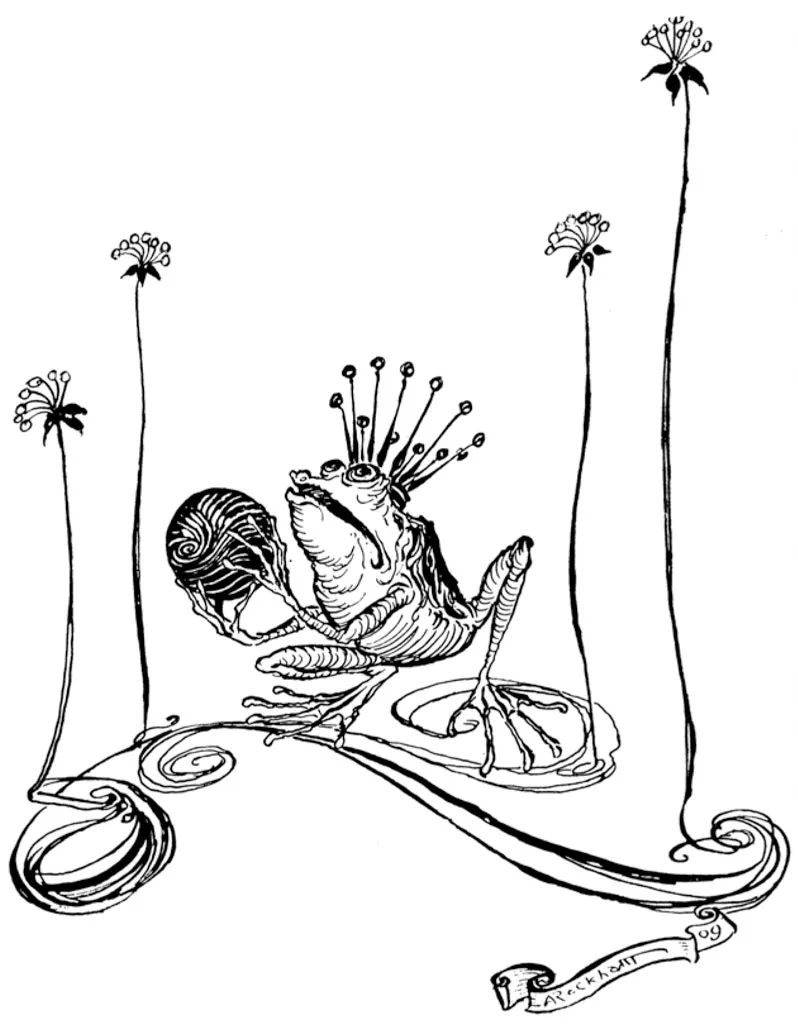
1. THE FROG-KING, OR IRON HENRY
In old times when wishing still helped one, there lived a king whose daughters were all beautiful, but the youngest was so beautiful that the sun itself, which has seen so
much, was astonished whenever it shone in her face. Close by the King’s castle lay a great dark forest, and under an old lime-tree in the forest was a well, and when the day was very warm,
the King’s child went out into the forest and sat down by the side of the cool fountain, and when she was dull she took a golden ball, and threw it up on high and caught it, and this ball was
her favourite plaything.
Now it so happened that on one occasion the princess’s golden ball did not fall into the little hand which she was holding up for it, but on to the ground beyond, and
rolled straight into the water. The King’s daughter followed it with her eyes, but it vanished, and the well was deep, so deep that the bottom could not be seen. On this she began to cry, and
cried louder and louder, and could not be comforted. And as she thus lamented, some one said to her, “What ails thee, King’s daughter? Thou weepest so that even a stone would show
pity.” She looked round to the side from whence the voice came, and saw a frog stretching forth its thick, ugly head from the water. “Ah! old water-splasher, is it thou?” said
she; “I am weeping for my golden ball, which has fallen into the well.”
“Be quiet, and do not weep,” answered the frog, “I can help thee, but what wilt thou give me if I bring thy plaything up again?” “Whatever thou wilt have, dear
frog,” said she—“my clothes, my pearls and jewels, and even the golden crown which I am wearing.”
The frog answered, “I do not care for thy clothes, thy pearls and jewels, or thy golden crown, but if thou wilt love me and let me be thy companion and play-fellow, and sit by thee at thy
little table, and eat off thy little golden plate, and drink out of thy little cup, and sleep in thy little bed—if thou wilt promise me this I will go down below, and bring thee thy golden
ball up again.”
“Oh, yes,” said she, “I promise thee all thou wishest, if thou wilt but bring me my ball back again.” She, however, thought, “How the silly frog does talk! He lives
in the water with the other frogs and croaks, and can be no companion to any human being!”
But the frog when he had received this promise, put his head into the water and sank down, and in a short time came swimming up again with the ball in his mouth, and threw it on the grass. The
King’s daughter was delighted to see her pretty plaything once more, and picked it up, and ran away with it. “Wait, wait,” said the frog, “Take me with thee. I can’t
run as thou canst.” But what did it avail him to scream his croak, croak, after her, as loudly as he could? She did not listen to it, but ran home and soon forgot the poor
frog, who was forced to go back into his well again.
The next day when she had seated herself at table with the King and all the courtiers, and was eating from her little golden plate, something came creeping splish splash, splish splash, up the
marble staircase, and when it had got to the top, it knocked at the door and cried, “Princess, youngest princess, open the door for me.” She ran to see who was outside, but when she
opened the door, there sat the frog in front of it. Then she slammed the door to, in great haste, sat down to dinner again, and was quite frightened. The King saw plainly that her heart was beating
violently, and said, “My child, what art thou so afraid of? Is there perchance a giant outside who wants to carry thee away?” “Ah, no,” replied she, “it is no giant,
but a disgusting frog.”
“What does the frog want with thee?” “Ah, dear father, yesterday when I was in the forest sitting by the well, playing, my golden ball fell into the water. And because I cried
so the frog brought it out again for me, and because he insisted so on it, I promised him he should be my companion, but I never thought he would be able to come out of his water! And now he is
outside there, and wants to come in to me.”
In the meantime it knocked a second time, and cried,
“Princess! youngest princess!
Open the door for me!
Dost thou not know what thou saidst to me
Yesterday by the cool waters of the fountain?
Princess, youngest princess!
Open the door for me!”
Then said the King, “That which thou hast promised must thou perform. Go and let him in.” She went and opened the door, and the frog hopped in and followed her, step by step, to her
chair. There he sat still and cried, “Lift me up beside thee.” She delayed, until at last the King commanded her to do it. When the frog was once on the chair he
wanted to be on the table, and when he was on the table he said, “Now, push thy little golden plate nearer to me that we may eat together.” She did this, but it was easy to see that she
did not do it willingly. The frog enjoyed what he ate, but almost every mouthful she took choked her. At length he said, “I have eaten and am satisfied; now I am tired, carry me into thy
little room and make thy little silken bed ready, and we will both lie down and go to sleep.”
The King’s daughter began to cry, for she was afraid of the cold frog which she did not like to touch, and which was now to sleep in her pretty, clean little bed. But the King grew angry
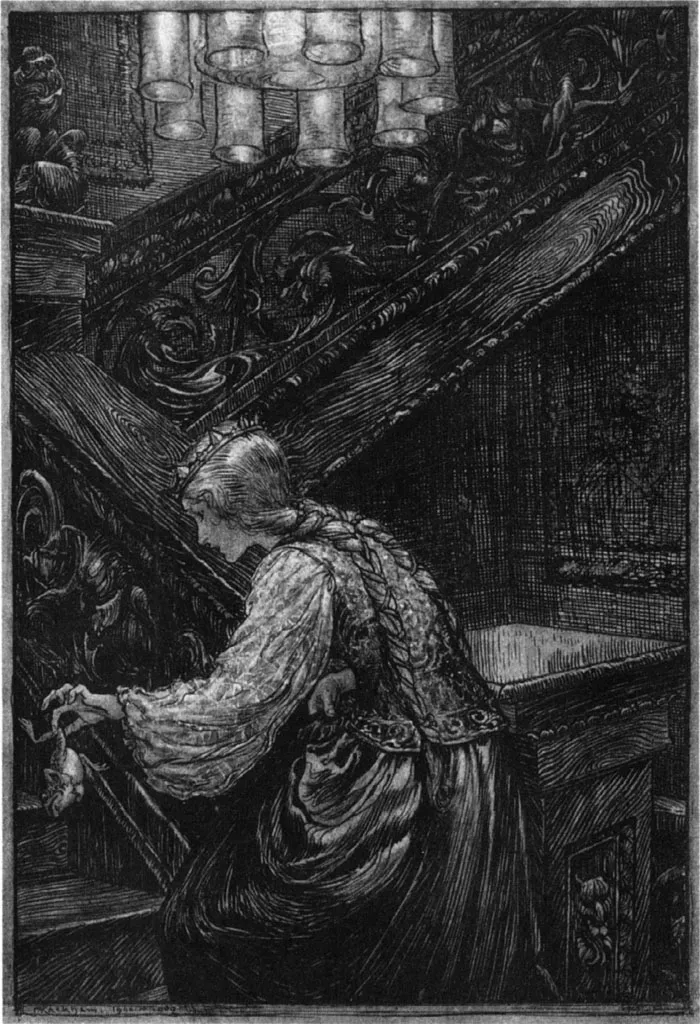
and said, “He who helped thee when thou wert in trouble ought not afterwards to be despised by thee.” So she took hold of the frog with two fingers, carried him upstairs, and put him in
a corner. But when she was in bed he crept to her and said, “I am tired, I want to sleep as well as thou, lift me up or I will tell thy father.” Then she was terribly angry, and took
him up and threw him with all her might against the wall. “Now, thou wilt be quiet, odious frog,” said she. But when he fell down he was no frog but a king’s son with beautiful
kind eyes. He by her father’s will was now her dear companion and husband. Then he told her how he had been bewitched by a wicked witch, and how no one could have delivered him from the well
but herself, and that tomorrow they would go together into his kingdom. Then they went to sleep, and next morning when the sun awoke them, a carriage came driving up with eight white horses, which
had white ostrich feathers on their heads, and were harnessed with golden chains, and behind stood the young King’s servant, faithful Henry. Faithful Henry had been so unhappy when his master
was changed into a frog, that he had caused three iron bands to be laid round his heart, lest it should burst with grief and sadness. The carriage was to conduct the young King into his kingdom.
Faithful Henry helped them both in, and placed himself behind again, and was full of joy because of this deliverance. And when they had driven a part of the way, the King’s son heard a
cracking behind him as if something had broken. So he turned round and cried, “Henry, the carriage is breaking.”
“No, master, it is not the carriage. It is a band from my heart, which was put there in my great pain when you were a frog and imprisoned in the well.” Again and
once again while they were on their way something cracked, and each time the King’s son thought the carriage was breaking; but it was only the bands which were springing from the heart of
faithful Henry because his master was set free and was happy.
![]()
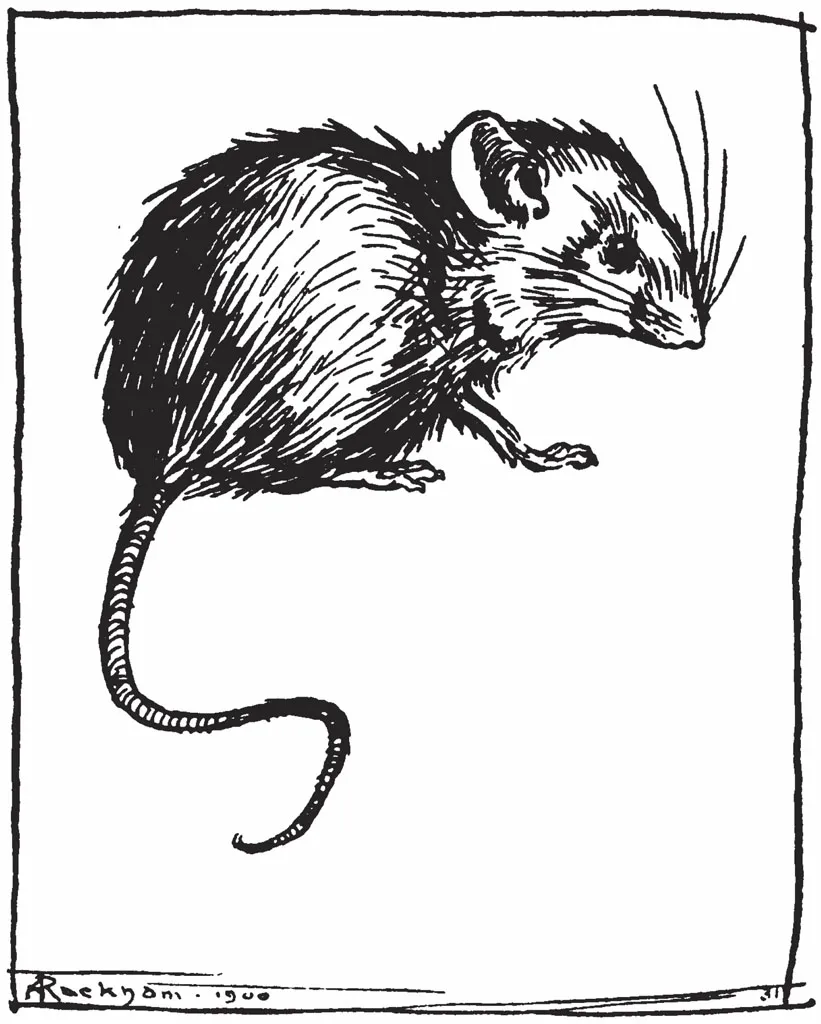
2. CAT AND MOUSE IN PARTNERSHIP
A certain cat had made the acquaintance of a mouse, and had said so much to her about the great love and friendship she felt for her, that at length the mouse agreed that they
should live and keep house together. “But we must make a provision for winter, or else we shall suffer from hunger,” said the cat, “and you, little mouse, cannot venture
everywhere, or you will be caught in a trap some day.” The good advice was followed, and a pot of fat was bought, but they did not know where to put it. At length, after much consideration,
the cat said, “I know no place where it will be better stored up than in the church, for no one dares take anything away from there. We will set it beneath the altar, and not touch it until
we are really in need of it.” So the pot was placed in safety, but it was not long before the cat had a great longing for it, and said to the mouse, “I want to tell you something,
little mouse; my cousin has brought a little son into the world, and has asked me to be godmother; he is white with brown spots, and I am to hold him at the christening. Let me go out today, and
you look after the house by yourself.” “Yes, yes,” answered the mouse, “by all means go, and if you get anything very good, think of me, I should like a drop of sweet red
christening wine too.” All this, however, was untrue; the cat had no cousin, and had not been asked to be godmother. She went straight to the church, stole to the pot of fat, began to lick at
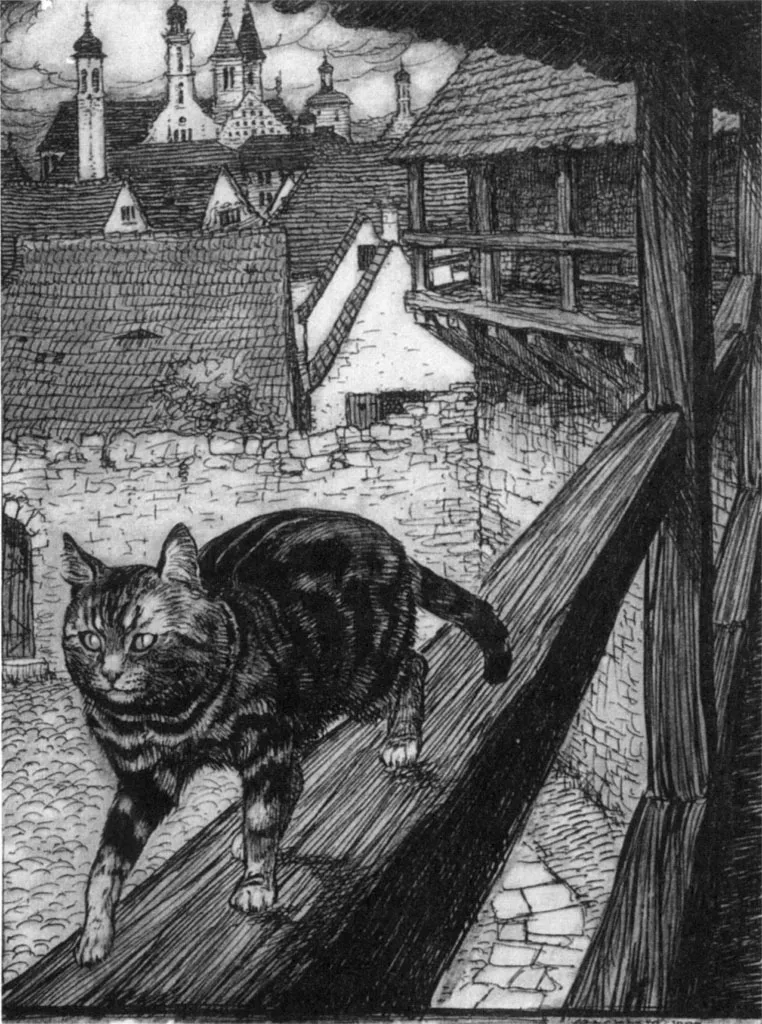
it, and licked the top of the fat off. Then she took a walk upon the roofs of the town, looked out for opportunities, and then stretched herself in the sun, and licked her lips
whenever she thought of the pot of fat, and not until it was evening did she return home. “Well, here you are again,” said the mouse, “no doubt you have had a merry day.”
“All went off well,” answered the cat. “What name did they give the child?” “Top off!” said the cat quite coolly. “Top off!” cried the mouse,
“that is a very odd and uncommon name, is it a usual one in your family?” “What does it signify,” said the cat, “it is not worse than Crumb-stealer, as your
god-children are called.”
Before long the cat was seized by another fit of longing. She said to the mouse, “You must do me a favour, and once more manage the house for a day alone. I am again asked to be godmother,
and, as the child has a white ring round its neck, I cannot refuse.” The good mouse consented, but the cat crept behind the town walls to the church, and devoured half the pot of fat.
“Nothing ever seems so good as what one keeps to oneself,” said she, and was quite satisfied with her day’s work. When she went home the mouse inquired, “And what was this
child christened?” “Half-done,” answered the cat. “Half done! What are you saying? I never heard the name in my life, I’ll wager anything it is not in the
calendar!”
The cat’s mouth soon began to water for some more licking. “All good things go in threes,” said she, “I am asked to stand godmother again. The child is quite black, only
it has white paws, but with that exception, it has not a single white hair on its whole body; this only happens once every few years, you will let me go, won’t you?” “Top-off!
Half-done!” answered the mouse, “they are such odd names, they make me very thoughtful.” “You sit at home,” said the cat, “in your dark-grey fur coat and long
tail, and are filled with fancies, that’s because you do not go out in the daytime.” During the cat’s absence the mouse cleaned the house, and put it in order, but the greedy cat
entirely emptied the pot of fat. “When everything is eaten up one has some peace,” said she to herself, and well filled and fat she did not return home till night. The mouse at once
asked what name had been given to the third child. “It will not please you more than the others,” said the cat. “He is called All-gone.”
“All-gone,” cried the mouse, “that is the most suspicious name of all! I have never seen it in print. All-gone; what can that mean?” and she shook her head, curled herself
up, and lay down to sleep.
From this time forth no one invited the cat to be godmother, but when the winter had come and there was no longer anything to be found outside, the mouse thought of their provision, and said,
“Come, cat, we will go to our pot of fat which we have stored up for ourselves—we shall enjoy that.” “Yes,” answered the cat, “you will enjoy it as much as you
would enjoy sticking that dainty tongue of yours out of the window.” They set out on their way, but when they arrived, the pot of fat certainly was still in its place, but it was empty.
“Alas!” said the mouse, “now I see what has happened, now it comes to light! You a true friend! You have devoured all when you were standing godmother. First top off, then half
done, then—” “Will you hold your tongue,” cried the cat, “one word more, and I will eat you too.” “All gone” was already on the poor mouse’s
lips; scarcely had she spoken it before the cat sprang on her, seized her, and swallowed her down. Verily, that is the way of the world.
![]()
3. THE STORY OF THE YOUTH WHO WENT FORTH TO LEARN WHAT FEAR WAS
A certain father had two sons, the elder of whom was sharp and sensible, and could do everything, but the younger was stupid and could neither learn nor understand anything, and when people saw him they said, “There’s a fellow who will give his father some trouble!” When anything had to be done, it was always the elder who was forced to do it; but if his father bade him fetch anything when it was late, or in the night-time, and the way led through the churchyard, or any other dismal place, he answered, “Oh, no, father, I’ll not go there, it makes me shudder!” for he was afraid. Or when stories were told by the fire at night which made the flesh creep, the listeners often said, “Oh, it makes us shudder!” The younger sat in a corner and listened with the rest of them, and could not imagine what they could mean. “They are always saying, ‘It makes me shudder, it makes me shudder!’ It does not make me shudder,” thought he. “That, too, must be an art of which I understand nothing!”
Now it came to pass that his father said to him one day, “Hearken to me, thou fellow in the corner there, thou art growing tall and strong, and thou too must learn something by which thou canst earn thy living. Look how thy brother works, but thou dost not even earn thy salt.” “Well, father,” he replied, “I am quite willing to learn something—indeed, if it could but be managed, I should like to learn how to shudder. I don’t understand that at all yet.” The elder brother smiled when he heard that, and thought to himself, “Good God, what a blockhead that brother of mine is! He will never be good for anything as long as he lives! He who wants to be a sickle must bend himself betimes.”
The father sighed, and answered him, “Thou shalt soon learn what it is to shudder, but thou wilt ...