eBook - ePub
Available until 21 Apr |Learn more
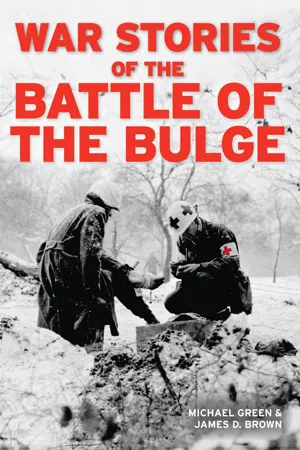
War Stories of the Battle of the Bulge
This book is available to read until 21st April, 2026
- 320 pages
- English
- ePUB (mobile friendly)
- Available on iOS & Android
eBook - ePub
Available until 21 Apr |Learn more
War Stories of the Battle of the Bulge
About this book
The powerful German counteroffensive operation codenamed "Wacht am Rhein" (Watch on the Rhine) launched against the American First Army in the early morning hours of December 16, 1944, would result in the greatest single extended land battle of World War II. To most Americans, the fierce series of battles fought in the Ardennes Forest of Belgium and Luxembourg that winter is better known as the Battle of the Bulge. Here are the first-person stories of the American soldiers who repelled the powerful German onslaught that had threatened to turn the tide of battle in Western Europe during World War II.
Frequently asked questions
Yes, you can cancel anytime from the Subscription tab in your account settings on the Perlego website. Your subscription will stay active until the end of your current billing period. Learn how to cancel your subscription.
At the moment all of our mobile-responsive ePub books are available to download via the app. Most of our PDFs are also available to download and we're working on making the final remaining ones downloadable now. Learn more here.
Perlego offers two plans: Essential and Complete
- Essential is ideal for learners and professionals who enjoy exploring a wide range of subjects. Access the Essential Library with 800,000+ trusted titles and best-sellers across business, personal growth, and the humanities. Includes unlimited reading time and Standard Read Aloud voice.
- Complete: Perfect for advanced learners and researchers needing full, unrestricted access. Unlock 1.4M+ books across hundreds of subjects, including academic and specialized titles. The Complete Plan also includes advanced features like Premium Read Aloud and Research Assistant.
We are an online textbook subscription service, where you can get access to an entire online library for less than the price of a single book per month. With over 1 million books across 1000+ topics, we’ve got you covered! Learn more here.
Look out for the read-aloud symbol on your next book to see if you can listen to it. The read-aloud tool reads text aloud for you, highlighting the text as it is being read. You can pause it, speed it up and slow it down. Learn more here.
Yes! You can use the Perlego app on both iOS or Android devices to read anytime, anywhere — even offline. Perfect for commutes or when you’re on the go.
Please note we cannot support devices running on iOS 13 and Android 7 or earlier. Learn more about using the app.
Please note we cannot support devices running on iOS 13 and Android 7 or earlier. Learn more about using the app.
Yes, you can access War Stories of the Battle of the Bulge by Michael Green,James Brown in PDF and/or ePUB format, as well as other popular books in History & Military & Maritime History. We have over one million books available in our catalogue for you to explore.
Information
1 THE GERMANS ATTACK
Edward A. Connors
B Battery, 108th Field Artillery Battalion, 28th
Infantry Division
The 28th Infantry Division had noticed increased enemy vehicle activity on the nights before the German attack in the Ardennes, but had discounted it as normal frontline relief activity. American soldier Edward Connors almost had a chance to see the German attack preparations.
IN DECEMBER 1944, THE 28TH INFANTRY DIVISION was in a rest area stretching from Wiltz, Luxembourg, to Eupen, Belgium, a distance of twenty-five miles. We had suffered heavy losses in the Hürtgen Forest on October 26 and 27 after having relieved the 9th and 47th Infantry Divisions, and we were in this rest area awaiting the replacements that would bring us up to battle strength.
I was a machine gunner positioned in front of the 155mm howitzers. The weather was bitterly cold, and we were constantly looking through binoculars for any type of movement. The first sergeant sent for me one day and said, “I’m sending you to guard the airstrip at Wiltz. There will be other gunners there, too.” He told me that I would stand guard duty only at night and that during the day I would be on my own. This assignment was to be for just one week. One gunner from each of the other batteries was to go with me. I told the sergeant that I didn’t like leaving the battery, but he said it was only for a week, it would be a nice break, and besides, he said, it was an order.
The next morning I was on my way to Wiltz with four other GIs. The airstrip was on a plateau halfway up a large hill. Wiltz was down in the valley below, and over the hill was a no man’s land, thick with trees. The machine guns were set up on raised tripods so that you had to stand up in order to fire them. This, I thought, is not a good situation, no gunners during the day, only at night, and no protection, not even a foxhole. When I questioned this, I was told, “This is a rest area, no action here.”
The fog was too thick for any of the planes to use the strip, but one of the pilots offered to give anyone a plane ride if the fog lifted before we moved out. The fog cleared in the afternoon of December 15, our last day there, so one other guy and I got our airplane ride. The other fellow went first and came back in a short time because he got airsick. The pilot wanted to know if I’d get sick too, and I told him, “No I wouldn’t.” I didn’t know for sure, but I really wanted that plane ride.
The pilot showed me where to place my feet so that they wouldn’t interfere with the control cables and told me I could remove my helmet and set it on my knees just in case I got sick. Well, we taxied down to the end of the uneven field, turned around, gunned the engine, and took off down the airstrip—and quickly we were in the air. What a thrill. We turned to the right and flew over the town of Wiltz. I could see the GIs below me grow smaller—what a different world it was from up in the sky. I was doing okay, so the pilot asked if I’d like to fly over the so-called front lines. At the moment, my mother’s image flashed before me, and as much as I wanted to fly over the lines, I said “No thanks, my mother would kill me if I got shot down.” He laughed, and we circled around Wiltz a few more times. I really enjoyed that plane ride.
Well, the next morning, December 16, we left to return to our outfits. Halfway back to the outfit we ran into heavy shell fire, but what happened on our way back is another story. We later learned that a half-hour after leaving the air strip at Wiltz, the Germans came over the hill area where we had been; it was the beginning of the Battle of the Bulge. We also found out that three of the four aircraft made it out safely. Sadly, though, the 28th Infantry Division Headquarters personnel stationed in Wiltz suffered heavy losses.
To this day I regret the decision I made not to fly over the front lines that day, for surely we would have seen the Germans preparing to attack the next day and maybe, just maybe, we could have made a difference.
—The Bulge Bugle, February 2001
Harry F. Martin Jr.
L Company, 424th Infantry Regiment, 106th
Infantry Division
The 106th Infantry Division had noticed a great deal of movement opposite its frontline positions in the days before the German Ardennes Offensive but was so green to combat it didn’t know what threat it might indicate. Soldiers like Henry “Harry” F. Martin Jr. would pay the price for that inexperience.
THE MORNING OF DECEMBER 16, ONE OF OUR LEADERS came charging into our cabin just before dawn, screaming, “The Germans are coming! The Germans are coming! We’ll all be killed!” Those exact words are etched in my brain for the rest of my life. Thoughts raced through my head: This had been a quiet sector for almost three months. We had only been here for five days, so why are the Germans attacking us? We grabbed our rifles and steel helmets without wasting a second and got out of the cabin as fast as we could. Bill and I were assigned to the open foxhole on the extreme left flank. The rest of the platoon went to the log bunkers directly in front of them.
As soon as we got into our foxhole, Bill announced that he was going to use a rifle grenade. He sat down in the foxhole and affixed the grenade to his rifle. Seconds later I could see hundreds of shadowy heads bobbing up and down, coming over the crest of the hill just before dawn. They acted like they were drunk or on drugs. They came over the hill screaming and shrieking. Their shrill screams went right through my head. I was absolutely terrified. They had already outflanked our company, and now they were coming to finish us off.
Being on the extreme left flank with nothing on our left and out of sight of our platoon on the right, it felt almost like we were against the entire German army. I was horror-stricken. There was no thought of running away or surrendering; the thought never entered my mind. I had an absolute conviction to fight to the death while being certain that we would be killed. Just about this time, Bill tugged on my leg. I was vaguely aware that Bill had asked me to let him know when the Germans were close enough. Neither one of us had ever fired a rifle grenade before. We did not have the slightest idea of the effective range. There were so many of them storming down the hill coming right for us. There was no way of stopping all of them. I had a feeling of utter hopelessness of surviving the attack. I was panic-stricken. I felt that my entire life force had left my body.
I was already dead and I was fighting like a zombie. Sheer panic set in, causing me to fire my rifle without thinking or aiming. I was unaware of my body, just terror, firing my rifle as fast as my finger could pull the trigger. But they still kept coming as though they were immune to death. Apparently I was not hitting a thing. I was so transfixed with fear and terror, my eyes did not focus on the individual enemy attacking. I was firing blindly as fast as I could without thinking or looking through the sights of my rifle. All hope of living was gone. Bill tugged on my leg again and yelled, “Are they close enough?” I can remember telling him no, but my brain did not register distance or range. I could not even think about what Bill was saying. He tugged on my leg a half dozen times during the battle, and I kept telling him no. In my terror-stricken seizure I continued to fire my rifle frantically in the general direction of the swarming sea of terror. I could only see the huge mass of bodies charging toward me. It appeared as though the entire hillside was alive and moving in with its huge tentacles reaching out to devour me.
Some of the Germans went to their right and stormed the company command posts. I was vaguely aware of hearing hand grenades exploding inside the CP (command post). They killed our company commander. But with the Germans charging closer and closer, still screaming, and bullets zipping by my head, any thoughts of regret for Captain Bartel did not register, and we all would soon be dead anyway.
In the middle of this terrifying battle I heard a very confident calm voice inside my head say, “squeeze the trigger.” I instantly calmed down, took careful aim at one of the charging Germans through my gun sight, and squeezed the trigger. He flung his arms up over his head and fell down dead, shot through the head. I felt a sensation surge through my whole body. I was no longer a zombie. My life force had come surging back. I was alive, and for the first time I felt that I had a chance to come out of this battle.
At this very moment I was a veteran combat soldier. I continued to shoot the attacking Germans until they finally stopped coming. The battle was over. After such intense fighting it was very strange how suddenly the battle ended, how quiet everything had become. I had a feeling of disbelief that it was over, but at the same time it seemed like it would never end.
Later I thought about the voice that I heard in my head and told me to squeeze the trigger. I had failed to qualify with the rifle in basic training. I had to go back and do everything by the numbers without live ammunition again. For the next five weeks after supper and on Sundays the practice continued. Over and over they drummed the procedure by the numbers into my head, always ending with, “Squeeze the trigger, do not jerk the trigger, slowly squeeze the trigger, sque-e-e-ze the trigger.” After a while at night I dreamt about squeezing the trigger. We made fun of doing things by the numbers, but it saved my life.
The battle was over. I had conquered my worst fears and I had stood to fight the enemy. The battle had started just before dawn. I have no idea what time it was over. It had seemed like an eternity, but now it was over. What a great feeling it was to have survived our first battle. I had just started to relax a little when suddenly I came to the full realization of what had happened when the Germans threw the grenades into our company command post. Captain Bartel was dead and I was responsible. At the beginning of the battle when I was in my terror-stricken stage firing my rifle without thinking or aiming, some of the Germans dispersed to their right and surrounded the CP. If I had not been so terrified, I could have stopped them before they reached the CP. Because of my inability to function in the beginning, Captain Bartel was dead. I let my company commander down, and I felt tremendous remorse.
About thirty minutes later, still feeling remorseful, I looked up as some of the men from the other platoons walked by on their way to our field kitchen. I could not believe my eyes. There, among the men, stood Captain Bartel. He was alive! Oh, thank God! Captain Bartel was alive! I was very surprised and at the same time very happy to see him. He had not been in the company command post when the Germans threw the grenades in. He had left that post before our 3rd Platoon was alerted. He was already up with the main body of our company. We had slept through the heavy artillery barrage that struck our forward platoons.
—The Bulge Bugle, August 1991
Leon J. Setter
Headquarters Company, 2nd Battalion, 42nd
Infantry Regiment, 106th Infantry Division
Most of the inexperienced 106th Infantry Division was quickly overwhelmed by the German Ardennes Offensive in the first few days. Leon Setter describes the confusion and his frustration during that time and his capture.
I WAS AN AMMO BEARER ON DECEMBER 16, 1944. I was quartered in a wood shack atop the Schnee-Eifel in the first belt of pillboxes of the Siegfried Line, which had been taken the previous fall. The 106th Infantry Division line extended north to include the 1st Battalion and the 14th Cavalry, attached to the 106th, and to the south by the 3rd Battalion and the 423rd Regiment, with the 2nd Battalion in reserve. Continuing to the south was the 424th Infantry Regiment. Initial attacks by the enemy against our division occurred in the 14th Cavalry area and against the 423rd and 424th Infantry Regiments.
My shack was among several built around pillboxes. It was close to a pillbox that served as 2nd Battalion headquarters. In turn, this pillbox was located about two miles east of the town of Schlausenbach, which was headquarters for the 422nd Infantry Regiment. The shacks had been vacated on December 12 by men of the 2nd Infantry Division as they were being relieved by the 106th Infantry Division. Their new assignment was to move north and prepare for an attack by filtering through the 99th Infantry Division. This attack was in progress when the Bulge began.
The shack was big enough to house two people: me and a truck driver. We were awakened early by the artillery fire on the morning of December 16. We had just finished preparing to go outside our hut when our platoon sergeant knocked on the door to inform us that the division had been placed on a class-one alert because of enemy activity in the area.
After chow, the truck driver and I were given orders to go to an ammo dump somewhere in the Schönberg–Saint-Vith area to pick up a truck load of ammo. At the ammo dump we loaded the truck and were resting when a truck from the 423rd Regiment pulled up. The driver explained that his truck guard had just been killed when they came into contact with the enemy near a road junction between Schönberg and Bleialf. He then told us where the incident took place and suggested we be careful on the way back. This was the first time we had heard of an actual attempt to penetrate our lines, even though we had picked up several rumors that an attack would occur soon.
We took off immediately with our loaded truck. We decided that it would be best for us to go back the same way we had come into the dump, rather than trying to determine a different way back. I was in the back of the truck while he was driving. After driving for about an hour we arrived at 2nd Battalion headquarters. During the trip back the driver kept a close lookout to the front as best he could while I kept scanning the area to the rear as we drove. The return trip was successful without coming in contact with the enemy, even though we had to pass near the location where the initial incident occurred.
As we pulled up in front of 2nd Battalion headquarters we learned that all available men from Headquarters Company had been sent to assist with responding to the activity at Auw. By this time, the flank of the 422nd Regiment was exposed and the enemy was beginning to penetrate us to the rear. I spent the afternoon as a guard just outside the 2nd Battalion headquarters pillbox. My orders were to keep scanning the area for the enemy and not to allow anyone outside to enter the pillbox without first getting the permission of one of the officers inside the pillbox. Late in the afternoon when I was on relief from guard duty, General Alan Jones and some of his staff pulled up in a Jeep. After talking to some officers in the headquarters pillbox, he and his staff members proceeded on foot, presumably to visit one of the rifle company areas. Soon thereafter, General Jones, who was the 106th Infantry Division commander, returned and continued his tour.
During the evening of the 16th, our platoon sergeant told us that the company had been ordered to be ready to pull out just after midnight. We were not to take our duffle bags because we would return in a few days. Shortly after midnight, we assembled on the logging road in front of the CP in columns of four. It was pitch dark and difficult to determine how many men in addition to my company were in front of us or behind us. After about twenty minutes, the column began walking down the road we had used to enter the area four days earlier. We walked for what seemed like one or two hours, stopping from time to time to rest and to allow the column to remain together or allow other companies to join us.
Suddenly I realized that I had lost contact with my squad. I noticed that a soldier just in front of me had a Browning automatic rifle (BAR). Also, I knew he was not in my company because no one in my company carried such a rifle. Evidently he was a member of the 2nd Battalion, which was in the process of moving into a wooded area. This soldier shot some rounds into a clump of trees to our front, which reduced the small-arms fire in my immediate area. One soldier got up and ran about a hundred yards into the cover area without getting hit despite the tracer bullets flying in all directions. The second soldier ran the hundred yards into the trees. Next, it was my turn. The fourth man to run the hundred yards I recognized as a member of my squad. Afterwards he showed me his mess kit on the back of his pack. There was a bullet hole through it. He had felt something hit as he was running and considered himself lucky because he was running with his head and shoulders down in a squatted position.
After walking into the woods about fifty yards, I saw Colonel Deschenaux, the 422nd Regiment’s commander. Then I went into a shack used by the field artillery. This must have been the 589th Field Artillery Battalion, as they were the support artillery unit for the 422nd Regiment. There, I saw a member of my platoon who had just had a bullet hit him in the front which had just penetrated his overcoat as he was standing parallel with the bullet as it traveled across his chest.
Next, I saw my squad leader. He called my squad together and told us our situation looked bad. He reminded us that we were completely surrounded. He concluded by telling us to dig foxholes to protect ourselves from the shelling and that we would assemble after dark in an attempt to find our way to make contact with American lines again. I spent the next hour digging a foxhole and dodging the shelling. A small fragment hit me in the hand. It was about the size of a toothpick and about a half-inch long. It stuck in my hand, so I pulled it out.
As I finished digging my foxhole, my squad leader came to me and told me that Colonel Deschenaux had ordered the entire 422nd Regiment to surrender to the enemy and that we were ordered to destroy our weapons. Also, we were to form in a group within thirty minutes to walk down the hill in accordance with instructions given by the enemy. Needless to say, I was confused. This had been my first day in actual combat. At first I felt relieved because of the combat pressure. Soon it began to sink in, and another kind of fear set in: that of the unknown. What was going to happen next?
I proceeded to dismantle my carbine after about ten minutes had passed, throwing the parts in all directions. As I walked toward the assembly area, I saw an American soldier that had been wounded and apparently was in shock. A few of the men were trying to make him as comfortable as possible.
By this time I saw a couple of the enemy soldiers who were lining us up in a column of fours to march us down the hill. It took about thirty to forty minutes for the column to get into Schönberg, where we were placed inside a Catholic church. As soon as the church was filled, the rest of the prisoners had to sleep outside on the ground.
On the morning of December 20, we were lined up in a column of four and walked into Germany. I was a prisoner of war until liberation on April 14, 1945. My weight when captured was 160 pounds, which fell to 100 pounds by the time I was liberated 119 days later.
This is my story. When I left the Bulge area, it was growing by the hour. Its containment and eventual elimination is the story of other men. God bless them.
—The Bulge Bugle, November 1991
Jesse L. Morrison
B Battery, 482nd Antiaircraft Automatic Artillery
Weapons Battalion, 9th Armored Division
Combat Command R of the 9th Armored Division had been stationed in Trois-Vierges, Luxembourg, to reinforce the 106th Infantry Division if needed. Jesse Morrison describes how his unit escaped capture during the German Ardennes Offensive.
MANY THINGS HAVE BEEN WRITTEN ABOUT THE BATTLE OF THE BULGE. Some are true, some not. One thing that is not true is that there was a breakthrough and that we had been surprised by the Germans.
My involvement in the campaign began a few days before December 16, 1944. We were dug in on a hill outside Trois-Vierges, Luxembourg. A lieutenant from my Battery B, 482nd AAA SP (self-propelled) 9th Armored, First Army, came to our half-track and told us our planes had spotted a large amount of German equipment assembled just across the border from us. He said our commanders had decided to move us out and open the line for five miles to allow them to come through. Then we would cut them off and starve them. This decision, instead of meeting them head on, was in my opinion the biggest blunder of the campaign. This has been covered up.
We moved to a small town in Belgium and sat waiting for the Germans to move. One morning before dawn, someone knocked on our front door and said, “Get out of town fast, as the Germans are coming in.” We got on our vehicles and rode out of town and kept driving until sometime before noon. We received orders by radio to proceed to Saint-Vith, Belgiu...
Table of contents
- Cover
- Title Page
- Contents
- Acknowledgments
- Introduction
- Chapter 1: The Germans Attack
- Chapter 2: The Americans Fight Back
- Chapter 3: Christmas in the Ardennes
- Chapter 4: Closing the Bulge
- Index
- Copyright Page
- Footnotes