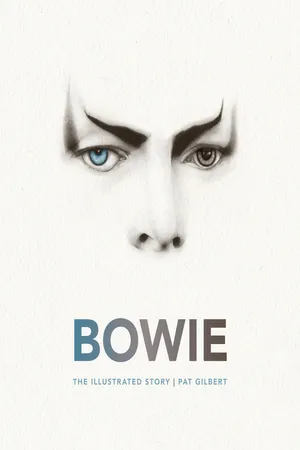
This book is available to read until 23rd December, 2025
- 224 pages
- English
- ePUB (mobile friendly)
- Available on iOS & Android
eBook - ePub
Available until 23 Dec |Learn more
About this book
Follow every step of David Bowie’s career; from Ziggy Stardust to Tin Machine, from “Space Oddity” to Let’s Dance to Blackstar, in Bowie: The Illustrated Story.
David Bowie released an incredible 27 studio albums, beginning with his eponymous 1967 debut and ending with Blackstar, released just two days before his untimely death in January 2016. Widely regarded as one of the most influential musicians and performers of the previous five decades, Bowie demolished what were thought to be the limitations of stagecraft in rock music, as well as proving it possible for an artist to constantly--and successfully--redefine himself. As a result, Bowie has been credited with inspiring genres as disparate as glam and punk rock.
This sharply written and gorgeously designed retrospective follows Bowie’s career from the folkie baroque rock of his debut, to his breakthrough single “Space Oddity,” and on to his flamboyant glam rock alter ego, Ziggy Stardust. Author Pat Gilbert continues through Bowie’s soul phase, his electronic Berlin trilogy, his massive pop success in the 1980s, and his turn to electronica in the 1990s, as well as subsequent tours, notable performances, collaborations, and accolades.
Nearly every page is illustrated with stunning concert and candid offstage photography, including gig posters, 7-inch picture sleeves, concert ticket stubs, and more. The result is a fitting tribute to one of the most influential and admired stars in rock history.
David Bowie released an incredible 27 studio albums, beginning with his eponymous 1967 debut and ending with Blackstar, released just two days before his untimely death in January 2016. Widely regarded as one of the most influential musicians and performers of the previous five decades, Bowie demolished what were thought to be the limitations of stagecraft in rock music, as well as proving it possible for an artist to constantly--and successfully--redefine himself. As a result, Bowie has been credited with inspiring genres as disparate as glam and punk rock.
This sharply written and gorgeously designed retrospective follows Bowie’s career from the folkie baroque rock of his debut, to his breakthrough single “Space Oddity,” and on to his flamboyant glam rock alter ego, Ziggy Stardust. Author Pat Gilbert continues through Bowie’s soul phase, his electronic Berlin trilogy, his massive pop success in the 1980s, and his turn to electronica in the 1990s, as well as subsequent tours, notable performances, collaborations, and accolades.
Nearly every page is illustrated with stunning concert and candid offstage photography, including gig posters, 7-inch picture sleeves, concert ticket stubs, and more. The result is a fitting tribute to one of the most influential and admired stars in rock history.
Frequently asked questions
Yes, you can cancel anytime from the Subscription tab in your account settings on the Perlego website. Your subscription will stay active until the end of your current billing period. Learn how to cancel your subscription.
At the moment all of our mobile-responsive ePub books are available to download via the app. Most of our PDFs are also available to download and we're working on making the final remaining ones downloadable now. Learn more here.
Perlego offers two plans: Essential and Complete
- Essential is ideal for learners and professionals who enjoy exploring a wide range of subjects. Access the Essential Library with 800,000+ trusted titles and best-sellers across business, personal growth, and the humanities. Includes unlimited reading time and Standard Read Aloud voice.
- Complete: Perfect for advanced learners and researchers needing full, unrestricted access. Unlock 1.4M+ books across hundreds of subjects, including academic and specialized titles. The Complete Plan also includes advanced features like Premium Read Aloud and Research Assistant.
We are an online textbook subscription service, where you can get access to an entire online library for less than the price of a single book per month. With over 1 million books across 1000+ topics, we’ve got you covered! Learn more here.
Look out for the read-aloud symbol on your next book to see if you can listen to it. The read-aloud tool reads text aloud for you, highlighting the text as it is being read. You can pause it, speed it up and slow it down. Learn more here.
Yes! You can use the Perlego app on both iOS or Android devices to read anytime, anywhere — even offline. Perfect for commutes or when you’re on the go.
Please note we cannot support devices running on iOS 13 and Android 7 or earlier. Learn more about using the app.
Please note we cannot support devices running on iOS 13 and Android 7 or earlier. Learn more about using the app.
Yes, you can access Bowie by Pat Gilbert in PDF and/or ePUB format, as well as other popular books in Media & Performing Arts & Music. We have over one million books available in our catalogue for you to explore.
Information
CHAPTER 1
1947–1967
London Boy
It’s perhaps fitting that David Bowie, an artist who combined music, image, theater, and myth with such boldness and originality, should have had a touch of the exotic in his background. At twenty-one years old, his father Haywood Jones, known as “John,” inherited a sizeable sum of money, which he invested in—of all the options available in 1930s Depression-era Britain—a nightclub revue featuring his first wife, Hilda. Clearly the young Jones had a liking for music and colorful characters, for when that venture failed, he ploughed the £1,000 he had left into a glitzy piano bar in London’s West End. But by the time World War II arrived in 1939, he’d lost all his money and taken a clerical job at Dr. Barnardo’s, a famous charity that provided homes for abandoned and abused children.
Bowie’s father left his job to fight in the war but returned to Dr. Barnardo’s in 1945. Soon afterward, he met a waitress named Peggy Burns while on business in Royal Tunbridge Wells in Kent. Peggy already had a son, Terry, born in 1937, and a wartime daughter, Myra, who’d been given up for adoption. While the couple waited for John’s divorce from Hilda to be finalized, they settled at 40 Stansfield Road, a Victorian house in inner-city Brixton that John had bought cheaply at the end of the war for £500. It was there that Peggy gave birth to a son, David Robert Jones, on January 8, 1947. Fair haired and nice looking, he would be the last addition to the family.
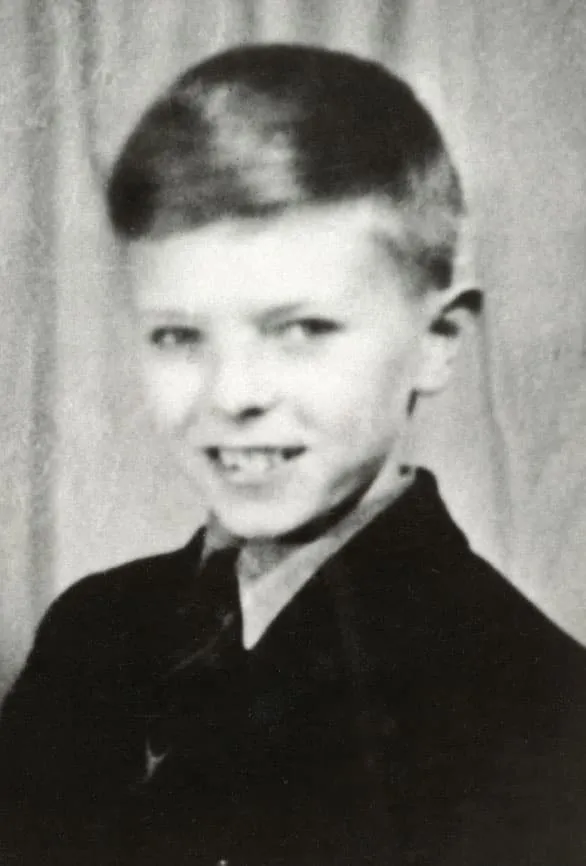
David Robert Jones in the mid-1950s, around seven years old.
Terry Burns came to live with the family, but his presence caused friction with Bowie’s father, by nature a reserved and taciturn character. John had fathered a daughter, Annette, in a prewar affair, and she too stayed at the house for a time. Stansfield Road was therefore a place of secrets and veiled tensions. But the overwhelming tone of Bowie’s early home life—and the thing that also seemed to drive him to escape into the outlandish, colorful world of rock ’n’ roll—would be something far more commonplace: the claustrophobia of drab, suburban normality.

Performing on television for the first time as David Bowie, at a taping of Ready Steady Go!, March 4, 1966.
Bowie was six when the family uprooted to Bromley, a small town on the edge of South London that by the 1950s had long been swallowed up by the ever-expanding metropolis. The Joneses eventually settled in a small terraced house in Plaistow Grove, just behind the Sundridge Park railway station. The area was characterized by its wide, leafy avenues and solid, middle-class homes, a stark contrast from the hubbub and poverty of war-damaged Brixton. Terry remained at Stansfield Road, ostensibly because of his job nearby, but also because the mental instability that characterized his adult years—and heavily shaded his younger half-brother’s best work in the 1970s—was already making life for those around him difficult. But even without Terry, the mood at Plaistow Grove was subdued and oppressive.
Visiting the house in the mid-1960s, singer Dana Gillespie noted how joyless the house felt; John’s history as a frivolous young nightclub impresario was long hidden behind the serious-minded front of a respected charity worker. “I went down to this little house, where everything was neatly laid out,” recalled Gillespie, whose own parents enjoyed an affluent, bohemian lifestyle in West London. “There was plastic lino, which I hadn’t seen before, and the sofa had one of those things to catch the Brylcreem. It was a place totally without humour or deep conversation.”
Bowie admitted in later life to finding his mother, Peggy, emotionally distant and being unable to make conversation with his father, whom he nevertheless loved. There were also unspoken worries that Terry’s illness, which ran through the Burns family line, might one day also claim Peggy or David. Plaistow Grove’s strained atmosphere spurred the singer to greedily consume whatever entertainment was available, even if he had to create it himself. By the age of eleven, in 1958, he was already the proud owner of a ukulele and tea-chest bass, two key ingredients for making “skiffle,” a homegrown hybrid of blues and country music popularized by Lonnie Donegan’s hit cover of “Rock Island Line” in 1956. He also possessed a bag of records that his father brought home from work, the most thrilling of which was Little Richard’s “Tutti Frutti,” whose camp squeals and wild energy filled the house with what he described as “colour and outrageous defiance.” Bowie was convinced at that moment that he’d “heard God.”
The first hint that Bowie, who delighted in the fact that he shared a birthday with Elvis Presley, wanted to be a star himself came in August 1958. That month he entertained his fellow Boy Scouts around a troop campfire on the Isle of Wight, singing the Everly Brothers’ “All I Have to Do Is Dream” and “Tom Hark” by Elias and His Zig Zag Jive Flutes (both hits that summer). He was joined by his school friend George Underwood, who would be a close musical ally throughout his teenage years. A further sign that Bowie was eager to take an artistic path through life occurred around the same time, when he convinced his parents to let him enroll at Bromley Technical High School, even though his borderline exam results entitled him to attend the far more prestigious and academic Bromley Grammar School.
His choice of school turned out to be a crucial move: with its emphasis on creativity and craftsmanship, Bromley Tech boasted a first-class art department headed by forward-thinking teacher Owen Frampton, whose son Peter, later of the group Humble Pie and then a successful solo artist, joined the school in 1961. Bowie and his best mate Underwood enjoyed a schedule where whole days were sometimes spent in art classes. It was a progressive regime that, as Bowie later explained, “was an experiment to try to get us [pupils] involved in art at a younger age.” Owen Frampton encouraged Bowie, Underwood, and Geoff MacCormack (another friend) to bring their instruments to school, where they’d harmonize rock ’n’ roll hits in the echoey stone stairwell of the art block. Even at that tender age, to them the road ahead seemed straightforward. “We saw the glint of stardom and we wanted to go after it,” Underwood recalled.
In 1959, Terry Burns had completed his compulsory three years’ National Service and moved into Plaistow Grove. Together with a degree of disquiet, he also brought with him a collection of jazz records and beat literature, including Jack Kerouac’s On the Road. These exotic totems helped fuel Bowie’s growing fascination with all things American, including the newly appointed President Kennedy’s haircut, which, to considerable amusement, Bowie requested at his local barber shop. He also developed a liking for baseball and American football—or at least the glamorous image of baseball players and NFL players—and wrote to the US Embassy declaring the fact. His enthusiasm was rewarded by an invitation to the embassy, where he and Underwood were each presented with an NFL helmet.
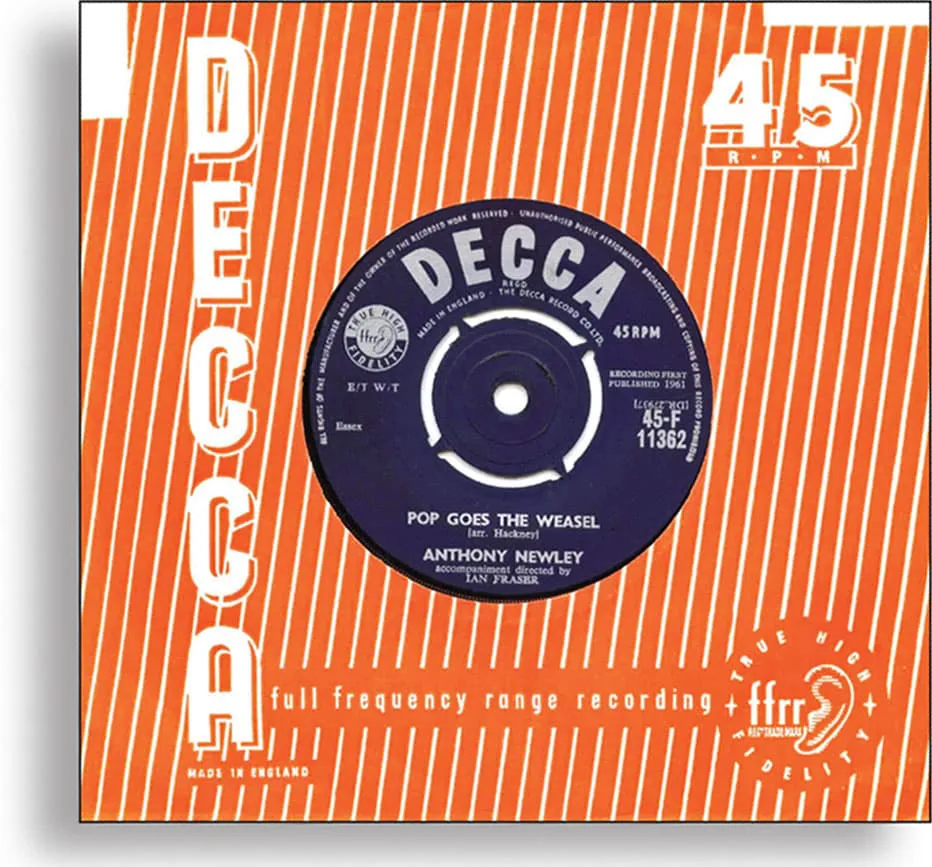
A key early influence, “Pop Goes the Weasel” by Anthony Newley.
The visit made the local paper, an early instance of Bowie’s knack for self-promotion and deep curiosity in subjects he’d quickly lose interest in. What remained constant was his obsession with music—everything from Charles Mingus and John Coltrane to novelty hits such as Anthony Newley’s “Pop Goes the Weasel” and the caveman rock of the Hollywood Argyles’ “Alley Oop.” He was, increasingly, also fascinated with girls. It was the latter interest that led him to acquire a startling physical trait th...
Table of contents
- Cover
- Title Page
- Contents
- Introduction
- 1 London Boy, 1947–1967
- 2 All the Madmen, 1968–1970
- 3 Leper Messiah, 1971–1972
- 4 Fame, 1973–1974
- 5 Cracked Actor, 1975–1976
- 6 Subterraneans, 1977–1979
- 7 It’s No Game, 1980–1984
- 8 Little Wonder, 1985–2016
- Sources
- Image Credits
- Index
- About the Author
- Copyright