This revised, updated and expanded edition Joy Larkcom's classic guide to growing your own vegetables contains everything you need to know to create a highly-productive vegetable plot. It covers every aspect of vegetable gardening, including preparing soil; manures, composts and fertilizers; growing techniques; protection; pests, diseases and weeds; and making good use of space.
The second half of the book provides cultivation information for over 100 vegetables, including site and soil requirements, cultivation, pests and diseases, and cultivars.
- 384 pages
- English
- ePUB (mobile friendly)
- Available on iOS & Android
eBook - ePub
Grow Your Own Vegetables
About this book
Information
1
TOOLS AND EQUIPMENT
Whatever the size of your garden, a set of basic tools is essential. Always buy the best you can afford: cheap tools are a false economy. Not only do they make the job harder, but they have a depressingly short life span. The best-quality tools are made of stainless steel with ash or fibreglass handles, and often carry a ten-year guarantee.
When buying tools try them out for weight, balance and size (particularly the handles), as it is most important that they feel comfortable. Specially adapted tools are available for disabled gardeners, while tools with extra long handles are an asset where bending is difficult.
The gardening market is flooded with gimmicky tools – most of which should be avoided. But occasionally someone with an inventive turn of mind produces an original, practical tool. My favourite example is a Taiwanese hoe, which has much the same dimensions as an onion hoe but is straight-handled. Made from an old saw blade, it has a toothed edge that serves as a rake, and the other straight edge of the blade serves as a hoe. I use it to make wide shallow drills for all my cut-and-come-again seedling sowings.
It is worth taking care of good tools so that they give long service. Scrape off the soil before putting them away and, ideally, wipe them clean with an oily rag. Needless to say, this does not always happen – even in the best gardening circles. Spades and hoes need occasional sharpening with a file or carborundum stone.
The following tools are almost essential: a spade, a digging fork, a rake, some kind of hoe, a hand fork and trowel, and a watering can. A spade is the traditional digging tool and the best for thorough digging on heavy soil, for breaking up clods and for work that involves moving soil. However, in a garden with reasonably well-worked soil, you could manage using only a fork. Various sizes of spade are sold, the smallest, the border or lady’s spade, being the lightest to handle.
The standard garden fork has four or five prongs or tines. It is used for digging too and is preferable to a spade on stony soil. It is also used for breaking up soil that has already been turned with a spade, and for generally ‘working’ the soil. For ordinary garden use the round-pronged fork is the most popular, though some people prefer the flat-pronged fork, which is also used for lifting potatoes and other root vegetables as it does less damage to tubers. A ‘lady’s fork’ is lighter in weight with shorter tines.
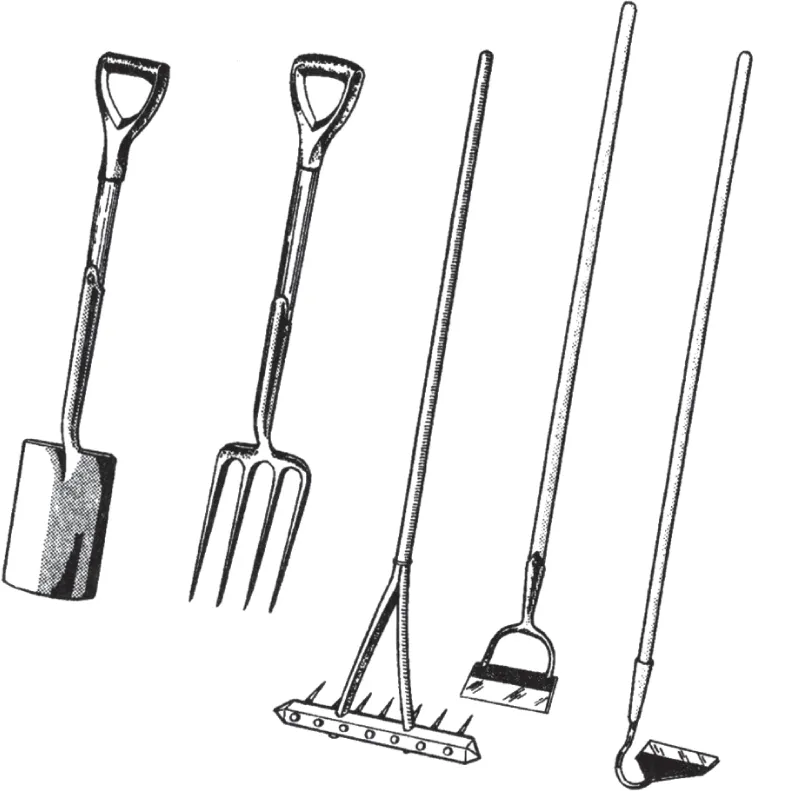
Useful long-handled garden tools. Left to right: spade, digging fork, rake, Dutch hoe, draw hoe.
Rakes are mainly used for levelling soil, removing stones and preparing the tilth on a seedbed. For general purposes an eight- or ten-tooth metal-headed rake is adequate. I am very attached to a handmade nail tooth rake (a wooden head fitted with iron teeth) which is perfectly balanced and easy to use (see above). This is worth getting if you come across one. A springbok rake comes in handy for raking up leaves and rubbish.
The Dutch hoe, the blade of which is pushed lightly through the soil, is for removing weeds and loosening relatively light soil. It can also be used for drawing a drill. When hoeing with a Dutch hoe, walk backwards as you work, so that you leave no footmarks on the soil. In small gardens, and gardens laid out in narrow beds, all hoeing can be done while standing on the path. Always hoe with gentle movements, as hoeing can quickly become surprisingly tiring.
The draw hoe is pulled towards you, rather than pushed. It can be used for hoeing on heavier soils, and for such jobs as earthing up and drawing a shallow flat-bottomed drill, typically for sowing peas.
The onion hoe is a small, swan-necked draw hoe on a short handle. It is invaluable for weeding, especially in confined spaces, for thinning, for drawing drills and even for earthing up. If I were restricted to one hoe in a small garden, this would be my choice (see below).
The Ibis hoe (also called a cultivator or plough) is a short-handled hand-forged steel tool of Asiatic origin, with a subtly curved triangular blade tapering to a point. This is another very versatile tool, and is used for weeding, planting, thinning and making a drill.

Some useful small hand tools. Left to right: onion hoe, hand trowel, hand fork, Ibis hoe.
Triangular, serrated edge, oscillating and double-edged hoes are very useful. It is really a question of finding what personally suits you.
The cultivator is a tool with three to five, occasionally more, claw-like prongs, which can be very useful for breaking up ground and for weeding between plants.
A hand trowel is primarily used for planting and must be sturdy. The strongest models have a concave steel blade and an angled or curved, rather than straight, shank. Its natural partner, a small hand fork, is useful for weeding near plants and loosening the soil in small areas.
A dibber is a pointed metal or wood tool, generally used to make holes for planting. Many a dibber has been whittled from a broken fork handle. A dibber is ideal for making a straight 20cm/8in-deep hole into which transplants are dropped (see page 94). It can also be used to make shallower holes for sowing large seeds such as broad beans; make sure that the seeds lie on the bottom of the hole and are not suspended in mid-air.
Garden lines, to ensure sowing or planting in straight rows, can be purchased or made by attaching twine to a pair of skewers or metal tent pegs. If your garden beds are a constant width, make the line the same width: that will save hours of ravelling and unravelling.
Watering cans should be robust and, for general watering, have a capacity of 7–9 litres/1 1/2–2 gallons. Detachable coarse and fine roses which are fitted to the spout allow you to moderate the force of the water according to the size of plant. Small cans of 1.5 litres/2 1/2 pints capacity with very narrow spouts are handy for watering seedlings, but are easily blocked if there is debris in the water supply.
Other useful items of equipment include a wheelbarrow and a small hand syringe or hand sprayer for applying pesticides. A capacity of 1/2 litre/1 pint is probably sufficient for most organic gardeners. For irrigation equipment see page 80; for plant-raising equipment see page 97. In large gardens there may be a case for using a mechanical cultivator; if you require machinery only occasionally, it is useful to hire it.
2
THE VEGETABLE GARDEN SITE
Vegetables need as much sunshine as possible, so the ideal site for vegetable growing in a temperate climate is ‘open’, in the sense that it is in full sunshine for most of the day and (in the northern hemisphere) is not facing due north. Shelter from strong winds is another key element in creating optimum conditions for vegetable growing. It goes without saying that a flat site, provided it is well drained, is far easier to work than a sloping site. So where there is a choice avoid deeply shaded, exposed and steep sites.
Shade is frequently cast by large trees or tall buildings and only a handful of vegetables will thrive in these conditions. Moreover, the drips from overhanging trees tend to damage plants beneath. In essentially shady gardens utilize any sunny spots, and consider growing vegetables in containers that can be moved around to catch the sun.
Exposure is more easily remedied (see Shelter, below).
One of the main problems with steep slopes is soil erosion, so working to the contours, that is laying out beds and paths to run across, rather than down, the slope, is recommended. In extreme situations a slope can be terraced.
Sites that are known frost pockets should be avoided. Frost pockets are liable to occur at the lowest points in a sloping garden, and can be remedied by making a gap in a hedge or fence at that point, so allowing the cold air to drain away.
Fertile soil, good drainage and an adequate supply of water are important, interrelated elements in any site intended for vegetable growing. They are covered in Chapters 3 and 4.
On the question of having a garden of appropriate size, let me quote my fellow garden writer Leonard Meager, writing in The New Art of Gardening over 300 years ago:
As for the quantity of Plot of ground to make a Suitable Garden … let me caution all, not to undertake more than can be well looked after with hands enough for the well management of things in their proper season; for a small Plot of ground well ordered, turns to greater advantage than a large one neglected … for if the weeds get the mastery for want of hands to rid them, it will not be easy to root them out … Also watering a large garden in droughty weather requires much Time and Pains.
SHELTER
The benefits of shelter cannot be exaggerated. Research has shown that sheltering vegetables from even light winds can increase their yields by up to 30 per cent – which is equivalent to the increase in returns from optimum irrigation or optimum fertilizer use. The benefits of sheltering plants from severe winds are considerably higher. In coastal areas windbreaks also give protection from wind-borne salt spray.
The mechanics of windbreaks
The most effective windbreaks are about 50 per cent permeable, allowing the wind to filter through to the other side. A completely solid windbreak, such as a wall or fence, can create a destructive area of turbulence on the leeward side. A well-grown hedge, lath fences, wattle hurdles and windbreak netting battened to posts are examples of good windbreaks.
As a general rule, windbreaks should have a gradually diminishing sheltering effect for up to at least six times their height. So a large exposed garden would benefit from several windbreaks sited across it. For maximum effect windbreaks 1.5m/5ft high, for example, should be spaced roughly 9m/30ft apart. As far as possible they should be erected across the path of the prevailing wind.
Exposed gardens benefit enormously from protection with some kind of windbreak. A choice has to be made between living windbreaks, such as trees or hedges, and artificial windbreaks.
Living windbreaks
The disadvantages of living windbreaks are that they compete with vegetable crops for nutrients, light and moisture, and normally require some pruning to keep them in check. With young trees and hedges it may be necessary to erect temporary artificial windbreaks until they have reached a reasonable size; indeed they may require protection themselves in the early stages of growth. Within the confines of a garden, robust tall annual crops can offer protection to lower-growing vegetables. Jerusalem artichokes and sunflowers are used in temperate climates, sweet corn or maize in warmer climates. They can be planted in rows two to three deep to make a sheltering enclosure for more tender vegetables.
Artificial windbreaks
A wooden lath fence makes an efficient artificial windbreak. To get the 50 per cent permeability, nail horizontal lath strips about 2.5cm/1in apart on to a lath framework.
Manufactured web and net windbreaks are another option. There’s no pretending that they are aesthetically pleasing and they are not cheap, but if erected around an exposed garden they transform the environment within it. They can be up to 2m/6 1/2ft high. They take an enormous strain in high winds, so posts must be rot-proof and exceptionally strong (at least 5–7.5cm/2-3in diameter), spaced about 1.8m/6ft apart. Corner posts should be reinforced with short bracing posts at a 45-degree angle (see below). Good modern windbreak materials last for many years.
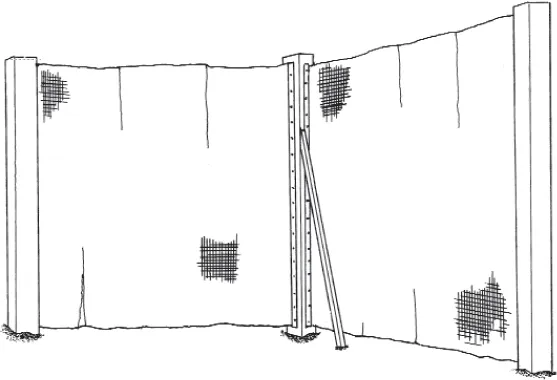
Our exposed garden is surrounded by a net windbreak, battened to strong posts with corner posts reinforced by a short bracing post.
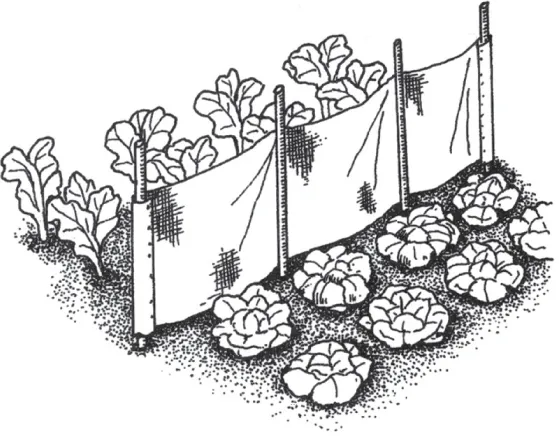
Low strips of hessian sacking attached to short poles or canes serve as a windbreak between rows of vegetables.
Where high surrounding windbreaks are not f...
Table of contents
- Cover
- Title Page
- Contents
- Introduction
- Chapter 1: Tools and Equipment
- Chapter 2: The Vegetable Garden Site
- Chapter 3: Soil, Manure and Compost
- Chapter 4: Digging, Mulching, Weeding and Watering
- Chapter 5: Seed, Sowing and Planting
- Chapter 6: Protection
- Chapter 7: Pests and Diseases
- Chapter 8: Space Saving and Productivity
- Chapter 9: Planning
- Vegetable Directory
- Seasonal Guide to Main Garden Jobs
- Appendix
- Further reading
- Seed suppliers
- Acknowledgments
- Index
- Dedication
- Copyright Page
Trusted by 375,005 students
Access to over 1.5 million titles for a fair monthly price.
Study more efficiently using our study tools.
Frequently asked questions
Yes, you can cancel anytime from the Subscription tab in your account settings on the Perlego website. Your subscription will stay active until the end of your current billing period. Learn how to cancel your subscription
No, books cannot be downloaded as external files, such as PDFs, for use outside of Perlego. However, you can download books within the Perlego app for offline reading on mobile or tablet. Learn how to download books offline
Perlego offers two plans: Essential and Complete
- Essential is ideal for learners and professionals who enjoy exploring a wide range of subjects. Access the Essential Library with 800,000+ trusted titles and best-sellers across business, personal growth, and the humanities. Includes unlimited reading time and Standard Read Aloud voice.
- Complete: Perfect for advanced learners and researchers needing full, unrestricted access. Unlock 1.5M+ books across hundreds of subjects, including academic and specialized titles. The Complete Plan also includes advanced features like Premium Read Aloud and Research Assistant.
We are an online textbook subscription service, where you can get access to an entire online library for less than the price of a single book per month. With over 1.5 million books across 990+ topics, we’ve got you covered! Learn about our mission
Look out for the read-aloud symbol on your next book to see if you can listen to it. The read-aloud tool reads text aloud for you, highlighting the text as it is being read. You can pause it, speed it up and slow it down. Learn more about Read Aloud
Yes! You can use the Perlego app on both iOS and Android devices to read anytime, anywhere — even offline. Perfect for commutes or when you’re on the go.
Please note we cannot support devices running on iOS 13 and Android 7 or earlier. Learn more about using the app
Please note we cannot support devices running on iOS 13 and Android 7 or earlier. Learn more about using the app
Yes, you can access Grow Your Own Vegetables by Joy Larkcom in PDF and/or ePUB format, as well as other popular books in Biological Sciences & Horticulture. We have over 1.5 million books available in our catalogue for you to explore.