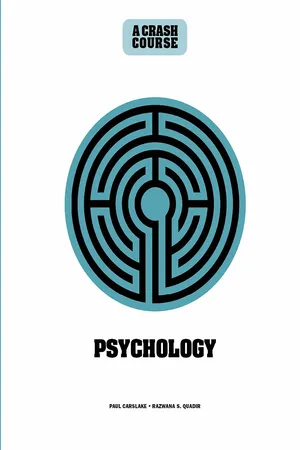
This book is available to read until 31st December, 2025
- 160 pages
- English
- ePUB (mobile friendly)
- Available on iOS & Android
eBook - ePub
Available until 31 Dec |Learn more
About this book
The way humans think and behave is endlessly fascinating and often surprising. Professional psychologists spend their working lives analyzing individuals’ mental processes and responses. Their subject is a science, but their practice and approach are governed by ethics and morality. We may all consider ourselves to be incidental psychologists in our daily interactions, confident of our ability to judge character, read body language, or to get to know someone, only to find ourselves confounded by seemingly unpredictable actions. Why do entirely good people sometimes do bad things? Is personality inherited or learned? Is there really such a thing as “being normal”? Psychology: A Crash Course looks at how these and many other questions have exercised the minds of those leading the way in psychology for more than 100 years. It’s a story of bold thinking, ingenious experiments, and sometimes startling conclusions that will make you stop and think.
Frequently asked questions
Yes, you can cancel anytime from the Subscription tab in your account settings on the Perlego website. Your subscription will stay active until the end of your current billing period. Learn how to cancel your subscription.
No, books cannot be downloaded as external files, such as PDFs, for use outside of Perlego. However, you can download books within the Perlego app for offline reading on mobile or tablet. Learn more here.
Perlego offers two plans: Essential and Complete
- Essential is ideal for learners and professionals who enjoy exploring a wide range of subjects. Access the Essential Library with 800,000+ trusted titles and best-sellers across business, personal growth, and the humanities. Includes unlimited reading time and Standard Read Aloud voice.
- Complete: Perfect for advanced learners and researchers needing full, unrestricted access. Unlock 1.4M+ books across hundreds of subjects, including academic and specialized titles. The Complete Plan also includes advanced features like Premium Read Aloud and Research Assistant.
We are an online textbook subscription service, where you can get access to an entire online library for less than the price of a single book per month. With over 1 million books across 1000+ topics, we’ve got you covered! Learn more here.
Look out for the read-aloud symbol on your next book to see if you can listen to it. The read-aloud tool reads text aloud for you, highlighting the text as it is being read. You can pause it, speed it up and slow it down. Learn more here.
Yes! You can use the Perlego app on both iOS or Android devices to read anytime, anywhere — even offline. Perfect for commutes or when you’re on the go.
Please note we cannot support devices running on iOS 13 and Android 7 or earlier. Learn more about using the app.
Please note we cannot support devices running on iOS 13 and Android 7 or earlier. Learn more about using the app.
Yes, you can access Psychology: A Crash Course by Paul Carslake,Razwana Quadir in PDF and/or ePUB format, as well as other popular books in Psychology & History & Theory in Psychology. We have over one million books available in our catalogue for you to explore.
Information
1
DEVELOPMENT & LANGUAGE
“The propensity to make strong emotional bonds to particular individuals is a basic component of human nature.”
JOHN BOWLBY, A SECURE BASE (1988)
INTRODUCTION
Before launching into the first chapter of this book, let’s think for a moment about the first chapter of each of our own lives. How did we get from that first day—our birth day—to where we are now? One of the missions of psychology is to try to answer this question. And one of the first people to do this in a systematic and theoretical way was Sigmund Freud. Broadly speaking, Freud believed that the most critical developmental challenge for every child is to negotiate the shift from being within an exclusive two-person relationship (mother and child), to realizing that they must share their mother with her own partner, with whom she has another kind of exclusive relationship. This is at the heart of Freud’s Oedipus Complex, which he believed brought with it a range of anxieties, jealousies, and even murderous fantasies (which we needn’t go into here) that would have a bearing on a person’s development later in life. Freud’s psychoanalytic theory of development can be seen as a starting point for a century of theory, research, and debate on how it is that we become our “selves”—and how we then go on to learn and develop as distinct individuals.
Attachment and beyond
We start off with the idea of attachment. Mary Ainsworth’s “strange situation” test (shown here) involves leaving a small child alone in an unfamiliar room, and is something that anyone who has ever met a toddler can instantly relate to. It proved to be of crucial importance to researchers, providing an ingenious kind of objective yardstick against which to measure the behavior of infants, and opening up an entire field of experimental psychology.
John Bowlby (shown here) is the pioneer of work that became known as “attachment theory,” and in this chapter we look at one of his early studies, “Forty-four Juvenile Thieves: Their Characters and Home Life,” which began to explore how early attachment failures can affect later behavior. The topic was a pressing one, with World War II displacing millions of young people, many of them orphaned, across the world.
From the 1930s to the 1960s, many psychology experiments used animals, such was the prevalence of the “behavioral” psychology tradition, which held that we, like other animals, are physically programmed to behave in a certain way: feeding, for example, will lead to attachment. Harry Harlow’s experiments with monkeys (shown here), however, showed that attachment to their mother was about more than craving food. The baby monkeys seemed to crave nurturing care even more than food, and an absence of this care would cause symptoms of depression and withdrawal.
Learning about learning
This first chapter also takes a look at the theory of how we learn—starting with Ivan Pavlov’s famous experiments on his laboratory dogs (shown here), which influenced generations of research on the learning and unlearning process. Thinking about learning throws up some interesting questions. Does our ability to learn and understand increasingly complex material simply depend on the physical development of our brains? Jean Piaget, watching his three clever children growing up, thought it probably did (shown here). In a similar way, Lawrence Kohlberg (shown here) believed that our moral senses also simply evolve with age. Others, like Lev Vygotsky, in revolutionary Russia, believed that the society around us was an essential component of learning (shown here). Not that learning is something that is confined to children, of course. Erik Erikson (shown here) saw life as containing a series of eight distinct “crises” to be negotiated at various stages, each with far-reaching consequences.
The mechanisms of learning are explored, too. Albert Bandura’s ideas on learning through imitation of others (shown here) may seem rather obvious today, but at the time they were revolutionary, challenging the behaviorist principles that suggest learning is only driven by incentives—sticks and carrots. In a similar way, Noam Chomsky comprehensively rubbished the behaviorist idea that we learn a language by trial and error. However, his alternative (shown here)—that we all possess the innate ability to learn a language—today appears a rather extreme alternative: it would appear that we still need some kind of teaching.
We offer two very different reflections on gender. Simon Baron-Cohen’s work on autism (shown here) has pointed out some significant differences between the functioning of male and female brains, based on what men and women appear to be “good at.” Returning to the learning theme, our second topic on gender identity (shown here) shows how far gender can be tied to the expectations of our social environment: gender as something we do, rather than something we are.
Finally, we take a look at the work of Carol Dweck and others on the kind of mindset that can help people push to achieve more, which comes down to how we view the nature of the task, and our capacity to learn (shown here). If you fall into a category of people who believe that learning capacity can be continually expanded, then read on!
BIOGRAPHIES
JEAN PIAGET (1896–1980)
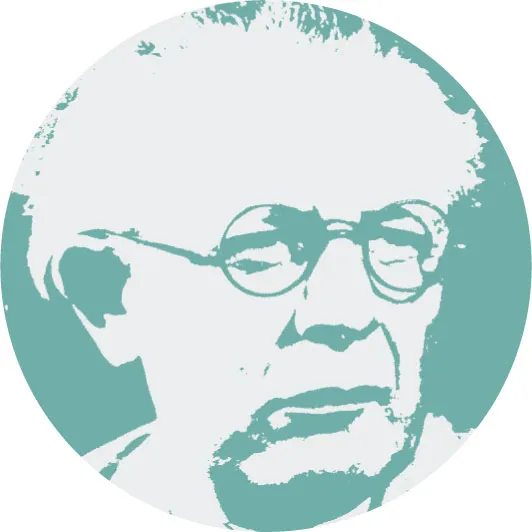
Piaget was born in Neuchâtel, Switzerland. Precociously bright, he idolized his academic father and quickly developed a boyhood passion for natural history, publishing a short paper on an albino sparrow when he was just age ten, and yet more papers on mollusks in his teens. He completed a Ph.D. in zoology and philosophy in 1918, but it was when working with Theodore Simon in 1920 on children’s intelligence tests that his contribution to psychology sparked into life. Piaget noticed how, in their answers, children made certain kinds of errors, depending on their age, and this led to a quest to discover how children acquire understanding. As professor of child psychology at the University of Geneva (where he remained for the rest of his career), Piaget developed sophisticated techniques for interviewing children (often his own three) about how they think. He then evolved his four-stage theory of learning, where a child uses “schemas” to make sense of the world around them, then adapts or replaces them when new explanations fit better. As Piaget famously said: “What we know changes what we see. What we see changes what we know.” Piaget’s ideas sparked new thinking in the area of education and curriculum development, with the notion that children learn best when the approach fits their capacity to think.
JOHN BOWLBY (1907–1990)
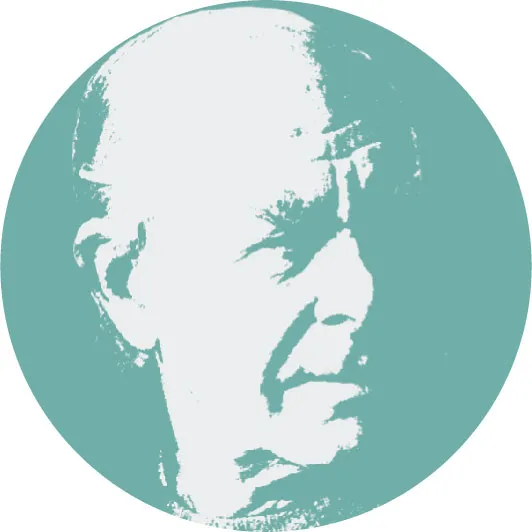
Bowlby was the pioneer of attachment theory, which explores the emotional bond between a child and their caregiver, and what happens when that bond is broken. Bowlby’s family was well-off (his father was surgeon to the royal household) and much of his early care was consigned to nannies. He later recalled his pain when one nanny left the job—he described it as like losing a mother. Bowlby was sent to boarding school at age ten, and later graduated from Cambridge ...
Table of contents
- Cover
- Title Page
- Contents
- Introduction
- Schools of Thought
- Timeline
- 1 Development & Language
- 2 Perception & Cognition
- 3 Social Psychology
- 4 Psychology of Difference
- Glossary
- Further Reading
- Index
- About the Authors
- Acknowledgments
- Copyright