![]()
CHAPTER 1
GEORGE WASHINGTON PUTS DOWN THE WHISKEY REBELLION AND DOOMS THE FEDERALIST PARTY
1794
ONE OF THE MOST DRAMATIC—AND VIOLENT—EPISODES IN THE WHISKEY Rebellion occurred shortly after sunrise on July 16, 1794. Sixty-three-year-old John Neville had just finishing dressing when he heard a commotion outside his house. Neville was one of the richest men in western Pennsylvania. His estate, Bower Hill, covered more than 1,000 acres (4 km2) in the Chartiers Valley outside Pittsburgh. He owned eighteen slaves who worked his land.
In addition to being a man of property, he was a veteran of the American Revolution, a retired brigadier general of the Continental Army, and most recently the regional inspector for the collection of the whiskey tax. The previous day Neville had guided a federal marshal, David Lenox, to the cabins of his neighbors who were delinquent in paying the tax.
Standing in his doorway, Neville saw fifty or more armed men and boys crowded into his front yard. They were all poor farmers and backwoodsmen, the backbone of the Whiskey Rebellion, men who deeply resented the federal tax on their homedistilled whiskey and refused to pay it. Shouting, he asked what they wanted. The spokesman answered that David Lenox’s life was in danger, and they had come to take him to a place of safety. Neville said he didn’t believe them. Besides, Lenox was not in his house. Then he ordered the crowd to get off his land.
When they refused, he grabbed his musket and fired. The musket ball hit one of the mob’s leaders, Oliver Miller, mortally wounding him. Enraged, every man raised his musket to fire on Neville, but the general slammed shut his heavy front door and bolted it. Seizing a signal horn, he gave a loud blast. A moment later the mob’s flank was raked by shotgun blasts coming from the slave quarters. The skirmish raged for twenty-five minutes, with the mob firing on both the manor house and the slave cabins, yet all the casualties were on the frontiersmen’s side. Finally they gave up, collected their six wounded, including Miller, and retreated back into the forest.
Certain that this was just the first scuffle, Neville sent his son Presley to Pittsburgh to summon the militia to defend Bower Hill. Whether they were afraid they would be overwhelmed at Neville’s house or afraid to leave Pittsburgh undefended, the militia refused to come to Neville’s rescue. But one major, James Kirkpatrick, as well as ten soldiers from Fort Pitt, volunteered to help Neville defend his home. Meanwhile, hundreds of frontiersmen had gathered in the forest, where they swore to avenge the death of Oliver Miller.
About 5 p.m. the next day, Neville, his family, and his little garrison heard the sound of drums approaching the house. Major Kirkpatrick convinced Neville to escape out the back and hide in a deep ravine behind the house. He had scarcely gotten away when an army of between 500 and 700 frontiersmen stepped out of the trees. One of them, James McFarlane, advanced carrying a flag of truce.
McFarlane ordered Neville to come out and bring the tax records with him. Kirkpatrick replied that Neville was not in the house, but he would permit McFarlane and six of his men to enter and confiscate the tax documents. This did not satisfy McFarlane, who changed his demands: Kirkpatrick and his men must come out and surrender their arms. Kirkpatrick refused. As some of the frontiersmen set fire to a barn and slave cabin, McFarlane made his final offer: Mrs. Neville and all other females in the house were free to go and no one would trouble them. Kirkpatrick accepted this offer, and all the women in the house left. When they were a safe distance from Bower Hill, the frontiersmen opened fire.
In the gun battle that followed, McFarlane was killed. Infuriated by the death of a second leader at the hands of the Nevilles, the frontiersmen set fire to the kitchen beside the manor house and the rest of the estate’s outbuildings. Kirkpatrick and Presley Neville, realizing that within minutes the fire would spread to the main house, called to the crowd that they were ready to surrender.
In addition to McFarlane, two members of the frontiersmen army lay dead and several were wounded. Three or four of the soldiers from Fort Pitt had also been wounded. As for Kirkpatrick and Presley, they feared the frontiersmen would kill them, but they suffered nothing worse than being roughed up. As for the Neville family’s fine house, it burned to the ground.
“THE STEEL CLAD BAND”
The attack upon and destruction of General Neville’s estate outraged the federal government in Philadelphia. Urged on by his cabinet, President George Washington called out an army of 13,000 militiamen to enforce the law and crush the Whiskey Rebellion. On October 4, 1794, Washington arrived in Carlisle, Pennsylvania, to review the troops. The president was sixty-two years old, yet he had not lost his military bearing. Dressed in the blue uniform of a general of the U.S. Army, surrounded by a staff of officers, Washington surveyed approximately 13,000 men—a larger force than he had commanded at Yorktown.
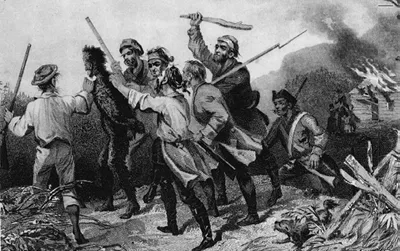
A GROUP OF CITIZENS ATTACK A FEDERAL EXCISE TAX COLLECTOR, WHOM THEY’VE TARRED AND FEATHERED AFTER BURNING HIS HOME, IN THIS NINETEENTH-CENTURY ENGRAVING. MANY SETTLERS, ESPECIALLY IN WESTERN PENNSYLVANIA, DEPENDED ON THE SALE OF HOMEMADE WHISKEY TO SURVIVE.
One Pennsylvania militiaman who was clearly overwhelmed by the sight left an anonymous description of what he saw that day. Washington, he wrote, “The Man of the People, with a mien as intrepid as that of Hector, yet graceful as that of Paris, moved slowly onward with his attending officers.” The commander in chief looked upon his army with “his eagle eye,” taking in “the dazzling effulgence of the steel clad band.” It was a scene, the Pennsylvanian wrote, that was both “augustly picturesque and inspiring.”
Five days later, two local government officials from the western counties of Pennsylvania, where the most serious disturbances had occurred, called upon the president to assure him that peace and order had been restored in their part of the state. But Washington was not convinced; he informed the delegates that he required “unequivocal proof of [the rebels’] absolute submission” before he would disband the army. Unable to supply such evidence, the two men went away, anxious and distressed. Once his visitors were gone, Washington confided to an aide, “I believe they are scared.”
If the frontiersmen who had fomented the uprising were frightened, Washington reasoned, they would be much less likely to put up a fight, and might even surrender their ringleaders. To give this fear a chance to spread, Washington kept his army in camp until October 20. Then, after handing over command to General Henry Lee, Washington returned to the capital in Philadelphia.
Washington’s reliance on the fear factor worked. No army of frontiersmen came out to fight the militia. Angry citizens lined the road to mock and harass the troops as they marched by, but no one took potshots at them. The rebels seemed to have vanished.
THE PRESIDENT’S MISGIVINGS
It was Alexander Hamilton, secretary of the treasury, who had first suggested taxing whiskey. After the American Revolution, the thirteen states struggled to pay off the debts they had incurred to keep their governments operational and to outfit and provision the troops they sent to the Continental Army. Making these debt payments was crippling the state economies, so Hamilton proposed that the federal government assume responsibility for the states’ debts. But although Hamilton’s plan liberated the states, it saddled the federal government with an $80 million obligation (approximately $1.820 billion in today’s money).
Toward the end of 1790 Hamilton examined the finances of the federal government and concluded that the current level of income was insufficient. If the government did not find other sources of revenue, it would see a shortfall of $826,624 in 1791. But he had a solution: a ten-cents-per-gallon tax on domestically produced whiskey. Hamilton estimated such a tax would bring in an additional $975,000, thereby enabling the federal government to cover its expenses, service the national debt, and remain comfortably in the black.
The type of tax Hamilton proposed is known as an excise tax, sometimes called an inland or interior tax, because it is levied on goods produced domestically rather than on those imported from over seas. The government could collect the tax at the place where the product was manufactured, at the point when it was sold to a distributor, or when it was sold to the consumer. Such taxes had always been unpopular with shopkeepers and consumers in Great Britain and the United States. In 1643, for example, mobs rioted in the streets of England’s cities and towns when Parliament placed an excise tax on beer and beef.
Washington was uneasy about taxing whiskey. He knew that every settler in the backwoods distilled his own whiskey, and that it was vital to the settler’s personal economy. Most pioneer families grew corn, but they had no way to get their grain to market: There were few roads through the forests, and shipping grain by riverboat was prohibitively expensive. The solution was to distill the corn into whiskey, load the casks on mules and horses, and transport it to towns and cities where it could be sold for as much as one dollar a gallon. The cash the frontiersmen earned from selling the whiskey enabled them to purchase goods they could not make for themselves, such as guns and farm implements.
If the government had only taxed the whiskey they sold, the frontiersmen might have tolerated it, but Hamilton’s plan called for a tax on every gallon of whiskey distilled, even the whiskey the settlers kept for their own consumption. Washington understood that in an average year most frontier families saw only a few dollars in hard money; they did not have reserves of cash to pay the ten cents on every gallon of whiskey they made. If the government demanded those dimes anyway, these independent-minded, volatile, well-armed, hard-drinking individuals might respond violently. Despite his misgivings, Washington endorsed Hamilton’s plan—the government needed the money—and a few weeks later in March 1791 Congress passed an excise tax on domestically distilled whiskey.
THE NEW SONS OF LIBERTY
When Robert Johnson took the job as collector of the whiskey tax for Washington and Allegheny counties in western Pennsylvania, he was aware that the settlers in the backwoods would resent his visits, but he felt confident that the worst he would experience were foul looks and probably a few harsh words.
On September 11, 1791, as he rode through the woods toward the town of Canonsburg, about a dozen men dressed in women’s dresses stepped out from behind trees and bushes and surrounded Johnson. They pulled him off his horse and dragged him into the forest, to a clearing where a cauldron of hot tar bubbled over a fire and a sack of feathers stood nearby. Johnson’s panic mounted as his abductors stripped him naked and hacked off his hair. He screamed in pain as they ladled the hot tar over his body, and he struggled to get away as they dumped the feathers over him. Then the men took Johnson’s horse and disappeared into the woods.
Tarring and feathering was not only cruel and humiliating, it was also an American memory strongly linked to the years leading up to the Revolution: Men who attempted to collect the stamp tax, tea tax, or any of the other taxes the British Parliament imposed upon the colonists had been ambushed in the streets or dragged from their homes and tarred and feathered. The gang that tarred and feathered Johnson was sending an unmistakable message to the federal government: The whiskey tax collectors were enemies of the common man, the vigilantes were a new incarnation of the Sons of Liberty, and the government in Philadelphia would be wise to repeal this unjust tax.
The attack on Johnson was not an isolated incident. In the western districts of Virginia, North Carolina, South Carolina, and Georgia, gangs of backwoodsmen attacked excise collectors, beating them up, flogging them, and of course tarring and feathering them.
At first glance the settlers’ response to the whiskey tax may appear excessive, but in fact they viewed the tax as the last straw after decades of what they regarded as mistreatment. Time and again they had asked for the construction of roads and canals so they could get their produce to market, troops to protect their settlements from Indian attacks, and surveyors who would establish clear boundaries so they could obtain legal title to their land. The colonial governors had ignored these petitions; so had the state legislatures. When the people of the backwoods petitioned for the right to split off the western lands into new states so they could elect representatives who would respond favorably to their concerns, members of the East Coast political elites, such as John Adams, dismissed such ideas as “utopian schemes.”
And the government was just as stubborn about the whiskey tax: In spite of three years of almost nonstop violence on the frontier, neither George Washington nor Congress would consider repealing it.
A TIMELY GIFT
Invariably, grassroots protest movements attract agitators, and David Bradford was a born rabble-rouser. Although a rich man, he got on well with his poor, backcountry neighbors, perhaps because he could be as irascible as they were. In the days after the destruction of Bower Hill, some settlers were saying that the situation was getting out of hand, that it was time to hold open discussions with representatives of the federal government regarding the whiskey tax and their other grievances.
But Bradford mocked the moderates as little better than cowards who fretted about personal property at a time when the government was trampling upon their liberties. Then Bradford surprised his neighbors by producing a handful of letters supporting his position, which were written by three citizens of the nearby town of Pittsburgh. They had come into his possession when he and a gang of thugs had ambushed the mail carrier. Exactly what Bradford and his men hoped to find in the mailbag is unknown—perhaps cash or other valuables. From Bradford’s perspective the letters were useful: In them the correspondents condemned the frontiersmen for burning the Neville place and attacking excise men and other government officials. Brandishing these letters, Bradford characterized the inhabitants of Pittsburgh as enemies of the freedom-loving people of the backwoods. In August 1794 he called upon his neighbors to arm themselves and prepare to attack Pittsburgh.
When word of the planned assault leaked out, the people of Pittsburgh panicked. They banished the three letter writers. Then while they were still scurrying about trying to find hiding places for their silver, jewelry, and other valuables, an armed mob of about 7,000 men and women appeared outside the town. (Pittsburgh at this time had a population of about 1,400.)
A delegation of very frightened men ventured out to meet the rebels. They announced that the letter writers who had been so critical of the uprising had been driven from the town; this news was well received. The delegates said they had brought barrels of whiskey, a gift from the people of Pittsburgh; this news was well received, too. As the crowd tapped the whiskey barrels, the delegates slipped back to the safety of the town, where, like everyone else in Pittsburgh, they waited to see what would happen next.
Sending whiskey to the mob had been a masterstroke: Within a few hours everyone was drunk and had lost all interest in attacking Pittsburgh. By sundown the 7,000 drunken men and women were staggering back to their homes in the woods.
AN AFFRONT TO THE GOVERNMENT
In Philadelphia it was apparent to everyone in the federal government that the situation in the western districts was spinning out of control. Alexander Hamilton viewed the uprisings not as a protest, but as sedition and a real threat to the stability of the government. He urged Washington to call out the militia to crush the rebellion.
John Jay, chief justice of the United States, argued against a military response to the uprising—not because he was a pacifist or sympathized with the frontiersmen, but because he had no confidence in the militia. Jay was convinced the backwoodsmen could drive the militia from the field. It was humiliating enough that the government could not collect a legal tax from these people, but being defeated by them on the battlefield would make the American government an international laughingstock. Jay did not even want the government to threaten reprisals. “No strong declarations should be made,” he said, “unless there be ability and disposition to follow them with strong measures.”
As for Washington, he told his cabinet plainly that he believed the new Democratic Clubs that were springing up around the country were to blame for the unrest: Led by unprincipled men, the clubs filled the heads of the uneducated with the radical principles and violent methods of the French Revolution.
Ultimately, Washington sided with Hamilton and called out the militias of Virginia, Maryland, New Jersey, and Pennsylvania. Hamilton urged Washington to target the rebels in western Pennsylvania. He chose Pennsylvania because, given its proximity to the capital in Philadelphia, the unrest there was a particular affront to the government. Washington agreed.
“A PERFECT SENSE OF THEIR MISCONDUCT”
No army of angry backwoodsmen ever appeared to face the militiamen, nor could the militia find David Bradford or any other leader of the uprising—they had fled, along with about 2,000 of their followers, deep into the mountains. In their frustration, the militia’s officers sent detachments into the countryside to round up suspected rebels. They seized about 200 men, but because the evidence against them ranged from slight to nonexistent, in December when the militia was called home, the officers released all but twenty of their prisoners—these they took to Philadelphia to stand trial.
On Christmas Day the army marched into Philadelphia, where it was greeted by cheering throngs. Standing amid the crowd was Presley Neville; watching the handful of bedraggled prisoners limp by, he said that he “could not help feeling sorry for them.”
Soon afterward Washington boasted to Chief Justice Jay that thanks to the army, the rebels had been brought “to a perfect sense of their misconduct without spilling a drop of blood.” It was true that there had been no battle between the militia and the army, but whether the rebels repented their rebellion was open to debate.
As for the twenty suspected rebels, all were a...