![]()
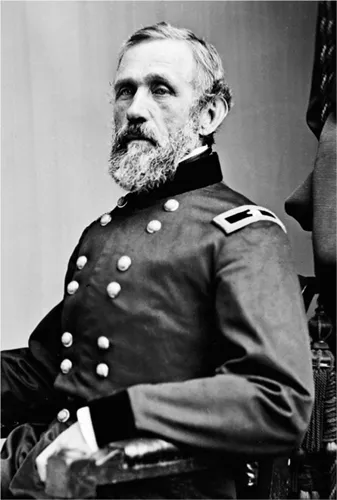
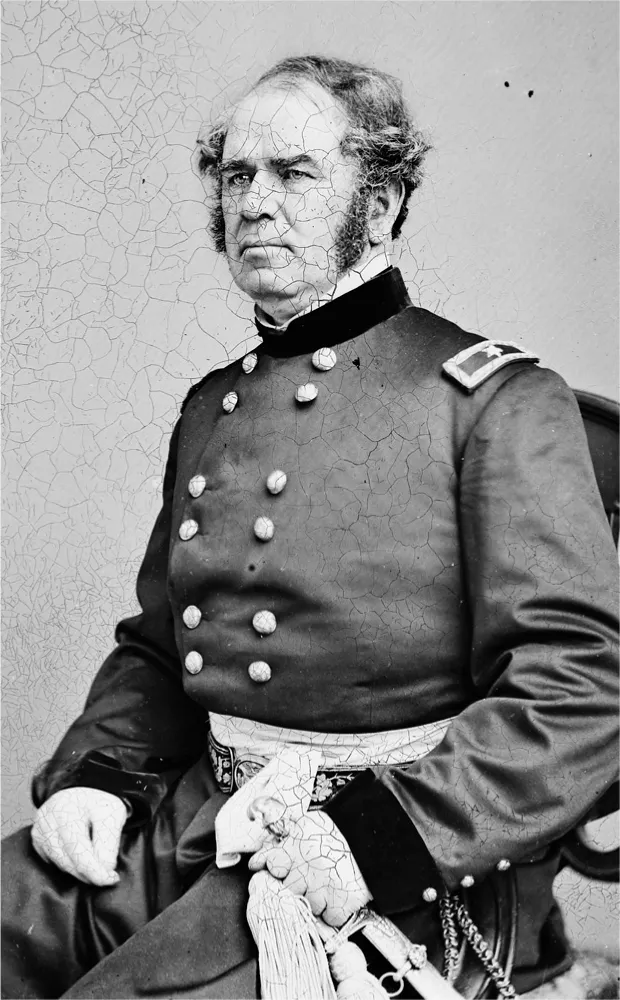
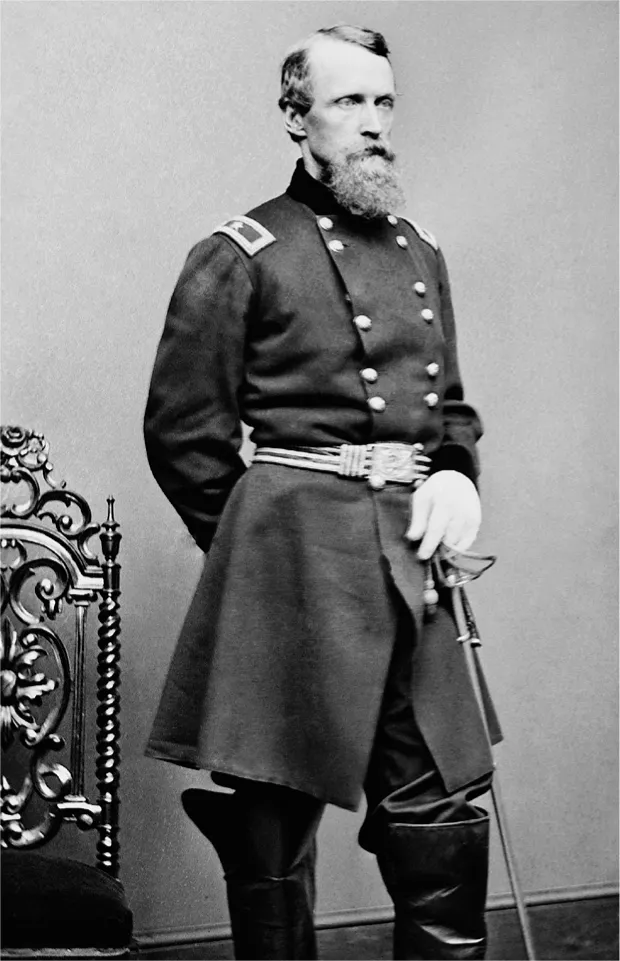
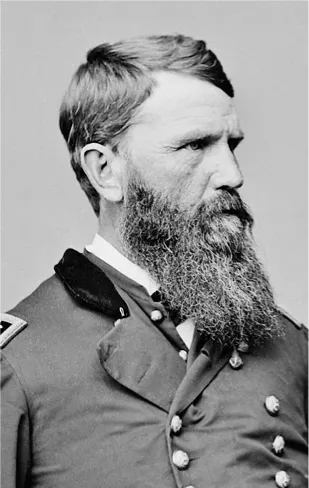
UNION GENERALS
JACOB AMMEN Brigadier general. West Point (1831). Colonel of 24th Ohio Infantry. Served in the western theater, in administrative capacity.
“He is somewhat superstitious. He never likes to see the moon through brush. He is to some extent a believer in dreams.… He is a strange combination of simplicity and wisdom, full of good stories, and tells them against himself with a great deal more pleasure than any others.… He talks incessantly; his narratives abound in episode, parenthesis, switches, side-cuts, and before he gets through, one will conclude a dozen times that he has forgotten the tale he entered upon, but he never does.… After all I have said about General Ammen, it is hardly necessary to remark that he does most of the talking.” —John Beatty, The Citizen Soldier, p. 156, 158
“When on duty, General Ammen was a stern, unbending disciplinarian. When off duty he was ever among his men, listening to their complaints and supplying their wants. No officer in the field was more beloved by the soldiers, and the name ‘Uncle Jake Ammen’ will ever be held in grateful remembrance by thousands of brave men who had the honor to serve under him.” —Whitelaw Reid, Ohio in the War, 1:903
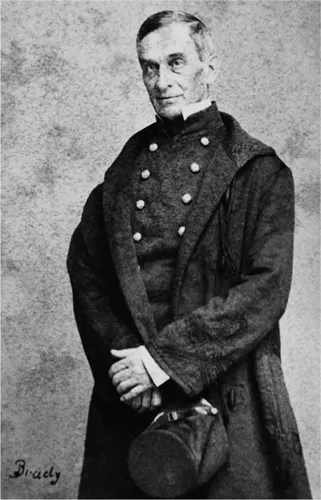
ROBERT ANDERSON Brevet major general. West Point (1825). Veteran of Black Hawk, Seminole and Mexican wars. Commanded Fort Sumter. Commander of Union forces in Kentucky, 1861.
“Of all my acquaintances among men, Anderson had the fewest vices of any one of them. In fact, I doubt if he had any quality which the world ordinarily denominates a vice … In all things he was rigorously temperate and moderate, and he was as honest and conscientious as it is possible for a man to be. He was a pattern of order and method, and worked out his plans slowly. He always had a reason for what he did, and generally he proclaimed his reasons, and his frankness sometimes rubbed me contre poil.” —Erasmus Keyes, Fifty Years’ Observations, p. 367–368
“Anderson … had many ties and associations which bound him to the South. He performed his part like the true soldier and man of the finest sense of honor that he was …” —Jefferson Davis, Rise and Fall, 1:216
GEORGE L. ANDREWS Brevet major general, West Point (1851). Brigade commander, Army of Virginia. Chief of staff to Nathaniel P. Banks in Louisiana.
“Gen’l Andrews I like very much & is really doing the right thing & is very strict, has a school of the officers himself so that the drill shall be uniform in the Corps, putting him at the head instead of Ullman is a change for the better.” —Cyrus Hamlin, Cyrus Hamlin’s Civil War, p. 47
ALEXANDER S. ASBOTH Brigadier general. Hungarian revolutionary. Chief of staff to John C. Fremont in 1861.
“General Asboth was a tall, spare, handsome man, with a gray mustache and a fierce look. He was an educated soldier, of unquestioned courage, but the responsibilities of outpost duty bore rather heavily on him, and he kept all hands in a state of constant worry in anticipation of imaginary attacks. His ideas of discipline were not very rigid either …” —Philip H. Sheridan, Memoirs, 1:168
WILLIAM WOODS AVERILL Brigadier general. West Point (1855). Served on the Plains. Commanded cavalry division in Army of the Potomac.
“It is curious to notice the nicknames that get applied to men in the corps and how obstinately they cling to the person to whom they are applied … In our class there is Swell Averill, very appropriate too for you can not name a subject with which he is not acquainted or tell a story he cannot double, with an AIR, too.” —Cyrus B. Comstock, Diary, p. 162
ROMEYN B. AYRES Major general. West Point (1847). Mexican War veteran. Brigade and division commander, Army of the Potomac.
“Ayres … bluff and gruff at questions about the lateness of his column; twitching his mustache in lieu of words, the sniff of his nostrils smelling the battle not very much afar; sound of heart, solid of force, all the manly and military qualities ready in reserve—the typical old soldier.” —Joshua Lawrence Chamberlain, Passing of the Armies, p. 122
EDWARD BAKER Major general. Lawyer. Black Hawk and Mexican War veteran. U.S. Senator and friend of Abraham Lincoln. Killed at Ball’s Bluff, 1861.
“Baker’s moral and physical courage was so great as almost to entitle him to be called intrepid, and yet in social life, he was the easiest and most amiable of men. He possessed the gift of eloquence to an extraordinary degree, and his perceptions were quick.” —Erasmus Keyes, Fifty Years’ Observations, p. 302
NATHANIEL P. BANKS Major general. Massachusetts Congressman and governor. Commanded Union volunteers in the Shenandoah, 1862 and captured Port Hudson, Louisiana, 1863. Commanded Red River Expedition, 1864.
“Banks has some ready qualities for civil administration, and if not employed in the field or active military operations, will be likely to acquit himself respectably as a provisional or military governor. He has not the energy, power, ability of Butler, nor, though of loose and fluctuating principles, will he be so reckless and unscrupulous.” —Gideon Welles, Diary, 1:210
“With all General Banks’ faults, he had some striking good qualities. He was a gentleman in his manners … He looked well in his uniform, and kept himself always scrupulously neat, though rather theatrical in his style of gloves and boots. With a better surrounding he would have had more success as a general. He had not much force of character, and lacked nerve in time of danger … Banks always preferred to be considered a soldier rather than a statesman. He never had sufficient military force to properly occupy the country under his immediate command, much less to make expeditions into hostile regions.” —David Dixon Porter, Naval History of the Civil War, p. 547
“It is plain from Admiral Porter’s account that Banks is no general, has no military capacity, is wholly unfit for the position assigned him. He has never exhibited military capacity … Banks has much of the demagogue, is superficially smart, has volubility and a smack of party management … Banks is not only no general, but he is not much of a statesman. He is something of a politician, and a party man of his own stamp, and for his own advancement, but is not true and reliable.” —Gideon Welles, Diary, 2:18
“General Banks was a fine representative of the higher order of Yankee … His personal graces were equaled by his energy, and his ability was considerable.” —George A. Townsend, Campaigns of a Non-Combatant, p. 233
“It is well known that Banks always saw things with very largely magnifying glasses when ‘Stonewall’ Jackson was about.” —Jubal A. Early, Narrative of the War Between the States, p. 156
FRANCIS C. BARLOW Major general. New York lawyer. Lieutenant colonel of the 61st New York. Brigade and division commander, Army of the Potomac.
“He looked like a highly independent mounted newsboy; he was attired in a flannel checked shirt; a threadbare pair of trousers, and an old blue kepi; from his waist hung a big cavalry saber; his features wore a familiar sarcastic smile … There, too, was General [David] Birney, also in checked flannel, but much more tippy than Barlow, and stout General [Winfield S.] Hancock, who always wears a clean white shirt (where he gets them nobody knows); and thither came steel-cold General Gibbon, the most American of Americans, with his sharp nose and up-and-down manner of telling the truth, no matter whom it hurts …” —Theodore Lyman, Meade’s Headquarters, p. 107
“He was not at first sight an impressive looking officer. He was of medium height, of slight build, with a pallid countenance, and a weakish drawling voice. In his movements there was an appearance of loose jointedness and an absence of prim stiffness … Francis C. Barlow was a great soldier. He was, in my judgment, fully equal for a corps commander. He knew the details of his business; he had the military instinct; and he was fearless.” —Charles Augustus Fuller, Personnel Recollections of the War of 1861, p. 7
“It’s pleasant and refreshing to meet a man like Barlow among the crowds of mediocrity which make up the mass of an army. Here’s a man who goes into the army and in everything naturally recurs to first principles. The object of discipline is obedience; the end of fighting is victory, and he naturally and instinctively sweeps away all the forms, rules and traditions which … in the hands of incompetent men, ultimately usurped the place of the ends they were calculated to secure … I am more disposed to regard Barlow as a military genius than any man I have yet seen …” —Charles Francis Adams Jr., A Cycle of Adams Letters, 2:167
“General Barlow was still a young man, but with his beardless, smooth face looked even much younger than he was. His men at first gazed at him wondering how such a boy could be put at the head of regiments of men. But they soon discovered him to be a strict disciplinarian, and one of the coolest and bravest in action. In both respects he was inclined to carry his virtues to excess.” —Carl Schurz, Reminiscences, 3:7–8
JOHN G. BARNARD Brevet major general. West Point (1833). Chief engineer, Army of the Potomac.
“Gen. Barnard of the engineers; an ungainly, studious looking man, with a stoop in his shoulders. He is as deaf as a post, extremely ill-bred; vastly book learned and thoroughly unreliable. In fact, a time serving critic and a military pedant, only fit to write disquisitions. Here, he is simply in the way, and he is here, only (as Meade said afterwards) to “make another book” and to try and glean a little credit for himself.” —Theodore Lyman, Meade’s Army, p. 195
JOHN BEATTY Brigadier general. Ohio banker. Brigade commander, Army of the Cumberland.
“General Beatty was never absent, during his entire term of service, from any command to which he had been assigned … He was thoroughly impressed with the duties and responsibilities of his position, and his soldierly reputation was stainless … His power of endurance was wonderful. When occasion demanded he could perform the longest and most fatiguing marches without complaint, and seemingly without suffering the slightest inconvenience from want of food or sleep.” —Whitelaw Reid, Ohio in the War, 1:926
HENRY W. BENHAM Brevet major general. West Point (1837). Mexican War veteran. Chief engineer, Department of the Ohio until 1862. Commanded engineer brigade, Army of the Potomac, 1863–1865.
“I was very glad to hear General Sedgwick speak so highly of General Benham … He said that he considered him the smartest man in the army, although he did not possess so much general information as some others … Although I have got along very well with General Benham, I don’t think I should like to be his adjutant-general permanently. He is not at all well posted in regard to office business, and keeps doing things which are irregular, and the blame of which, if any mischief should ensue, would fall upon the adjutant-general … and from seeing General B. not disposed to stand up for his staff … I feel somewhat anxious … he is very incautious in what he says about others, and censures the acts and abilities and doings of other generals … He is very ambitious, and very conceited … He is unfortunately very quick-tempered, and pitches into officers without giving them the slightest chance to tell their side … he is a man that I have no respect for at all. He loses his temper and becomes so violent that it is ludicrous to see him.” —Stephen M. Weld, War Diary, p. 160, 172, 174, 180, 181
“Benham is to be made the scapegoat for all our misfortunes—and the last is the only item of news which gives us any satisfaction … Everything here but honor has been sacrificed to the fussy incompetence of Benham, the unmilitary amiability of Hunter, and the misplaced philanthropy of Edward L. Pierce …” —Charles Francis Adams Jr., A Cycle of Adams Letters, 1:160
“On Sunday there arrived General Benham, one of the dirtiest and most ramshackle parties I ever saw … You ought to see this ‘Ginral.’ He has the face and figure of Mr. Briggs and wears continually the expression of Mr. B. when his horse sat down at the band of music.” —Theodore Lyman, Meade’s Headquarters, p. 23, 241
DAVID B. BIRNEY Major general. Lawyer and businessman. Brigade, division, and corps commander, Army of the Potomac.
“Birney was one who had many enemies, but, in my belief, we had few officers who could command 10,000 men as well as he. He was a pale, Puritanical figure, with a demeanor of unmovable coldness; only he would smile politely when you spoke to him. He was spare in person, with a thin face, light-blue eye, and sandy hair. As a General he took very good care of his Staff and saw they got due promotion. He was a man, too, who looked out for his own interests sharply and knew the mainsprings of military advancement. His unpopularity among some persons arose partly from his promotion … and partly from his cold covert manner … I always felt safe when he had the division; it was always well put in and safely handled.” —Theodore Lyman, Meade’s Headquarters, p. 266
“In person General Birney was a strikingly handsome man. He was tall, straight and lithe, and of the pure Saxon complexion. His face was remarkably intellectual. His manners were kind and courteous and his voice was as gentle as a woman … esteemed as a man by all who knew him, and honored by his country as one of her best and noblest soldiers.” —Benjamin Butler, Life of David Bell Birney, p. 282
“General Birney is undoubtedly a loss to the army. He was a very good soldier, and very energetic in the performance of his duties. During the last campaign he had quite distinguished himself.” —George G. Meade, Life and Letters, 2:235
FRANCIS P. BLAIR Major general. Lawyer and politician. Brigade division, and corps commander, Army of the Tennessee.
“General Blair joined me at Milliken’s bend … a full-fledged general, without having served in a lower grade...