![]()
CHAPTER 1
KHEIR-ED-DIN
BARBAROSSA,
A.K.A.R EDBEARD
1470s–1546
TWO BROTHERS AND ONE LEGEND WHO CREATED FEAR
AND MAYHEM THROUGHOUT THE MEDITERRANEAN
There were four of them originally. They were all brothers, all pirates at first and then corsairs, which was simply the Mediterranean word for privateer—a pirate with a license to steal. From a single small brigantine they had expanded to a small fleet of galliots, as their light galleys were called. But Elias was long dead now, killed by the corsairing Knights of Rhodes in an attack near Crete, the same attack that left Aruj, the eldest, a galley slave until he was finally ransomed as much as a year later. Isaac, governor of Djerba, Tunisia, was busy building the light galleys necessary for a great expedition. Hizir, the youngest, was a fierce, capable corsair captain.
Yet it was Aruj, the first of the brothers to become a pirate, who was so far the most successful sea rover of them all. Called Barbarossa—Redbeard—by the Italians for the “perfectly red” hair that grew on his face and head, he was now known by this name across the Mediterranean, from the Pillars of Hercules to the Levant. Some, though, said his nickname derived first from the Spaniards who mistook Baba Aruj, as he was known among his followers, as Barbaroja.
In late 1512, Aruj, bloodthirsty “only in battle and cruel only when disobeyed,” saw off his brother Hizir and the nine galleys he gave him to command. Aruj could not lead the cruise, for he was still recovering from a near-mortal wound received while trying to wrest Bougie, a piratical port city in modern-day Algeria, from the Spaniards, who had violently dislodged its ruler. The ousted sultan beseeched the corsairs to restore the city to him, and offered them a reward. After days of bombardment, the force of Turks and Moors finally breached a castle wall, leaving a passage blocked only by men whose blood could easily be spilled by cold Damascus steel. But just as Aruj charged at the head of his Janissaries and North Africans toward the shattered wall, a cannonball carried most of his left arm away and crushed his body and his warriors’ spirit. The corsairs retreated.
Hizir was doubtless glad of his brother’s faith in him. Earlier that year, Aruj had installed him at La Goulette, the fortress of Tunis, which lay next to the salted ruins of Carthage. In retaliation for the capture of a rich Genoese galliot, an overpowering force under the command of forty-four-year-old veteran pirate hunter Andrea Doria made a surprise attack of reprisal on La Goulette, forcing Hizir and his men to flee. Hizir did not lose his Christian slaves, or much else of value except the six galliots he sank so Doria could not capture them, but Aruj was nonetheless furious with his brother. The Genoese had destroyed the fortress, recaptured the rich galliots, and burned or captured any other vessels. The loss of the galleys hurt the corsairs, for they needed them not only for attacks at sea but also to make great expeditions ashore. Only after Hizir sailed to Djerba, the corsairs’ new home port, and ordered three fine new galleys to be built, was his brother appeased.
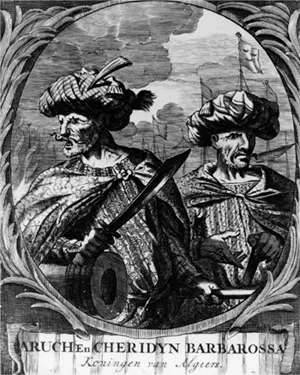
The Barbarossa brothers, Aruj and Hizir, the latter of whom would become known as Kheir-ed-Din—Defender of the Faith. These corsair brethren refined pirate galley tactics and developed North African privateering and piracy into a serious threat across the Mediterranean. The illustration, from a late-seventeenth-century Dutch compendium of naval heroes, was engraved more than a century after the brothers’ deaths and is probably inaccurate. We do know that Aruj’s hair was red, thus the name Barbarossa meaning “Redbeard.” Hizir’s hair was auburn, although he is said to have colored it red with henna after his brother’s death. Private Collection / The Bridgeman Art Library International
“Allah speed us!” the crews of the nine vessels shouted as the galleys pulled away from the port of Djerba, or at least the warriors did. The oars of the light raiding galleys were probably still manned with freemen, warriors all, although within a few decades this would change. Still, the corsairs usually had a larger galley or two manned with slave oarsmen in their company. These slaves, chained to their benches, did only what they were told—and if they were told to shout blessings, doubtless they did. Some may have shouted good wishes out of sincerity. But many oarsmen were captured Christians put to work propelling the larger corsair galleys across the Mediterranean, just as Christians often put captured Muslims to work on their galleys. They wished for nothing more than to be home again.
“Allah give you many prizes!” shouted well-wishers on the shore amid the loud crack of cannons fired to announce the cruising voyage and wish it much success. Among the spectators were fishermen, laborers, owners, and outfitters, as well as soldiers and sailors not departing with Hizir’s expedition. They shouted not only in Turkish and Arabic but also in Lingua Franca, the mix of tongues used by Christians, Muslims, and Jews for trade in the many ports of the Mediterranean. The Ottoman Turks would soon expand into the corsair ports of the Barbary Coast, and the corsair brothers were the cutting edge of the curved conquering sword, although they did not know it yet.
The galleys moved swiftly across the near-placid sea, their brilliantly colored, exquisitely appointed ensigns and banners denoting what these galleys were and what they were after. They were larger than the common small galleys that the Barbary corsairs often used for raids. The corsairs referred to their small galleys as frigates, but the Christians called them brigantines, for they were small craft manned by brigands. Though Hizir’s galleys were larger than the Barbary frigates, they were still smaller than the large heavy Christian galleys, and for this reason the Christians referred to them as galliots rather than galleys. Hizir’s rakish galleys were low, swift, and well-manned. Further, holy men, investors, outfitters, and even corsair wives had blessed the voyage with prayers, incense, and myrrh, and astrologers had sought signs in the heavens that the cruise would be profitable.
But it is sea fighters who actually make a voyage, not those who are left behind. Hizir’s mixed crew, of Turkish Janissaries lured to Barbary by the prospect of riches and a smaller number of local Moors already well acquainted with the riches to be had in the western Mediterranean, were disciplined and experienced, as was Hizir himself. From his brother he had learned to command and fight a galley, and by his side he had bloodied the decks and plundered the holds of European and North African merchant vessels.
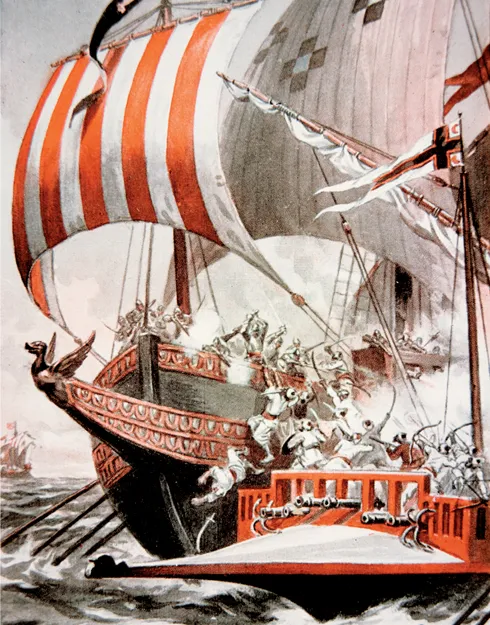
The Barbarossa brothers, led by Aruj, attacking one of two papal galleys in 1504 in this somewhat fanciful nineteenth-century American engraving. The illustration conveys a sense of the difficulties and dangers of boarding a ship under fire. Not only were there the hazards of enemy polearms, swords, arrows, crossbow bolts, and stones, but also of falling into the sea and drowning or being crushed between the two vessels. Typically, an attacking galley would have driven its boarding prow into the side (specifically, into the rails and outriggers) of its prey, rather than “laying it aboard alongside” as is depicted here. Private Collection / Peter Newark Pictures / The Bridgeman Art Library International
DECEPTION, SPEED, AND VIOLENCE
The brothers first great prizes had come not as their first captures had, taken by mere speed of oar and force of arms. Cruising for plunder in 1504, Aruj, perhaps not yet thirty years old, and Hizir, perhaps only twenty-one, lay in wait near the island of Elba, in a single galley, probably flying the colors of Genoa or Marseilles, or of some other Christian port. The island rests between the mainland of northwestern Italy and the island of Corsica, along the trade route from Genoa to the south of Italy. The day was fair, the Ligurian Sea quiet, perfect for vessels swift under oars.
It was not long before they sighted two great Italian galleys flying papal colors—they were obviously vessels of Pope Julius II, sailing from Genoa to Rome and doubtless richly laden. Aruj ordered his men to arms and then waited to see what the leading galley, which rowed distractedly and even “careless, indolently supine, and, according to custom, in very indifferent order,” would do. Given that it lay a fair distance, surely two miles (302 km) or more, ahead of the second, Aruj was cert s could capture it before its consort caught up.
But many among his crew were not as certain. They complained to their captain of the size of the papal galley, and of their own small force, and suggested they would be better off rowing swiftly away than fighting what was doubtless a well-armed galley, for riches were always well protected. Worse, if there were any resistance at all, would that not give time for the second galley to come alongside and slaughter them? Who can fight and win when attacked in force on two sides?
“God forbid,” Arij is said to have thundered at his reticent crew, “that I should ever live to be branded of such infamy!” Immediately he ordered them to throw half or more of their oars overboard, leaving just enough to send the light galley alongside their papal prey. Flight was now impossible, and the lead galley was on a course to intercept the corsairs.
At first, the papal galley rowed casually. It was soon obvious that it had made no preparations for battle and saw no threat in the approaching corsair vessel. Indeed, the papal crew had no idea what it was. Few could recall when Turks and Moors last raided in these seas, and why would pirates venture into these waters where powerful Christian warships were common?
It is difficult to see good detail in faces, clothing, and arms until very close, within 200 or 300 yards (180 or 275 m) even, and in those days the telescope was not in use. Only at close range did the papal galley’s captain and crew discern turbans and scimitars and realize who they faced. Quickly the Italian crew began to make ready for an engagement, but Barbarossa had already ordered his men to attack. They hoisted their true colors, probably Tunisian, and the Islamic crescent created even more fear among the Italians. As quickly as they could, the corsairs rowed their galley with their remaining oars across the short distance. Within 100 yards (91.5 m) they opened fire, sending waves of harquebus lead and arrows into the mass of exposed crew and oarsmen. With these swift projectiles they “killed some Christians, wounded many, and terrified all the rest.”
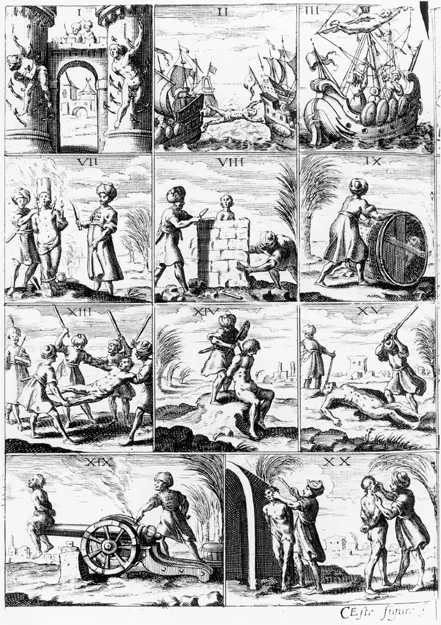
The first of two pages of illustrations, numbering twenty-two in all, of Barbary corsair methods of torture and execution, from Histoire de Barbarie and des Corsaires by Father Pierre Dan, 1637. Such cruelties were not limited to Barbary corsairs. Most states and peoples practiced torture for a variety of reasons, ranging from religious and political intolerance to intelligence collection to the search for plunder. Abuse depicted in this illustration includes impalement on spikes; quartering by four vessels; being used for target practice by archers; burning torches inserted in wounds created for the purpose; internment, leaving only the head exposed; being rolled in a barrel filled with nails; beatings of five or six hundred blows; strangulation by garrote; having one’s bones broken with an iron rod and being left to die; being tied to the mouth of a cannon so that the body is torn apart when the piece is fired; and mutilation of the nose and eyes. © Mary Evans Picture Library/Alamy
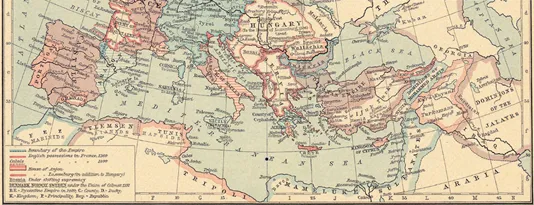
A map depicting the Mediterranean during the late Middle Ages and Renaissance. The Barbary Coast—shown here as the area from Tlemsen to Tripoli—was ideally situated for sea roving. Barbary corsairs had easy access to the coasts, islands, and trade routes that ranged from Spain to Greece. The Barbarossa brothers were based first at Tunis, but later established themselves as rulers of Algiers. From this location they could attack vessels entering or leaving the Mediterranean, and could easily launch expeditions against Spain, France, and the Italian states.
Confusion reigned aboard the papal galley as the bow spur of the corsair galley slipped over the extended oars and pierced the outrigger. The corsairs surged over the spur and aboard the prey vessel, their sleeves drawn up to their elbows, their scimitars in hand, their voices shouting “Allah!” and hurling war cries and promises of bloody slaughter. They gave no quarter to anyone, and would not until the galley surrendered, as was their practice. Both victor and victim were covered in blood as the naked blades rang against opposing arms and armor, as sharp steel carved flesh from bone and limb from body. The broad strokes of the Turkish scimitars and North African swords cut easily, for their sharply curved blades were made for such cutting. The blades need not be drawn or pulled through their living targets in order to cut: the curve of the blades did this for them.
Axes and pikes entered the bloody fray as well, and even stones. Arrows fired at close range from powerful Turkish bows struck one side of a chain-mailed warrior or hapless oarsman and passed right through to the other. It was not long before the crew of the papal galley cried for quarter. By now, the second galley was fast approaching—and this one, seeing the fight, should have been prepared for battle.
Barbarossa immediately, and over the opposition of some of his crew, tried an old trick, one that almost never failed. He ordered the prisoners to be secured below where they could not be seen, released and armed the Turks and other Muslims among the slave oarsmen, and had his crew dress in the clothing of the papal soldiers and crew. His own galley he took in tow, as if it were a papal prize. The approaching galley was unaware of what had happened, although by the time its crew saw the corsair galley in tow, they would have known what was up—or at least what they thought was up.
Within 100 yards (91.5 m) the pirates opened fire, sending waves of harquebus lead and arrows into the mass of exposed crew and oarsmen. With these swift projectiles they “killed some Christians, wounded many, and terrified all the rest.”
If the crew of the second galley had armed itself, it relaxed its guard. If it had not armed, or if it thought about doing so, it was reassured at the sight of the “defeated” galliot in tow. Congratulations were in order, not bloody battle! But fortune forever inclines to the side of the daring and typically scorns those who take things for granted.
As soon as the second galley came near, the corsair sped forward, drove its boarding prow onto the deck of the papal galley, and boarded. The Italians were unprepared for the onslaught, and like the crew of their sister galley, soon surrendered. The capture of both galleys had probably taken less than two hours. Turkish and Moorish corsairs had been known in the Mediterranean for centuries, as had Christian ones. But of late the large European galleys had considered themselves invulnerable to attack by the light brigantines and galliots of the Barbary corsairs. Barbarossa and his brothers had just shown them how wrong they were. And it was only a hint of what was to come.
Later that year the corsair brothers “scoured the coasts of Sicily and Calabria, taking several vessels, and a considerable number of slaves.” In 1505 they captured a large Spanish galley filled with pieces of eight—a new Spanish silver coin—intended for the Spanish garrison at Naples. The galley was leaking badly, its crew exhausted from pumping, its 500 soldiers seasick. It could neither run nor fight effectively. The plunder of silver and slaves increased the renown and naval might of Aruj and his brothers. It was not long before Aruj commanded a fleet of eight galliots, two of whose captains were his brothers. With such a fleet, the brothers quickly grew wealthy, and their fleet and followers even larger. The shares paid out from successful cruises drew as many experienced fighting men as they could use. As common soldiers, Janissaries were paid in small silver coins called akçes. But as successful corsairs, they discovered they could be paid far better, and often in heavy Spanish pieces of eight.
PLUNDERING THE CHRISTIAN COASTS
By the time Hizir took the flotilla to sea in his brother’s place eight years later, in 1512, he had more than a decade, and perhaps as many as two, of experience as a successful corsair—or, as his Christian enemies and even some of the Moors he had raided would say, as a successful pirate. After all, one man’s pirate was another’s corsair. And the fact was, even corsairs, both Muslim and Christian, often stole from those they were not authorized to, if they thought they could get away with it.
From Djerba, Hizir led the nine galliots to the Andalusian coast of Spain, quite possibly seeking profitable revenge for the Spanish shot that took Aruj’s arm, which had now been replaced by one of silver. Along the Spanish coast, Hizir “spread terror wherever he showed himself.” He sacked a town or village and moved quickly on to sack another while Spanish forces raced about, unsure where he was. Those who believed that Andrea Doria had broken the Barbary corsairs were mistaken, although, for now, Hizir would not venture into Italian waters.
As he raided the Spanish coast, his tactics were those of Mediterranean corsairs for centuries before and after, but Hizir had a talent for the timing necessary for surprise. Unless well defended, ships and other vessels at anchor or becalmed were easily taken by these “eagles or queens of the sea,” as corsair galleys were known. With no wind, the prey could not flee.
While attacks ashore were based on surprise, Hizir’s tactics at sea were those of ruse whenever possible. Galleys could row swiftly when necessary, but not for long periods, making a long chase almost impossible except under sail. However, galleys were difficult to spot at sea or along a coastline. They were low vessels, unlike the large, and now often cannon-armed, “round” sailing ships that were spreading across the seas as merchantmen and men-of-war. They had but to lower their sails and they became nearly invisible against the background of the coastline or at even medium distances across the water. And this was a great advantage, as Hizir and his crew knew.
Often, to lure the prey closer, the corsairs lowered the sails of all but a single vessel. A well-armed, well-manned carrack of great tonnage, which towered far above oared vessels, did not fear to approach a solitary galley. It was easily a match for a pirate galley under any circumstance, no...