This colourful and lively history book tells the story of allotments from their origin in the 17th century protests against enclosures to the present day. Will include the effects of the Napoleonic Wars, the Corn Laws, the Diggers, the role of allotments in both World Wars and the present-day revival. The author champions the history of allotments in the hope of protecting them for the future.
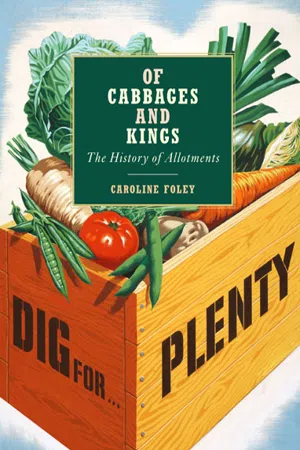
- 224 pages
- English
- ePUB (mobile friendly)
- Available on iOS & Android
eBook - ePub
Of Cabbages and Kings: The History of Allotments
About this book
Information
1. THE SERF & THE COMMONS 1066–1349
‘It is the custom in England, as in other countries, for the nobility to have great power over the common
people, who are their serfs.’
Froissart’s Chronicles (1395)
Medieval Britain lay under a vast canopy of trees – predominantly oaks and ash on the clay downs, with beech on the limestone of the hills. Gradually, though, the virgin forest was being cleared by fire and axe. In the clearings, there were hamlets or small crudely built villages, mostly with fewer than one hundred inhabitants, sometimes only fifty. Depending on the terrain, there were fields for pasture and areas of common land, where the villagers had their plots. On the plains, these ‘commons’, as they were known, stretched as far as the eye could see from the small nuclear village. They were divided into seemingly random strips and resembled an allotment site on a giant scale.
The commons of the medieval landscape were the precedent for the allotments provided centuries later. They were an accepted right at a time when society was deeply agrarian and all looked to Mother Earth for sustenance in one way or another. A plot on which to grow food was a crucial part of life for the peasant. It could make the difference between life and death, and was safeguarded by the custom of centuries.
Although land for the peasants is known to have preceded written records, the arrival of William the Conqueror in British history marks a good starting point to this story. Despite his reputation as a tyrant, William I was an able administrator. He introduced a formal structure to society, where everyone, from the highest to the lowest, had their own secure place and clearly defined rights, enshrined in the law of the manor courts.
The Norman Conquest & the manor
After his 1066 victory in the Battle of Hastings, William, with his archers and crack horsemen, swept through England, taking ownership of the Anglo-Saxon estates. King Harold’s troops, fighting on foot, had been no match for the Normans, whose warhorses were percheron stallions. Their cavalrymen rode with spurs for speed and had stirrups – the latest novelty – to help steady their aim. Battleaxes, stones and a few bows and arrows were easily defeated by spear, lance and sword. The south of the country crumbled quickly. The north, which was under the Danelaw, made the mistake of holding out. William’s swift and terrible vengeance in 1069 became known as the Harrying of the North. Villages were razed and populations massacred between York and Durham. Of those who escaped slaughter, many starved or gave themselves up as slaves.
Harrying of the North
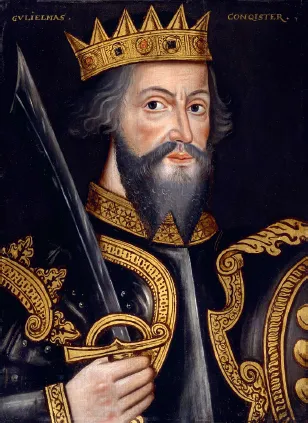
William the Conqueror introduced manorialism, in which all, even the most humble serf, had a share in the land.
William swore at his coronation that he would keep the existing laws. At the same time, he introduced manorialism, the feudal system widely practised across Europe in which the king, divinely appointed, owned all the land himself. William, having confiscated the estates of the ‘traitor thegns’ of the old regime, distributed them to his friends among the Norman aristocracy. They in turn divided up their land further and offered tenancies to the Norman knights who had distinguished themselves in battle and proved their loyalty to the king. The barons and knights, in return for holding land, would raise armies, fight wars and put down rebellions. They built motte-and-bailey castles for defence and as symbols of power. William built the Tower of London as his personal city fortress.
The nobles were handed out several manors in different parts of the country. In this way, and as they were often abroad fighting, it was ensured that none could be on all their estates at one time and become too powerful. While away, they entrusted the management of the manors to the sheriffs. These were French-speaking men of baronial rank who could if necessary be removed by the king. William’s aim was nulle terre sans seigneur – no land without its lord.
The manor was the unit of land at the heart of the feudal system, usually consisting of a lord’s demesne and lands rented to tenants. However, manors varied in structure. In the Midlands the land usually centred on the nucleated village, where houses, church and a single manor were clustered together. In Norfolk it was not unusual to find four manors to one village, whereas in the west of England there might be one manor for four villages and possibly a town. In some areas the uncultivated ‘wastes’ were so huge that they were shared by many manors and had no known boundaries. The 24,000 hectares/60,000 acres of the New Forest were shared by twenty-one villages. The main grain-growing areas were the lowlands of Yorkshire, Lancashire, Cambridgeshire, the Midlands and the central-south areas of England. These were farmed largely as ‘champion land’, with big open fields stretching for hundreds of acres.
Feudal hierarchy
The manorial system was at is most powerful between the middle of the twelfth and fourteenth centuries. The hierarchy of the feudal manor consisted of king, the Norman nobility, knights, and the clergy. William had replaced all key posts in the Church, which included the archbishops, bishops and abbots, with his own appointments. He Latinized the liturgy and, indebted to the Pope for sanctioning his Holy War against England, gave the Church a fifth of the land in England. One result of this was an architectural renaissance and the building of many churches and monasteries in the Romanesque style.
The peasants, 85 per cent of the population, were on the lowest rung of society. Most worked on the lord’s demesne, the manorial land reserved for his own use. Among the peasantry was a further hierarchy. The freemen, yeomen and husbandmen were, often enough, independent smallholders. They paid rent for the land but had few obligations to the lord apart from jury service at the manor courts, overseeing the workers at harvest time and loaning their draft animals, farm equipment or carts as needed. Below them, the serfs and slaves had little or no freedom. They were part of the lord’s chattels and therefore could be bought and sold. They were obliged to work for him and commit their heirs to serfdom. The lords, for their part, undertook to protect their serfs from marauders, to provide justice and some land for their subsistence.
Villeins & serfs
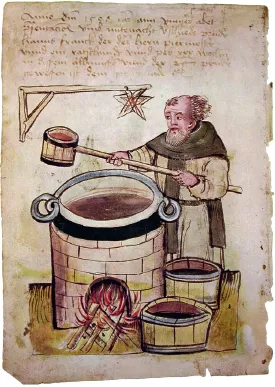
A medieval monk brewing ale. The Church had huge influence, while the clergy dominated feudal society and demanded tithes.
The largest category of serfs were the villeins. Among them were skilled workers – ploughmen, carters, blacksmiths, basket weavers, carpenters, bakers, shepherds, ironmongers, beekeepers, millers, swineherds and the like. Then came the unskilled bordar or cottar, the cottager. He might only have just enough land to feed his family, so had to pay his dues in extra labour for the lord. Lowest of all was the slave. He owned nothing but ‘his belly’ and was dependent on handouts from the landlord in return for his service. The ‘unfree’ peasants were not allowed to leave the estate without permission. Some may have absconded, since the law stated that an escapee who remained undiscovered for a year and a day could claim to be a freeman. However, it was dangerous to strike out for independence. Vagrancy was considered a crime and was severely punished.
According to the Domesday Book of 1086, the peasant population was made up of 12 per cent freemen, 35 per cent villeins, 30 per cent cottagers and 9 per cent slaves. It also recorded the resources of each and every shire in minute detail, so none might escape the king’s taxes. An Anglo-Saxon chronicler remarked of King William: ‘So narrowly did he cause the survey to be made, that there was not one single hide nor rood of land, nor – it is shameful to tell but he thought it no shame to do – was there an ox, cow or swine that was not set down in the writ.’
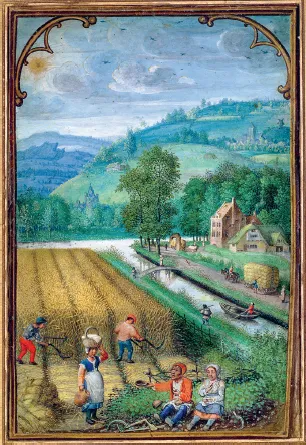
In August or September the whole family was pressed into ‘boon works’. The wheat was chopped down with a sickle or reap hook. This picture is taken from the 1540 Book of Hours.
The serf paid rent for his strips on the common land in labour, kind or coin – for example, by handing over a proportion of his harvest. Arrangements varied on different manors and according to the size of the serf’s shares in the land, and payment could involve a mixture of elements. There was a further fee, known as a merchet, when his daughters married, and a heavier one if he wanted to send a son to school or to a priest to get some education. When a peasant died, the lord was entitled to his first beast and the Church took second pick as a heriot, or mortuary tax. Livestock, precious to the peasants, was often used to provide dowries and bequests. A share was expected for the lord of the manor when a farm animal was sold. If a peasant wanted to keep poultry, a hen or eggs were required as payment. Rents paid in kind as food were usually payable in the form of chickens at Christmas, eggs at Easter and grain at Martinmas on 11 November. Peasants were obliged to use the master’s mill, and both pay and give him a multure, a proportion of the flour.
Further payment was due for the peasant’s pigs to root for acorns in the forests, and there was a fine if his beasts strayed. By contrast, the lord’s bulls, rams and wild boar could wander freely, helping themselves to crops and mates. The lord had jus faldae – the right to fold all the manorial sheep on his own land so the manure would enrich the soil of his fields. The ‘tallage at will’ was a tax that could be imposed by the lord at whim. In the twelfth century this was modified, so that the amount and frequency were controlled by the ‘custom of the manor’.
Church tithes
In addition to the heavy set of dues and services owed to the lord, the serfs were obliged to work free of charge for the Church and pay tithes, a tax of one-tenth of annual earnings or produce, right down to their vegetables and goose feathers. The tithes were locked up in the hated tithe barns. Along with the magnificent priories and abbeys, these buildings demonstrated the power and wealth of the Church Militant. There were also Mass pennies to be found for the parish church, which serfs would attend on Sundays, Saints’ Days (when spared from work), at Christmas, Easter, and for baptisms, marriages and funerals. Wandering friars, pilgrims and wayside crosses in every village were potent daily reminders of Heaven and Hell. Most parish churches had attached to them glebe land, otherwise known as ‘church’s furlongs’ or ‘parson’s closes’; this was provided as a source of income for the clergy, who would be competing with the peasants at market.
Chaucer’s priest was an exception to the general rule. Unusually, he was a villein himself, a shepherd and ‘holy man of good renown’ who was reluctant to collect the tithes.
He did not set his benefice to hire
And leave his sheep encumbered in the mire,
Or run to London to earn easy bread
By singing masses for the wealthy dead,
Or find some brotherhood and get enrolled.
He stayed at home and watched over his fold.
A serf’s life
The cottager’s house was typically timber-framed, built on a cruck structure in which two upturned V-shaped trees, usually oak, were secured at the top to a ridge pole. The roofs would be thatched with straw or rushes, and the wattle walls pierced with a hole for a window. Mud floors would be covered with straw. At night the farm animals would be brought in to protect them from theft, bears and wolves. Smoke from the fire would escape through a hole in the roof.
Bread and a potage of beans and grain was the peasant’s staple diet. Whereas their masters ate refined white bread, the peasants ate a coarser type made of mixed wheat and rye, or maslin. In areas where wheat was not grown, bread was made from oats instead. When times were hard, flour would be made out of peas and beans, an important crop for winter stores; or, when truly desperate, from acorns. Paupers and cottagers were usually permitted to scavenge through the pea and bean fields after harvest, to collect any seeds overlooked. Drinking water was often contaminated as slops went into the same source. The peasants, including children, mostly drank weak beer, or ‘small ale’, brewed at home.
The Great Famine
In 1315–1317 the Great Famine struck, followed by further devastating famines in 1321, 1351 and 1369. Many died of starvation. The lack of food was caused by cold, rainy summers when there was not enough sunshine to rip...
Table of contents
- Cover
- Title Page
- Dedication
- Contents
- Prologue
- Introduction
- 1. The Serf & the Commons 1066–1349
- 2. Black Death, Poll Taxes & the Peasants’ Revolt
- 3. Wool, the Theft of the Commons & the Parish Workhouse 1500–1800
- 4. The Fight for the Right to Dig & the Agricultural Revolution 1500–1780
- 5. Parliamentary Enclosures & the First Allotment Movement 1750–1850
- 6. William Cobbett & the Swing Riots of 1830 1791–1830
- 7. Land, the Labourers’ Friend & the Second Allotment Movement 1832–1914
- 8. Industry, Popular Protest & How Allotments Left the Country for the City 1800–1914
- 9. Digging For DORA – Allotments & the War Effort 1914–1918
- 10. The Depression, the Quakers & Allotments for the Miners 1918–1939
- 11. Digging For Victory 1939–1945
- 12. Post-war Doldrums & the Green Revolution 1945 to the 21st century
- Epilogue
- Further Reading
- Timeline
- Acknowledgments
- Index
- Copyright
Trusted by 375,005 students
Access to over 1.5 million titles for a fair monthly price.
Study more efficiently using our study tools.
Frequently asked questions
Yes, you can cancel anytime from the Subscription tab in your account settings on the Perlego website. Your subscription will stay active until the end of your current billing period. Learn how to cancel your subscription
No, books cannot be downloaded as external files, such as PDFs, for use outside of Perlego. However, you can download books within the Perlego app for offline reading on mobile or tablet. Learn how to download books offline
Perlego offers two plans: Essential and Complete
- Essential is ideal for learners and professionals who enjoy exploring a wide range of subjects. Access the Essential Library with 800,000+ trusted titles and best-sellers across business, personal growth, and the humanities. Includes unlimited reading time and Standard Read Aloud voice.
- Complete: Perfect for advanced learners and researchers needing full, unrestricted access. Unlock 1.5M+ books across hundreds of subjects, including academic and specialized titles. The Complete Plan also includes advanced features like Premium Read Aloud and Research Assistant.
We are an online textbook subscription service, where you can get access to an entire online library for less than the price of a single book per month. With over 1.5 million books across 990+ topics, we’ve got you covered! Learn about our mission
Look out for the read-aloud symbol on your next book to see if you can listen to it. The read-aloud tool reads text aloud for you, highlighting the text as it is being read. You can pause it, speed it up and slow it down. Learn more about Read Aloud
Yes! You can use the Perlego app on both iOS and Android devices to read anytime, anywhere — even offline. Perfect for commutes or when you’re on the go.
Please note we cannot support devices running on iOS 13 and Android 7 or earlier. Learn more about using the app
Please note we cannot support devices running on iOS 13 and Android 7 or earlier. Learn more about using the app
Yes, you can access Of Cabbages and Kings: The History of Allotments by Caroline Foley in PDF and/or ePUB format, as well as other popular books in Law & Environmental Law. We have over 1.5 million books available in our catalogue for you to explore.