The powerful German counteroffensive operation code-named “Wacht am Rhein” (Watch on the Rhine) launched in the early morning hours of December 16, 1944, would result in the greatest single extended land battle of World War II. To most Americans, the fierce series of battles fought from December 1944 through January 1945 is better known as the “Battle of the Bulge.” Almost one million soldiers would eventually take part in the fighting. Different from other histories of the Bulge, this book tells the story of this crucial campaign with first-person stories taken from the authors’ interviews of the American soldiers, both officers and enlisted personnel, who faced the massive German onslaught that threatened to turn the tide of battle in Western Europe and successfully repelled the attack with their courage and blood. Also included are stories from German veterans of the battles, including SS soldiers, who were interviewed by the authors.
eBook - ePub
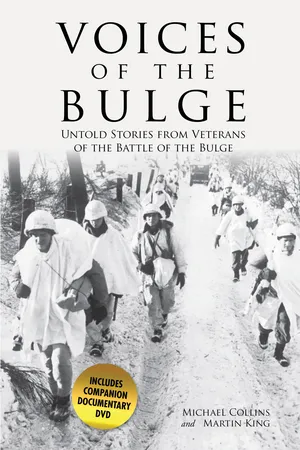
Voices of the Bulge
Untold Stories from Veterans of the Battle of the Bulge
- 320 pages
- English
- ePUB (mobile friendly)
- Available on iOS & Android
eBook - ePub
Voices of the Bulge
Untold Stories from Veterans of the Battle of the Bulge
About this book
Information
CHAPTER ONE
THE CENTER OF A STORM
16 DECEMBER 1944
IT’S FAIR TO SAY that Col. Count Claus Schenk von Stauffenberg probably provided some of the impetus behind Hitler’s plans to mount a counteroffensive in the west. Hitler’s relations with his generals had never been particularly amiable, but after the failed attempt on his life at the Wolfsschanze (Wolf’s Lair) near Rastenberg, they were understandably at an all-time low. The whole system of command control that worked so well at the outbreak of World War II had started to disintegrate. In fact, it had been going downhill since the Battle of Stalingrad. It was while recovering from the abortive attempt on his life orchestrated by von Stauffenberg on July 20, 1944, that Hitler began to ruminate on the possibility of striking back at the Allies who had waded ashore just forty-five days earlier. Der Fuehrer had escaped the assassination attempt with minor injuries and been ordered to bed by his physicians, and although Hitler made the first announcement of the projected counteroffensive in the Ardennes during the meeting on September 16, the idea had been festering in his mind for some weeks prior to that date. August was a nightmare for German forces in the west. Shattered by the weight of Allied guns and armor, hunted and hounded along the roads by the unopposed Allied air forces, captured and killed in droves, there was no doubt that the German forces in France had been routed and were now regarded by many Western commanders as a spent force.
In September, the British and Americans could mount a daily bomber attack of over five thousand planes, but the German will to resist and the means of resistance, so far as then could be measured, remained quite sufficient for a continuation of the war. Patton himself said, “There are still six million Germans that can pick up a rifle.” He, for one, knew that the war was far from over.
For the second time in a century, Germany found itself fighting and maintaining a war on two fronts. The strategic and operational problem posed by this was almost as old as Germany itself and had been often analyzed, with solutions previously proposed by the great German military thinkers Helmuth von Moltke, Alfred von Schlieffen (who masterminded the invasion of Belgium in 1914), and Erich Ludendorff. Moltke and Schlieffen, traveling by the theoretical route, had arrived at the conclusion that Germany lacked the strength to conduct successful offensive operations simultaneously in the east and west. The Reich’s famous tank commander, Heinz Guderian, the man who could choreograph tank movements with the precision of a ballet, sincerely believed that the war would be settled in the east, whereas OKW (Oberkommando der Wehrmacht—the high command of the Third Reich armed forces), with its chiefs Wilhelm Keitel and Alfred Jodl, saw the Western Front as the paramount theater of operations. Whatever the opinions of his generals were, there is no doubt that Hitler personally lacked many of the qualities he needed to organize and control military affairs with consistent success. That said, Hitler’s operational decisions, especially early in the war, were often as good as, or better than, those of his generals. He was, after all, one of the two men who first thought up the campaign plan that the German army used against France with such stunning success in 1940.
Nevertheless, Hitler took the practice of personal command much too far. No military leader could hope to understand the realities of the situation on the ground from hundreds of miles away, and yet he came to believe that he could control all but the smallest units at the front. Hitler started the war using the highly effective system of “command control.” Operation Eben Emael and ensuing invasions both to the east and the west proved that the system worked. The whole premise of command control was being able to delegate, to have sufficient faith in the competence of your generals to be able to perform their allocated tasks, but by the end of 1942, it began to disintegrate. For example, during the Battle of Stalingrad, Hitler actually had a street map of the city spread out before him so that he could follow the fighting, block by block. After the plot to assassinate him failed, Hitler became even more paranoid and unpredictable. The problem was complex; so were Hitler’s mental processes. Hitler was a leader who never found himself distracted or restrained by the facts and who, by nature, clung to an almost mystic confidence in his own strategic ability. He thought that defeat could be postponed and perhaps even avoided by some decisive stroke. To this configuration of circumstances must be added Hitler’s implicit faith that the course of conflict might be reversed by his military stroke of genius.
Hitler made the first announcement of the projected counteroffensive in the Ardennes during the meeting of 16 September 1944. It’s a well-recorded fact that during the meeting he asked Herman Goering precisely how many aircraft he could get into the air to support this offensive. “Three thousand, mein Fuehrer,” replied Goering, to which Hitler retorted with a somewhat sardonic smile, “I think that two thousand will be enough.” Is it remotely possible that both of them knew that both of these numbers were unfeasible at that time? There is no simple or single explanation for Hitler’s choice of the Western Front as the scene of the great German counterstroke, but nevertheless he had already cast the die.
It was obvious that Hitler was going to do his best to protect the Ruhr area of western Germany because this was the heart of German military production, a fact the Allies knew all too well. Even after the disastrous 1944 Soviet summer offensive, Hitler clung to the belief that the Ruhr factories were far more important to Germany than the loss of territory in the east. Then, too, in the summer and early autumn of 1944, Allied air attacks against the Ruhr had failed to deliver any succession of knockout blows. The very real vulnerability of this area was not yet apparent to Hitler, despite the fact that the hallowed “Siegfried Line” had been breached in the Hürtgen Forest.
Notwithstanding the somber and often despairing reports prepared by western commander Walther Model and his successor, Gerd von Rundstedt, during late August and early September, Hitler and his intimate staff in the East Prussian headquarters continued to give thought to a decisive attack in the west. Sometime around September 6, Jodl gave the Fuehrer an evaluation of the situation inherited by Rundstedt. The task at hand was to withdraw as many troops from the line as possible, refit, and re-form units. As a first step the SS Panzer divisions in the west were ordered out of the line and turned over to a new army headquarters, that of the Sixth Panzer Army. On the scale required, this work could not be completed before the first day of November. Since he was probably listening to a clearer phrasing of his own oblique concept, Hitler agreed to the withdrawal, on the condition that the battlefront be kept as far to the west as possible. The reason, expressed apparently for the first time, was that the Allied air effort needed to be kept at a distance from the Rhine bridges or the consequences might be disastrous. Did Hitler fear that fighter-bombers operating from fields in France or Belgium might leave the Rhine crossing complex stricken and incapable of supporting the line of communications to the armies then on the left bank of the Rhine? Or did he foresee that the Rhine bridges would be systematically hammered in an effort to strangle the German bid for the initiative when the day for the counteroffensive came?
Why did Hitler choose the Ardennes as the location for the proposed counteroffensive? To answer this question simply, the Ardennes would be the scene of a great winter battle because the Fuehrer had placed his finger on a map and made a pronouncement. There was also a historical precedent to this decision, since the German army had used this route before, in 1870 at the beginning of the Franco-Prussian War, in 1914 as part of the von Schlieffen plan, and again in 1940. Nevertheless, it’s safe to say that these considerations were not paramount in Hitler’s mind at that particular time. It is possible, however, that Hitler had discussed the operational concept of a counteroffensive through the Ardennes with Jodl before the September 16 edict. The relationship between these two men has bearing on the entire “prehis-tory” of the Ardennes campaign.
Clear evidence indicates that Jodl and a few of his subordinates from the Wehrmacht operations staff did examine the Ardennes concept very closely in the period from September 25, when Hitler gave the first order to start detailed planning, to October 11, when Jodl submitted the initial operations plan. Other less certain evidence indicates that those present in the conference on September 16 were taken by surprise when Hitler made his initial announcement. Jodl definitely ascribes the selection of the Ardennes to Hitler and Hitler alone, but at the time Jodl expressed this view he was about to be tried before an international tribunal on the charge of preparing aggressive war. Even so, the “argument from silence”—the fact that there is no evidence of other discussion about the Ardennes as the point of concentration prior to Hitler’s statement on September 16—has some validity.
The most impressive argument for ascribing sole authorship of the Ardennes idea to Hitler is found in the simple fact that every major military decision in the German High Command for months past had been made by the Fuehrer, and that these Hitler decisions were made in detail, never in principle alone.
The major reasons for Hitler’s selection of the Ardennes were as follows:
• Hitler ruled out the Alsace-Lorraine area because of the Third Army/Patton’s armor and the Meuse River.
• The enemy front in the Ardennes sector was very thinly manned. A normal division front in 1944 was about five miles, but some divisions in that particular area, such as the 106th, found themselves guarding up to twenty-five miles.
• A blow here would force a breach between the British and the Americans and lead to political as well as military disharmony between the Allies. Furthermore, an entrance along this breach would isolate the British 21st Army Group and allow for the encirclement and destruction of the British and Canadians before American leadership (particularly the political leadership) could react.
• The distance from the jump-off line to a solid strategic objective (Antwerp) was not too great and could be covered quickly, even in bad weather. The only serious natural obstacle was the river Meuse that runs from north to south through the Ardennes.
• Ground for maneuver in the Ardennes area was limited and would therefore require the use of relatively few divisions.
• The terrain to the east of the breakthrough sector selected was very heavily wooded and offered good cover against Allied air observation and attack during the build-up for the assault.
• An attack to regain the initiative in this particular area would erase the enemy ground threat to the Ruhr.

Walther Model was the only general who openly criticized Hitler’s plan to attack the Allies in the west. Hitler was convinced the war could still be decided in the Reich’s favor by fighting in that direction. For many months, he and his closest advisors had worked to reorganize and re-equip the beaten divisions streaming back to Germany on both fronts. A massive surprise counterattack—deceptively code-named “Wacht am Rhein” (Watch on the Rhine)—against the weakly held Ardennes sector of the American front was prepared.
These were all the reasons Hitler needed. Meanwhile Gen. George Patton waited with his Third Army in the Alsace on the assumption that this was where the German army would strike back. Patton, who had often professed that he knew his military history, obviously had not studied contemporary history quite closely enough. If he had done so, he would have recognized that the German army had used the route through the Ardennes before, on no less than three occasions (as detailed previously). Never before had there been such polarity of opinions about one general’s ability. To put it simply, the armored divisions venerated Patton while the infantry vilified him. Nevertheless, he was to play an integral role during Hitler’s attack in the west.

One of the critical problems facing Gen. Dwight D. Eisenhower on the eve of the Battle of the Bulge was a severe shortage of infantrymen. By December 15, Gen. Omar Bradley reported that his army group lacked 17,000 riflemen because of casualties caused by prolonged combat and almost constant exposure to one of the severest winters Europe had ever known. Although Eisenhower ordered the reclassification as infantrymen of as many support personnel as possible, the shortfall continued to grow. The Ardennes-Alsace Campaign only worsened matters, while the Selective Service System in the United States could not close the increasing manpower gap. In response to this, Eisenhower made a momentous decision. Previously, most African-American soldiers in the European theater had been assigned to service units. Now these troops were permitted to volunteer for duty as combat infantrymen, with the understanding that after the necessary training, they would be committed to frontline service. Eventually, some 2,200 were organized into fifty-three platoons and assigned to all-white rifle companies in the two U.S. Army groups. The exigencies of combat had temporarily forced the Army to discard its policy of segregating white and black soldiers. Further on in this volume there are other references to the “invisible” African-American soldiers who fought just as bravely as their white counterparts on the Bulge. The German army was not going to regard them as equals, though.
During the first morning of the Battle of the Bulge, the northern shoulder area of the Bulge, which extended into Germany, contained parts of both the British and American armies.
Robert Kennedy was a member of XIX Corps, which was positioned in the northern area of the Bulge, just outside of Aachen, Germany. Aachen was the first German town to be attacked by the Allied army. Kennedy was a German translator/ interrogator, and later he joined the 65th Division.
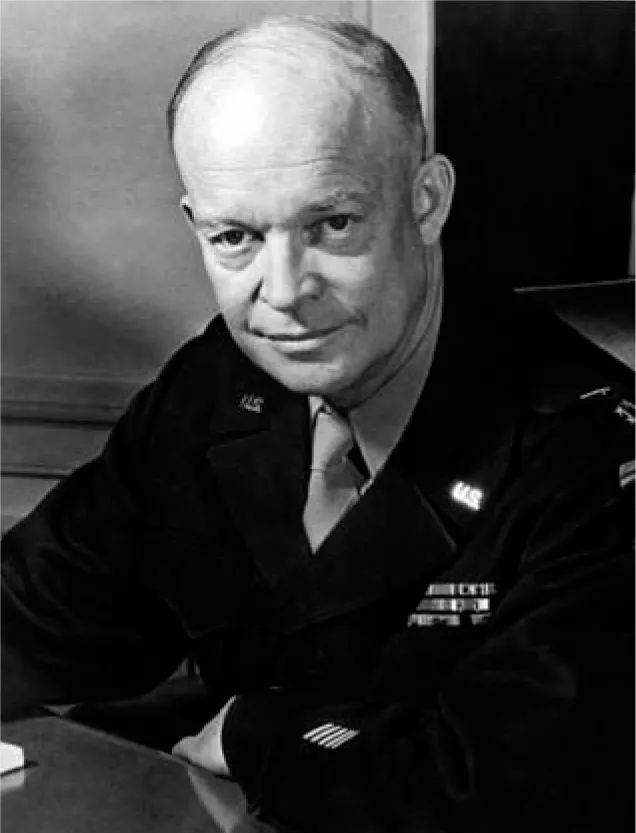
The son of a devoutly pacifist mother, Dwight D. Eisenhower was appointed Supreme Commander of the Allied Expeditionary Forces in December 1943. By mid-December, Eisenhower’s forty-eight divisions were distributed along a six-hundred-mile front that stretched from the North Sea to Switzerland.
Robert Kennedy: I was there the first morning that we got the surprise attack. We got up and were near Aachen, just outside the town in a suburban area. The front was just down a little ways. We heard all this firing and wondered what it was, and it was German firing. They were firing over our heads back at the replacement depots, and they had a lot of heavy artillery. Then we found out that the Germans had passed us over and made a turn and presented a front to the south. We were strung out east and west, and back behind us were the British, who were facing the German front. In fact, before we came out of the sack, we heard the firing, and I recall a lot of firing. It was miserably cold morning, and the streets were terrible with ice.
There was nothing much we could do because we did not know what was going on, and they did not advance toward us, just toward the frontlines.

WHEN THE BULGE BROKE, the soldiers of the XIX Corps were just outside of Aachen, and even though they did not deal with the first wave of the German attack, they were still part of the Bulge. With the British positioned behind them, the responsibility of the XIX Corps was to make sure the German army did not try to swing northward to get to the Meuse River via Aachen, Germany. The first artillery volleys by the German army were audible to these Allied soldiers, demonstrating how large the offensive really was. As John Hillard Dunn, Company H, 423rd Regiment, 106th Division wrote: “The vortex of a tornado is a vacuum. And that is where we were—in the center of a storm of armor and artillery roaring into the Ardennes.” The eerie silence that pervaded those rolling hills out on the frozen Schnee Eifel...
Table of contents
- Cover
- Title Page
- Contents
- List of Maps
- Prologue
- Preface
- Chapter 1 The Center of a Storm 16 December 1944
- Chapter 2 The Offensive and the Atrocities 17 December 1944
- Chapter 3 We’re On the Move 18 December 1944
- Chapter 4 A Rock and a Hard Place 19 December 1944
- Chapter 5 Fighting Back 20 December 1944
- Chapter 6 Digging In and Holding On 21 December 1944
- Chapter 7 Our Worst Enemy 22 December 1944
- Chapter 8 Siege, Relief, and Strife 23 December 1944
- Chapter 9 Christmas Eve on the Bulge 24 December 1944
- Chapter 10 Christmas Day on the Bulge 25 December 1944
- Chapter 11 Breakthrough 26 December 1944
- Chapter 12 It Isn’t Over Yet 27 December 1944
- Chapter 13 The End Game 28 December 1944–End of January 1945
- Postscript
- Sources
- Index
- Dedication
- Acknowledgments
- Copyright Page
Trusted by 375,005 students
Access to over 1.5 million titles for a fair monthly price.
Study more efficiently using our study tools.
Frequently asked questions
Yes, you can cancel anytime from the Subscription tab in your account settings on the Perlego website. Your subscription will stay active until the end of your current billing period. Learn how to cancel your subscription
No, books cannot be downloaded as external files, such as PDFs, for use outside of Perlego. However, you can download books within the Perlego app for offline reading on mobile or tablet. Learn how to download books offline
Perlego offers two plans: Essential and Complete
- Essential is ideal for learners and professionals who enjoy exploring a wide range of subjects. Access the Essential Library with 800,000+ trusted titles and best-sellers across business, personal growth, and the humanities. Includes unlimited reading time and Standard Read Aloud voice.
- Complete: Perfect for advanced learners and researchers needing full, unrestricted access. Unlock 1.5M+ books across hundreds of subjects, including academic and specialized titles. The Complete Plan also includes advanced features like Premium Read Aloud and Research Assistant.
We are an online textbook subscription service, where you can get access to an entire online library for less than the price of a single book per month. With over 1.5 million books across 990+ topics, we’ve got you covered! Learn about our mission
Look out for the read-aloud symbol on your next book to see if you can listen to it. The read-aloud tool reads text aloud for you, highlighting the text as it is being read. You can pause it, speed it up and slow it down. Learn more about Read Aloud
Yes! You can use the Perlego app on both iOS and Android devices to read anytime, anywhere — even offline. Perfect for commutes or when you’re on the go.
Please note we cannot support devices running on iOS 13 and Android 7 or earlier. Learn more about using the app
Please note we cannot support devices running on iOS 13 and Android 7 or earlier. Learn more about using the app
Yes, you can access Voices of the Bulge by Michael Collins,Martin King in PDF and/or ePUB format, as well as other popular books in History & Military & Maritime History. We have over 1.5 million books available in our catalogue for you to explore.