You know that Rome wasn't built in a day, but just how did a cluster of small hilltop villages expand to become one of the greatest empires in history? Why did Romulus kill his brother Remus? How was a legion organized? Did people really speak Latin? What entertainment could you see at the Colosseum? And what was daily life like for a Roman citizen? This book takes a novel approach to answering all these questions and more. 30-Second Ancient Rome presents a unique insight into one of the most brilliantly governed societies, where military might and expansive empire paved the way for technological advances that helped shape our modern existence. From aqueducts to sewers, from mosaics to medical diagnoses, this is the straightest road toward understanding the 50 key innovations and ideas that developed and defined one of the worlds great civilizations.
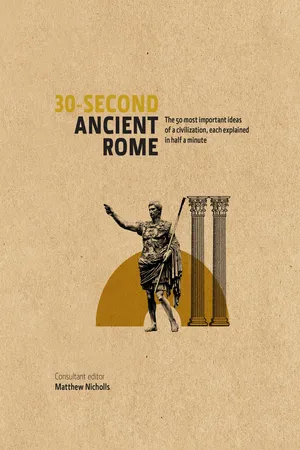
eBook - ePub
30-Second Ancient Rome
The 50 Most Important Achievements of a Timeless Civilization, each Explained in Half a Minute
- 160 pages
- English
- ePUB (mobile friendly)
- Available on iOS & Android
eBook - ePub
30-Second Ancient Rome
The 50 Most Important Achievements of a Timeless Civilization, each Explained in Half a Minute
About this book
Information

ARCHITECTURE, MONUMENTS & ART
ARCHITECTURE, MONUMENTS & ART
GLOSSARY
basilica Aisled halls, often found in the forum of a Roman town, using for banking, law courts, and other civic business.
“bread and circuses” panem et circenses—a shorthand for the emperors’ generosity toward the urban population of Rome through the provision of cheap food and free entertainment.
capital The topmost element of a column, between the shaft and the lower element (architrave) of the entablature. The easiest way to tell Doric, Ionic, and Corinthian orders apart is to look at their capitals.
catacombs Extensive galleries of underground tombs cut into the rocks around Rome from the second century CE, often by Christian and Jewish communities.
cella The inner chamber of a Roman temple, in which the statue of the god or goddess might be housed.
columbaria Literally “dovecots,” burial chambers whose walls were lined with niches for the burial urns of the cremated poor and middling inhabitants of Rome.
column A vertical load-bearing pillar: the basic unit of classical architecture, developed into different orders.
Composite order A Roman variation of the Corinthian order, combining its foliage with the scrolling volutes of the Ionic.
concrete One of the great Roman contributions to architecture: a versatile, robust material that can be molded into any shape and even made to set underwater.
Corinthian order A columnar order whose elaborate capitals, with (massed) tiers of carved acanthus foliage, are easy to spot. Favored by Roman architects for its elaboration and richness.
Doric order A columnar order consisting of massive fluted columns terminating in a plain capital, with the frieze of the entablature divided between metope panels and a grooved decoration called triglyphs.
entablature The horizontal superstructure running above the column capitals in a Classical building. Each order specified a form of decoration for the surfaces of this element.
fresco Wall decoration painted directly onto wet plaster. Roman houses often featured frescos of mythological scenes, or architectural perspectives.
Ionic order An architectural order whose columns are more slender in proportion to their height than the Doric, with curving scrolled volutes at the corners of their capitals.
On Architecture Ten-book Latin treatise on architecture by Augustan architect Vitruvius. Covers theory, materials, means of construction, the disposition of public and private buildings, and military technology.
manes The Roman spirits of the dead; manes could mean something like the “soul” or “shade” of the departed.
mausoleum An elaborate monumental tomb for an individual or dynasty. Named after the tomb of King Mausolus at Halicarnassus (modern Bodrum in Turkey), one of the seven wonders of the ancient world.
orders Architectural styles consisting of columns plus their capitals and entablatures. The choice of order—usually Doric, Ionic, or Corinthian—entailed a set of rules of form and proportion and set the “rhythm” or overall style of a building.
piers Masonry supports carrying the weight of a vaulted roof (more massive than columns).
podium The platform on which a temple or other structure might stand, raising it up from ground level.
tesserae The tiny cubes of stone or glass that were laid in patterns to make up a mosaic.
Triumphatores A triumphator was a victorious Roman general who had earned the right to an elaborate victory parade through Rome called a “triumph”—the ultimate celebration of military and political success.
templum Technically not a “temple” building but a space inaugurated by a sacred ritual, in which a shrine might be located.
Tuscan order A plain, simple columnar order, not unlike the Doric.
veristic A style of Roman portrait sculpture that emphasized “warts and all” realism, favoring signs of aging to imply authority.
COLUMNAR ORDERS
the 30-second history
Greek temples, such as the Parthenon in Athens, base their whole visual language on the proportions and ornament of the different columnar “orders” (the column and its associated superstructure or “entablature”). Roman architects appreciated this heritage and the rules that governed the use of each order: the sturdy, masculine Doric; the slender, feminine Ionic (Vitruvius writes that its scrolled capitals were like a lady’s “graceful curling hair”); the more elaborate Corinthian, with its carved acanthus-leaf foliage. The Corinthian order and its near-relative, the Composite, particularly appealed to the Roman love of detail. It additionally had the advantage of being totally symmetrical and as a result useful for all sorts of structures. Roman architects therefore made heavy use of these orders, but gradually took the column a long way from its roots. Whereas in Greek architecture the column was a structural element, transmitting the weight of a building’s roof into its foundations, in Roman architecture, massive concrete piers and vaults often carried the weight, meaning columns or columnar elements could be deployed as decorative details—in ever more elaborate arrays—without actually holding anything up.
3-SECOND SURVEY
Roman architects borrowed the columnar orders of the Greeks, but adapted them to their own aesthetic ends, devising new forms like the Tuscan and Composite orders.
3-MINUTE EXCAVATION
...Table of contents
- Cover
- Title
- Contents
- Introduction
- Land & State
- People & Society
- Roman Life
- Language & Literature
- Thought & Belief
- Architecture, Monuments & Art
- Buildings &Technology
- Resources
- Notes on Contributors
- Index
- Acknowledgments
- Copyright
Trusted by 375,005 students
Access to over 1.5 million titles for a fair monthly price.
Study more efficiently using our study tools.
Frequently asked questions
Yes, you can cancel anytime from the Subscription tab in your account settings on the Perlego website. Your subscription will stay active until the end of your current billing period. Learn how to cancel your subscription
No, books cannot be downloaded as external files, such as PDFs, for use outside of Perlego. However, you can download books within the Perlego app for offline reading on mobile or tablet. Learn how to download books offline
Perlego offers two plans: Essential and Complete
- Essential is ideal for learners and professionals who enjoy exploring a wide range of subjects. Access the Essential Library with 800,000+ trusted titles and best-sellers across business, personal growth, and the humanities. Includes unlimited reading time and Standard Read Aloud voice.
- Complete: Perfect for advanced learners and researchers needing full, unrestricted access. Unlock 1.5M+ books across hundreds of subjects, including academic and specialized titles. The Complete Plan also includes advanced features like Premium Read Aloud and Research Assistant.
We are an online textbook subscription service, where you can get access to an entire online library for less than the price of a single book per month. With over 1.5 million books across 990+ topics, we’ve got you covered! Learn about our mission
Look out for the read-aloud symbol on your next book to see if you can listen to it. The read-aloud tool reads text aloud for you, highlighting the text as it is being read. You can pause it, speed it up and slow it down. Learn more about Read Aloud
Yes! You can use the Perlego app on both iOS and Android devices to read anytime, anywhere — even offline. Perfect for commutes or when you’re on the go.
Please note we cannot support devices running on iOS 13 and Android 7 or earlier. Learn more about using the app
Please note we cannot support devices running on iOS 13 and Android 7 or earlier. Learn more about using the app
Yes, you can access 30-Second Ancient Rome by Matthew Nicholls,Luke Houghton in PDF and/or ePUB format, as well as other popular books in History & Roman Ancient History. We have over 1.5 million books available in our catalogue for you to explore.