eBook - ePub
Available until 31 Dec |Learn more
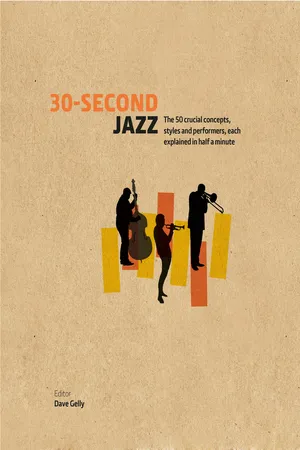
30-Second Jazz
The 50 Crucial Concepts, Styles, and Performers, each Explained in Half a Minute
This book is available to read until 31st December, 2025
- 160 pages
- English
- ePUB (mobile friendly)
- Available on iOS & Android
eBook - ePub
Available until 31 Dec |Learn more
30-Second Jazz
The 50 Crucial Concepts, Styles, and Performers, each Explained in Half a Minute
About this book
For its initiates, jazz is instinctive and engaging the way that popular music should be. For non-aficionados, it can be slippery and difficult to grasp: without familiar forms or a hard-and-fast format, and largely ruled by improvisation, jazz leaves the novice baffled, not sure how to listen, and asking how is it that they know what to play? 30-Second Jazz explains, in easy, short riffs that keep you engaged, taking readers from the African-American roots of jazz all the way to todays global mix of musicians and styles. Along the way, it looks at the shape, style, and instruments of jazz, at key personalities and recordings in the jazz canon and at what might be expected next from this most diverse of musical forms.
Frequently asked questions
Yes, you can cancel anytime from the Subscription tab in your account settings on the Perlego website. Your subscription will stay active until the end of your current billing period. Learn how to cancel your subscription.
No, books cannot be downloaded as external files, such as PDFs, for use outside of Perlego. However, you can download books within the Perlego app for offline reading on mobile or tablet. Learn more here.
Perlego offers two plans: Essential and Complete
- Essential is ideal for learners and professionals who enjoy exploring a wide range of subjects. Access the Essential Library with 800,000+ trusted titles and best-sellers across business, personal growth, and the humanities. Includes unlimited reading time and Standard Read Aloud voice.
- Complete: Perfect for advanced learners and researchers needing full, unrestricted access. Unlock 1.4M+ books across hundreds of subjects, including academic and specialized titles. The Complete Plan also includes advanced features like Premium Read Aloud and Research Assistant.
We are an online textbook subscription service, where you can get access to an entire online library for less than the price of a single book per month. With over 1 million books across 1000+ topics, we’ve got you covered! Learn more here.
Look out for the read-aloud symbol on your next book to see if you can listen to it. The read-aloud tool reads text aloud for you, highlighting the text as it is being read. You can pause it, speed it up and slow it down. Learn more here.
Yes! You can use the Perlego app on both iOS or Android devices to read anytime, anywhere — even offline. Perfect for commutes or when you’re on the go.
Please note we cannot support devices running on iOS 13 and Android 7 or earlier. Learn more about using the app.
Please note we cannot support devices running on iOS 13 and Android 7 or earlier. Learn more about using the app.
Yes, you can access 30-Second Jazz by Dave Gelly in PDF and/or ePUB format, as well as other popular books in Media & Performing Arts & Jazz Music. We have over one million books available in our catalogue for you to explore.
Information

CLASSIC JAZZ ALBUMS
CLASSIC JAZZ ALBUMS
GLOSSARY
acoustic Literally, to do with the sense of hearing. Main uses of this adjective in jazz are: 1) ‘unamplified’, referring to instruments (e.g. acoustic guitar) or unamplified music generally; 2) referring to the effect of the physical surroundings where music is played on the listening experience (acoustic conditions). The noun ‘acoustics’ is applied to this whole topic.
big band Normally a band of around 16 players, arranged in sections – trumpets, trombones, saxophones, rhythm. This format evolved in the late 1920s and early 1930s as the standard American dance orchestra, reaching its apotheosis in the swing era of the late 1930s. Big bands for dancing declined in popularity after World War II, but a few of those with a jazz reputation survived or soon re-formed – notably those of Count Basie, Duke Ellington and Woody Herman. They now played mainly to concert audiences and were joined by others, such as Stan Kenton’s orchestra and the Gerry Mulligan Concert Band. In more recent times the standard big-band formula has grown somewhat stiff and predictable, relying on complex arrangements and virtuosic ensemble playing.
chord progression The series of harmonies (‘chords’) underlying a melody. More usually called ‘chord sequence’.
cool jazz A restrained, undemonstrative style of jazz that emerged in the early 1950s, possibly in reaction to the vehemence of bebop. Leading early exponents included Stan Getz, Lee Konitz and the young Miles Davis. The aesthetic of ‘cool’ went beyond mere style, to embrace an attitude of self-contained detachment towards the world at large. The exemplar for both style and attitude was the saxophonist Lester Young, said to have been the first to use the word ‘cool’ as a term of approbation.
fusion music Any synthesis of jazz with rock, soul, funk, pop, etc.
mode scales Musical scales, other than the standard major and minor scales, used as a basis for improvisation.
nonet A band of nine players.
quintet A band of five players.
rhythm section Literally, the instruments and their players generating the ‘rhythm’. Nowadays it consists almost always of the bass and drums. In pre-bebop styles the guitar is generally also present and in pre-swing styles the banjo. The piano commonly plays a dual role, acting as part of the rhythm section when accompanying and as a solo instrument at other times.
section writing Written score for the brass, saxophone rhythm sections of a big band.
sextet A band of six players.
stride piano Piano style in which the left hand marks the beat by vigorously ‘striding’ forward. Fats Waller was its most famous exponent.
studio musician A musician employed wholly or largely in radio or recording studios.
synthesizer An electronic instrument that generates and processes sound. Used mainly by players of keyboard instruments to extend their range of available sounds and effects. The composers Gil Evans and Quincy Jones both made extensive use of synthesizers in the 1970s and 1980s, as did Herbie Hancock and other keyboard artists.
territory bands Touring bands of the 1930s which confined themselves to a certain area or ‘territory’ in the US. They catered particularly to the scattered communities of the large southwestern states, such as Texas, Oklahoma, Missouri and Kansas.
vibraphone Tuned percussion instrument with metal chime-bars mounted above resonating tubes. Fans, driven by an electric motor and set between the bars and the tubes, cause the sound to oscillate, or vibrate.
L...
Table of contents
- Cover Page
- Title Page
- Contents
- Introduction
- The Shape of Jazz
- Styles of Jazz
- Instruments of Jazz
- Vocal Jazz
- Classic Jazz Albums
- Jazz & the Blues
- Today Is the Question
- Resources
- Notes on Contributors
- Index
- Acknowledgements
- Copyright