If you only have 30 seconds, there is time using this book to make sense of the science behind the seeming vagaries of the weather, the controversies, predictions and forecasts for climate change that shape our day-to-day experiences of the great outdoors. Ever since Aristotle first tried to explain the forces that seem to fall from the heavens, meteorology has opened up the study of weather, and caused disputes over the reasons why seasons change, where precipitation falls, why winds blow and when the sun shines. From halcyon days to hurricanes, super cells to silver linings, global warming to giant hailstones, here is the ultimate guide to a near universal preoccupation: whats the weather like?
eBook - ePub
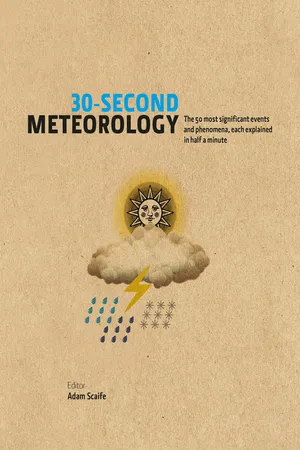
30-Second Meteorology
The 50 Most Significant Events and Phenomena, each explained in Half a Minute
- 160 pages
- English
- ePUB (mobile friendly)
- Available on iOS & Android
eBook - ePub
30-Second Meteorology
The 50 Most Significant Events and Phenomena, each explained in Half a Minute
About this book
Trusted by 375,005 students
Access to over 1.5 million titles for a fair monthly price.
Study more efficiently using our study tools.
Information
Topic
Ciencias físicasSubtopic
Meteorología y climatología
THE ELEMENTS
THE ELEMENTS
GLOSSARY
Aerosols An aerosol consists of billions of minute droplets of liquid or particles of solid suspended in a gas. Pollen, sea salt and soot from combustion can all make aerosols in the atmosphere. Pollution and volcanic eruptions can lead to aerosols high in the stratosphere that consist of tiny droplets of sulphuric acid. Some aerosols (e.g. soot) absorb incoming solar radiation and so act to warm the Earth; others (e.g. sulphuric acid droplets) can reflect solar radiation back into space and so have a cooling effect. Aerosols can act as the seeds around which cloud droplets form. The size of aerosol particles can range from 1 nanometre (one billionth of a metre) to 100 micrometres (one ten-thousandth of a metre).
Equinox/equinoctial seasons The equinoctial seasons contain the equinoxes – when day and night are equally long – which occurs twice yearly on or around 21 March and 21 September. They are the seasons between winter and summer; so spring and autumn are equinoctial seasons. In meteorological terms equinoctial seasons are usually considered to be the three-month periods of March, April and May and September, October and November. The equinoctial seasons are transition seasons between the more extreme summer and winter.
Long-wave radiation The heat radiated by the warm surface of the Earth and warm areas in the atmosphere. It has a longer wavelength than the visible and ultraviolet light from the Sun which is known as short-wave radiation. Long-wave radiation is infrared and invisible but it is a form of electromagnetic radiation just like light and radio waves.
Pressure gradients The change of atmospheric pressure with distance in a given direction. This gradient results in a force that acts on the air in a direction that is at right angles to the isobars – the lines of equal air pressure seen on weather maps. This force tries to push the air from areas of high atmospheric pressure towards areas of lower pressures and it is a source of wind. The steeper the pressure gradient, the more tightly packed the isobars, and the stronger the resulting wind. In meteorology, the idea of pressure gradients is applied to the behaviour of the atmosphere and is usually measured in millibars per kilometre (mb/km) – a millibar being a unit of atmospheric pressure. The nominal atmospheric pressure of the Earth at sea level is 1,000 millibars or 1 bar.
Saturation The state of the atmosphere in which the air contains the maximum amount of water vapour that it can hold at that particular temperature and air pressure. At saturation, relative humidity – the amount of water vapour in the air compared to the amount that the air could hold – is 100 per cent and further evaporation of water vapour into the air cannot occur. The capacity of the air to hold water vapour grows with increasing temperature and declines with decreasing temperature. This is why warmer climates experience greater humidity and why warm humid air forms clouds as the air rises and cools.
Solstice An astronomical event that occurs twice yearly around 21 June and 21 December due to the tilt of the axis of the Earth’s rotation to the plane of its orbit around the Sun. A solstice occurs in the summer and winter. In the northern hemisphere the summer solstice occurs in June and the winter solstice in December, and vice versa in the southern hemisphere. At solstice, the amount of daylight is at an annual maximum in one hemisphere and at an annual minimum in the other.
Supercooling/supercooled water Supercooling occurs when a liquid is cooled below its normal freezing point but does not solidify. Supercooled water droplets are found in high-altitude clouds where the temperature of the air is below the freezing point of water. This supercooled state can only be achieved in droplets that do not contain impurities or aerosols that would otherwise act as seeds to trigger crystallization. Research suggests that the phenomenon of supercooling may be due to the molecules of water arranging themselves in a way that is incompatible with crystallization.
Temperature inversion In the troposphere (the lowest layer of the Earth’s atmosphere) air temperature usually falls with increasing altitude but sometimes it can increase, resulting i...
Table of contents
- Cover Page
- Title Page
- Content
- Foreword
- Introduction
- The Elements
- The Global Atmosphere
- The Sun
- Weather Watching & Forecasting
- Can We Change the Weather?
- Weather Cycles
- Extreme Weather
- Resources
- Notes on Contributors
- Index
- Acknowledgements
Frequently asked questions
Yes, you can cancel anytime from the Subscription tab in your account settings on the Perlego website. Your subscription will stay active until the end of your current billing period. Learn how to cancel your subscription
No, books cannot be downloaded as external files, such as PDFs, for use outside of Perlego. However, you can download books within the Perlego app for offline reading on mobile or tablet. Learn how to download books offline
Perlego offers two plans: Essential and Complete
- Essential is ideal for learners and professionals who enjoy exploring a wide range of subjects. Access the Essential Library with 800,000+ trusted titles and best-sellers across business, personal growth, and the humanities. Includes unlimited reading time and Standard Read Aloud voice.
- Complete: Perfect for advanced learners and researchers needing full, unrestricted access. Unlock 1.5M+ books across hundreds of subjects, including academic and specialized titles. The Complete Plan also includes advanced features like Premium Read Aloud and Research Assistant.
We are an online textbook subscription service, where you can get access to an entire online library for less than the price of a single book per month. With over 1.5 million books across 990+ topics, we’ve got you covered! Learn about our mission
Look out for the read-aloud symbol on your next book to see if you can listen to it. The read-aloud tool reads text aloud for you, highlighting the text as it is being read. You can pause it, speed it up and slow it down. Learn more about Read Aloud
Yes! You can use the Perlego app on both iOS and Android devices to read anytime, anywhere — even offline. Perfect for commutes or when you’re on the go.
Please note we cannot support devices running on iOS 13 and Android 7 or earlier. Learn more about using the app
Please note we cannot support devices running on iOS 13 and Android 7 or earlier. Learn more about using the app
Yes, you can access 30-Second Meteorology by Adam Scaife in PDF and/or ePUB format, as well as other popular books in Ciencias físicas & Meteorología y climatología. We have over 1.5 million books available in our catalogue for you to explore.