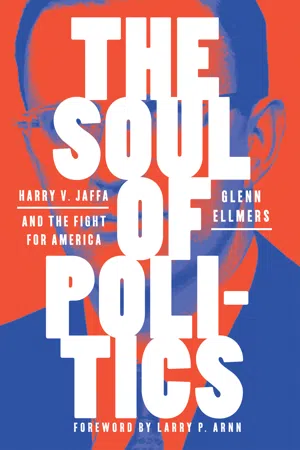
Harry V. Jaffa (1918-2015), professor at Claremont McKenna College and Distinguished Fellow of the Claremont Institute, was one of the most influential thinkers of the 20th century. His hundreds of students have reached positions of power and prestige throughout the intellectual and political world, including the Supreme Court and the Trump White House.
Jaffa authored Barry Goldwater's famous 1964 Republican Convention speech which declared, "Extremism in the defense of liberty is no vice. And moderation in the pursuit of justice is no virtue." William F. Buckley, Jaffa's close friend and a key figure in shaping the modern conservative movement, wrote, "If you think it is hard arguing with Harry Jaffa, try agreeing with him." His widely acclaimed book Crisis of the House Divided: An Interpretation of the Issues in the Lincoln-Douglas Debates (1959), was the first scholarly work to treat Abraham Lincoln as a serious philosophic thinker.
As the earliest protégé of the controversial scholar Leo Strauss, Jaffa turned his theoretical insights to understanding the United States as the "best regime" in principle. He saw the American Revolution and the Civil War as world-historical events that revealed the true nature of politics. Statesmanship, constitutional government, and the virtues of republican citizenship are keys to unlocking the most important truths of political philosophy.
Jaffa's student, Glenn Ellmers, was given complete access to Jaffa's private papers at Hillsdale College to produce the first comprehensive examination of his teacher's vast body of work. In addition to Lincoln and the founding fathers, the book shares Jaffa's profound insights into Aristotle, Shakespeare, Winston Churchill, and more.
- 408 pages
- English
- ePUB (mobile friendly)
- Available on iOS & Android
eBook - ePub
About this book
Information
1
BALLOTS, BULLETS, AND BOOKS
Then out spake brave Horatius,
The Captain of the Gate:
To every man upon this earth
Death cometh soon or late.
And how can man die better
Than facing fearful odds,
For the ashes of his fathers,
And the temples of his gods.
—THOMAS MACAULAY, The Lays of Ancient Rome
The bomb that detonated at Scripps College on the afternoon of February 26, 1969, didn’t injure anyone, but an innocent young woman was badly maimed when another device exploded almost simultaneously in Carnegie Hall at adjacent Pomona College. Hidden inside a shoebox wrapped in brown paper, the second bomb left twenty-year-old Mary Ann Keatley blind in one eye and ripped two fingers from her right hand. Keatley, married just five months earlier to an undergraduate at Claremont Men’s College, worked as the secretary for the Pomona political science department. These two explosions, and a third two weeks later, shattered windows and wrecked buildings. But they also rattled the confidence of those responsible for the academic mission and integrity of the Claremont Colleges.1 The student unrest and mayhem of the late 1960s affected many campuses besides Claremont, but what happened there is notable for other reasons, particularly the response of the academic and administrative authorities and a small minority of faculty who opposed them.
Resistance to the Vietnam War motivated the campus violence in California and elsewhere, but so did the demands of the Black Power Movement, especially at Claremont, where protestors called for various new programs in ethnic studies as well as quotas for minority students. A leading member of this group had asked, shortly before a fire that destroyed Claremont McKenna’s historic Story House (a separate incident, in addition to the bombings), “Do you want this campus burned down this summer or next summer?”2
Among the small group of faculty opposing those demands was a professor of political philosophy named Harry V. Jaffa. Though diametrically opposite in outlook and temperament, Jaffa and the radical students agreed at one level with the slogan, “No Justice, No Peace.” Jaffa had studied with Leo Strauss, the brilliant Jewish émigré scholar who fled Nazi Germany in the 1930s. From Strauss, Jaffa learned that this apparently outrageous statement is in fact a true observation about human life: there can’t be peace without justice, nor vice versa. Jaffa’s philosophical reasoning and explanation for this observation were nearly polar opposite of the justifications invoked by the violent protesters. But he understood that the radicals, in their passionate commitment to building a new social order, perceived something essential about political life, a truth missed or suppressed by mainstream academic thought. The protestors had a conception of justice they were extreme in pursuing and saw no virtue in moderating their demands. This was a view Jaffa understood well.
Despite strong resistance and dire warnings from the small coterie of conservative professors, the administrators of the Claremont Colleges opened negotiations with the radicals on the assumption that those responsible for the bombings shared their faith in compromise and dialogue. The leadership of the colleges granted nearly every demand of the protestors in the vain hope that capitulation would appease those who threatened to burn down the campus. (It didn’t.) Not for the first or last time, the unwillingness of the academic establishment to defend the integrity of the university would remind Jaffa of the aphorism attributed to Winston Churchill: “You were given the choice between war and dishonor. You chose dishonor, and you will have war.”3
Compromise, Jaffa noted later, “presupposes an end that the compromisers share and that it is more important to them than what they are asked to sacrifice in compromising.”4 The administrators’ avowed principles evidently were less important to them than the commitment of the radicals to their principles. Jaffa expressed particular disappointment over how the rhetorical bravery of the “no-nonsense” businessmen on the board of trustees melted away when courage was really needed. In a letter to a colleague years afterward, Jaffa explained:
We who opposed this policy of surrender, were very much in the position of the defenders of the Alamo. And … I could not detect any prospect of relief emanating from the trustees. And this, notwithstanding the bold and uncompromising talk I had so often heard over brandy and cigars from conservative trustees—when there was no danger to face. “You don’t understand,” [one trustee] declared, “Rome was not built in a day.” “You don’t understand,” I replied, “Rome is not being built, it’s being burned.”5
At the time of the bombings, Jaffa, then fifty years old, already had established himself as a figure of controversy and an enemy of facile conciliation. Five year earlier, he had helped Republican presidential nominee Barry Goldwater jab a thumb in the eye of this same establishment crowd, those who seemed, both to Goldwater and Jaffa, too eager to sacrifice upon the altar of safety and expediency. Jaffa had grown up in a “high-spirited” Jewish family in New York, studied English at Yale, then earned a PhD in political philosophy under Strauss at the New School for Social Research. In 1963, he took a temporary leave from academic life to help advise the Goldwater campaign as a noted Lincoln scholar and student of American political thought.
At the Republican National Convention in San Francisco, he was recruited by Goldwater to write the bulk of the nomination acceptance speech. In a memo for the campaign prepared a few days earlier, after sitting through the debates of the platform committee, Jaffa had crafted the famous lines that caught Goldwater’s attention and, reformulated for the speech, would become world famous: “I would remind you that extremism in the defense of liberty is no vice. And let me remind you also that moderation in the pursuit of justice is no virtue!” Though the crowd in the “Cow Palace” auditorium erupted in cheers, the mainstream establishment—including television commentators, prominent journalists, and moderate Republicans (not to mention Democrats)—reacted with alarm and consternation. Pat Brown, the liberal governor of California, embraced his own form of extremism and went so far as to say, “The stench of fascism is in the air.”6
Today, looking back on these years from a distance of five decades, such scenes may seem depressingly familiar: social-justice warriors pulling to port and conservative demagogues keeling to starboard threaten to tear apart the ship of state. Moderation, tolerance, and civil debate are left to drown at sea. What, then, can be gained by retelling moldy stories about Jaffa’s campus skirmishes from a half century ago? They seem only to remind us how little has changed and how fruitless must be any effort to affect the course of human affairs. The ’60s radicals grew up and became the establishment. Goldwater morphed into Reagan and then into Trump. History carries us along on her tedious course, monotonously reenacting the same “crimes, follies, and misfortunes,” and we ride as flotsam on the current.
And yet, the very fact that our politics are so divided and bitter today demonstrates that nothing, really, has been settled—despite a century of efforts by progressives, reformers, and well-educated experts to create a modern “administrative state” overseen by nonpartisan and professional bureaucrats. If the Donald Trump presidency revealed anything, it was that the superficial consensus that dominated postwar America was an illusion. But despite today’s availability of 24-7 commentary, from every possible ideological perspective, there is little understanding of the deeper political and philosophical roots of our current crisis.
More so than Jaffa himself, his students have developed a body of scholarship, now built up over several decades, exploring how progressive ideas overturned the framers’ constitutionalism. Yet as early as 1986, Jaffa himself observed, with astounding prescience, what was happening to consent and self-government. In a letter to his friend Lewis Lehrman, Jaffa noted “that elections are a necessary, but not a sufficient condition for the exercise of political power in our government as it really is.”
[The] preferences registered by the voters at the polls have been vetoed, in large part, by a combination of the media elite and the institutionalized pressure groups who control Congress and the bureaucracy. These people are, to paraphrase Keynes, the slaves of ideas that are, if not defunct, then moribund. But they are the ideas patronized by the universities, particularly those in the northeast whose prestige is the greatest. Even men as strong willed as Nixon and Reagan lose much of the confidence that they have had in the ideas they expressed before their election, when they are subject to the unrelenting bombardment of the Fourth Estate and its dependents.7
No nostalgia for “the Reagan revolution” clouded Jaffa’s judgment about the march toward an unaccountable class of ruling elites. (In 1988, he would complain in a letter that “the last years of the Reagan presidency have turned into a disaster,” describing “the old Man in the Oval Office” as “hen pecked.”)8 To be sure, Jaffa credited Reagan for his admirable resolution in leading the West’s victory over the Soviet Union in the Cold War (an achievement of statesmanship perhaps underappreciated by those who did not live through the 1970s). But a recurring theme one finds in both Strauss and Jaffa is that triumph in arms is not necessarily triumph in minds. “That is why the present so-called victory of liberal democracy over Communism being trumpeted in Washington, London, Paris, etc. is such a delusion,” Jaffa wrote in 1991.9 As vital as it was to win the Cold War, there was still an ideological battle at home with which to contend.
Jaffa’s student John Marini has devoted his career to expanding on Jaffa’s observation about how the voters’ preferences are overturned or ignored. Marini explored in great depth the theoretical basis and institutional contours of this “second constitution”:
In political practice, liberals and conservatives had established a kind of symbiotic relationship that made them appear as opposite sides of the same coin. The contemporary meaning of those terms had been derived from the theories and policies that had become embodied within the administrative state. There were disagreements over how certain domestic or foreign policies should be promulgated, or when they should take effect, or how much they should cost. However, there was little partisan disagreement as to whether those policies should have been pursued, or abandoned, because there was no political standard by which to judge results in terms of success or failure. Those decisions were put in the hands of experts, or bureaucrats, whose knowledge established their authority. But the outcome of the decisions based on that supposed knowledge, whether successful or not, remained unquestioned by those who had political power.The authority of the intellectuals had established a theoretical, or socially constructed, reality that appeared indifferent to reality as it revealed itself in practical or political life. It seemed as though liberal and conservative intellectuals could disagree when it came to practical means, but they were in apparent agreement concerning technical ends. But it was the ends—the results or failures—that brought about the political turmoil that led to the questioning of their authority. Much of official Washington rested on the authority of the knowledge that had been invested in those technical administrative positions. And nearly all concerned had a stake in maintaining the status quo.10
That is, until the big crack-up began in 2016. Although Antifa and other leftist radicals would surely bristle at the idea, the heartland unease that helped elect Trump has a common origin with the campus protest culture: they are both eruptions of the human concern for justice breaking through the artificial shell of the uniparty establishment. (Chapter 8 considers Jaffa’s teachings in light of recent political developments.)
Jaffa spent his entire long career rejecting the false consensus of the status quo intellectuals because he had learned how unnatural and even impossible it was to suppress what Strauss called our “simple experiences regarding right and wrong.”11 Jaffa was accused of being a superficial moralizer, a potentially great scholar who frittered away the promise of his early work through a regrettable descent into florid patriotism. But such a view cannot seriously be entertained by anyone who has examined Jaffa’s writings with any care. This book will reveal his appreciation for Churchill’s ruthlessness, Shakespeare’s Machiavellian poetry, Aristotle’s denigration of “mere” moral virtue, and Lincoln’s keen appraisal of tyranny and its singular attractions. All of these stark portraits are drawn by Jaffa with unstinting candor, not sparing the unsettling implications.
In a fascinating paper delivered in 1986, Jaffa compares Shakespeare’s Coriolanus with the Sherlock Holmes mysteries to show how men of intellect, ambition, and passion may locate their sense of justice in an all-consuming self-justification. The awareness of one’s own compulsive need to escape stultifying conformity—the urge simply to act and feel alive—may be what matters most, regardless of which side one chooses. Literature’s most famous detective is depicted living in the relative safety and comfort of Victorian London. But, as Jaffa observes, Holmes “is bored by it all. He cannot live without danger.” His epic battle with his archrival, the master criminal Moriarty, reveals a curious similarity and a certain ambiguous, mutual dependence.
Justice has been defined as the art of safekeeping and who knew better how to keep something safe than the one who best knew how to steal it? Holmes and Moriarty both had the art of the thief. What then can be the difference between them? Is Holmes the one who exercises his art justly, and Moriarty the one who does so unjustly? But is justice itself just? There is nothing in the conception of the art itself, to distinguish the just exercise of the art of justice from the unjust exercise of the art of justice.12
In Shakespeare’s play, Coriolanus is an aristocratic Roman general. Returning from a hard-won victory over Rome’s enemy, Aufidius, he refuses to grovel before the people in order to claim what he regards as his rightful title as consul. Spurned by the ungrateful and fickle mob, Coriolanus turns his back on his fatherland and joins forces with his former rival to exact vengeance. Jaffa elaborates the comparison between the unlikely pairs:
Holmes and Moriarty are related very much as Coriolanus and Aufidius, according to Shakespeare. Each is a representative of heroic virtue, and each is ambitious to be recognized as the supreme representative of such virtue, which is possible only by combat with the other. Each is a necessary means to the other’s highest end—and in that sense is at once his dearest friend and bitterest enemy.13
“Coriolanus hates the ple...
Table of contents
- Cover
- Title Page
- Copyright
- Contents
- Foreword
- A Note to the Reader
- 1 Ballots, Bullets, and Books
- 2 The Open Door
- 3 Lincoln, Justice, and America
- 4 The Philosopher and the Poet: Aristotle and Shakespeare
- 5 Reason, Revelation, and the Theological-Political Problem
- 6 Statesmanship, Tyranny, and Freedom
- 7 Quarrels: Neocons and Paleocons, the Strauss Wars, Original Intent
- 8 “The Unfinished and Unfinishable Quest”: Jaffa’s Legacy and the Future of America
- Postscript: The Problem of the Divided Mind
- Acknowledgments
- Harry V. Jaffa Selected Bibliography
- Notes
- Index
Trusted by 375,005 students
Access to over 1.5 million titles for a fair monthly price.
Study more efficiently using our study tools.
Frequently asked questions
Yes, you can cancel anytime from the Subscription tab in your account settings on the Perlego website. Your subscription will stay active until the end of your current billing period. Learn how to cancel your subscription
No, books cannot be downloaded as external files, such as PDFs, for use outside of Perlego. However, you can download books within the Perlego app for offline reading on mobile or tablet. Learn how to download books offline
Perlego offers two plans: Essential and Complete
- Essential is ideal for learners and professionals who enjoy exploring a wide range of subjects. Access the Essential Library with 800,000+ trusted titles and best-sellers across business, personal growth, and the humanities. Includes unlimited reading time and Standard Read Aloud voice.
- Complete: Perfect for advanced learners and researchers needing full, unrestricted access. Unlock 1.5M+ books across hundreds of subjects, including academic and specialized titles. The Complete Plan also includes advanced features like Premium Read Aloud and Research Assistant.
We are an online textbook subscription service, where you can get access to an entire online library for less than the price of a single book per month. With over 1.5 million books across 990+ topics, we’ve got you covered! Learn about our mission
Look out for the read-aloud symbol on your next book to see if you can listen to it. The read-aloud tool reads text aloud for you, highlighting the text as it is being read. You can pause it, speed it up and slow it down. Learn more about Read Aloud
Yes! You can use the Perlego app on both iOS and Android devices to read anytime, anywhere — even offline. Perfect for commutes or when you’re on the go.
Please note we cannot support devices running on iOS 13 and Android 7 or earlier. Learn more about using the app
Please note we cannot support devices running on iOS 13 and Android 7 or earlier. Learn more about using the app
Yes, you can access The Soul of Politics by Glenn Ellmers in PDF and/or ePUB format, as well as other popular books in Política y relaciones internacionales & Filosofía política. We have over 1.5 million books available in our catalogue for you to explore.