eBook - ePub
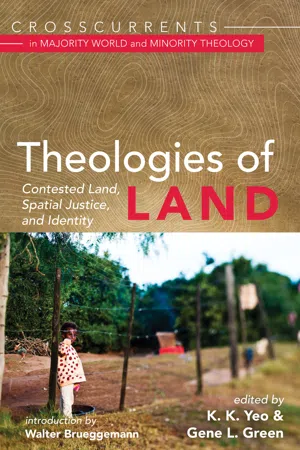
Theologies of Land
Contested Land, Spatial Justice, and Identity
- 194 pages
- English
- ePUB (mobile friendly)
- Available on iOS & Android
eBook - ePub
Theologies of Land
Contested Land, Spatial Justice, and Identity
About this book
The Crosscurrents series highlights emerging theologies and biblical interpretations from Majority World and minoritized communities. The first volume in the series elaborates theologies of land, a theme often missing or ignored by churches and theologians, especially in the Global North. In this volume, four authors who represent Palestinian, First Nations, Latinx, and South African communities examine the intricate relationship among land(scape), migration, and identity. Together with a Malaysian Chinese, the authors deliberate on the complex issues arising out of political domination, as well as humanity's conquest and abuse of land that create unjust space, landless people, and the broken landscape of God's creation.
Trusted by 375,005 students
Access to over 1.5 million titles for a fair monthly price.
Study more efficiently using our study tools.
Information
Topic
Theology & ReligionSubtopic
Christian TheologyIntroduction
Theologies of the Land
The four strong essays plunge us into hard contestation concerning long assumed colonizing truths and new historical possibility beyond that long assumed normativity. One of the sites for that contestation is indeed the Bible; the Bible offers a narrative of predation that thrives on chosenness, entitlement, and God-authorized conquest. The Bible offers, alongside that narrative of predation, an alternative narrative of emancipation wherein the holy power of God is mobilized to create and authorize life outside the reach of predatory power. That contestation between predation and emancipation is surely present in the Bible itself. It is, moreover, powerfully present in the long history of biblical interpretation, a contest between those who read “from above,” who have dominated Western reading (in both fundamentalist and historical-critical modes), and those who read “from below,” now represented by bold, imaginative, post-colonial work. These essays reflect various specific socio-cultural contexts; in the end, however, the contestation is the same everywhere, wherein the powers of predation have the upper hand, but witnesses to and practitioners of emancipation continue the long work of subversive imagination.
Wondering how I might introduce these essays as an Old Testament teacher, I have decided that they might be read as shrewd, poignant commentary on Psalm 73. Thus I will take Psalm 73 as a map for this on-going introduction. The Psalm is divided into two extended parts with an abrupt turn in between the two parts. I will let this mapping shape my introductory comments.
I.
In Psalm 73, verses 2–14 offer self-critical reflection by one who has engaged in long-term resistance to a life of exploitative self-indulgence. I take these verses in the psalm to articulate envy of the way of the colonizing ones so well identified in these essays. The psalmist reflects on a practice of arrogance that has led to uncommon wealth, privilege, and wellbeing. Those who practice such aggressive exploitation have bodies that reflect rest, good food, comfort, and security (vv. 4–7). Their unmitigated wellbeing produces a sense of self-sufficiency that makes them immune to any accountability to God: “How can God know?” (v. 11). Their wealth and social power give them the capacity to do as they please so that they are “always at ease” with ever growing wealth (v. 12). They are shameless in their wellbeing that no doubt has resulted from sharp exploitative practices that leads to the seizure of the property of others.
By verse 13 the psalmist concludes that his/her pious practice of Torah obedience and neighborly ethics are foolish investments of attention and energy, a waste of time, all “in vain.” The psalmist sees that it works better to do whatever is necessary to be on to top of the social heap, unrestrained by old-fashioned neighborly mandates. I take the words of these verses to be a fair characterization of the ruthless exploitative power of the colonizers of the West who have reduced the rest of the world and its inhabitants to disposable commodities, including for example, the Palestinians and the Black population of South Africa.
It is useful, I judge, to see that these essays reflect the same critical awareness as these verses in the psalm. Such exploitation does work . . . for some at the high cost to others. García-Johnson has seen that the long history of Western exploitation, authorized by the Papal decree of 1493, has moved through colonizing (1500–1800), Americanizing (1900), development (1930–1960), and market capitalism (1970–2000). The logic of colonizing and the rhetoric of modernity have resulted in a ruthless division of the earth and its goods between landlords and the landless. There is, moreover, no doubt that this long-term exploitative enterprise is permeated with racism, even now in the mantra of US white nationalism, “Make America Great Again.” Raheb has shown how the Bible has served such predation so that even the land of the Bible (Palestine) has been endlessly occupied by exploitative powers, not least by the brutal coming of the community of Joshua at the outset. His appeal to the narrative of Naboth’s vineyard is exactly to the point, where ruthless usurpatious power takes the land (inheritance!) of the vulnerable. (It should be noted that in US foreign policy, that same narrative has been a useful point of critical awareness for US preemptive aggression. In 1870 Charles Sumner in the US Senate gave a speech that was titled “Naboth’s Vineyard” concerning the proposed US annexation of the island of San Domingo. In 1928 Sumner Welles, in the US State Department, wrote of Naboth’s Vineyard: The Dominican Republic 1844–1924, again concerning rapacious US policy. Ramentswana has pursued the same prism to identify the theft of land in South Africa by the long-term occupiers. He offers a brilliant reading of how conquest works in the book of Joshua whereby the land comes to new “ownership.” Zacharias has seen, moreover, that common notions of “stewardship” of the creation have been hubristic and have exalted human persons over other creatures to their great detriment and diminishment. On all these counts, the work of the occupiers has been to grab the land of the vulnerable, a point made by the prophet Micah in his exposition of the Tenth Commandment of Sinai:
Alas for those who devise wickedness and evil deeds on their beds!
When morning dawns, they perform it,
because it is in their power.
They covet fields, and seize them;
houses, and take them away;
they oppress householder and house,
people and their inheritance (Mic 2:1–2).
“Alas” indeed! Alas, because such exploitation is not sustainable in the long run of history where the purpose of the holy God is operative. This is a conclusion reached only slowly by the psalmist.
II.
In verses 18–28 the psalmist reflects a fresh, alert awareness of the reality of God as the psalmist has come to herself/himself (see Luke 15:17). Now the psalmist criticizes the predators that he/she has recently envied and sees that such envy was an act both “stupid and ignorant” as a dumb-ass (“brute beast,” v. 21). The psalmist sees that prideful arrogance will not endure, but will vanish from the earth without a track in the sand:
How they are destroyed in a moment,
swept away utterly by terrors!
They are like a dream when one awakes;
on awaking you despise their phantoms. (vv. 19–20)
The point is seen so clearly by Raheb in his shrewd reading of the Beatitude. He readily observes that “empires come and go” and have no staying power. By contrast the “meek” inhabitants of the land persist and endure, and finally will have their land because it rightly belongs to them. This is a remarkable insight of affirmation that concerns Palestinians, Blacks in South Africa, and Indigenous peoples in North America and beyond. It is a lesson the US has learned the hard way in Viet Nam. Those who belong in, with, to, and for the land will not be displaced by the force and mechanisms of the ruthless confiscators who occupy.
The psalmist comes to see that the aggressiveness of the predators brings no durable safety or satisfaction. In the end what matters is close connection to the creator God who, beyond every such predation, brings the “meek” to wellbeing. It is fair to see that this connection to the creator is both corporeal and dialogical. It is corporal as the psalmist can speak of “flesh, heart, and hand” all linked to the creator. The psalmist has not forgotten that the creator God cares about bodily reality, even when it is not “sound and sleek” (v. 4) in a way that resists the preferred disembodied minds of colonial modernity. It is dialogical in that the psalmist is “with you” (v. 23). The psalmist and the creator God are “hand-in-hand” in ways that give strength to the psalmist (v. 26). This dialogical mode of life is resistance to the top-down monologic mode that i...
Table of contents
- Title Page
- Theologies of Land
- Preface
- Contributors
- Chapter 1: Theologies of the Land
- Chapter 2: The Bible and Land Colonization
- Chapter 3: Faith Seeking for Land
- Chapter 4: The Land Takes Care of Us
- Chapter 5: Negotiation and/or Conquest of the Land
- Chapter 6: Theologies of Land
Frequently asked questions
Yes, you can cancel anytime from the Subscription tab in your account settings on the Perlego website. Your subscription will stay active until the end of your current billing period. Learn how to cancel your subscription
No, books cannot be downloaded as external files, such as PDFs, for use outside of Perlego. However, you can download books within the Perlego app for offline reading on mobile or tablet. Learn how to download books offline
Perlego offers two plans: Essential and Complete
- Essential is ideal for learners and professionals who enjoy exploring a wide range of subjects. Access the Essential Library with 800,000+ trusted titles and best-sellers across business, personal growth, and the humanities. Includes unlimited reading time and Standard Read Aloud voice.
- Complete: Perfect for advanced learners and researchers needing full, unrestricted access. Unlock 1.5M+ books across hundreds of subjects, including academic and specialized titles. The Complete Plan also includes advanced features like Premium Read Aloud and Research Assistant.
We are an online textbook subscription service, where you can get access to an entire online library for less than the price of a single book per month. With over 1.5 million books across 990+ topics, we’ve got you covered! Learn about our mission
Look out for the read-aloud symbol on your next book to see if you can listen to it. The read-aloud tool reads text aloud for you, highlighting the text as it is being read. You can pause it, speed it up and slow it down. Learn more about Read Aloud
Yes! You can use the Perlego app on both iOS and Android devices to read anytime, anywhere — even offline. Perfect for commutes or when you’re on the go.
Please note we cannot support devices running on iOS 13 and Android 7 or earlier. Learn more about using the app
Please note we cannot support devices running on iOS 13 and Android 7 or earlier. Learn more about using the app
Yes, you can access Theologies of Land by K. K. Yeo, Gene L. Green, K. K. Yeo,Gene L. Green in PDF and/or ePUB format, as well as other popular books in Theology & Religion & Christian Theology. We have over 1.5 million books available in our catalogue for you to explore.