- English
- ePUB (mobile friendly)
- Available on iOS & Android
eBook - ePub
Agile focus in governance
About this book
• Are you member of either the management team or the board and do you see the need to adapt your organization to Agile? Do you intend to make the organization more agile?
• Are you a coach helping organizations in the transformation to becoming more agile? And are you planning to support this transition using a bottom-up or top-down approach?
In this pocket guide you will find a practical approach on how to handle this. Governing an organization in a fast-changing world. And all this although the issues of the day require a lot of your attention and can distract you from the results you want to achieve. The authors consider how to operationalize the organization's strategic goals and consequently the governance of the entire organization.
The authors start from the position of:
• Clarifying what has to be achieved in the next quarter in order to achieve the strategic goals.
• Introducing a system of short cyclical adjustments, with which you can respond to changing demand from customers or emerging laws and regulations.
• Working closely together as management team or board towards the long-term strategic goals and preventing everyone within the organization from following their own goals.
• Bringing more focus on the operationalization of the strategy, less 'fire-fighting' and greater emphasis on fire prevention.
• Getting a clear picture of what prevents your employees from doing their jobs effectively.
Will you succeed in removing the barriers holding back your organization?
The core message of this pocket guide is application of the FOCUS board. This is a visual approach to management and a strong tool for governing the organization. When this is applied, it will result in collaboration between all layers of the organization, enable short cyclical adjustment and provide a clear focus on achieving the strategic goals.
Information
Topic
EducationSubtopic
Architecture General
“One must always be careful of books”, said Tessa, “and what is inside them, for words have the power to change us.”
Cassandra Clare (1973), Clockwork Angel
Big innovative themes like digitalization, globalization, robotics and artificial intelligence (AI) demand that organizations change. If you do not go along you can no longer play.
Those organizations who can respond and adapt quicker to these changing customer wishes and needs have a much better chance to survive than organizations who cannot. But becoming an adaptive and agile organization is not easy and a lot of board members are struggling with these transformations.
The American consultancy office McKinsey & Company points out in their influence model what you need for an effective transformation.
In this model there are four parts that, when used together, lead to change by employees and with that, the whole organization.
Employees change when the purpose, the common goal, of the organization is clear so they understand what is being asked of them and that this is logical for them so that they can connect to it. But that alone is not sufficient. The processes in the organization must have a perfect fit with the changes the organization is making. The employees must be educated in these new ways so that their talents and capabilities are consistent with the purpose and processes.
And finally acting as a “role model” is important. Show exemplary behavior: “be the change”. Transforming into an organization which is adaptive to the innovative themes and changing customer needs requires a “purpose” which connects to behavioral change in the whole organization.
The four sequential parts which provide the basis for an effective Agile change are:
1. Explain to all the employees why the change is necessary in relation to the strategic goals.
2. Introduce a system of short cyclical adjustments, with which you steer towards the long-term strategic goals.
3. Educate employees (including members of the board) in the new way of working, the Agile mindset.
4. Show exemplary behavior by, for example, organizing stand-ups with board members and stimulate transparency and learning from mistakes.
Adaptiveness is at the core of the principles and assumptions of the Agile way of working. Many books have been written about this way of working. Most of them are about how to do this with teams on the work place. But few of these explain how executives can put this into practice and how to connect with the work place so both sides reinforce each other.
The more focus the boardroom gives to their organization and their strategic goals, the bigger the chance they will actually achieve these goals. In this pocket guide you will find a concrete and practical way of working to get this focus in agile governance.
The topics in this pocket guide are connected through a case study. This case study describes a situation in a fictional organization, WeTrans4m. It is a medium sized organization with a board consisting of a chairman and four board members. Each board member has their own management team (MT) consisting of four managers and each manager has eight operational teams.
The organization has been working on continuous improvement for eight years now, using a combination of Lean and Agile. They call this “the Trans4M Way of Working”.
The following persons each have a role in this case study:
■ Chairman, Victor;
■ Member of the board, Diana;
■ Manager, Mike;
■ Team member, Tim;
■ FOCUS coach, Kate.
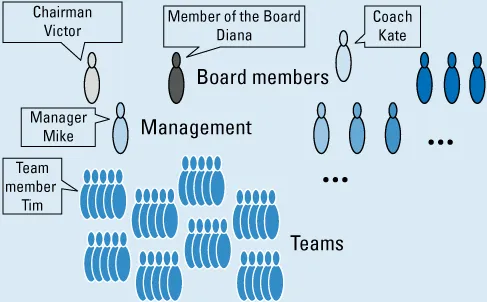
Figure 1 Organization chart WeTrans4m
“I know of no single formula for success. But over the years I have observed that some attributes of leadership are universal and are often about finding ways of encouraging people to combine their efforts, their talents, their insights, their enthusiasm and their inspiration to work together.”
Queen Elizabeth II (1926), Queen of Great Britain
To understand what Agile is, we look back to the Agile Manifesto. It was created in 2001, which is a long time ago and its origin in IT is easy to recognize. However, the four values and twelve principles are still just as usable today to provide the basis of where Agile came from and where it is moving towards.
The form of the Manifesto includes values on both the right and left sides. The values on the right show where a lot of organizations are coming from, whilst the values on the left indicate where they want to move to. This from/to setup of the Manifesto is used frequently in change processes. In this chapter you will find an example of its use.
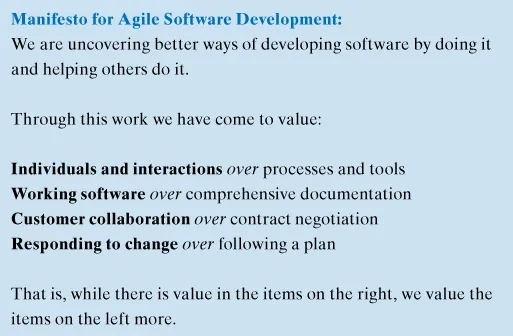
Figure 2 Manifesto for Agile Software Development
The Agile Manifesto is described in the form of twelve principles:
1. Our highest priority is to satisfy the customer through early and continuous delivery of valuable software.
2. Welcome changing requirements, even late in development. Agile processes harness change for the customer’s competitive advantage.
3. Deliver working software frequently, from a couple of weeks to a couple of months, with a preference to the shorter timescale.
4. Business people and developers must work together daily throughout the project.
5. Build projects around motivated individuals. Give them the environment and support they need, and trust them to get the job done.
6. The most efficient and effective method of conveying information to and within development teams is face-to-face conversation.
7. Working software is the primary measure of progress.
8. Agile processes promote sustainable development. The sponsors, developers, and users should be able to maintain a constant pace indefinitely.
9. Continuous attention to technical excellence and good design enhances agility.
10. Simplicity – the art of maximizing the amount of work not done - is essential.
11. The best architectures, requirements, and designs emerge from self-organizing teams.
12. At regular intervals, the team reflects on how to become more effective, then tunes and adjusts its behavior accordingly.
Agile is often wrongly equated with Scrum. However, in reality they are positioned at a different level. Agile is a set of values and principles, a set of ideas. Scrum is one of the Agile methods. In reality Scrum is the most popular Agile method and because of this it is easy to see why a lot of people see Agile and Scrum as the same thing. Scrum provides tools and a language for teams to work in an Agile way. Elements of thi...
Table of contents
- Cover
- Title
- Copyright
- Contents
- 1 Preface
- 2 What is Agile? The Agile Executive Manifesto highlighted
- 3 It starts with vision
- 4 The change to a responsive organization
- 5 The FOCUS board
- 6 The agenda and ground rules of the stand-up
- 7 The quarterly change: continuous refinement over the next three months
- 8 Cascading from strategic goals to underlying management teams
- 9 Scrum for executives
- 10 FOCUS toolbox
- 11 Application in practice: The Rabobank case, FOCUS way of working
- 12 Agile leadership maturity
- 13 Three tips to start with an Agile focus in government
- Literature
- About the authors
- Index
Trusted by 375,005 students
Access to over 1.5 million titles for a fair monthly price.
Study more efficiently using our study tools.
Frequently asked questions
Yes, you can cancel anytime from the Subscription tab in your account settings on the Perlego website. Your subscription will stay active until the end of your current billing period. Learn how to cancel your subscription
No, books cannot be downloaded as external files, such as PDFs, for use outside of Perlego. However, you can download books within the Perlego app for offline reading on mobile or tablet. Learn how to download books offline
Perlego offers two plans: Essential and Complete
- Essential is ideal for learners and professionals who enjoy exploring a wide range of subjects. Access the Essential Library with 800,000+ trusted titles and best-sellers across business, personal growth, and the humanities. Includes unlimited reading time and Standard Read Aloud voice.
- Complete: Perfect for advanced learners and researchers needing full, unrestricted access. Unlock 1.5M+ books across hundreds of subjects, including academic and specialized titles. The Complete Plan also includes advanced features like Premium Read Aloud and Research Assistant.
We are an online textbook subscription service, where you can get access to an entire online library for less than the price of a single book per month. With over 1.5 million books across 990+ topics, we’ve got you covered! Learn about our mission
Look out for the read-aloud symbol on your next book to see if you can listen to it. The read-aloud tool reads text aloud for you, highlighting the text as it is being read. You can pause it, speed it up and slow it down. Learn more about Read Aloud
Yes! You can use the Perlego app on both iOS and Android devices to read anytime, anywhere — even offline. Perfect for commutes or when you’re on the go.
Please note we cannot support devices running on iOS 13 and Android 7 or earlier. Learn more about using the app
Please note we cannot support devices running on iOS 13 and Android 7 or earlier. Learn more about using the app
Yes, you can access Agile focus in governance by Jeroen Venneman,Marjolijn Feringa in PDF and/or ePUB format, as well as other popular books in Education & Architecture General. We have over 1.5 million books available in our catalogue for you to explore.