According to conventional wisdom, American social policy has always been exceptional--exceptionally stingy and backwards. But Edwin Amenta reminds us here that sixty years ago the United States led the world in spending on social provision. He combines history and political theory to account for this surprising fact--and to explain why the country's leading role was short-lived.
The orthodox view is that American social policy began in the 1930s as a two-track system of miserly "welfare" for the unemployed and generous "social security" for the elderly. However, Amenta shows that the New Deal was in fact a bold program of relief, committed to providing jobs and income support for the unemployed. Social security was, by comparison, a policy afterthought. By the late 1930s, he shows, the U.S. pledged more of its gross national product to relief programs than did any other major industrial country.
Amenta develops and uses an institutional politics theory to explain how social policy expansion was driven by northern Democrats, state-based reformers, and political outsiders. And he shows that retrenchment in the 1940s was led by politicians from areas where beneficiaries of relief were barred from voting. He also considers why some programs were nationalized, why some states had far-reaching "little New Deals," and why Britain--otherwise so similar to the United States--adopted more generous social programs. Bold Relief will transform our understanding of the roots of American social policy and of the institutional and political dynamics that will shape its future.
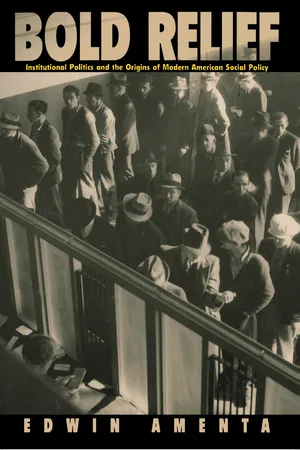
eBook - PDF
Bold Relief
Institutional Politics and the Origins of Modern American Social Policy
- 364 pages
- English
- PDF
- Available on iOS & Android
eBook - PDF
About this book
Information
Publisher
Princeton University PressYear
2021Print ISBN
9780691050683
9780691017129
eBook ISBN
9780691227481
Table of contents
- Cover Page
- Half-title Page
- Title Page
- Copyright Page
- Contents
- List of Illustrations
- List of Tables and Figures
- Preface
- Introduction: Paradoxes of American Social Policy
- Chapter 1: An Institutional Politics Theory of Social Policy
- Chapter 2: An Indifferent Commitment to Modern Social Policy, 1880-1934
- Chapter 3: America's First Welfare Reform, 1935-1936
- Chapter 4: Consolidating the Work and Relief Policy, 1937-1939
- Chapter 5: Some Little New Deals Are Littler than Others
- Chapter 6: Redefining the New Deal, 1940-1950
- Chapter 7: A Welfare State for Britain
- Conclusion
- Afterword
- Notes
- Initials of Organizations And Programs
- Sources of Illustrations
- Index
Trusted by 375,005 students
Access to over 1.5 million titles for a fair monthly price.
Study more efficiently using our study tools.
Frequently asked questions
Yes, you can cancel anytime from the Subscription tab in your account settings on the Perlego website. Your subscription will stay active until the end of your current billing period. Learn how to cancel your subscription
No, books cannot be downloaded as external files, such as PDFs, for use outside of Perlego. However, you can download books within the Perlego app for offline reading on mobile or tablet. Learn how to download books offline
Perlego offers two plans: Essential and Complete
- Essential is ideal for learners and professionals who enjoy exploring a wide range of subjects. Access the Essential Library with 800,000+ trusted titles and best-sellers across business, personal growth, and the humanities. Includes unlimited reading time and Standard Read Aloud voice.
- Complete: Perfect for advanced learners and researchers needing full, unrestricted access. Unlock 1.5M+ books across hundreds of subjects, including academic and specialized titles. The Complete Plan also includes advanced features like Premium Read Aloud and Research Assistant.
We are an online textbook subscription service, where you can get access to an entire online library for less than the price of a single book per month. With over 1.5 million books across 990+ topics, we’ve got you covered! Learn about our mission
Look out for the read-aloud symbol on your next book to see if you can listen to it. The read-aloud tool reads text aloud for you, highlighting the text as it is being read. You can pause it, speed it up and slow it down. Learn more about Read Aloud
Yes! You can use the Perlego app on both iOS and Android devices to read anytime, anywhere — even offline. Perfect for commutes or when you’re on the go.
Please note we cannot support devices running on iOS 13 and Android 7 or earlier. Learn more about using the app
Please note we cannot support devices running on iOS 13 and Android 7 or earlier. Learn more about using the app
Yes, you can access Bold Relief by Edwin Amenta in PDF and/or ePUB format, as well as other popular books in Economics & Political Economy. We have over 1.5 million books available in our catalogue for you to explore.