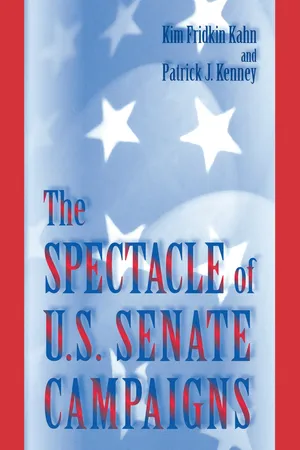
This book offers a bold, comprehensive look at how campaigns actually work, from the framing of issues to media coverage to voters' decisions. In so doing, it challenges the common wisdom that campaigns are a noisy, symbolic aspect of electoral politics, in which the outcomes are determined mainly by economic variables or presidential popularity. Campaigns, the authors argue, do matter in the political process. Examining contested U.S. Senate races between 1988 and 1992, Kim Kahn and Patrick Kenney explore the details of the candidates' strategies and messages, the content, tone, and bias of the media coverage, and the attitudes and behaviors of potential voters. Kahn and Kenney discover that when the competition between candidates is strong, political issues become clearly defined, and the voting population responds.
Through a mix of survey data, content analysis, and interviews, the authors demonstrate how competition influences serious political debates in elections. Candidates take stands and compare themselves to their opponents. The news media offer more coverage of the races, presenting evaluations of the candidates' positions, critiques of their political careers, and analyses of their campaign ads. In response, the voters pay closer attention to the rhetoric of the candidates as they learn more about central campaign themes, often adjusting their own voting criteria. The book concentrates on Senate races because of the variance in campaign strategy and spending, media coverage, and voter reactions, but many of the findings apply to elections at all levels.
- 256 pages
- English
- ePUB (mobile friendly)
- Available on iOS & Android
eBook - ePub
The Spectacle of U.S. Senate Campaigns
About this book
Information
Publisher
Princeton University PressYear
2021Print ISBN
9780691005058
9780691005041
eBook ISBN
9780691227924
Part One
UNDERSTANDING AND MEASURING CAMPAIGNS
One
The Nature of Political Campaigns
IN THE FALL of 1990, most Americans watched intently and anxiously as George Bush prepared to send the nation to war in the Persian Gulf. The citizens of Minnesota, however, were treated to a political respite in the form of an engaging senatorial campaign between incumbent Republican Rudy Boschwitz and challenger Paul Wellstone. When the campaign began, Boschwitz, first elected in 1978, was well known, well liked, well heeled, and well respected by Minnesotans. By the end of the campaign, Minnesota voters had decided to retire Boschwitz from the U.S. Senate. The turn of events leading to Boschwitz’s defeat illustrates the importance of campaigns and how the actions and reactions among the candidates, the media, and the voters determine electoral fortunes.
In mid-September, the senatorial campaign in Minnesota resembled a typical election involving a popular incumbent with plenty of resources facing an unknown challenger. The first polls taken after Wellstone won the Democratic primary on September 11 revealed that Boschwitz led by approximately 20 points. Wellstone had expended his resources to win the primary, and media coverage of the campaign was sparse because press attention was focused on the state’s highly competitive gubernatorial campaign.
Boschwitz’s first communication with voters, even before he knew who his opponent would be, was a set of ads reminding voters of his family’s escape from Nazi Germany, his experience in the Senate, and his service to Minnesota. After the primary, Boschwitz launched a second round of ads that was aimed at telling voters about his positive personal traits, how he is “warm [and] sympathetic,” especially on issues such as child care (Alger, 1996). The ads were uniformly positive and there were no mentions of Wellstone.
Wellstone, in the meantime, was laboring in virtual obscurity. The Minneapolis Star Tribune, the largest circulating paper in the state, mentioned Wellstone’s name in only thirty-eight paragraphs in the entire month of September, including articles describing his victory in the primary election. Wellstone’s response was to produce a set of unconventional and critical commercials stressing the size of Boschwitz’s campaign war chest (i.e., Boschwitz spent $6.2 million compared to Wellstone’s $1.3 million), his links to large money contributors, his unwillingness to debate the issues, and his voting record on issues such as welfare and the environment. The ads were full of negative messages, but they were presented in a “breezy, light-hearted way” (Alger, 1996: 81).
For example, Wellstone’s “Faces” advertisement began with a picture of Boschwitz and a Wellstone voice-over saying, “You’ll be seeing this face on TV a lot. It belongs to Sen. Rudy Boschwitz who’s got 6 million dollars to spend on commercials.” A picture of Wellstone is then shown with Wellstone saying, “This is a face you won’t be seeing as much on TV. It’s my face. I’m Paul Wellstone, and unlike Mr. Boschwitz, I didn’t take money from out-of-state special interests.” As the picture of Boschwitz reappears, Wellstone says, “So when you get tired of seeing this face, just imagine the face of someone [Boschwitz’s face TRANSFORMING into Wellstone’s face] who is better prepared and in a better position to represent your interests.” Wellstone then adds, “Not to mention, better looking” (Alger, 1996). The immediate impact of these unusual and effective ads was to frustrate Boschwitz, stimulate voter interest in Wellstone’s campaign, and, most important, attract much-needed media attention.
In fact, as early as October 4, the Star Tribune ran an article on the first page of the Metro/State section that claimed one of Wellstone’s ads was “the zaniest TV ad of Minnesota’s political season.” On October 11, a headline on the first page of the Star Tribune's Metro/State section heralded “TV Ads Generating Recognition, Respect for Paul Wellstone.” The article went on to quote extensively from the advertisement and noted that “the commercials are getting so much attention that some of the top Boschwitz aides are upset.” The ads became known as “must see” ads for both journalists and citizens alike. Local television stations replayed some of the commercials during their broadcasts, and national news programs commented on Wellstone’s unusual approach to political advertising.
Polls began to detect a narrowing of the race. A poll reported in mid-October showed Wellstone had closed the lead to 15 points. Then, in dramatic fashion, a poll reported on the front page of the Star Tribune on October 24 that Boschwitz’s lead had narrowed to only 3 points. By this time, the media, although still monitoring a negative, competitive, and sordid gubernatorial campaign, began focusing much more attention on the senatorial contest.1 In the first fifteen days of October, Wellstone’s coverage in the Star Tribune nearly tripled over that of the entire month of September. And, in the last ten days of the campaign, media attention in the paper tripled once again, with nearly three hundred paragraphs devoted to Wellstone and his “come from behind” campaign. Wellstone’s finances improved dramatically with the positive and prevalent media reports. He raised $400,000 in the last week of October, allowing him to run his now popular ads more frequently.
Boschwitz responded by running a series of five attack ads during the final two weeks of the campaign. In these ads Boschwitz characterized Wellstone as a “big-spending liberal.” The harsh characterization of Wellstone seemed to work. A poll reported in the Star Tribune on the Sunday before the election showed Boschwitz had regained the lead by 9 points.
Nevertheless, concerned about the volatility of the polls, Boschwitz blitzed the airwaves with negative advertisements during the final weekend of the campaign. In addition, he attempted a negative and bizarre communication aimed at Jewish voters during this same period. A letter was sent to them stressing that Wellstone, although Jewish, was married to a non-Jew and had “raised his children as non-Jews.” On Sunday, November 4, and Monday the 5th, a series of criticisms aimed both at the letter and at Boschwitz’s final advertising blitz appeared in local newspapers. Even the respected Walter Mondale, who had played a minor role during the campaign, criticized Boschwitz’s tactics in an article appearing in the Star Tribune the day before the election. The former vice-president accused Boschwitz of “a relentless, brutal, heavily financed, and in my judgment, untruthful television assault” unheard of in Minnesota history. The next day Wellstone garnered 50 percent of the vote, defeating Boschwitz by two percentage points.
Although it was more dramatic than most, this race illustrates the complex interactions among candidates, the media, and the voters. During the course of the campaign, it appears that Wellstone’s and Boschwitz’s actions influenced the media’s presentation of the campaign and voters’ preferences. In addition, the candidates modified their initial strategies based on polling reports and patterns of press coverage. In the end, most people close to the campaign believed that the combination of the candidates’ messages and the news media’s portrayal of the race had a profound impact on the final vote tally (Alger, 1996).
This example raises questions about the nature and dynamics of political campaigns. What type of candidate messages captivate the interest of typically jaded reporters and normally distracted citizens? What political conditions conspire to lead candidates to attack their opponents? How does the media coverage of the race motivate candidates to alter their campaign strategies? How do the media present the content of the candidates’ messages to potential voters? Do the media focus on issues, or candidate traits, or polling numbers? What role does competition play in shaping the content of candidates’ messages and the substance of campaign coverage? How do voters react to a stream of negative messages from candidates?
Our goal in this book is to increase the public’s understanding of political campaigns by examining the population of U.S. Senate races contested between 1988 and 1992. Senate elections present an optimal setting for the study of campaigns because they provide impressive variance in campaign strategy, campaign spending, media coverage, and voter reactions (Abramowitz and Segal, 1992; Franklin, 1991; Krasno, 1994; Westlye, 1991). Unlike House races, which are usually low-key affairs, and presidential races, which are often hard-fought contests, campaigns for the U.S. Senate vary considerably in their competitiveness.
In our explorations, we examined the details of the candidates’ strategies and messages, the content, tone, and bias of the media coverage, and the attitudes and behaviors of potential voters. We discovered that competition is the driving force in American electoral politics. More than anything else, competition shapes, conditions, and colors the behavior of candidates, the reporting of the press, and the citizens’ evaluations of competing candidates. Without competition, campaigns are nothing more than self-aggrandizing exercises by incumbents. Their communications with voters are well-rehearsed scripts recounting their successes as legislators. There is little, if any, discussion of public policy. In addition, when competition is scarce, the media look to other political campaigns and events to report to voters. The press simply ignores noncompetitive campaigns. There are few headlines, virtually no front-page articles, and precious little actual reporting about these low-key campaigns. The ultimate losers in these noncompetitive settings are the voters. Citizens witnessing these campaigns are presented with almost no political information, debate, and discussion on which to evaluate candidates before Election Day.
Competitive elections, in contrast, are characterized by political debates, critiques, and discourse over the issues facing the nation and the leadership qualities of those candidates seeking office. Voters are presented with numerous reasons to vote for one candidate over another. These reasons are plentiful in the candidates’ advertisements as well as in the local press. Candidates talk about contemporary issues, they take stands on the issues, and they present comparisons with their opponents. The news media dedicate significantly more resources to the coverage of close races. In competitive campaigns, reporters and editors evaluate the candidates’ stands on the issues, they critique politicians’ careers, and they analyze their political ads.
Most importantly, voters respond to their political environment. The data and analyses presented in this book clearly demonstrate that “campaigns matter.” The activities of the candidates and the media make campaigns more or less competitive. Voters’ attitudes about politicians are not fixed and beyond the control of candidates. Polls change in response to the events of campaigns. While campaigns for noncompetitive seats may be largely symbolic, voters observing competitive campaigns listen and respond to the rhetoric of the candidates and the reporting by the local press. We show that “voters are not fools.” In competitive contests, citizens are knowledgeable about the candidates and understand the central themes of the campaigns. Even more impressively, individuals adjust their decision rules depending on the closeness of the contests. As campaigns become more competitive, voters respond by relying more heavily on sophisticated criteria, such as ideology and issues, when evaluating the opposing candidates.
In the end, we feel confident concluding that competitive campaigns are an essential element of American democracy. They enliven and enrich people’s political life. They empower voters with information to make choices about their representatives.
The Importance of Campaigns
In the United States, elections are the cornerstone of our representative democracy. Through elections, voters determine who is to hold political power and for how long. For the better part of two centuries, norms, practice, and tradition have dictated that political campaigns precede elections in the United States.2 Campaigns enrich the political process in several important ways. They provide a formal period of time when political parties and politicians introduce themselves to potential voters. During campaigns, competing candidates and the political parties they represent have the opportunity to discuss matters of public policy for a sustained period of time. Campaigns also afford candidates an occasion to highlight their personal qualifications for office, such as their leadership ability, integrity, competence, and compassion. Candidates disseminate their messages to large numbers of voters by distributing campaign brochures, delivering speeches, airing advertisements on television and radio, and orchestrating fund-raisers and political rallies. This concentrated and sometimes intense political campaigning has the potential to provide voters with the information necessary to make informed decisions at the ballot box.
Beyond simply introducing candidates to voters, campaigns provide an avenue for widespread political discussion. No other forum produces political discourse that is as readily accessible to millions of American citizens as political campaigns. An extensive and ongoing political dialogue is often regarded as a key component of a healthy and functioning democracy. As John Stuart Mill (1951: 27) explains in his essay “On Liberty”: “There must be discussion, to show how experience is to be interpreted. Wrong opinions and practices gradually yield to fact and argument: but facts and arguments, to produce any effect on the mind, must be brought before it. Very few facts are able to tell their own story, without comment to bring out their meaning.” In today’s political campaigns, the commentary employed by candidates to animate “factual” discussion is pervasive, presented in deftly designed pamphlets, cleverly crafted commercials, and carefully worded speeches. In addition, local and national news media outlets routinely present the “facts of the matter” concerning the campaign in newspaper and magazine articles, during televised news programs, and on the radio.
More broadly still, in his work Considerations on Representative Government, Mill (1991: 321) argues that political discussion enlivens a sense of political community among a disparate citizenry.
It is by political discussion that the manual labourer, whose employment is a routine, and whose way of life brings him in contact with no variety of impressions, circumstances, or ideas, is taught that remote causes, and events which take place far off, have a most sensible effect even on his personal interests; and it is from political discussion, and collective political action, that one whose daily occupations concentrate his interests in a small circle round himself, learns to feel for and with his fellow citizens, and becomes consciously a member of a greater community.
To be sure, empirical research has demonstrated that the style and tone of political discussion during campaigns affect the likelihood that citizens will participate in their political community by voting. If candidates present interesting ideas that pertain directly to topics that are salient to people’s lives, then turnout increases (Ragsdale and Rusk, 1995; Caldeira, Patterson, and Markko, 1985). On the other hand, if the outcome of the election is virtually certain, with little engaging discussion between competing candidates, or worse, if the political discussion is harsh, strident, and unduly negative, then voter participation tends to decline (Ansolabehere and Iyengar, 1995; Filer et al., 1993).
Scholars have also demonstrated that campaigns directly influence the amount and type of political discussion in the United States (Kinder and Sanders, 1996; Zaller, 1992; Page, 1978). Recently, for example, Kinder and Sanders (1996) have shown how presidential campaigns can generate or discourage discussion of racial issues in America, easily the most complicated, emotional, poignant, and divisive issue in our nation’s history. Kinder and Sanders explain that the 1988 presidential campaign made clear the links between race and crime generating a national discussion by candidates Bush and Dukakis explicitly on crime, and implicitly on race. In 1992, in contrast, ...
Table of contents
- Cover Page
- Title Page
- Copyright Page
- Dedication
- Contents
- List of Figures
- List of Tables
- Acknowledgments
- Part One: Understanding and Measuring Campaigns
- Part Two: The Campaign Strategies of Candidates
- Part Three: The News Media’s Coverage of Campaigns
- Part Four: Citizens’ Reactions to Campaigns
- Part Five: Conclusions
- Appendixes
- References
- Index
Trusted by 375,005 students
Access to over 1.5 million titles for a fair monthly price.
Study more efficiently using our study tools.
Frequently asked questions
Yes, you can cancel anytime from the Subscription tab in your account settings on the Perlego website. Your subscription will stay active until the end of your current billing period. Learn how to cancel your subscription
No, books cannot be downloaded as external files, such as PDFs, for use outside of Perlego. However, you can download books within the Perlego app for offline reading on mobile or tablet. Learn how to download books offline
Perlego offers two plans: Essential and Complete
- Essential is ideal for learners and professionals who enjoy exploring a wide range of subjects. Access the Essential Library with 800,000+ trusted titles and best-sellers across business, personal growth, and the humanities. Includes unlimited reading time and Standard Read Aloud voice.
- Complete: Perfect for advanced learners and researchers needing full, unrestricted access. Unlock 1.5M+ books across hundreds of subjects, including academic and specialized titles. The Complete Plan also includes advanced features like Premium Read Aloud and Research Assistant.
We are an online textbook subscription service, where you can get access to an entire online library for less than the price of a single book per month. With over 1.5 million books across 990+ topics, we’ve got you covered! Learn about our mission
Look out for the read-aloud symbol on your next book to see if you can listen to it. The read-aloud tool reads text aloud for you, highlighting the text as it is being read. You can pause it, speed it up and slow it down. Learn more about Read Aloud
Yes! You can use the Perlego app on both iOS and Android devices to read anytime, anywhere — even offline. Perfect for commutes or when you’re on the go.
Please note we cannot support devices running on iOS 13 and Android 7 or earlier. Learn more about using the app
Please note we cannot support devices running on iOS 13 and Android 7 or earlier. Learn more about using the app
Yes, you can access The Spectacle of U.S. Senate Campaigns by Kim Fridkin Kahn,Patrick J. Kenney in PDF and/or ePUB format, as well as other popular books in Politics & International Relations & Political Process. We have over 1.5 million books available in our catalogue for you to explore.