Never before has the legitimacy of a dominant American culture been so hotly contested as over the past two decades. Familiar terms such as culture wars, multiculturalism, moral majority, and family values all suggest a society fragmented by the issue of cultural diversity. So does any social solidarity exist among Americans? In Diversity and Its Discontents, a group of leading sociologists, political theorists, and social historians seek to answer this question empirically by exploring ideological differences, theoretical disputes, social processes, and institutional change. Together they present a broad yet penetrating look at American life in which cultural conflict has always played a part. Many of the findings reveal that this conflict is no more or less rampant now than in the past, and that the terms of social solidarity in the United States have changed as the society itself has changed.
The volume begins with reflections on the sources of the current "culture wars" and goes on to show a number of parallel situations throughout American history--some more profound than today's conflicts. The contributors identify political vicissitudes and social changes in the late twentieth century that have formed the backdrop to the "wars," including changes in immigration, marriage, family structure, urban and residential life, and expression of sexuality. Points of agreement are revealed between the left and the right in their diagnoses of American culture and society, but the essays also show how the claims of both sides have been overdrawn and polarized. The volume concludes that above all, the antagonists of the culture wars have failed to appreciate the powerful cohesive forces in Americans' outlooks and institutions, forces that have, in fact, institutionalized many of the "radical" changes proposed in the 1960s. Diversity and Its Discontents brings sound empirical evidence, theoretical sophistication, and tempered judgment to a cultural episode in American history that has for too long been clouded by ideological rhetoric.
In addition to the editors, the contributors are Seyla Benhabib, Jean L. Cohen, Reynolds Farley, Claude S. Fischer, Frank F. Furstenberg, Jr., John Higham, David A. Hollinger, Steven Seidman, Marta Tienda, David Tyack, R. Stephen Warner, Robert Wuthnow, and Viviana A. Zelizer.
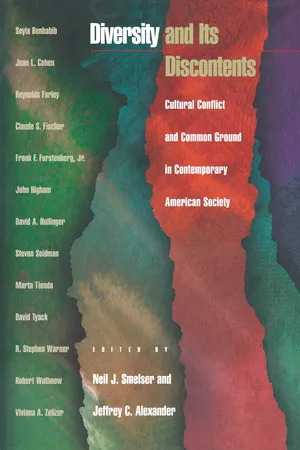
eBook - ePub
Diversity and Its Discontents
Cultural Conflict and Common Ground in Contemporary American Society
- 320 pages
- English
- ePUB (mobile friendly)
- Available on iOS & Android
eBook - ePub
Diversity and Its Discontents
Cultural Conflict and Common Ground in Contemporary American Society
About this book
Information
Publisher
Princeton University PressYear
2021Print ISBN
9780691004372
9780691004365
eBook ISBN
9780691228334
PART ONE
Introduction: Sources of Cultural Conflict
CHAPTER ONE
Introduction: The Ideological Discourse of Cultural Discontent
PARADOXES, REALITIES, AND ALTERNATIVE WAYS OF THINKING
JEFFREY C. ALEXANDER AND NEIL J. SMELSER
POLITICAL and academic arguments about social justice over the last decade—and the controversies they ignited—have shown a notably cultural face. The language is revealing: moral majority, family values, cultural pluralism, cultural diversity, multiculturalism, and culture wars. Wuthnow (ch. 2 in this vol.) refers to this development as a “discourse of discontent.” It reaches deeply into American social structure, identifying crises in family, marriage, religion, education, and race relations. This discourse also draws attention to shifts in social behavior and social process, pointing to public displays of homosexuality and cultural difference, massive new waves of legal and illegal immigration, and economic and cultural globalization. Moreover, this growing chorus of complaint has struck a chord in American public life because it meshes with cultural themes that carry great symbolic weight.
The core of the complaint concerns common values in American society. Critics at both ends of the political spectrum claim that such values are disappearing or have disappeared. Conservatives complain that the solidarity of American society has become fragmented, that the very fabric of society has been ruptured. They claim that unprecedented developments are undermining the cultural homogeneity on which a democratic society depends. In response, conservatives assert, traditional values must be revitalized. For their part, radical critics celebrate the end of common cultural values. Arguing that diversity and difference constitute the high moral goods of society, they view any attempt to connect this diversity to shared values oppressive. In the academy, this leftist position has contributed to the appearance and vitality of “cultural studies,” a new field challenging traditional disciplinary authority. Originating in British neo-Marxism and highly influenced by Foucault, cultural studies stress hegemony rather than common culture, and domination rather than civil solidarity. It has been in centers of cultural studies that the more radical programs in race, gender, and ethnic studies have been launched.
A glance at earlier twentieth-century periods of intense, polarized cultural conflict highlights not only the uniqueness of the contemporary cultural emphasis but also the unique polarizing nature of this rhetoric.
•In the 1930s, American society experienced intense and divisive social conflict. Because this crisis was triggered by the collapse of the American economy and its consequent large-scale unemployment and poverty, the dominant frames of discourse in that era were those of economic and political stability, the viability of capitalism as compared with socialist alternatives, and the possibilities of achieving social justice through structural reforms. Although cultural themes certainly were not absent, the integrity of American cultural values did not enter significantly into the conflicting social and political dialogues of the time. Indeed, as many have since pointed out, the “popular front” ideology espoused by the left in the 1930s was as “American as apple pie.”
•In the 1960s, dramatic and polarizing turmoil was triggered by demands—first by African Americans, later by feminists and by other racial minorities—for deepening the nation’s long-established constitutional and cultural commitments to civil rights. Countercultural issues of the youth movement sometimes obscured this traditional framing, as did the often violent conflicts generated by the moral and political debacle of the Vietnam War. The discursive framework of that decade of protest, however, was clearly established by the model of citizenship. Social justice and inclusion were to be achieved by making citizenship more real for outgroups and more binding for ingroups. Radicals and conservatives both agreed on the necessity for achieving greater “equality of opportunity,” the cultural theme that Tocqueville had already discerned in American society almost a century and a half earlier.
•During the last period of massive immigration, from the 1880s to the early 1920s, conflict over economic and political issues was indeed permeated by rhetoric about the salience and stability of traditional cultural values. Conservative WASP intellectuals raised cries of alarm that the new, largely Catholic and Jewish immigration would undermine homogeneity. In mounting a defense of the new immigrant groups, progressive intellectuals proclaimed not only that they could easily be assimilated—that immigrant values were complementary to traditional American ones—but that the new immigrants fervently sought such cultural incorporation. From the current perspective, what is remarkable about this debate is that the existence and legitimacy of a dominant, “hegemonic” national culture was assumed on all sides. American culture was not itself the object of debate. The issue that divided Americans was whether or not immigrant groups could be brought to come to terms with it.
The uniquely cultural orientation of contemporary social complaints and conflicts, however, should not imply that we ourselves should adopt a purely “culturalist” approach in studying them. Of course, we must do our best to understand radical and conservative complaints interpretatively, from within their own framework of ideas and symbols. At the same time, as social scientists we must remain skeptical of the reality claims that emanate from the contenders on both sides. Our goal is not simply to provide a “thick description” of these discourses, to employ the term by which Clifford Geertz (1973a) illuminated hermeneutical interpretation, but to explain them as well. In order to achieve this goal, we must examine these critical complaints not simply from the inside (as coherent cultural discourses) but from the outside (as ideological constructions).1
Moreover, rather than simply understanding the symbolic structure of ideology (Geertz 1973b), we are interested in finding out whether these discourses are realistic descriptions of contemporary American society or whether they distort it in potentially damaging ways. Does the widely shared discourse of complaint fairly represent the actual practices of Americans today? Does it accurately and responsibly describe contemporary institutions and interactions? The discourse of discontent has been created by intellectuals of the left and the right and has become part of the rhetoric of political leaders and aspirants, ideologically sophisticated media figures, and highly visible “movement intellectuals” (Eyerman and Jameson 1990) who articulate and oppose ethnic, racial, and gender programs. How deeply do these frameworks actually inform the ideas of those who organize routine social practice? As we shall show, the evidence suggests that although the critics of the right and the left refer to society-wide crisis and polarization, their theories and rhetorics neither penetrate nor reflect the routine politics of the nation, institutional activities at the grass roots, or the attitudes, cares, and interactions of the proverbial person in the street.
SOME PARADOXES, AND THE LOSS OF COMMON GROUND
In regarding the contemporary discourse of discontent as an ideology, we note some striking paradoxes. (In doing so, we move toward developing a political sociology of the cultural turn.) The first paradox concerns what might be called a contrast between culture and materiality. The current cultural framing of national crisis has occurred almost at the expense of traditional claims about economic injustice. During the two decades beginning in 1973, economic conditions for many Americans actually declined. The real wages of much of the country’s labor force fell, and the distribution of income became more regressive. The interrelated social problems of poverty, homelessness, drug use, and crime also worsened during those decades. Yet, although these socioeconomic problems have remained the focus of substantial attention in government and in policy-oriented academic circles, they have been given little systematic attention in contemporary cultural debates.
A second, related paradox concerns the social status of the movement intellectuals themselves. The left, or “progressive,” participants in this cultural complaint often represent groups that have experienced significant economic, status, and political gains in the past three decades. For women, working- and middle-class members of disadvantaged racial groups, and other traditionally stigmatized minorities these gains have been uneven and hard fought, to be sure, but they are real and have been documented in statistics about income, occupational mobility, intermarriage, and even to a modest degree residential segregation. In an oddly parallel fashion, conservatives often come from members of elite, high-prestige groups who have also experienced gains in income and wealth in the two decades of wage stagnation and more regressive distribution. The normal logic of class and status deprivation does not promise an adequate explanation for the discourse of discontent.
The most striking anomaly of the current situation is that it has made strange bedfellows on the left and the right. Those who have created the contemporary sense of cultural polarization find common ground in the claim that, in contemporary America, common ground no longer exists. Conservative ideologists launch an apocalyptic complaint that contemporary developments are destroying common values, and the critical left seems to agree.
Nowhere is this anomaly more striking than in the public controversies over multiculturalism. Rather than viewing claims for increasing recognition of diversity as responses to discrimination, inequality, and exclusion, conservative critics claim that such demands actually introduce divisions where none existed before. Thus, Arthur Schlesinger, Jr., former Kennedy liberal and cosmopolitan thinker, blames multicultural activists for reviving “ancient prejudices” (1991: 15). By “exaggerating differences,” he writes, “the cult of ethnicity . . . intensifies resentments and antagonisms,” producing “a nation of minorities [and] makes it appear that membership in one or another ethnic group is the basic American experience” (112). On this basis Schlesinger argues that multiculturalism has undermined the solidarity necessary for American democracy. “The cult of ethnicity,” he laments, “has reversed the movement of American history,” and he condemns it for “breaking the bonds of cohesion—common ideals, common political institutions, common language, common culture, common fate—that holds the republic together” (13). More strident neoconservatives denounce multiculturalism as itself a new form of racism, one directed against the white majority. D’Sousa denounces “the new separatism” and likens it to defending the South African apartheid regime (1992: 30). For Kimball, multiculturalism, “far from being a means of securing ethnic and racial inequality,” is “an instrument for promoting ideological separatism based on . . . differences” (1992: 82). He asserts that “what we are facing is nothing less than the destruction of the fundamental premises that underlie ... a liberal democratic polity” (65).
One might suppose that multicultural advocates would respond to such shrill and disparaging attacks by arguing that their approach does nothing of the kind but that multiculturalism merely articulates and extends long-standing American values of tolerance of diversity. The paradox is that they argue in an opposite way. Some of the most articulate and publicly visible multiculturalists argue that their movement is indeed destructive of the traditional concept of American community. In her influential philosophical treatise Justice and the Politics of Difference, Iris Marion Young (1990) proposes as her normative ideal a social system of insulated but equally empowered groups who, rather than experiencing some shared humanity and solidarity, simply grant one another the right to pursue their distinct and “different” lifestyles and goals. In her presidential address to the Modern Language Association in 1990, Catharine Stimpson, the well-known feminist literary scholar, described multiculturalism as “treating society as the sum of several equally valuable but distinct racial and ethnic groups (1992: 43-44; italics added). At the same meeting, the editor of the omnibus Health Anthology of American Literature defended his textbook’s emphasis on race and gender by insisting, “I know of no standard of judgment . . . which transcends the particularities of time and place ... of politics” (Kimball 1992: 75). In another scholarly presentation at the MLA, a Shakespearean scholar justified the need for a multicultural approach to literature by highlighting the boundedness of his own particular identity. Reading the work of a black woman author, he explained, “I do not enter into a transcendent human interaction but become more aware of my whiteness and maleness, social categories that shape my being” (Kimball 1992: 69). In another context, Molefi Kete Asante, chair of the Department of African American Studies at Temple University, justified Afrocentrism on the grounds that even for Black Americans, “our Africanity is our ultimate reality” (quoted in Schlesinger 1991: 65). “The idea of ‘mainstream American’,” he writes, “is nothing more than an additional myth meant to maintain Eurocentric hegemony” (305).
What emerges from these polarizing and mutually reinforcing discourses is a further weakening of the intellectual middle ground, of the possibility for finding a progressive but democratic “vital center” (a formula for politics advocated in an earlier era by Schlesinger [1949]) that can create grounds for ideological consensus and the resolution of political conflict in American public life. Such ideological fragmentation, of course, reinforces recent political developments. Liberal politicians and intellectuals were stigmatized throughout the 1980s and 1990s from the right during the Reagan and Bush administrations as being soft on family values, crime, drugs, pornography, and heterosexuality, all of which touch upon core American values. During this same period—and earlier—the same liberal intellectuals were attacked from the left by an ideology that viewed them as part of a hegemonic establishment, thus denying them the possibility of articulating authentic, progressive values and programs.
We can appreciate the powerful combination of social and intellectual forces that have driven some of the middle to the right and some to the left, yet we believe it is important to assert the continuing vitality of the middle ground. It is justified on normative grounds, because mutual understanding is the key to mutual respect, deliberative democracy, engaged debate, and affirming citizenship. The middle position is also justified on empirical grounds; our belief is that more common ground exists than protagonists of discontent allow. Both left and right have an unjustifiably “thin” (Walzer 1994) appreciation of what kind of solidarity is required in a highly differentiated, diverse, and inclusive civil society. From the right comes a hope for the regeneration of solidarity through the reassertion of common family, religious, and community values—a vision that reveals an impoverished sense of the richness and multiplicity of social institutions and attitudes that constitute civil solidarity. From the left comes a minimalist, procedural vision suggesting that democratic solidarity can be constituted by elaborating the sociological equivalents of what Isaiah Berlin called negative liberties—protection and tolerance of differences and the promotion of formal respect.
As if realizing the inadequacy of such visions of solidarity, both right and left, while scarcely denouncing democracy, sometimes advocate more coercive roads to solidarity. The right would implement a governmental program of cultural homogeneity, replete with media censorship and English-only language rules, and would supplement this cultural program with tough laws and sanctions against immigration, criminals, drugs, pornography, and sexual deviation. Some intellectuals on the left have also been drawn to direct forms of control, not only to hegemonic assertions of political correctness but also to legal restrictions on hate speech and pornography, and to “requirements” for diversity throughout the educational system. These temptations signify, to us, an uneasiness on both sides with the utopian visions of solidarity that each embraces.
In the remainder of this introduction we undertake to examine the adequacy of the culture of discontent according to traditional theoretical and empirical criteria of social science. This summary will suggest that social and cultural polarization is neither as unprecedented nor as dramatic as some discontented intellectuals and political figures believe. We will also advance the claim, based on documentation provided by the essays in this book, that there are good reasons to believe that a vital center persists in American society, both despite and because of the intensity of social change we continue to experience.
WHAT WE HAVE LEARNED IN THIS VOLUME
We may now confess to an initial sense of apprehension when we convened our conference on Common Values, Social Diversity, and Cultural Conflict. We feared that we and our participants would produce nothing new, that we would fall into the polarizations that the current cultural debates have produced, and that we would embrace the presuppositions and language of these debates rather than problematize them. In light of these initial fears, we were surprised at the degree of objectivity achieved, both from the causes and positions participants personally favored and from their feelings about those they opposed. We were even more surprised by the convergence if not consensus on the part of scholars gathered. We will now attempt to distill this convergence.
A Historical Glance at Contemporary Realities. It seems clear that the contemporary sense of decline of and anxiety about social cohesion is nothing new. From the beginnings of the Republic, institutional and social change has been constant, creating periodic crises of confidence and spasms of concern about national stability, social cohesion, and democracy itself. Immigration has been a continual sore spot, and the urban areas that have received immigrants have long been decrie...
Table of contents
- Cover Page
- Title Page
- Copyright Page
- Contents
- Contributors
- Part One: Introduction: Sources of Cultural Conflict
- Part Two: How Much Has Really Changed?
- Part Three: Social Change and New Forms of Social Connection
- Part Four: Rethinking Diversity and Social Solidarity
- Index
Trusted by 375,005 students
Access to over 1.5 million titles for a fair monthly price.
Study more efficiently using our study tools.
Frequently asked questions
Yes, you can cancel anytime from the Subscription tab in your account settings on the Perlego website. Your subscription will stay active until the end of your current billing period. Learn how to cancel your subscription
No, books cannot be downloaded as external files, such as PDFs, for use outside of Perlego. However, you can download books within the Perlego app for offline reading on mobile or tablet. Learn how to download books offline
Perlego offers two plans: Essential and Complete
- Essential is ideal for learners and professionals who enjoy exploring a wide range of subjects. Access the Essential Library with 800,000+ trusted titles and best-sellers across business, personal growth, and the humanities. Includes unlimited reading time and Standard Read Aloud voice.
- Complete: Perfect for advanced learners and researchers needing full, unrestricted access. Unlock 1.5M+ books across hundreds of subjects, including academic and specialized titles. The Complete Plan also includes advanced features like Premium Read Aloud and Research Assistant.
We are an online textbook subscription service, where you can get access to an entire online library for less than the price of a single book per month. With over 1.5 million books across 990+ topics, we’ve got you covered! Learn about our mission
Look out for the read-aloud symbol on your next book to see if you can listen to it. The read-aloud tool reads text aloud for you, highlighting the text as it is being read. You can pause it, speed it up and slow it down. Learn more about Read Aloud
Yes! You can use the Perlego app on both iOS and Android devices to read anytime, anywhere — even offline. Perfect for commutes or when you’re on the go.
Please note we cannot support devices running on iOS 13 and Android 7 or earlier. Learn more about using the app
Please note we cannot support devices running on iOS 13 and Android 7 or earlier. Learn more about using the app
Yes, you can access Diversity and Its Discontents by Neil J. Smelser, Jeffrey C. Alexander, Neil J. Smelser,Jeffrey C. Alexander in PDF and/or ePUB format, as well as other popular books in Social Sciences & Sociology. We have over 1.5 million books available in our catalogue for you to explore.