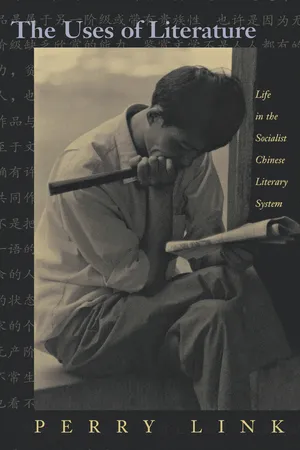
Why do people in socialist China read and write literary works? Earlier studies in Western Sinology have approached Chinese texts from the socialist era as portraits of society, as keys to the tug-of-war of dissent, or, more recently, as pursuit of "pure art." The Uses of Literature looks broadly and empirically at these and many other "uses" of literature from the points of view of authors, editors, political authorities, and several kinds of readers. Perry Link, author of Evening Chats in Beijing, considers texts ranging from elite "misty" poetry to underground hand-copied volumes (shouchauben) and shows in concrete detail how people who were involved with literature sought to teach, learn, enjoy, explore, debate, lead, control, and resist.
Using the late 1970s and early 1980s as an entree to the workings of China's "socialist literary system," the author shows how that system held sway from 1950 until around 1990, when an encroaching market economy gradually but fundamentally changed it. In addition to providing a definitive overview of how the socialist Chinese literary system worked, Link offers comparisons to the similar system in the Soviet Union. In the final chapter, the book seeks to explain how the word "good" was used and understood when applied to literary works in such systems.
Combining aspects of cultural and literary studies, The Uses of Literature will reward anyone interested in the literature of modern China or how creativity is affected by a "socialist literary system."
- 402 pages
- English
- PDF
- Available on iOS & Android
eBook - PDF
About this book
Information
Publisher
Princeton University PressYear
2021Print ISBN
9780691001982
9780691001975
eBook ISBN
9780691227849
Table of contents
- Cover Page
- Title Page
- Copyright Page
- Contents
- Acknowledgments
- A Note On Documentation
- Introduction
- Chapter One: Historical Setting
- Chapter Two: The Mechanics of Literary Control
- Chapter Three: Writers
- Chapter Four: Media and Market
- Chapter Five: Readers: The Popular Level
- Chapter Six: Readers: Socially Engaged Level
- Chapter Seven: The Uses of Literature
- Select Glossary of Chinese Characters
- Bibliography of Works Cited In the Notes
- Index
Trusted by 375,005 students
Access to over 1.5 million titles for a fair monthly price.
Study more efficiently using our study tools.
Frequently asked questions
Yes, you can cancel anytime from the Subscription tab in your account settings on the Perlego website. Your subscription will stay active until the end of your current billing period. Learn how to cancel your subscription
No, books cannot be downloaded as external files, such as PDFs, for use outside of Perlego. However, you can download books within the Perlego app for offline reading on mobile or tablet. Learn how to download books offline
Perlego offers two plans: Essential and Complete
- Essential is ideal for learners and professionals who enjoy exploring a wide range of subjects. Access the Essential Library with 800,000+ trusted titles and best-sellers across business, personal growth, and the humanities. Includes unlimited reading time and Standard Read Aloud voice.
- Complete: Perfect for advanced learners and researchers needing full, unrestricted access. Unlock 1.5M+ books across hundreds of subjects, including academic and specialized titles. The Complete Plan also includes advanced features like Premium Read Aloud and Research Assistant.
We are an online textbook subscription service, where you can get access to an entire online library for less than the price of a single book per month. With over 1.5 million books across 990+ topics, we’ve got you covered! Learn about our mission
Look out for the read-aloud symbol on your next book to see if you can listen to it. The read-aloud tool reads text aloud for you, highlighting the text as it is being read. You can pause it, speed it up and slow it down. Learn more about Read Aloud
Yes! You can use the Perlego app on both iOS and Android devices to read anytime, anywhere — even offline. Perfect for commutes or when you’re on the go.
Please note we cannot support devices running on iOS 13 and Android 7 or earlier. Learn more about using the app
Please note we cannot support devices running on iOS 13 and Android 7 or earlier. Learn more about using the app
Yes, you can access The Uses of Literature by Perry Link in PDF and/or ePUB format, as well as other popular books in Literature & Asian Literary Criticism. We have over 1.5 million books available in our catalogue for you to explore.