Civil Society and Government brings together an unprecedented array of political, ethical, and religious perspectives to shed light on the complex and much-debated relationship between civil society and the state. Some argue that civil society is a bulwark against government; others see it as an indispensable support for government. Civil society has been portrayed both as a independent of the state and as dependent upon it. This book reveals the extraordinary diversity of views on the subject by examining how civil society has been treated in classical liberalism, liberal egalitarianism, critical theory, feminism, natural law, Christianity, Judaism, Islam, and Confucianism.
The volume draws on the work of eminent scholars to address six questions: In terms of function and consequences, does it matter where the line is drawn between civil society and the state? What is the relationship of civil society to the state? In what contexts and under what conditions should government interact with individuals directly or instead indirectly through communal associations? What are the prerogatives and duties of citizenship, and what is the role of civil society in forming good citizens? How should a society handle the conflicts that sometimes arise between the demands of citizenship and those of membership in the non-governmental associations of civil society?
A theoretical introduction by the editors--political theorist Nancy Rosenblum and legal scholar Robert Post--and a conclusion by religious ethicist Richard Miller, tie the book together. In addition to Rosenblum, the contributors are Kenneth Baynes, David Biale, John Coleman, Farhad Kazemi, John Kelsay, William Galston, Will Kymlicka, Tom Palmer, Fred Miller, Susan Moller Okin, Peter Nosco, Henry Rosemont, Steven Scalet, David Schmidtz, William Sullivan, Max Stackhouse, Stephen White, and Noam Zohar.
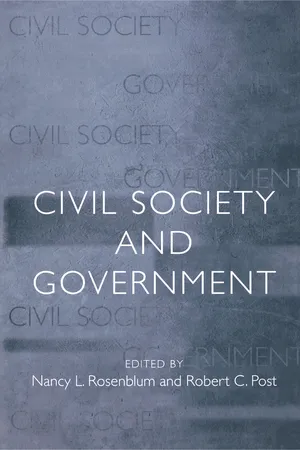
eBook - ePub
Civil Society and Government
- 408 pages
- English
- ePUB (mobile friendly)
- Available on iOS & Android
eBook - ePub
Civil Society and Government
About this book
Information
Publisher
Princeton University PressYear
2021Print ISBN
9780691088020
9780691088013
eBook ISBN
9780691228396
Topic
PhilosophySubtopic
Political PhilosophyINDEX
Adorno, Theodor, 123, 146–49
ahadith: duties to obey ruler, 295, 305; recommending disobedience, 295
Anabaptism, 242
Aquinas, Thomas, 188, 199, 203, 220, 225, 228
Arato, Andrew, 125
Arendt, Hannah, 15, 161
Aristotle, 188, 191, 193, 196, 202, 203, 206–7, 376
associations: as components of society, 199; covered by civil society, 298; in development of civil society, 50–56; eleemosynary, 200; excluding women, 182–83; nature-based norms of civil, 192–93; purposes of, 4–5; role in governance, 16–17; variety in civil society of, 195; of women, 173
associations, voluntary: in ancient China, 363; in civil society, 3–4, 334; in medieval Jewish community, 270, 281; rise in East Asia, 340–41
Augustine, 225
authoritarianism, in Islamic world, 320–22
Barber, Benjamin, 49–50, 56, 61
Barry, Brian, 68, 112
Bauer, Otto, 67
Bellah, Robert, 247
Benhabib, Seyla, 235, 236
Bennett, John C., 230
Berlin, Isaiah, 3–4
Berman, Harold, 51–52
Black, Antony, 53
boundaries: between civil society and government, 3, 10–12; between civil society/state in Christian thought, 243–45; between civil society/state in critical theory, 129–33; between civil society/ state in liberal-egalitarian thought, 81–84, 115–17; between civil society/state in natural law perspective, 193–95; in feminist theory, 152–55, 179–81; liberal view of government and society, 30–32, 61–62; between public and private spheres, 179–80; between society and state in Islamic thought, 294–97; between society/state in Judaic perspective, 266–69; between state and society in Confucian thought, 337–41, 362–63, 371–73
Boyt, Harry, 170
Brogan, D. W., 246
Burrell, David, 225
Butler, Judith, 166
Calvinism, 229–30, 242–43
capitalism: criticized by Frankfurt School, 146; natural law view in support of, 201–2; suspicions about, 201
Casanova, Jose, 232, 234–35
casuistry, 189, 202
Catholicism: deprivatization of religion in, 236–37; distinction between state and society in, 233–38; feminist aspirations in, 182; natural law arguments of, 216; sense of its mission, 233–42; social, 226, 231–34, 236–47, 377, 378, 393–94; social thought of, 237, 239–40; subsidiarity principle of, 238–43; theory of church-state, 231–33; theory of subsidiarity and common good, 223; views about church,...
Table of contents
- Cover Page
- Title Page
- Copyright Page
- Contents
- Acknowledgments
- Introduction
- State, Civil Society, and Classical Liberalism
- Classical Liberalism and Civil Society: Definitions, History, and Relations
- Civil Society and Government: A Liberal-Egalitarian Perspective
- Liberal Egalitarianism: A Family of Theories, Not a Single View
- A Critical Theory Perspective on Civil Society and the State
- Skeptics at the Celebration: Civil Society and the Early Frankfurt School
- Feminist Perspectives on Civil Society and Government
- Comment on Nancy Rosenblum’s “Feminist Perspectives on
- Natural Law, Civil Society, and Government
- Natural Law: A Response
- A Limited State and a Vibrant Society: Christianity and Civil Society
- Christianity, Civil Society, and the State: A Protestant Response
- Civil Society and Government: Seeking Judaic Insights
- Response to Noam Zohar
- Civil Society and Government in Islam
- Perspectives on Islam and Civil Society
- Confucian Perspectives on Civil Society and Government
- Commentary and Addenda on Nosco’s “Confucian Perspectives on Civil Society and Government”
- Overview: The Virtues and Vices of Civil Society
- Contributors
- Index
Trusted by 375,005 students
Access to over 1.5 million titles for a fair monthly price.
Study more efficiently using our study tools.
Frequently asked questions
Yes, you can cancel anytime from the Subscription tab in your account settings on the Perlego website. Your subscription will stay active until the end of your current billing period. Learn how to cancel your subscription
No, books cannot be downloaded as external files, such as PDFs, for use outside of Perlego. However, you can download books within the Perlego app for offline reading on mobile or tablet. Learn how to download books offline
Perlego offers two plans: Essential and Complete
- Essential is ideal for learners and professionals who enjoy exploring a wide range of subjects. Access the Essential Library with 800,000+ trusted titles and best-sellers across business, personal growth, and the humanities. Includes unlimited reading time and Standard Read Aloud voice.
- Complete: Perfect for advanced learners and researchers needing full, unrestricted access. Unlock 1.5M+ books across hundreds of subjects, including academic and specialized titles. The Complete Plan also includes advanced features like Premium Read Aloud and Research Assistant.
We are an online textbook subscription service, where you can get access to an entire online library for less than the price of a single book per month. With over 1.5 million books across 990+ topics, we’ve got you covered! Learn about our mission
Look out for the read-aloud symbol on your next book to see if you can listen to it. The read-aloud tool reads text aloud for you, highlighting the text as it is being read. You can pause it, speed it up and slow it down. Learn more about Read Aloud
Yes! You can use the Perlego app on both iOS and Android devices to read anytime, anywhere — even offline. Perfect for commutes or when you’re on the go.
Please note we cannot support devices running on iOS 13 and Android 7 or earlier. Learn more about using the app
Please note we cannot support devices running on iOS 13 and Android 7 or earlier. Learn more about using the app
Yes, you can access Civil Society and Government by Nancy L. Rosenblum, Robert C. Post, Nancy L. Rosenblum,Robert C. Post in PDF and/or ePUB format, as well as other popular books in Philosophy & Political Philosophy. We have over 1.5 million books available in our catalogue for you to explore.