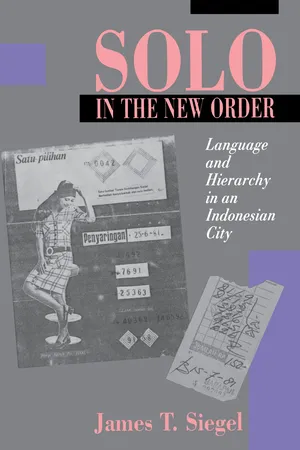
In this brilliant ethnography of contemporary Java, James Siegel analyzes how language operates to organize and to order an Indonesian people. Despite the imposition of Suharto's New Order, the inhabitants of the city of Solo continue to adhere to their own complex ideas of deference and hierarchy through translation between high and low Javanese speech styles. Siegel uncovers moments when translation fails and compulsive mimicry ensues. His examination of communication and its failures also exposes the ways a culture reconstitutes itself. It leads to insights into the "accidents" that precede the formulations of culture as such.
- 350 pages
- English
- ePUB (mobile friendly)
- Available on iOS & Android
eBook - ePub
About this book
Information
Publisher
Princeton University PressYear
2021Print ISBN
9780691000855
9780691094274
eBook ISBN
9780691228341
PART ONE
Language and Hierarchy: The Establishment of Translation
CHAPTER ONE
The Javanese Language and Related Matters
JAVANESE IS two languages,1 High Javanese, or Kromo, and Low Javanese, or Ngoko. Though High Javanese has only a few hundred vocabulary items, these include most of the items used in ordinary speech.2 Javanese is one of those languages whose speakers frequently complain that they cannot speak it. What they mean is that they cannot speak High Javanese; occasionally a Low Javanese equivalent will slip out where it does not belong. (The opposite does not seem to happen.) Their complaints, however, are exaggerated. One knows this by the way they deprecate themselves when hearing a foreigner speak High Javanese; nearly always they say, with apparent conviction, that the foreigner's Javanese is better than their own, though this is never the case. It is nonetheless conceivable to them that it is so, since no one has High Javanese as a first language. It is always learned after one can speak Low Javanese.
One should speak Low Javanese to children and to those with whom one is intim, a term that comes from the Dutch equivalent of "intimate" but that is not properly translated as such. To all others one speaks High Javanese or a mixture of the two languages.3 One thus cannot speak Javanese without making a statement about one's hierarchical position vis-à-vis the second person. The Solonese warn foreigners about learning Javanese. It is not merely that it is difficult, but that the consequences of making mistakes are not only linguistic but also social: one might address the second person as though he were of low rank. To speak inappropriately could thus wound one's listener or even anger him. Since, however, the Solonese consider it unmannerly to show their anger, and since manners are important, one might never know if one has offended someone. As it would be a solecism for someone to notice a mistake in usage, one can worry for a long while, not merely that one has been offensive, but that one has made an error of speech. The concerns are identical; thus foreigners find themselves reviewing their words, trying to remember not what they said, but what words they used.
High Javanese is often conflated with other forms of Javanese: the literary language, still used in shadow-puppet performances, which is little known to most Javanese; court language, whose existence is known but which is unavailable to most; Old Javanese; and even Javanese script. Ability to read and write the latter is vastly admired; most people seem to have the ability to decipher letter for letter, but few ever use the script. When Javanese complain about the difficulty of High Javanese, they sometimes have in mind all of these, the languages of high culture.
When such authority does infiltrate one's language, it is not possible to behave improperly. A man told me that as a boy he used to quarrel with his brother. His mother forbade the brothers to speak Low Javanese to each other. Not until they realized they could use Indonesian did they begin to fight again. By the same reasoning, to make a linguistic mistake in High Javanese itself would be to betray authority.
Nervousness about language is also nervousness about behavior. As in other Indonesian languages, it is also true that speaking properly is equated with behaving properly. Speaking Kromo properly is the most essential ingredient of being alus, the desirable standard of Javanese behavior that is usually translated as "refined."4 To be alus in speech is to speak appropriately, that is, to use the language appropriate to one's listener and to please, or at least not to upset, him or her. In most circumstances this means not merely using the vocabulary suitable to one's listener's social status, but also speaking in a tone that is cajoling, pleasing, and without sharp edges. If one is speaking High Javanese, it means phrasing one's sentences so that they are long and, if possible, full of archaisms. Given the right opportunity and a skilled speaker, the result can be a pleasing vacuity, one that stills whatever tumultuous feelings one's listener might have while one says as little as possible. For example, an orator at a funeral was greatly admired, the person next to me saying with a certain awe that "he has spoken for a long while now and said nothing." Given that his topic was the biography of the deceased, this was, indeed, an accomplishment. In ordinary conversation nothing quite so extended would occur. Nonetheless the tone of High Javanese is chosen in the first place not to suit the content of one's remarks, but to please one's listener. The aim is not to match one's feelings to one's words, but to one's listener's sensibility.
High Javanese can be thought of as a second language in the sense that it is not the speaker's "own" language. Identification between the "self" or speaker and his speech is avoided. One sees this in the way in which Kromo is taught. Javanese children learn Low Javanese in a way that seems not to differ from the way children acquire languages anywhere. In the case of High Javanese, however, the child, when he speaks to an adult, will have his words rephrased by the adult in High Javanese.5 Thus the child does not appropriate the language of his parents for himself, taking over their authority with their words. Rather, he imitates adults speaking the way children ought to speak, in this way picking up an imitation of a language, one that is divorced from the person of the speaker and that indicates social inferiority. By speaking it, however, he at once indicates his own adherence to social norms and is allowed, indeed encouraged, to say nothing of substance. One understands how speaking High Javanese successfully, demonstrating social obedience, can alleviate fear.
That Kromo remains a second language to its speakers is due in part to it being taught in the context of the child's mistakes. When he speaks Ngoko to adults, his words are pushed aside and replaced with Kromo. Control of language means not the ability to say what one wants to say, but the ability to replace one's "own" words, the words one would ordinarily use, with others. But these strange words honor others and, at the same time, give the child who speaks them a certain standing. He is on the way to becoming someone who can behave like an adult—in Javanese parlance, on the way to becoming "Javanese," the opposite of which is not another ethnic label but "animalish."
Just as one only speaks proper High Javanese when one speaks slowly, softly, and uses many words, Low Javanese is quick, abbreviated, abrupt, and usually harsh. Many conversations with three people thus involve constant switching of tones. For instance, the following incident occurred between myself and an upper-class couple: I asked them about sending a package through the post, a topic appropriate in its triviality for Kromo conversation. It led, however, to technical details about string, knots, paper, and glue and their acceptability by the post office, then to a difference of opinion about these matters between husband and wife. They, quite correctly, spoke to each other in Ngoko, but both addressed me in Kromo, and I answered them in Kromo. Thus I would ask if the post office would accept staples. The woman said yes, but the man said to her "No," in a tone that can only be said to convey that the wife was an idiot, that only a fool could have such an opinion, etc. The wife replied, saying something about string, using the same tone. Without understanding the conversation—listening, that is, only to the harshness, loudness, and abruptness of the exchange— one would assume that the couple was not merely disagreeing but actually having a quarrel. This is unlikely. It is merely that Low Javanese often sounds as if the speakers are quarreling. To speak Low Javanese means that one need not attend to the position of one's hearer, to his social standing. Stripped of the tones that designate consideration for others, Javanese sounds quite harsh. Often one hears indirect discourse. The speaker will repeat something that has been said to him and his own reply. It is not unusual for the speaker to reproach himself in the gruff tones of Low Javanese while the voice of the person who spoke to him is given the wholly distinct tones and vocabulary of High Javanese. Such examples could be multiplied.6
To speak High Javanese is to choose one's words to suit the hearer. In this sense it is not a second language at all; it does not seem to the speaker as if he has a choice of languages, as though one's hearer understands both French and English and one will speak whichever is most comfortable for both parties. The Javanese speaker has to choose his words not according to his listener's capability to understand, but as though languages are not arbitrary matters. He or she has to find out where the hearer fits in society, and then speak as though the words were attached to the status, part of the nature of the world. The ability to speak High Javanese is assumed to be the ability to read signs inscribed in the world itself. To speak High Javanese, then, is constantly to uncover the unchanging nature of the social world. The result is a picture of the world as absolutely steady, provided only that its hierarchical quality is realized in Javanese speech. Furthermore, to speak High Javanese is to demonstrate that one has the ability to read such signs and therefore has a place in society. Merely to speak Low Javanese will not do; that is not considered an acquired ability, but rather something that anyone at all is capable of doing. It does not reflect the structure of the social world, and thus gives its speaker no place in it. Nervousness about speaking High Javanese therefore comes from the fear not merely of offending someone, but of losing one's place in a world that appears immutable.
The history of High Javanese is still unstudied. It seems, however, to have developed as a court language. What is remarkable about its development is that, though designed to mark differences of status within the Javanese feudal world, it has lost no ground in a period of nationalism and independence. It has done this by encompassing all new statuses. Not just court officials but anyone with a recognized position of any sort is ordinarily entitled to be spoken to in Kromo. Thus government officials, army officers, and schoolteachers, for instance, all persons considered to be, we might have once said, "respectable," will usually receive this form of deference.7 In addition, the old are always deferred to. Every adult, in fact, is ordinarily given some degree of linguistically expressed deference. In the marketplace this might take the form of a very low form of Middle Javanese (Madyo); but Middle Javanese is still considered part of High Javanese, not of Ngoko. It can happen that someone will speak such a low form of Madyo that there is little way of telling whether or not it is, in fact, Ngoko. But ordinarily a high form will be inserted every once in a while, in order to indicate that one is, after all, not speaking Low Javanese.
Gradations of status can be quite fine. To an old person of low status, for instance, one might speak Low Javanese in keeping with his general status; but one would also use High Javanese pronouns and certain other High Javanese words out of respect for his age. Such speech would be considered by the Solonese to be a form of deference. That one can actually defer to someone lower than oneself is possible because of the line that the Solonese draw between Ngoko and all other forms of Javanese. Reciprocal speakers of Ngoko do not recognize each other as equals; rather, the question of each other's status is not reflected in their speech. (Equals, those of the same rank, might well address each other in Kromo.) To speak some form of Javanese that is not Ngoko, even though it is not pure High Javanese (Kromo Inggil) but is linguistically almost undistinguishable from Ngoko, is still thought to confer recognition of the listener's social worthiness. One thus defers to the social order itself.8
Indonesian, the national language, has been given a place in this hierarchy.9 It is the language used for public meetings, for instance, when people speak as citizens. It replaces High Javanese in certain settings such as classrooms; there, students speak to each other in Low Javanese and to their teachers in Indonesian because the schools are national. It is also used to avoid hierarchy. When, for instance, a prince, head of the junior line of the Surakarta nobility, spoke to a cabinet minister, himself from Surakarta, during a celebration in honor of the former's ancestors, they spoke Indonesian to avoid the difficult problem of different hierarchies. When Javanese hierarchy is by-passed through the speaking of Indonesian, it does not mean that such hierarchy is degraded by speakers. It is precisely to avoid doing anything that might diminish the status of the prince that the minister spoke Indonesian; for the prince, it was the sort of subtle gesture of concern for the other that a highborn Javanese should show, as well, of course, as being the act of a citizen. In such ways Javanese retains its public nature, including its sense of encompassing, even defining, public hierarchy.
One can compare this to the relation of another regional language, Acehnese, to Indonesian. In the 1960s, when I last was in Aceh, a province of Sumatra, Acehnese was the usual language of villagers on all occasions, including meetings with government officials. Acehnese was also spoken in the city. There, however, it had changed character. In the city, Acehnese was used in the home and between people who knew each other. Otherwise, particularly in government and university circles, people spoke Indonesian. (In government offices in Solo, though Indonesian is used on formal occasions, office workers generally speak to each other in Javanese.) Acehnese was thus on its way to becoming a language associated with house-hold and privacy and being stripped of its public functions. Javanese, by contrast has retained all of its public nature, including its sense of defining the public hierarchically.10
The undiminished hierarchical quality of Javanese poses a problem. The burden of High Javanese is put on those who speak up, who show deference through speaking High Javanese. Given the opportunity to avoid the implication of social inferiority by substituting Indonesian for Javanese (and in Solo as a rule people speak fluent Indonesian), why should Javanese have kept its vitality? In certain respects, this repeats the problem of the origin of High Javanese. Though originally a court language, it developed, to the best of our knowledge at least, under the pressure of colonialism.11 At the time that the Dutch were eating away at the independence of the courts, High Javanese developed as a language and then was adopted by all Javanese. One can understand the eagerness of the court to bolster itself through the exaggeration of forms of deference. Wh...
Table of contents
- Cover Page
- Title Page
- Copyright Page
- Dedication
- Table of Contents
- Introduction
- Part One: Language and Hierarchy: The Establishment of Translation
- Part Two: The Anéh, or Oddity In and Out of Place
- Part Three: Money, or The Failure of the Anéh
- Part Four: Language Against Hierarchy: The Failure of Translation
- Notes
- Index
Trusted by 375,005 students
Access to over 1.5 million titles for a fair monthly price.
Study more efficiently using our study tools.
Frequently asked questions
Yes, you can cancel anytime from the Subscription tab in your account settings on the Perlego website. Your subscription will stay active until the end of your current billing period. Learn how to cancel your subscription
No, books cannot be downloaded as external files, such as PDFs, for use outside of Perlego. However, you can download books within the Perlego app for offline reading on mobile or tablet. Learn how to download books offline
Perlego offers two plans: Essential and Complete
- Essential is ideal for learners and professionals who enjoy exploring a wide range of subjects. Access the Essential Library with 800,000+ trusted titles and best-sellers across business, personal growth, and the humanities. Includes unlimited reading time and Standard Read Aloud voice.
- Complete: Perfect for advanced learners and researchers needing full, unrestricted access. Unlock 1.5M+ books across hundreds of subjects, including academic and specialized titles. The Complete Plan also includes advanced features like Premium Read Aloud and Research Assistant.
We are an online textbook subscription service, where you can get access to an entire online library for less than the price of a single book per month. With over 1.5 million books across 990+ topics, we’ve got you covered! Learn about our mission
Look out for the read-aloud symbol on your next book to see if you can listen to it. The read-aloud tool reads text aloud for you, highlighting the text as it is being read. You can pause it, speed it up and slow it down. Learn more about Read Aloud
Yes! You can use the Perlego app on both iOS and Android devices to read anytime, anywhere — even offline. Perfect for commutes or when you’re on the go.
Please note we cannot support devices running on iOS 13 and Android 7 or earlier. Learn more about using the app
Please note we cannot support devices running on iOS 13 and Android 7 or earlier. Learn more about using the app
Yes, you can access Solo in the New Order by James T. Siegel in PDF and/or ePUB format, as well as other popular books in Social Sciences & Anthropology. We have over 1.5 million books available in our catalogue for you to explore.