eBook - ePub
Pasts at play
Childhood encounters with history in British culture, 1750–1914
- 258 pages
- English
- ePUB (mobile friendly)
- Available on iOS & Android
eBook - ePub
Pasts at play
Childhood encounters with history in British culture, 1750–1914
About this book
This collection brings together scholars from disciplines including Children's Literature, Classics, and History to develop fresh approaches to children's culture and the uses of the past. It charts the significance of historical episodes and characters during the long nineteenth-century (1750-1914), a critical period in children's culture. Boys and girls across social classes often experienced different pasts simultaneously, for purposes of amusement and instruction. The book highlights an active and shifting market in history for children, and reveals how children were actively involved in consuming and repackaging the past: from playing with historically themed toys and games to performing in plays and pageants. Each chapter reconstructs encounters across different media, uncovering the cultural work done by particular pasts and exposing the key role of playfulness in the British historical imagination.
Information
Biblical and archaeological pasts
1
Noah's Ark-aeology and nineteenth-century children
Oh the wonderful Noah's Ark! It was not found seaworthy when put in a washing-tub, and the animals were crammed in at the roof, and needed to have their legs well shaken down before they could be got in, even there – and then, ten to one but they began to tumble out at the door, which was but imperfectly fastened with a wire latch – but what was THAT against it! Consider the noble fly, a size or two smaller that the elephant: the lady-bird, the butterfly – all triumphs of art! Consider the goose, whose feet were so small, and whose balance was so indifferent, that he usually tumbled forward, and knocked down all the animal creation. Consider Noah and his family, like idiotic tobacco-stoppers, and how the leopard stuck to warm little fingers; and how the tails of the larger animals used gradually to resolve themselves into frayed bits of string!1
A leaky boat, wobbling out-of-scale animals, sticky childish fingers and fraying tails or tempers: the experience of playing with a Noah's Ark toy set was fondly remembered by many people growing up in the nineteenth century. As Charles Dickens captured in this characteristically exuberant prose for Household Words, certain specific material features of the Ark acted as a time machine to his middle-class readers, immediately transporting them back to nostalgic childhood days. Alongside the doll's house, rocking-horse, or spinning-top, Noah's Ark had found a home in the Victorian nursery as a popular commodity. More than just a toy, however, its intrinsic spiritual heft and ability to conjure a multi-layered series of pasts gave it additional power. In what follows, I explore a range of nineteenth-century children's playful encounters with the pasts of their Noah's Arks, whether engaging with Bible stories, extinct creatures, early human history or even with maritime engineering. The toy sets, I argue, provided a safe refuge in which to embark on imaginative or subversive excursions through space and time, their very domestic materiality – with all those remembered physical sensations of its use – a familiar shelter from the storms of history.
When Fun sent up the Royal Academy as ‘Noah's Ark-ademy’ in 1868 (John Everett Millais was one of the giraffes), its comic cartoonist assumed that readers needed no further introduction to the biblical boat; moreover, the satirical piece had opened with the purchase of a toy ark.2 Not only was the scriptural story well-known in the Christianised world of the imperial metropolis, but its visual iconography had settled on a series of stock images, bringing together boat, animals and deluge as punishment for sinfulness in contemporary depictions. Noah's Ark found itself an important and recurrent part of nineteenth-century culture, appearing across a wide range of media targeted at both adults and children: Bibles, conversational works, fiction, alphabets, games, natural history books, periodicals, picture books and – by the early twentieth century – film.3 But perhaps its most significant presence in children's lives was as an embodied artefact: the numerous nineteenth-century Noah's Ark toy sets which survive today in private, local and national collections – from beautiful examples in London's V&A Museum of Childhood to lonely broken lions in family attics – attest to their vast historical popularity.4 These toys retained relatively stable and identifiable shapes and contents across the long nineteenth century (see Figure 1.1): a painted wooden boat that more closely resembled a floating barn than a seagoing clipper and – nestled inside or marching across the carpet – matched pairs of wildly out-of-scale animals, identified by shape rather than decoration, and one or more robed human figures. Indeed, Noah's Ark toy sets were such a notable part of the consumer and domestic landscapes that even their characteristic process of manufacture was the subject of periodical articles, and of deposits at the Museum of Economic Botany at Kew. For instance, readers of All the Year Round learned in 1865 of the connections between the wood samples held in London, the German toy industry and the means by which individual Noah's Ark animals were standardised by being sliced off an ‘endless ring of elephants’, doves or donkeys.5
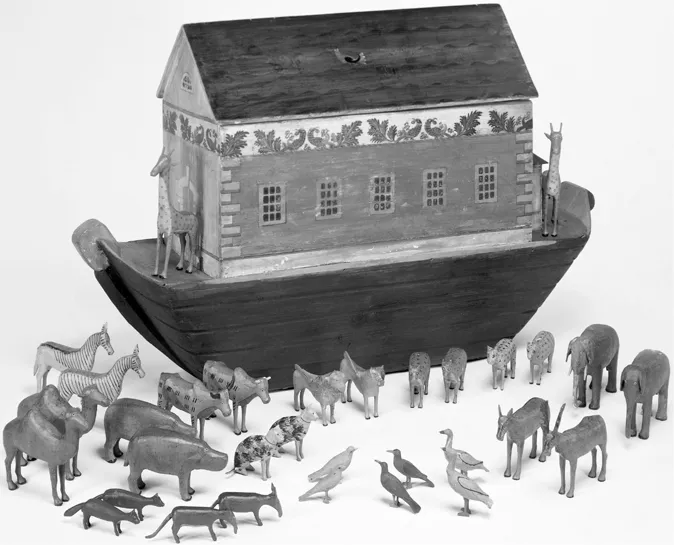
1.1 A painted wooden Noah's Ark, c. 1830, given by Miss M. M. Wyley, from Malvern. © Victoria and Albert Museum.
In this chapter, I will explore how Noah's Ark could be used as a means of playing, both figuratively and literally, with presents and pasts, and to facilitate moving between different types of media. Boys, girls and family groups, I will reveal, used this particular sacred story as a means of learning not only scriptural and natural history, but also how to navigate moral values, social interactions, imaginative conjecture and even nascent consumerism. I first outline the various ways in which children played with their arks, before taking each layered past (biblical, geological, zoological) in turn to investigate how these meanings were brought together. In the final section, a reappraisal of one children's book unites the chapter's themes and demonstrates connections between literary and material cultures of childhood. Throughout, we will see how the Ark embodies the comic potential in the clash of canonical ancient and scriptural narratives with modern science and technology.6 More than this, the following examples highlight the tensions between past and present in the evolving world of the nineteenth century, in which familiar forms could provide refuge, but also themselves mutate. Underpinning Dickens's remembered chaos and creativity of childhood encounters with Noah and his Ark, therefore, many pasts were at play.
‘I play at them going in pairs’:7 Noah's Ark as a children's toy
Two-year-old Edith Robinson was, her father Phil declared, a toddler ‘authority’ on all things Noah's Ark, her (arguably superior) scribbled separate preface accompanying his to Noah's Ark; or, ‘Mornings at the Zoo’ (1882):
I am of opinion that no one living can be considered a greater authority upon the subject of Noah's Ark than my daughter Edith, for on the occasion of her second birthday (last Thursday), we gave her a Noah's Ark, and her life ever since has been devoted to original researches into the properties of its various inhabitants. Not only does she bathe and feed each individual of the menagerie every day, but she puts Noah and all his family, and as many of the Beasts as she can find, under her pillow every night. Moreover, she approaches her subject quite...
Table of contents
- Cover
- Half-title page
- Series page
- Title page
- Copyright page
- Dedication
- Contents
- Figures
- Contributors
- Acknowledgements
- Introduction: pasts at play
- Part I: Biblical and archaeological pasts
- Part II: Classical pasts
- Part III: Medieval and early modern pasts
- Part IV: Revived pasts
- Appendix A: A list of ‘tour books’
- Appendix B: A list of British history-themed toys and games
- Index
Trusted by 375,005 students
Access to over 1.5 million titles for a fair monthly price.
Study more efficiently using our study tools.
Frequently asked questions
Yes, you can cancel anytime from the Subscription tab in your account settings on the Perlego website. Your subscription will stay active until the end of your current billing period. Learn how to cancel your subscription
No, books cannot be downloaded as external files, such as PDFs, for use outside of Perlego. However, you can download books within the Perlego app for offline reading on mobile or tablet. Learn how to download books offline
We are an online textbook subscription service, where you can get access to an entire online library for less than the price of a single book per month. With over 1.5 million books across 990+ topics, we’ve got you covered! Learn about our mission
Look out for the read-aloud symbol on your next book to see if you can listen to it. The read-aloud tool reads text aloud for you, highlighting the text as it is being read. You can pause it, speed it up and slow it down. Learn more about Read Aloud
Yes! You can use the Perlego app on both iOS and Android devices to read anytime, anywhere — even offline. Perfect for commutes or when you’re on the go.
Please note we cannot support devices running on iOS 13 and Android 7 or earlier. Learn more about using the app
Please note we cannot support devices running on iOS 13 and Android 7 or earlier. Learn more about using the app
Yes, you can access Pasts at play by Rachel Bryant Davies,Barbara Gribling, Anna Barton in PDF and/or ePUB format, as well as other popular books in Literature & Literary Criticism. We have over 1.5 million books available in our catalogue for you to explore.