Fundamentals of Person-Centred Healthcare Practice
  1. English
  2. ePUB (mobile friendly)
  3. Available on iOS & Android
eBook - ePub

About this book

Fundamentals of Person-Centred Healthcare Practice presents evidence-based perspectives on a broad range of approaches to person-centred practice in healthcare. Featuring contributions from internationally recognised experts in the field, this valuable textbook helps students and staff across healthcare disciplines understand the essential concepts of person-centred practice in various health-related contexts. Using the Person-centred Practice Framework—an innovative theoretical model based on more than two decades of research and practice—students develop a strong understanding of the different components of person-centredness, their connections and interactions, and how they can be implemented to promote positive healthcare experiences for care providers, service-users, and families.

Recognising the dynamic and complex nature of person-centredness, the text emphasises the importance of a common language and a shared understanding of person-centred practice in all areas of healthcare, from hospital and social care systems, to mental health, learning disability, and rehabilitation services. This practical and insightful introduction to the subject:

  • Provides engaging, student-friendly coverage of the central principles and practice of person-centredness within a multi-professional and interdisciplinary context
  • Features cases and examples of person-centred practice in curricula worldwide
  • Includes activities designed to support person-centred practitioner development
  • Discusses the future of person-centred facilitation, learning and practice
  • Offers real-world guidance on providing a holistic approach to developing person-centred relationships that facilitate meaningful connections with others

Fundamentals of Person-Centred Healthcare Practice is an indispensable resource for nursing and allied health professionals, and an important reference work for educators, facilitators, supervisors and healthcare practitioners.
Frequently asked questions

Yes, you can cancel anytime from the Subscription tab in your account settings on the Perlego website. Your subscription will stay active until the end of your current billing period. Learn how to cancel your subscription.
At the moment all of our mobile-responsive ePub books are available to download via the app. Most of our PDFs are also available to download and we're working on making the final remaining ones downloadable now. Learn more here.
Perlego offers two plans: Essential and Complete
  • Essential is ideal for learners and professionals who enjoy exploring a wide range of subjects. Access the Essential Library with 800,000+ trusted titles and best-sellers across business, personal growth, and the humanities. Includes unlimited reading time and Standard Read Aloud voice.
  • Complete: Perfect for advanced learners and researchers needing full, unrestricted access. Unlock 1.4M+ books across hundreds of subjects, including academic and specialized titles. The Complete Plan also includes advanced features like Premium Read Aloud and Research Assistant.
Both plans are available with monthly, semester, or annual billing cycles.
We are an online textbook subscription service, where you can get access to an entire online library for less than the price of a single book per month. With over 1 million books across 1000+ topics, we’ve got you covered! Learn more here.
Look out for the read-aloud symbol on your next book to see if you can listen to it. The read-aloud tool reads text aloud for you, highlighting the text as it is being read. You can pause it, speed it up and slow it down. Learn more here.
Yes! You can use the Perlego app on both iOS or Android devices to read anytime, anywhere — even offline. Perfect for commutes or when you’re on the go.
Please note we cannot support devices running on iOS 13 and Android 7 or earlier. Learn more about using the app.
Yes, you can access Fundamentals of Person-Centred Healthcare Practice by Brendan McCormack, Tanya McCance, Cathy Bulley, Donna Brown, Ailsa McMillan, Suzanne Martin, Brendan McCormack,Tanya McCance,Cathy Bulley,Donna Brown,Ailsa McMillan,Suzanne Martin in PDF and/or ePUB format, as well as other popular books in Medicine & Nursing. We have over one million books available in our catalogue for you to explore.

Information

Year
2020
Print ISBN
9781119533085
eBook ISBN
9781119533023
Edition
1
Subtopic
Nursing

SECTION 1
The Person in Person‐Centred Practice

The first section of this book will guide you through a brief philosophical history of the concepts person, personhood and self. The chapters include a number of activities that we would encourage you to participate in and which will inform your understanding of the concepts. The range of activities are designed to help you to reflect on your self and then to consider the influence you have on others and they on you. We hope you notice and experience the ongoing development of your understanding of your own personhood through critical reflection. This represents some of our beliefs and values that we are never the completed article as there is always capacity to construct new learning and understanding.
The first three chapters in this section of the book introduce you to the key concepts of person‐centredness and person‐centred practice. These are the foundation chapters that will guide your initial thinking and learning in relation to the different perspectives of what it means to be a person and how person‐centredness and person‐centred practice may be realised. The focus here is on the continuously evolving nature of person‐centred practice. As part of your exploration and learning, you will be introduced to the Person‐centred Practice Framework. This framework will be used as a lens to critically examine some of the challenges we face in contemporary healthcare as we try to operationalise person‐centredness.
As you work through Chapter 1, you will learn who the person is and consider the importance of personhood and why it is essential to person‐centred practice. Chapter 2 builds on notions of being a person and encourages you to explore the concepts and complexities of person‐centred practice, paying particular attention to the core values of person‐centredness. In Chapter 3, you will be introduced to the Person‐centred Practice Framework and guided through its component parts and how it links to the key underpinning theoretical concepts described in Chapters 1 and 2.
Chapter 4 challenges us to explore self. You will be guided to consider different aspects of self and introduced to a variety of different approaches that can be used to know self better. This leads to exploring the concept of human flourishing in Chapter 5. The alignment with person‐centred practice emerges as you engage with this chapter and the activities. We encourage you to take time to participate in the activities and reflect afterwards. Some of the activities can be repeated at various times and we imagine you will become aware of your own development. Chapter 6 will enable you to make links between your practice, the required standards you need to demonstrate for professional practice and how professionalism contributes to person‐centred practice. You will also explore the tensions that may exist between the reality of practice and delivering person‐centred care. Finally, Chapter 7 examines the future nursing, midwifery and allied health professional in the context of person‐centred practice.

1
The person in person‐centred practice

Brendan McCormack1, Tanya McCance2, and Jan Dewing1
1 Queen Margaret University, Edinburgh, Scotland, UK
2 Ulster University, Northern Ireland, UK

Learning outcomes

  • Develop insight into the meaning of ā€˜person’ in person‐centred practice.
  • Distinguish the meaning of ā€˜person’ from other concepts such as individual or people.
  • Be able to articulate a meaning of personhood and why this meaning is important in person‐centred practice.
  • Identify and describe the challenges posed for healthcare practitioners when adopting different personhood perspectives

Introduction

Being a person means more than just existing as a human being. There are elements of our make‐up as persons that we may struggle to understand or make sense of – the deeper parts of ourselves! In this chapter we will explore some perspectives on what it means to be a person as this is the starting point of person‐centredness and person‐centred practice.

Who am I?

There is a sense in which the word ā€˜person’ is merely the singular version of ā€˜people’, yet we are all instinctively aware that it has greater meaning than this – that it represents everything about me as a human being. ā€˜Who am I?’ is a question that is probably asked by many of us at various key stages of our lives – as a part of growing up and forming our identity; at a major transition point in our lives (such as reaching a significant birthday) or at a moment of crisis (e.g. the death of a person [or another entity] loved by us). When we reflect on such a question, we sometimes focus on functional aspects of our lives, such as ā€˜my’ job, friendships and relationships, ambitions, career prospects, life balance, etc. However, we can also focus on some core aspects of our being, such as the core values, beliefs or attitudes I hold towards particular aspects of my life, i.e. who I REALLY am! To start, we would like to invite you to engage with the following activity.

Activity Who am I as a person?

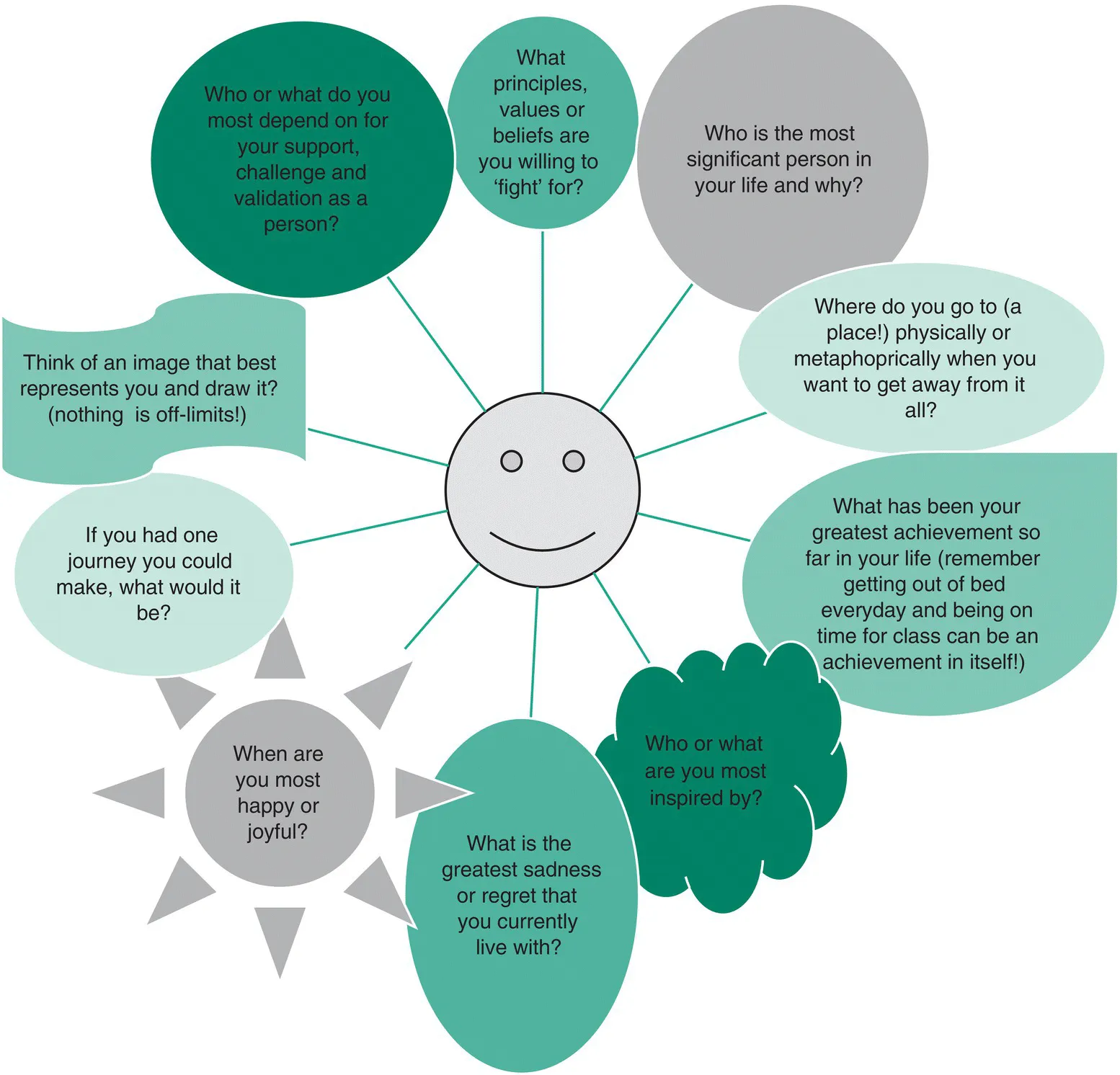
For 20 minutes, create a collage (this could be either on paper or in digital form) representing your own self‐portrait based on the following 10 points for creating your portrait. Place your name in the centre of the collage.
Schematic illustration of the 10 questions that define the self-portrait.
Reflect on your answers to these questions. Is there anything that surprises you about your answers? Have you gained new insights about yourself as a person? What do your collective responses tell you about who you are as a person?
Each time we (the chapter authors) do this activity, we are surprised at some of the things that emerge. No two collages are ever the same – there may be some common elements (such as a place of importance) but we are always inter...

Table of contents

  1. Cover
  2. Table of Contents
  3. Title Page
  4. Copyright Page
  5. Dedication Page
  6. List of contributors
  7. Foreword
  8. Acknowledgement
  9. Editor Biographies
  10. Introduction
  11. SECTION 1: The Person in Person‐Centred Practice
  12. SECTION 2: Being Person‐centred
  13. SECTION 3: Person‐Centredness in Health and Social Care Systems
  14. SECTION 4: Approaches to Learning and Development for Person‐Centred Practice
  15. Index
  16. End User License Agreement