This book questions the relationship and compatibility between current beliefs in neurology and contemporary textual linguistic theories, interpretative semantics and discourse analysis.
It begins with a critical examination of the screenings for Alzheimer?s type dementia through cognitive testing, particularly screenings where language is used. It then analyzes the various linguistic properties (morphological, syntactic and semantic) of the speech of Alzheimer?s patients, which can be troubling for both caregivers and their environment in general.
More than a synthesis of critical linguistic reflections, Language and Neurology provokes a fruitful reflection through adjustments suggested by the acquired knowledge of textual semantics.
1 Linguistics, Language Pathologies and Alzheimer’s Disease: A Brief History
As we noted in the introduction, very few linguists have studied language pathologies in a medical context; the development of specialized linguistic theories with practical applications in this area has seemingly been perceived as overly challenging. This does not mean that theories developed in unrelated contexts – for example, in our own field of interpretative semantics or speech analysis – may not be used to cast light on these issues; however, it reinforces the general perception of a persistent lack of research in this area.
It is thus the history of the domain itself, and not simply our summary of this history, which is “brief”. The lack of interest in this area on the part of linguists has left the field wide open for a series of postulates, mostly derived from the field of neuroscience, to take root; we shall discuss these postulates in greater detail later.
For the moment, we shall focus our discussion on the theory of mediation, the only linguistic theory focusing on language pathologies; we shall then turn our attention to other theories which have been used in attempting to describe or explain these pathologies.
1.1. Gagnepain’s theory of mediation: an approach to pathological speech on its own terms
Few linguistic theories have addressed the issue of language disorders. One of the most incendiary and original theories in this select group is Jean Gagnepain’s theory of mediation. This theory is, inexplicably, not well known among linguists; however, its wide applicability has inspired many researchers and supporters from across the field of social sciences. The theory has its roots in a meeting between Gagnepain and Sabouraud, a neuropsychiatrist, following the former’s installation as professor of “pure” linguistics at Rennes in 1956. At this early date, there was nothing to suggest that Gagnepain – whose thesis concerned Celtic syntactics – would direct his attentions to pathologies. This change in direction was to his advantage: the author is not particularly well known for his earlier work1, but for his proposed “deconstruction” of language, which reverses the usual logic whereby we define a norm, then describe deviations from this norm. On the contrary, Gagnepain and Sabouraud considered language pathologies as a type of reagent, revealing the true, underlying mechanisms of language; each pathology highlights, in some way, processes which are not visible when everything is functioning “correctly” (Gagnepain 2006, p. 54)2:
“We consider the mental patient as a teacher of linguistics: he or she teaches us how language works. Insofar as its operation is not haphazard, we attempt, from the patient’s behavior, to induce the grammatical rules which govern the construction of their messages”3.
Before going into detail concerning this theory and its main contributions, it is interesting to note that the dominance of structuralism in recent decades has resulted in the marginalization of certain “fringe” theories in spite of their clear structuralist slant, such as Tesnière’s structural syntax. The same can be said of the theory of mediation, situated by its authors along these lines (Tesnière 1963, p. 86), as we clearly see from the conclusion to their remarkable study of aphasia:
“Using structural linguistics, we have attempted to define the principal illustrations provided by the study of aphasic patients”.
The theory of mediation (TDM, from the French théorie de la médiation) posits that human beings exercise a form of “mediation” in their relations with the world. Gagnepain defines this as “the intrusion, into the immediate of an element which cannot be immediately understood, of a mediate, whether in the structure, in praxis, or on an implicit level” (Gagnepain 2016, p. 31). In this quotation, we see that the author refuses to assimilate reason to language alone; we also detect the “essence” of the TDM itself, in the division of human capacities into a series of planes, or levels. The TDM is systematically referred to as a theory of deconstruction, by Gagnepain himself and by subsequent commentators. This deconstruction is rendered necessary by the number and variety of disorders observed in patients, and operates on four different planes, not just the capacity of speech; Gagnepain sweepingly asserted that all previous authors – including Saussure – had limited their reflection to this more simplistic approach:
“We have made a clear break with those who have gone before us in refusing to reduce rationality to a single mode. While most thinkers have restricted reason to its verbal form alone, following the Greek tradition of the logos, we have established four rational modes”.
According to Gagnepain, these four planes are not a priori objects, but rather products, based on observations. Working closely with Sabouraud, Gagnepain gained access to a large group of aphasic patients (the subjects of the authors’ earliest analyses), along with dyslexic, dysgraphic, dyspraxic and even schizophrenic patients, straddling the line between neurology and psychiatry with ease. This approach to pathologies as a whole is the reason TDM is also referred to as a “clinical anthropology”.
The difficulties and inabilities of each type of patient highlight different capacities. Mjachký (2016, p. 29), author of a thesis on determinants which was based, in part, on the theory of mediation, calls attention to both the independence of planes (enabling understanding of phenomena) and the unity resulting from their presence, to a greater or lesser extent, in all subjects:
“These modalities, which Gagnepain refers to as ‘planes’, are ‘language’, the aforementioned faculty of representation; the ‘tool’, which is the faculty of fabrication; the ‘person’, which is the faculty of the social being; and the ‘norm’, which is the faculty of ethical analysis. The value of this model lies, amongst other aspects, in the fact that each of these autonomous rationales is viewed analogically, i.e. that man, whilst a pluridimensional being – deconstructed, in a certain way – remains one, precisely in light of the identity of construction of each dimension (plane)”.
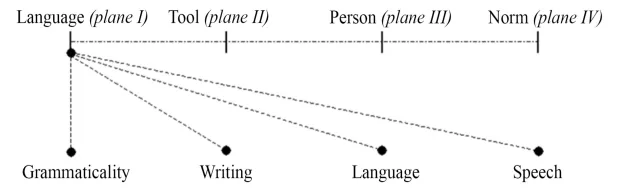
The four planes identified by Gagnepain and Sabouraud, in their own terms, are: language (plane I, giving rise to the science in question here, glossology); tools (plane II, the subject of ergology); the person (plane III: sociology, and to some extent politics and even legislation) and norms (plane IV, relating to ethics). In this case, Gagnepain showed a rare degree of humility in noting that, as these four planes were identified through observations, his list was not necessarily exhaustive.
Just as the TDM is broken down into four planes, glossology itself can be broken down, in the context of pathology studies, into four levels. These do not correspond in any way to the conventional division of domains within the language sciences; Gagnepain’s aim was for these four levels to correspond, analogically, to the four higher levels. In this sense, the term “sub-levels” is not entirely appropriate, as we shall see. This difficulty is clearly explained by Jean-Quentel and Beaud (2006, p. 39):
“We have thus ‘deconstructed’ language into four registers which correspond to the four planes of the theory of mediation: grammaticality, writing, word usage and speech. Only one of these four registers, grammaticality, specifically concerns language. The other three registers result from the action of external processes of a different order on language. Writing is, at the end of the day, a technical matter; word usage relates to a social dimension, and speech involves an ethical process”.
The analogy between the divisions at the higher level and those identified within the language register is remarkably original, practical and, according to the author, applicable to a range of pathologies. This double deconstruction is summarized in the diagram below (according to our interpretation: neither Gagnepain nor any of his followers have used this representation).
Figure 1.1.The four planes of the theory of mediation and the four registers of language
Quentel and Beaud’s illustration of language deconstruction does not specifically touch on pathologies, but is centered on a convincing discussion of language acquisition in children. In a succinct discussion, the authors present at least one disorder associated with each dimension. Quentel and Beaud present dysphasia as a disorder relating to grammaticality, and dyslexia as a disorder relating to reading. Disorders connected with word usage are harder to identify clearly, corresponding to infantile psychoses which act on the child’s capacity to interact with others but do not affect grammaticality. Finally, communication disorders, or the lack of desire to communicate, relate to the speech register.
Gagnepain and Sabouraud began by testing their hypotheses in the context of aphasia, notably confirming, in practice, Saussure’s theory of the biaxiality between paradigm and syntagm. Patients with Wernicke-type aphasia were shown to be unable to complete identification, recognition or choice tasks on both the signifier and signified levels. Patients suffering from Broca’s aphasia were unable to segment speech chains in any appropriate way (neither phonemes nor lexical units). Once again, this disorder concerns both the signifier and signified levels. However, Wernicke-type aphasia clearly involves a disorder on the paradigmatic operation level (or the “taxonomic” level, according to Gagnepain 2016, p. 61): “Patients with Wernicke’s aphasia have lost the capacity to choose, but retain the ability to segment text; everything in their lexicon is confused”. Broca-type aphasia patients cannot carry out syntagm segmentation (Gagnepain’s “generative” level, 2016, p. 62): “Patients with Broca’s aphasia, who are unable to combine and who cannot add one and one, tend to make more precise choices”. These examples both concern language production, but these disorders may also be observed in language reception.
As we have just seen, aphasia sufferers may be grouped according to their relation to biaxiality; they may also be categorized according to the signifier/signified duality: “one finding of aphasiology concerns the ‘breaking up’ of signs: some patients possess the capacity for phonological analysis alone, without semiological analysis, or vice-versa” (Gagnepain 2016, pp. 55–56). The author refers to phonological Wernicke’s or Broca’s aphasia when the capacity for phonological analysis is deficient, and to semiological Wernicke’s or Broca’s aphasia when the capacity for semiological analysis is lacking. In this way, Gagnepain defines four different types. We shall not go into any detail concerning Gagnepain’s studies of aphasia here; interested readers may wish to consult the works cited in the bibliography.
Gagnepain only briefly touches on Alzheimer’s disease, perhaps due to a lack of personal interest, or to the period in which he was working (1970s–1990s), when the contours of the disease were only just becoming clear. He mentioned the disease only in the context of a discussion of the way in which society regards the elderly. In his sixth “lesson”, Devenir ce que nous sommes (Becoming What We Are), the author considers elder care homes, offering up a reflection in which he questions the practice of placing seniors in these establishments, noting that the idea of the “...
Table of contents
Cover
Table of Contents
Title page
Copyright
Acknowledgments
Introduction: Application of Linguistics to Cognitive Tests and Speech Patterns in Alzheimer’s Patients
1 Linguistics, Language Pathologies and Alzheimer’s Disease: A Brief History
2 Alzheimer’s Disease: General Symptoms and Language Impairments
3 Cognitive Testing: The Key to Diagnosing Memory Pathologies
4 Analyzing the Speech of Alzheimer’s Patients: Methods and Perspectives
Conclusion: Improving Psychological Tests and Developing Discourse Analysis
Appendices
References
Index
End User License Agreement
Trusted by 375,005 students
Access to over 1.5 million titles for a fair monthly price.
Study more efficiently using our study tools.
Frequently asked questions
Yes, you can cancel anytime from the Subscription tab in your account settings on the Perlego website. Your subscription will stay active until the end of your current billing period. Learn how to cancel your subscription
No, books cannot be downloaded as external files, such as PDFs, for use outside of Perlego. However, you can download books within the Perlego app for offline reading on mobile or tablet. Learn how to download books offline
Perlego offers two plans: Essential and Complete
Essential is ideal for learners and professionals who enjoy exploring a wide range of subjects. Access the Essential Library with 800,000+ trusted titles and best-sellers across business, personal growth, and the humanities. Includes unlimited reading time and Standard Read Aloud voice.
Complete: Perfect for advanced learners and researchers needing full, unrestricted access. Unlock 1.5M+ books across hundreds of subjects, including academic and specialized titles. The Complete Plan also includes advanced features like Premium Read Aloud and Research Assistant.
Both plans are available with monthly, semester, or annual billing cycles.
We are an online textbook subscription service, where you can get access to an entire online library for less than the price of a single book per month. With over 1.5 million books across 990+ topics, we’ve got you covered! Learn about our mission
Look out for the read-aloud symbol on your next book to see if you can listen to it. The read-aloud tool reads text aloud for you, highlighting the text as it is being read. You can pause it, speed it up and slow it down. Learn more about Read Aloud
Yes! You can use the Perlego app on both iOS and Android devices to read anytime, anywhere — even offline. Perfect for commutes or when you’re on the go. Please note we cannot support devices running on iOS 13 and Android 7 or earlier. Learn more about using the app
Yes, you can access Language and Neurology by Christophe Cusimano in PDF and/or ePUB format, as well as other popular books in Psicologia & Neuroscienza e neuropsicologia cognitiva. We have over 1.5 million books available in our catalogue for you to explore.