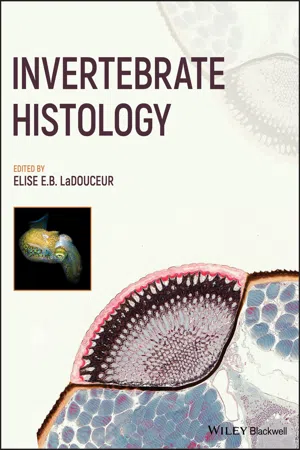
Invertebrate Histology
eBook - ePub

Invertebrate Histology

  1. English
  2. ePUB (mobile friendly)
  3. Available on iOS & Android
eBook - ePub

Invertebrate Histology

About this book

The first comprehensive reference to invertebrate histology

Invertebrate Histology is a groundbreaking text that offers a comprehensive review of histology in invertebrates. Designed for use by anyone studying, diagnosing, or researching invertebrates, the book covers all major taxonomic groups with details of the histologic features, with color photographs and drawings that clearly demonstrate gross anatomy and histology. The authors, who are each experts in the histology of their respective taxa, bring together the most recent information on the topic into a single, complete volume.

An accessible resource, each chapter focuses on a single taxonomic group with salient gross and histologic features that are clearly described in the text and augmented with color photographs and greyscale line drawings. The histologic images are from mostly hematoxylin and eosin stained microscopic slides showing various organ systems at high and low magnification. In addition, each chapter provides helpful tips for invertebrate dissection and information on how to process invertebrates for histology. This important book:

  • Presents detailed information on histology of all major groups of invertebrates
  • Offers a user-friendly text that is organized by taxonomic group for easy reference
  • Features high-quality color photographs and drawings, with slides showing histology and gross photographs to demonstrate anatomy
  • Provides details on invertebrate dissection and processing invertebrates for histology

Written for veterinary pathologists, biologists, zoologists, students, and other scientists studying these species, Invertebrate Histology offers the most updated information on the topic written by over 20 experts in the field.

Trusted by 375,005 students

Access to over 1.5 million titles for a fair monthly price.

Study more efficiently using our study tools.

Information

Year
2021
Print ISBN
9781119507659
eBook ISBN
9781119507604
Edition
1

1
Echinodermata

Alisa L. Newton1,2 and Michelle M. Dennis3,4
1 Wildlife Conservation Society, Bronx, NY, USA
2 Disney’s Animals, Science and Environment, Orlando, FL, USA
3 Center for Conservation Medicine and Ecosystem Health, Department of Biomedical Sciences, Ross University School of Veterinary Medicine, Basseterre, St Kitts and Nevis
4 Department of Biomedical and Diagnostic Sciences, University of Tennessee College of Veterinary Medicine, Knoxville, TN, USA

1.1 Introduction

Phylum Echinodermata consists of three subphyla (Asterozoa, Echinozoa, and Crinozoa) and five main classes. Subphylum Asterozoa contains two extant classes: Asteroidea (sea stars, sea daisies) and Ophiuroidea (brittle and basket stars). Echinozoa contains two extant classes: Echinoidea (sea urchins, sand dollars) and Holothuroidea (sea cucumbers). Subphylum Crinozoa contains only one extant class: Crinoidea (feather stars, sea lilies). There are 7000 living species of echinoderms (Mulcrone 2005). All are marine and almost exclusively benthic. Some subphyla are mobile (Asterozoa, Echinozoa) and others are sessile (Crinozoa), though some sea lilies have been documented to swim significant distances. Echinoderms do not appear to have near relatives among other invertebrate phyla.
Most members of Echinodermata are dioecious and undergo sexual reproduction, with a few species reproducing asexually. Holothuroids are gonochoric (Leake 1975). Asexual reproduction through fragmentation may occur in some Asteroidea and Holothuroidea due to trauma or predation. The diet varies widely by class, with Asterozoa being carnivorous, Echinozoa and Crinozoa being vegetarian browsers and filter feeders, and Holothuroidea being detritivores. Significant conservation concerns and anthropogenic stressors include commercial fisheries, which impact diet availability, particularly clams, mussels, and oysters, and the pet trade through individual animal collection and the collection of coral and live rock causing habitat loss. Environmental concerns include habitat destruction and direct animal impacts due to ocean acidification. Population declines due to disease such as the Caribbean Diadema antillarum mortality event in 1983–1984 (Carpenter 1990; Lessios 2016) and “wasting disease” events across multiple species of asteroid (Hewson et al. 2014; Menge et al. 2016) have more recently received significant focus. Certain Asteroidea are keystone species in their ecosystems, critical for controlling prey populations and diversity. Echinoidea and Holothuroidea are of paramount importance to marine ecosystems because of respective roles in counteracting macroalgal competition with corals, and recycling nutrients from decaying organic matter.

1.2 Gross Anatomy

Uniting features of all echinoderms include radial symmetry (pentamerous symmetry), a tricoelomate body cavity, and a body wall composed of calcite endoskeletal plates (dermal ossicles) connected by “mutable collagenous tissue.” Most internal features, including the alimentary system, reproductive system, nervous system, respiratory system, and a unique water vascular system, share similar basic plans between the subphyla. The basic echinoderm body plan has 10 divisions: five radii (rays or arms) which alternate with five interradii (interrays). Typically, there is an oral surface with a central mouth and an aboral surface that contains the anus. Despite these commonalities, morphology does vary widely and thus representative examples of each subphylum are discussed separately.
The asteroid (sea star) body plan consists of a central disc with typically five but in some species (sun stars) up to 40 or more individual rays. Rays are broad based and arise from the lateral margins of the disc. They taper distally and each ray terminates in one or more tentacle‐like sensory tube feet and a red eyespot. The aboral surface is dorsal and contains the anus at the center of the central disc, which may not be grossly apparent. The madreporite, bearing openings of the water vascular system, is on one side of the disc near the interradius of the first and second rays (Figure 1.1a). The oral surface is ventral and in contact with the substrate. Originating at the mouth and extending the length of each ray is a prominent groove, the ambulacrum (ambulacral groove). Two to four rows of tube feet (podia) lie within the ambulacral groove (Figure 1.1b). The margins are lined by moveable spines that can close over the top of the groove. Ophiurids (brittle and basket stars) demonstrate similar morphology. They typically have five rays, but these are distinctly offset from a round to pentagonal central disc. The rays are typically very long, slender, and very flexible. In basket stars the rays are highly branched. The disc has a proportionally smaller diameter compared to most sea stars. Ophiurid rays lack an ambulacral groove and the tube feet lack distal suckers as they are not typically used for movement.
Photos depict the aboral (a) and oral (b) surface of a chocolate chip sea star demonstrating pentamerous symmetry. Labels include (A) radius, (B) interradius, (C) mouth, (D) ambulacral groove, (E) anus, and (F) madreporite.
Figure 1.1 Representative image of the aboral (a) and oral (b) surface of a chocolate chip sea star (Protoreaster nodosus) demonstrating pentamerous symmetry. Labels include (A) radius, (B) interradius, (C) mouth, (D) ambulacral groove, (E) anus, and (F) madreporite.
Photos depict the aboral (a) and oral (b) surface of a purple urchin demonstrating pentamerous symmetry. Labels include (A) ambulacral plates, (B) interambulacral plates, (C) mouth, (D) anus, and (E) madreporite.
Figure 1.2 Representative image of the aboral (a) and oral (b) surface of a purple urchin (Arabacia punctulata) demonstrating pentamerous symmetry. Labels include (A) ambulacral plates, (B) interambulacral plates, (C) mouth, (D) anus, and (E) madreporite.
Echinoidea lack rays and have either a slightly compressed globoid body plan (urchin) or a flattened body plan (sea biscuits, sand dollars). Similar to asteroids, they have a dorsal aboral surface ...

Table of contents

  1. Cover
  2. Table of Contents
  3. Title Page
  4. Copyright Page
  5. List of Contributors
  6. Foreword
  7. 1 Echinodermata
  8. 2 Porifera
  9. 3 Cnidaria
  10. 4 Mollusca
  11. 5 Mollusca
  12. 6 Mollusca
  13. 7 Annelida
  14. 8 Arthropoda
  15. 9 Arthropoda
  16. 10 Arthropoda
  17. 11 Arthropoda
  18. 12 Arthropoda
  19. Index
  20. End User License Agreement

Frequently asked questions

Yes, you can cancel anytime from the Subscription tab in your account settings on the Perlego website. Your subscription will stay active until the end of your current billing period. Learn how to cancel your subscription
No, books cannot be downloaded as external files, such as PDFs, for use outside of Perlego. However, you can download books within the Perlego app for offline reading on mobile or tablet. Learn how to download books offline
Perlego offers two plans: Essential and Complete
  • Essential is ideal for learners and professionals who enjoy exploring a wide range of subjects. Access the Essential Library with 800,000+ trusted titles and best-sellers across business, personal growth, and the humanities. Includes unlimited reading time and Standard Read Aloud voice.
  • Complete: Perfect for advanced learners and researchers needing full, unrestricted access. Unlock 1.5M+ books across hundreds of subjects, including academic and specialized titles. The Complete Plan also includes advanced features like Premium Read Aloud and Research Assistant.
Both plans are available with monthly, semester, or annual billing cycles.
We are an online textbook subscription service, where you can get access to an entire online library for less than the price of a single book per month. With over 1.5 million books across 990+ topics, we’ve got you covered! Learn about our mission
Look out for the read-aloud symbol on your next book to see if you can listen to it. The read-aloud tool reads text aloud for you, highlighting the text as it is being read. You can pause it, speed it up and slow it down. Learn more about Read Aloud
Yes! You can use the Perlego app on both iOS and Android devices to read anytime, anywhere — even offline. Perfect for commutes or when you’re on the go.
Please note we cannot support devices running on iOS 13 and Android 7 or earlier. Learn more about using the app
Yes, you can access Invertebrate Histology by Elise E. B. LaDouceur in PDF and/or ePUB format, as well as other popular books in Medicine & Veterinary Medicine. We have over 1.5 million books available in our catalogue for you to explore.