Expand your existing portfolio by using the creative luxury process to elevate specific products and provide greater value to customers.
Contrary to popular belief, luxury is a well-defined code that can be reapplied to any other product or service to enhance its value. Adding Prestige to Your Portfolio reveals how non-luxury companies can apply the principles of luxury and creativity to transition parts of their portfolio to luxury status.
Adding Prestige to Your Portfolio describes how companies can elevate any product or service at each step of the customer buying journey (awareness, search and compare, purchase, use, advocate). By applying the creativity technique Closed World Principle, readers can determine which luxury benefits (security, fun, self-respect, self-fulfillment, accomplishment, recognition, relationships or belonging) would best map to their product or service and garner the greatest business impact at that particular stage of the customer buying journey.
Illustrated with examples from industries as diverse as healthcare and industrial equipment, Adding Prestige to Your Portfolio shows companies how to borrow the elements of luxury and sprinkle them throughout the customer experience in order to strengthen loyalty and increase their appeal to potential new customers. Online resources include sample syllabi, templates to aid in application of framework, case studies and discussion questions.
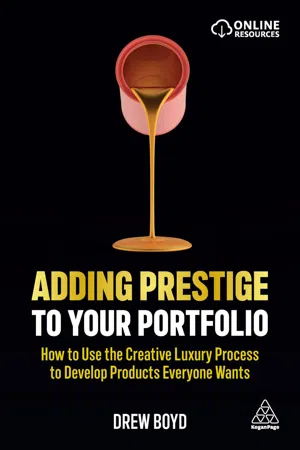
eBook - ePub
Adding Prestige to Your Portfolio
How to Use the Creative Luxury Process to Develop Products Everyone Wants
- English
- ePUB (mobile friendly)
- Available on iOS & Android
eBook - ePub
Adding Prestige to Your Portfolio
How to Use the Creative Luxury Process to Develop Products Everyone Wants
About this book
Information
1
The Luxury Opportunity
Upscale and Grow
Homo sapiens is the only species on Earth that buries its dead. This practice started approximately 130,000 years ago and continues to this day. And traditionally we haven’t buried the dead by themselves. We sent them off with their most prized possessions. Even the oldest burial sites show signs of tools, food, and clothing—still perfectly useful implements for the living yet taken out of service permanently and placed in the ground along with the dead. Today, people are being buried with—wait for it—their mobile devices.
Why? It can mean only one thing. Humans, then and now, believe in an afterlife, that something very important will happen when we die—something so important that we’d better have all our important stuff with us, just in case. And so it is perfectly human to want to take possessions of greatest value to the grave where they could be put to “use” during eternity.
Archaeologists have noticed that, over time, the possessions found in burial sites became more extravagant. Crude tools evolved to finely crafted ones like swords. The most prized items of an era could be found inside tombs from that time. It was not uncommon, for example, for British burial grounds from the early seventh century to contain swords, shields, and other weapons. Peru’s Paracas cemeteries are full of people buried with textiles of the highest quality and of intricate designs.
But not every dead member of a particular society had the same level of extravagant items in their graves with them. Only certain people did. This finding suggests that people with such grave goods were the leading members, the most successful and therefore the most elevated members of that society. The chosen items included things that might seem odd to us today—a Chinese king from the Han Dynasty chose to be buried with a stone toilet—but at the time they were considered extraordinarily special. Just like today, if a person were buried with a Patek Philippe watch, an archaeologist digging 1,000 years in the future would know the watch was a clear indicator of economic status during our time.
What do all these prized items through the centuries have in common?
They are luxury items.
What does that mean? That these so-called grave goods were not, for the most part, things people needed for survival when alive. In a burial site at the Royal Tombs in the Mesopotamian city of Ur (today’s southern Iraq), the women were dressed in expensive clothing with elaborate headdresses made from gold, silver and lapis lazuli. In one Viking grave that included an entire buried ship, scientists found a single walnut in a place of prominence.
What was it that made these items so special that a society’s most important members would want them for eternity? It’s as if a magical potion had been poured over the items to make them so prized.
Imagine if you had a way to sprinkle that same magic potion over your products and services, a guaranteed way to increase their value. Imagine making them not only more desirable but irresistible—so irresistible that your customers would want to take them with them to the grave.
That’s what this book is about: how to grow your company by transforming part of your product or service portfolio so that it is upgraded to this exalted luxury status.
How is this possible? Luxury adheres to a well-defined code that can be applied to any other product or service to enhance its value. Even the most mundane, everyday product or service can be turned into something you want to have with you eternally.
Don’t believe it? Take a look at something as simple as a car key. Let’s journey through time with this product and see how it has progressed. As you do, see if you notice a pattern.
The very first cars didn’t use keys. They started with a push-button ignition—interestingly, the same method used in most new cars today. It wasn’t until 1949 that Chrysler introduced the modern car key, like a house key, to be inserted into an ignition tumbler. Turn the key, start the car.
In 1987, we saw the keyless-entry fobs that opened and closed doors remotely. Jaguar went a different direction. In 1990, it introduced the Tibbe key with a long shaft and unique code to thwart break-ins. Nice idea, but it didn’t last long.
Around that same time, Lexus piloted laser-cut keys that were difficult to replicate. Then Mercedes-Benz launched the so-called switchblade key, which flips out of a remote fob on the press of a button. It was the best of both worlds—keyless entry but keyed ignition.
In 1993, Chevrolet created the passive keyless entry system to improve security. Not to be outdone, Mercedes and Lexus each launched keys shaped like credit cards that fit in a wallet. In 2016, BMW leapt forward with its display key. It was like a tiny iPad that displayed everything about the car (fuel level, lights, doors, climate, etc.). Finally, Tesla made the natural leap to putting the entire key function into a smartphone app. No more key, just an app on your phone that controls everything imaginable in your car.
Can you see what’s happened over the last 70 years of car key evolution? Automakers leapfrogged one another with ever improving versions of car security and key systems. They competed by addressing performance, by making each successive version better than the last one.
But none of these car key innovations reached luxury status. Would you want to be buried with a key fob? Certainly not a key fob like the ones you and I are accustomed to. But you might change your mind if that key fob were made by a Finnish company called Awain. It has taken car key fobs to a whole new dimension. It’s created a luxury version of a key fob that you really might want to take with you to the afterlife. Let’s look at how.
Each Awain key fob is handmade by skilled artisans using high-modulus carbon fiber and aerospace-grade titanium, and each takes over 50 hours to create. The company makes these limited-edition fobs in batches of only 20 a year, and prices start at $11,000. Of course, not just anyone can buy one of these little masterpieces. To qualify, you have to own one of these car models deemed worthy enough to go with it—a Bugatti, Bentley, Aston Martin, Lamborghini, Maybach, McLaren, or Rolls-Royce… you get the picture.
According to Forbes magazine (Gorzelany, 2019), one lucky customer, the owner of a one-of-a-kind Phantom, ordered a one-of-a-kind Awain key fob to go with it. The fob was inlaid with 34.5 carats of diamonds set in 175 grams of solid gold for a mere $555,000. I can just imagine the look on archaeologists’ faces when they find this fob in a future burial site. They will have to fit this object into their conceptions of our society—as a high-status item of its day, assuming they figure out what it does! A simple car key turned into a stunning luxury product.
Did you notice how Awain achieved this with its keys? Don’t worry if you didn’t. The rest of this book is designed to teach you how to replicate what Awain did for car keys for your own products and services.
I know what you’re thinking. “Luxury? Are you kidding? Why would I turn part of my business into luxury? My clients would never go for it. Luxury is wasteful and conspicuous.”
Before you put down this book, hear me out. When I say “luxury,” I don’t mean the typical luxury most people think of like Cartier watches and Bugatti cars. I admit that the word has a lot of negative connotations—it’s applied to things that are excessive, opulent, and overpriced, to name just a few of the negative qualities. When you understand the roots of luxury, it’s not hard to see why. The luxury industry has evolved over literally thousands of years to appeal to a unique part of the human psyche. And in many ways, it’s not the most attractive part of our psyche.
For now, I want you to forget all those negative connotations. Imagine the word “luxury” has a different meaning, a different connotation. Imagine a new string of words in its place—prestige, ultra-premium, ultra-performance, and super value. Ah! There’s an important word—value.
Think of a luxury option for your customers as a way to communicate the value of what your company does, but in such an extreme way that they are truly impressed. They understand your company and your brands in a way that wasn’t possible before. And they are better equipped to buy your products and services with a fuller appreciation of what you deliver. They become more loyal.
By the way, the luxury industry is a $1 trillion market globally, growing more than 5 percent annually. It must be doing something right. Why couldn’t that industry offer valuable lessons to the rest of us?
In this book, I’ll share with you a detailed, step-by-step formula to transition any part of your portfolio, regardless of your industry, to a prestigious, luxury-like status. The key is to apply the code of luxury at a specific time and manner. Think of the code as a series of individual switches that you can flip on or off like a light, and understand that they occur at each stage of the customer journey (buying process). To transform any product or service, you throw as many switches as possible. Those switches signal luxury.
Adding a prestige option at the tip of your portfolio brings many benefits, both internally and externally. Let’s explore each, starting with internal benefits.
Develop New Core Competencies
Adding luxury options will force your employees to stretch their skills in new, beneficial directions. Those skills will enhance what they currently do and improve their performance. Of course, they may not see it that way at first.
Imagine the look on your employees’ faces when you announce that the company is going to develop and market a new luxury option for your products and services. Now, if you are in the cosmetic industry, this would seem like a natural conversation, an expected one, even one that is welcomed.
But if you’re producing toilet paper or perhaps jet engines, this will come across as a lame joke. Why on earth would the company move in this direction? It’ll never (wipe) fly!
Let’s assume you overcome their doubts. The next thought in their minds will be one of self-preservation: How do I fit in? I know nothing about luxury except what I see on TV or in stores. Your employees will have some natural anxiety about learning new skills, especially in an area so foreign to them. In Chapter 7, I’ll give you strategies to overcome their resistance. For now, let’s look at the benefits.
Developing competency means developing three things: new skills, knowledge, and dispositions (think behaviors).
Delivering luxury options means you must be skilled at unique design, sourcing the best ingredients, manufacturing at the highest levels of quality, value pricing, branding, marketing communications, and customer service.
Delivering luxury will push your employees in every part of the business—push in a good way. They will have to keep doing what they do now, except enhance their performance so they deliver a more advanced product or service.
They will have to research every aspect of your industry—its history, its current state of practice, trends, and most important, its best practices. This applies to not just your product development people, but everyone—accountants, delivery teams, sales, human resources… the works.
Take accounting, for example. In the United States, the Financial Accounting Standards Board (FASB, pronounced “FAZ-bee”) has strict rules for how accounting is practiced. FASB-type rules exist in most countries. But even for something as basic as accounting, focusing on luxury forces new questions. For example, luxury-like products might have different margin requirements, or unique taxation policies, or separate inventory recognition rules. Valuation of unique luxury assets and technologies may require new procedures. Thinking about these questions improves how accountants account for the rest of the business. Asset valuation, depreciation, cost allocation, write-downs, taxation, auditing—in the real world of luxury, these skills are practiced differently. Acquiring the luxury mindset will improve how your accountants make decisions across the entire business, not just the luxury items.
Luxury will also force new knowledge into the organization. Look at consumer behavior—the psychology behind why your customers do what they do. Today, your teams understand consumer behavior as it relates to the level of quality and service they currently deliver. But if they focus on delivering luxury, teams will develop never-before-thought-of insights into potential customers. In the process of creating and delivering luxury options, they will come to understand customer decision making, risk assessment, beliefs, and attitudes at a deeper level. These insights will improve how they think about the rest of your p...
Table of contents
- List of Figures and Tables
- About the Author
- Preface
- 1 The Luxury Opportunity: Upscale and Grow
- 2 Switching on Luxury: The Tools of Creative Luxury
- 3 Transforming a Product or Service to Luxury
- 4 Transforming the Shopping and Buying Experience
- 5 Transforming the Usage Experience
- 6 Transforming the Post-Purchase Experience
- 7 Driving Prestige into Your Culture
- Conclusion
- Index
Trusted by 375,005 students
Access to over 1.5 million titles for a fair monthly price.
Study more efficiently using our study tools.
Frequently asked questions
Yes, you can cancel anytime from the Subscription tab in your account settings on the Perlego website. Your subscription will stay active until the end of your current billing period. Learn how to cancel your subscription
No, books cannot be downloaded as external files, such as PDFs, for use outside of Perlego. However, you can download books within the Perlego app for offline reading on mobile or tablet. Learn how to download books offline
Perlego offers two plans: Essential and Complete
- Essential is ideal for learners and professionals who enjoy exploring a wide range of subjects. Access the Essential Library with 800,000+ trusted titles and best-sellers across business, personal growth, and the humanities. Includes unlimited reading time and Standard Read Aloud voice.
- Complete: Perfect for advanced learners and researchers needing full, unrestricted access. Unlock 1.5M+ books across hundreds of subjects, including academic and specialized titles. The Complete Plan also includes advanced features like Premium Read Aloud and Research Assistant.
We are an online textbook subscription service, where you can get access to an entire online library for less than the price of a single book per month. With over 1.5 million books across 990+ topics, we’ve got you covered! Learn about our mission
Look out for the read-aloud symbol on your next book to see if you can listen to it. The read-aloud tool reads text aloud for you, highlighting the text as it is being read. You can pause it, speed it up and slow it down. Learn more about Read Aloud
Yes! You can use the Perlego app on both iOS and Android devices to read anytime, anywhere — even offline. Perfect for commutes or when you’re on the go.
Please note we cannot support devices running on iOS 13 and Android 7 or earlier. Learn more about using the app
Please note we cannot support devices running on iOS 13 and Android 7 or earlier. Learn more about using the app
Yes, you can access Adding Prestige to Your Portfolio by Drew Boyd in PDF and/or ePUB format, as well as other popular books in Business & Manufacturing. We have over 1.5 million books available in our catalogue for you to explore.