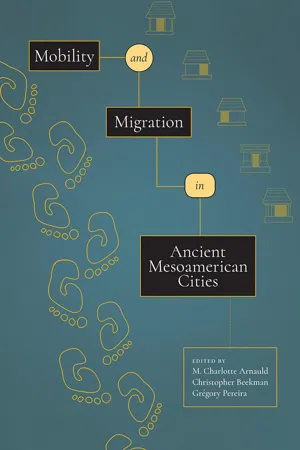
Mobility and Migration in Ancient Mesoamerican Cities is the first focused book-length discussion of migration in central Mexico, west Mexico and the Maya region, presenting case studies on population movement in and among Classic, Epiclassic, and Postclassic Mesoamerican societies and polities within the framework of urbanization and de-urbanization. Looking beyond the conceptual dichotomy of sedentism versus mobility, the contributors show that mobility and migration reveal a great deal about the formation, development, and decline of town- and city-based societies in the ancient world.
In a series of data-rich chapters that address specific evidence for movement in their respective study areas, an international group of scholars assesses mobility through the isotopic and demographic analysis of human remains, stratigraphic identification of gaps in occupation, and local intensification of water capture in the Maya lowlands. Others examine migration through the integration of historic and archaeological evidence in Michoacán and Yucatán and by registering how daily life changed in response to the influx of new people in the Basin of Mexico.
Offering a range of critical insights into the vital and under-studied role that mobility and migration played in complex agrarian societies, Mobility and Migration in Ancient Mesoamerican Cities will be of value to Mesoamericanist archaeologists, ethnohistorians, and bioarchaeologists and to any scholars working on complex societies.
Contributors:
Jaime J. Awe, Meggan Bullock, Sarah C. Clayton, Andrea Cucina, Véronique Darras, Nicholas P. Dunning, Mélanie Forné, Marion Forest, Carolyn Freiwald, Elizabeth Graham, Nancy Gonlin, Julie A. Hoggarth, Linda Howie, Elsa Jadot, Kristin V. Landau, Eva Lemonnier, Dominique Michelet, David Ortegón Zapata, Prudence M. Rice, Thelma N. Sierra Sosa, Michael P. Smyth, Vera Tiesler, Eric Weaver
eBook - ePub
Mobility and Migration in Ancient Mesoamerican Cities
- English
- ePUB (mobile friendly)
- Available on iOS & Android
eBook - ePub
Mobility and Migration in Ancient Mesoamerican Cities
About this book
Information
Publisher
University Press of ColoradoYear
2021Print ISBN
9781646426591
9781646420728
eBook ISBN
9781646420735
Part I
Bioanthropological Approaches
1
Urban and Rural Population Movement Patterns during the Late and Terminal Classic in the Belize River Valley, Belize
Carolyn Freiwald
Migration in ancient cultures used to be described as understudied, neglected, or poorly understood, but new methods and innovative theoretical frameworks now allow archaeologists to ask who moved, where the migrants came from, and even when or why they chose—or were forced—to move. Direct radiocarbon dating of burials allows for more precise ceramic and settlement chronologies (Ebert et al. 2016; Hoggarth et al. 2014), and data from historic accounts and epigraphic texts may reveal the reasons people moved (Bullock, chapter 4, this volume; McAnany et al. 2016). Studies of modern migration behaviors offer a theoretical framework to predict broader population movement patterns (Ezzo et al. 1997; Freiwald 2011a), and biodistance studies of similarities and differences in human tooth and bone metrics and morphology offer a means to test them (Aubry 2009; Miller 2015; Scherer 2004, 2007; Scherer and Wright 2015; Willermet et al. 2013; Wrobel 2004).
Biogeochemical methods have proved particularly informative in reconstructing population movement and how it relates to key anthropological questions, from the range of early hominins (Copeland et al. 2011; Richards et al. 2008), to migration patterns at the onset of the European Neolithic (Bentley et al. 2003; Grupe et al. 1997; Price et al. 2004) and mobility within states and empires (Buzon et al. 2007; Killgrove and Montgomery 2016; Knudson 2008; Prowse et al. 2007; Turner et al. 2009). In the Maya region, research has focused on key questions that include the growth of large cities such as Copan and Tikal (Price et al. 2014; Wright 2012) and the origins of important historic figures and their relation to foreign powers during critical moments of Classic-period (AD 250–900) culture change (Buikstra et al. 2004; Wright 2005a; Wright et al. 2010). More important, population movement has been identified at nearly every center studied using biogeochemical methods, including both large and small settlements in the Maya region (Awe et al. 2017; Chinchilla Mazariegos et al. 2015; Cucina et al. 2011, 2015; das Neves 2012; Davies 2012; Donis 2013; Freiwald 2011a, 2011b, 2019; Freiwald et al. 2014; Freiwald and Pugh 2018; Green 2016; Hoggarth et al., chapter 2, this volume; Krueger 1985; Micklin 2015; Miller 2015; Miller Wolf and Freiwald 2018; Mitchell 2006; Novotny 2015, Novotny et al. 2018; Patterson and Freiwald 2016; Price et al. 2008, 2010, 2014, 2015, 2018; Rand et al. 2015; Sierra Sosa et al. 2014; Somerville et al. 2016; Spotts 2013; Sutinen 2014; Trask 2018; Trask et al. 2012; White et al. 2001; Wright 2005a, 2005b, 2007, 2012; Wright and Bachand 2009; Wright et al. 2010; Wrobel et al. 2014, 2017), as well as elsewhere in Mesoamerica (e.g., Bullock Kreger 2010; Manzanilla 2017; Price et al. 2000; Wells et al. 2014; White et al. 2002, 2004a).
More recently, the focus has shifted from identifying population movement, which now is acknowledged as an ordinary occurrence (M.E. Smith 2014), to understanding its structure and the information that different methods can (and cannot) provide. For example, biogeochemical methods are not useful for identifying ongoing mobility related to trade, warfare, pilgrimages, or visits. Strontium, oxygen, and more recently sulfur and lead, provide better indicators of migration, defined as a change in residence that is long-term or permanent and breaks with previous habits (sensu Arnauld et al., chapter 8, this volume; Cabana and Clark 2011a). The term migration also describes movement across a political border, regardless of distance (Finnegan 1976; Hoerder 2004). Ancient political and social boundaries in the Maya region are not well understood and were likely different than the geologic and geographic boundaries that form the basis for isotopic variation.
Migration in this chapter is interpreted as a change in residence between locations with distinct strontium isotope values, which may include movement within and across political boundaries as well as social ones in parts of the Maya lowlands. More specifically, it is a difference in isotope values in early-forming tooth enamel that represents the place of birth, and the place of burial, which serves as a proxy for the residence at the end of life. The term nonlocal refers to individuals whose isotope values are statistical outliers from the sample population, and local describes individuals with isotope values found nearby, with the understanding that similar values may exist elsewhere in the Maya region.
This study uses a rural community in the eastern Maya lowlands to explore migration patterns among the Maya during the Late and Terminal Classic period (AD 700–900). Barton Ramie was a hinterland settlement located on the floodplain of the Belize River in a region where isotopic studies suggest substantial population movement. Strontium isotope values for individuals buried at 20 surface sites and caves suggest that nearly a quarter of the Belize Valley population relocated at least once between birth and burial (Freiwald 2011a; also see Freiwald 2011b; Green 2016; Krueger 1985; Micklin 2015; Mitchell 2006; Novotny 2015; Spotts 2013; Wrobel et al. 2014, 2017). At Barton Ramie, 14 percent of individuals sampled (n = 28) had origins elsewhere...
Table of contents
- Cover
- Title Page
- Copyright Page
- Contents
- List of Figures
- List of Tables
- Mobility and Migration in Ancient Mesoamerican Cities: An Introduction
- Part I: Bioanthropological Approaches
- Part II: Classic Lowland Maya Mobility
- Part III. Late Mesoamerican Migrations
- Part IV: Discussion
- References
- Contributors
- Index
Trusted by 375,005 students
Access to over 1.5 million titles for a fair monthly price.
Study more efficiently using our study tools.
Frequently asked questions
Yes, you can cancel anytime from the Subscription tab in your account settings on the Perlego website. Your subscription will stay active until the end of your current billing period. Learn how to cancel your subscription
No, books cannot be downloaded as external files, such as PDFs, for use outside of Perlego. However, you can download books within the Perlego app for offline reading on mobile or tablet. Learn how to download books offline
Perlego offers two plans: Essential and Complete
- Essential is ideal for learners and professionals who enjoy exploring a wide range of subjects. Access the Essential Library with 800,000+ trusted titles and best-sellers across business, personal growth, and the humanities. Includes unlimited reading time and Standard Read Aloud voice.
- Complete: Perfect for advanced learners and researchers needing full, unrestricted access. Unlock 1.5M+ books across hundreds of subjects, including academic and specialized titles. The Complete Plan also includes advanced features like Premium Read Aloud and Research Assistant.
We are an online textbook subscription service, where you can get access to an entire online library for less than the price of a single book per month. With over 1.5 million books across 990+ topics, we’ve got you covered! Learn about our mission
Look out for the read-aloud symbol on your next book to see if you can listen to it. The read-aloud tool reads text aloud for you, highlighting the text as it is being read. You can pause it, speed it up and slow it down. Learn more about Read Aloud
Yes! You can use the Perlego app on both iOS and Android devices to read anytime, anywhere — even offline. Perfect for commutes or when you’re on the go.
Please note we cannot support devices running on iOS 13 and Android 7 or earlier. Learn more about using the app
Please note we cannot support devices running on iOS 13 and Android 7 or earlier. Learn more about using the app
Yes, you can access Mobility and Migration in Ancient Mesoamerican Cities by M. Charlotte Arnauld, Christopher Beekman, Grégory Pereira, M. Charlotte Arnauld,Christopher Beekman,Grégory Pereira in PDF and/or ePUB format, as well as other popular books in Social Sciences & Archaeology. We have over 1.5 million books available in our catalogue for you to explore.