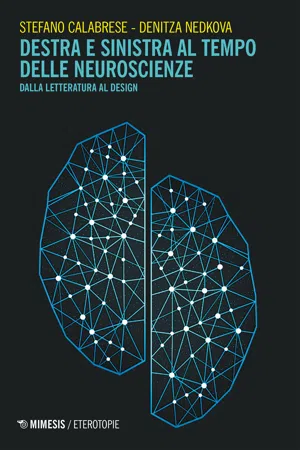
Circolano molte semplificazioni giornalistiche sulle rispettive competenze dell'emisfero destro e sinistro del cervello. Contro di esse, l'importante scoperta che, di fronte a una nuova esperienza, si attiverebbe dapprima l'emisfero destro e solo successivamente l'informazione passerebbe all'emisfero sinistro è stata in seguito codificata dalla comunità scientifica in questi termini: i nuovi stimoli sono preferenzialmente processati dall'emisfero destro, mentre la routine lo è dal sinistro. All'emisfero destro arriverebbe dalla realtà un corpo pulsante di vita, mutevole dall'oggi al domani; all'emisfero sinistro una spoglia cadaverica, non più contagiosa, né proiettata a un futuro da cui è stata esonerata per sempre. E l'intera storia dell'uomo – come questo libro documenta, passando in rassegna ambiti differenti quali la pittura, il cinema, il design, la letteratura, l'architettura – è la storia di un'incessante sopraffazione di un emisfero sull'altro, in Occidente con una nitida prevalenza del sinistro sul destro. Nessuna aria di gioviale camaraderie tra destra e sinistra. Un cupo, esulcerato conflitto in cui il valore di un emisfero spesso cresce in proporzione alla resistenza che incontra il suo riconoscimento da parte dell'altro, e dove le differenze tra l'uno e l'altro sono talvolta semplici interruzioni di reciprocità.
eBook - ePub
Destra e sinistra al tempo delle neuroscienze
Dalla letteratura al design
- English
- ePUB (mobile friendly)
- Available on iOS & Android
eBook - ePub
Destra e sinistra al tempo delle neuroscienze
Dalla letteratura al design
About this book
Information
Subtopic
History & Theory in PsychologyIndex
PsychologyBibliografia
Acosta L. M. Y., Williamson J. B., Heilman K. M. (2015), Which Cheek did the Resurrected Jesus Turn?, in “Journal of Religion and Health”, vol. 54, n. 3, pp. 1091-1098.
Albert D., Steinberg L. (2011), Age differences in strategic planning as indexed by the Tower of London, in “Child Development”, n. 82, pp. 1501-1517.
Amirshahi S. A., Koch M., Denzler J., Redies C. (2012), PHOG analysis of self-similarity in aesthetic images, in “Human Vision and Electronic Imaging XVII”, International Society for Optics and Photonics, vol. 8291, art. 82911J.
Antoniello D., Gottesman R. (2017), Limb misidentification: a clinical-anatomical prospective study, in “The Journal of Neuropsychiatry and Clinical Neurosciences”, n. 29, pp. 284-288.
Appleton J. (1996), The Experience of Landscape, Chichester, Wiley.
Ardila A. (2017), Historical development of human cognition: A cultural-historical neuropsychological perspective (Vol. III), Berlin, Springer.
Armstrong J. (2015), Empiritexts: Mapping attention and invention in post-1980 French literature, In “French Forum”, n. 40, pp. 93-108.
Baars B. J. (1999), Art must move: Emotion and the biology of beauty, in “Journal of Consciousness Studies”, n. 6-7, pp. 59-61.
Baas D., Aleman A., Kahn R.S. (2004), Lateralization of amygdala activation: a systematic review of functional neuroimaging studies, in “Brain Research Reviews”, n. 45, pp. 96-103.
Babic M. J., Morgan P. J., Plotnikoff R. C., Lonsdale C., White R. L., Lubans D. R. (2014), Physical activity and physical self-concept in youth: systematic review and meta-analysis, in “Sports Medicine”, vol. 44, n. 11, pp. 1589-1601.
Bacha-Trams M., Alexandrov Y. I., Broman E., Glerean E., Kauppila M., Kauttonen J., ... Jääskeläinen I. P. (2018), A drama movie activates brains of holistic and analytical thinkers differentially, in “Social Cognitive and Affective Neuroscience”, vol. 13, n. 12, pp. 1293-1304.
Badzakova-Trajkov G., Haberling I.S., Roberts R.P., Corballis M.C. (2010), Cerebral asymmetries: complementary and independent processes, in “PLoS One”, n. 5, art. e9682.
Baldwin C. L., Penaranda B. N. (2012), Adaptive training using an artificial neural network and EEG metrics for within-and cross-task workload classification, in “NeuroImage”, vol. 59, n. 1, pp. 48-56.
Baraud I., Buytet B., Bec P., Blois-Heulin C. (2009), Social laterality and ‘transversality’ in two species of mangabeys: influence of rank and implication for hemispheric specialization, in “Behavior Brain Research”, vol. 198, n. 2, pp. 449-458.
Barnea-Goraly N., Menon V., Eckert M., Tamm L., Bammer R., Karchemskiy A., Dant C.C., Reiss A.L. (2005), White matter development during childhood and adolescence: a cross-sectional diffusion tensor imaging study, in “Cerebral Cortex”, vol. 15, n. 12, pp. 1848-1854.
Baron-Cohen S. (2004), Questione di cervello: la differenza essenziale tra uomini e donne, trad. it., Milano, Mondadori – Baron-Cohen S., Without a Theory of Mind one cannot participate in a conversation, in “Cognition” (1988), n. 29, pp. 83-84.
Baron-Cohen S. ...
Table of contents
- Introduzione
- Capitolo I Animali bilateri
- Capitolo II Architettura e design
- Capitolo III Letteratura, cinema e altri media
- Capitolo IV Che cosa è bello per il cervello
- Capitolo V La socializzazione: baci, abbracci, amenità varie
- schema sinottico
- Bibliografia
Trusted by 375,005 students
Access to over 1.5 million titles for a fair monthly price.
Study more efficiently using our study tools.
Frequently asked questions
Yes, you can cancel anytime from the Subscription tab in your account settings on the Perlego website. Your subscription will stay active until the end of your current billing period. Learn how to cancel your subscription
No, books cannot be downloaded as external files, such as PDFs, for use outside of Perlego. However, you can download books within the Perlego app for offline reading on mobile or tablet. Learn how to download books offline
Perlego offers two plans: Essential and Complete
- Essential is ideal for learners and professionals who enjoy exploring a wide range of subjects. Access the Essential Library with 800,000+ trusted titles and best-sellers across business, personal growth, and the humanities. Includes unlimited reading time and Standard Read Aloud voice.
- Complete: Perfect for advanced learners and researchers needing full, unrestricted access. Unlock 1.5M+ books across hundreds of subjects, including academic and specialized titles. The Complete Plan also includes advanced features like Premium Read Aloud and Research Assistant.
We are an online textbook subscription service, where you can get access to an entire online library for less than the price of a single book per month. With over 1.5 million books across 990+ topics, we’ve got you covered! Learn about our mission
Look out for the read-aloud symbol on your next book to see if you can listen to it. The read-aloud tool reads text aloud for you, highlighting the text as it is being read. You can pause it, speed it up and slow it down. Learn more about Read Aloud
Yes! You can use the Perlego app on both iOS and Android devices to read anytime, anywhere — even offline. Perfect for commutes or when you’re on the go.
Please note we cannot support devices running on iOS 13 and Android 7 or earlier. Learn more about using the app
Please note we cannot support devices running on iOS 13 and Android 7 or earlier. Learn more about using the app
Yes, you can access Destra e sinistra al tempo delle neuroscienze by Stefano Calabrese,Denitza Nedkova in PDF and/or ePUB format, as well as other popular books in Psychology & History & Theory in Psychology. We have over 1.5 million books available in our catalogue for you to explore.