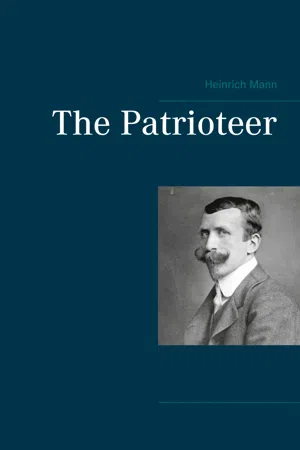
"Der Untertan" (literally "the subject", translated into English under the titles "Man of Straw", "The Patrioteer", and "The Loyal Subject") is one of the best known novels of German author Heinrich Mann. The title character, Diederich Hessling, a dedicated "Untertan" in the sense of a person subservient to a monarch or prince, is an immoral man who is meant to serve as an allegory of both the reign of Kaiser Wilhelm II and German society of his time.The novel was completed during the July Crisis in 1914, shortly before the outbreak of World War I. Extracts had been published in the satirical magazine "Simplicissimus" from 1912 onwards, causing great controversy. A book edition was not published until 1918 by Kurt Wolff in Leipzig.
- 364 pages
- English
- ePUB (mobile friendly)
- Available on iOS & Android
eBook - ePub
The Patrioteer
About this book
Information
VI
Here and Frau Dr. Hessling from Netzig looked at one an other in the lift of the hotel in Zurich, for they were being taken up to the fourth floor. This was the result of the glance of quick, discreet appraisal which the clerk at the desk had given them. Diederich obediently filled up the form for visitors, but when the waiter had withdrawn, he relieved his feelings about the way things were done here, and about Zurich in general. His indignation increased more and more, and finally took shape in the resolve to write to Baedeker. As this relief meanwhile seemed a little too remote, he turned on Guste. It was all the fault of her hat. Guste, in her turn, blamed his German military cape. Thus they descended to lunch, both red with anger. At the door they stopped, and sniffed superciliously as they met the gaze of the hotel guests, Diederich in his dinner jacket, and Guste wearing a hat whose ribbons, feathers and buckle combined, certainly entitled her to the best floor in the hotel. Their earlier acquaintance, the waiter, conducted them in triumph to their seats.
That night they became reconciled both to Zurich and the hotel. In the first place their room on the fourth floor was cheap, if not distinguished. And then, just opposite the twin beds of the wedded couple there hung an almost life-size picture of an odalisque, whose brownish body reclined voluptuously on a pillow, her hands under her head, and her dark eyes full of languishing desire. The figure was cut off in the middle by the frame, a fact which moved them to joking comment. The next day they went about with eyelids heavy as lead, ate enormous meals, and wondered what would have happened if the odalisque had been entirely visible instead of being cut off from the waist. They were too tired to catch the train and returned in the evening, as soon as possible, to their inexpensive and inspiring room. There was no saying when this sort of existence might have ended, if Diederich’s heavy eyes had not caught sight of an announcement in the newspaper that the Emperor was on his way to Rome to visit the King of Italy. He aroused himself in a flash. With elastic stride he went from the hall-porter to the office, and from the office to the lift, and though Guste wailed that her head was turning, the trunks were made ready, and Diederich got Guste away. “Oh, why,” she complained “must we leave a place where the bed is so comfortable?” But Diederich had only a mocking look for the odalisque as they left. “Have a good time, by dear young lady!”
For a long time he could not sleep from excitement. Guste snored peaceably on his shoulder while Diederich, as the train roared through the night, remembered how at that very moment, on another line, the Emperor himself was being carried by a train which roared similarly, towards the same goal. The Emperor and Diederich were having a race! And, as Diederich had more than once been privileged to utter thoughts which seemed in some mystic way to coincide with those of the All-Highest, perhaps at that hour His Majesty knew of Diederich, knew that his loyal servant was crossing the Alps by his side, in order to show these degenerate Latins what loyalty to king and country means. He glared at the sleepers on the opposite seat, small, dark people, whose faces seemed haggard in their sleep. They would see what Germanic valour was!
Passengers got out in the early morning at Milan, and at Florence, about noon, to Diederich’s astonishment. Without any noticeable success he endeavoured to impress upon those who remained what a great event awaited them in Rome. Two Americans showed themselves somewhat more susceptible, at which Diederich exclaimed triumphantly: “Ah, I am sure you also envy us our Emperor.” Then the Americans looked at one another in a mute and vain interrogation. Before they reached Rome Diederich’s excitement was translated into a feverish desire to be up and doing. With his finger in a phrasebook he ran after the employes on the train, trying to find out who would arrive first, his Emperor or he. His enthusiasm had infected Guste. “Diedel!” she cried, “I feel like throwing my veil on the ground for him to walk on it and flinging the roses from my hat at him!”—”If he sees you and you make an impression on him?” asked Diederich, with a feverish smile. Guste’s bosom began to heave and she dropped her eyes. Diederich, who was gasping, broke the fearful tension. “My manly honour is sacred, I must insist. But in such a case … and he concluded with a brief gesture.
Then they arrived, but very differently from what they had imagined. In the greatest confusion the passengers were pushed by officials out of the station, over to the edge of a broad square and into the streets behind it, which were immediately closed off again. With unshakable enthusiasm Diederich broke through the barriers. Guste, who stretched out her arm in horror, was left standing there with all the hand-luggage, while he stormed blindly forward. He had got as far as the middle of the square, and two soldiers with plumed helmets were running after him so that the tails of their gaily-coloured dress tunics flapped in the breeze. Then several gentlemen walked down the sloping entrance to the station, and almost simultaneously Diederich saw a carriage driving towards him. He waved his hat and bawled so loudly that the gentlemen in the carriage interrupted their conversation. The one on the right leaned forward and—they were face to face, Diederich and his Emperor! The Emperor smiled coldly and critically, and the lines of his mouth relaxed slightly. Diederich ran along beside the carriage for a while, his eyes staring wildly, shouting continuously and waving his hat. For a few seconds, while the foreign crowd in the background applauded, the Emperor and his loyal subject were alone together, in the middle of the empty square, beneath the glaring blue sky.
The carriage had already disappeared along the streets hung with bunting, cheers could be heard in the distance, when Diederich heaved a great sigh and put on his hat.
Guste was beckoning to him frantically, and the people who were still standing around applauded, with looks of cheerful good nature. Even the soldiers who had previously followed him were now laughing. One of them showed his sympathy so far as to call a cab. As he drove off Diederich saluted the crowd. “They are like children,” said his wife. “Yes, but correspondingly undisciplined,” he added, and he admitted: “That could not have happened in Berlin. … When I think of the row Unter den Linden, order was much more sharply maintained.” He tidied himself before they drove up to the hotel. Thanks to his manner, they were given a room on the second floor.
The early morning sun saw Diederich once more in the streets. “The Emperor is an early riser,” he had informed Guste, who only grunted from the pillows. In any case she could not assist him in his task. Guiding himself with a plan of the city he arrived in front of the Quirinal, and took up his position. The quiet square gleamed bright gold under the oblique rays of the sun. Gaunt and massive the palace stood out against the empty sky—and opposite stood Diederich, awaiting His Majesty, the Order of the Crown, fourth class, on his protruding chest. A herd of goats tripped up the steps from the city, and disappeared behind the fountain and the statues of giant horse-breakers. Diederich did not look around. Two hours went by, more people began to pass, a sentry had come out of his box, in one of the portals a gatekeeper was moving about, and several persons went in and out. Diederich became uneasy. He approached the fagade, moved slowly up and down, peeping anxiously inside. On his third appearance the gatekeeper touched his hat hesitatingly. When Diederich stopped and returned his salute, he became more confidential. “Everything in order,” he said behind his hand, and Diederich received the information with an air of understanding. It seemed to him only natural that he should be informed of the Emperor’s welfare. His questions, when the Emperor would be going out and where, were answered without hesitation. The gatekeeper himself got the idea that, in order to accompany the Emperor, Diederich would need a carriage and he sent for one. Meanwhile a knot of curious onlookers had formed, and then the gatekeeper stepped to one side. Behind an outrider, in an open carriage came the blond ruler of the North, beneath his flashing eagle-helmet. Diederich’s hat was in the air and he shouted in Italian, with the precision of a pistol shot: “Long live the Emperor!” And obligingly the knot of people shouted with him.
In a jump Diederich had got into his one-horse carriage, which stood ready, and was off in pursuit, urging the coachman with hoarse cries and an ample tip. Now he stops, for the royal carriage is only just coming up. When the Emperor gets out there is another little knot of people, and again Diederich shouts in Italian. … Watch must be kept in front of the house where the Emperor lingers! With chest extended and flashing eyes: let him beware who ventures to come too near! In ten minutes the little group re-forms, the carriage drives out through the gate, and Diederich: “Long live the Emperor!” and the shout is echoed by the crowd, as the company rushes wildly back to the Quirinal. Guard is mounted. The Emperor in a shako. The little crowd. Another visit, another return, another uniform, and again Diederich, and again an enthusiastic reception. So it went, and never had Diederich enjoyed himself so much before. His friend the gatekeeper kept him reliably informed as to the Emperor’s movements. It also happened that an official would salute and give him a message which he condescendingly received, or that another would ask for instructions, which Diederich gave in general terms, but in a commanding tone. The sun rose higher and higher. In front of the marble squares of the façade, behind which his Emperor was holding conversations covering the whole orbit of the world, Diederich was suffering hunger and thirst without flinching. Although he held himself firmly erect, he felt, nevertheless, as if his paunch were sinking to the pavement under the burden of noon, and his Order of the Crown, fourth class, were melting on his breast. … The coachman, whose visits to the nearest tavern were becoming more frequent, finally was impressed by the German’s heroic sense of duty and brought him back some wine. With a new fire in their veins the pair took part in the next race. The imperial horses ran quickly, in order to get there before them, it was necessary to plunge through side streets that looked like canals, and whose few pedestrians shrank back in terror against the walls. Or they had to get out and clamber madly up flights of steps. But Diederich was punctually at the head of his little crowd, watched for the seventh uniform emerging from the carriage, and shouted. Then the Emperor turned his head and smiled. He recognised him, his loyal subject! The one who shouted, who was always on the spot, like a devoted retainer. Diederich felt as if he were flying on the wings of elation because of the All Highest’s attention. His eyes flashed at the people whose faces wore an expression of cheerful good nature.
Only when the gatekeeper assured him that His Majesty was now at lunch did Diederich allow himself to think of Guste. “What a sight you are!” she cried, drawing back against the wall, when she beheld him. He was as red as a tomato, soaked with perspiration, and his eyes were as bright and wild as those of a Germanic warrior of yore on a foray through the Latin territories. “This is a great day for the national cause!” he said furiously. “His Majesty and I are making moral conquests!” How fine he looked! Guste forgot her fright and her annoyance at the long wait. She came up with her arms affectionately outstretched and clung to him humbly.
Diederich, however, would hardly allow himself the brief hour for lunch. He knew that the Emperor rested after eating. Then it was his duty to mount guard under his windows with out shirking. He did not shirk his duty, and the result showed how well he had done. He had not been eighty minutes at his post opposite the portal of the palace, when a suspicious looking individual, profiting by the brief absence of the gatekeeper, slipped in, hid behind a pillar, and in the dark shadow concealed plans which could not be otherwise than dangerous. This was Diederich’s opportunity! With a warlike cry he could be seen thundering across the square like a storm. Startled people rushed after him, the guard hurried up, in the gateway servants were running about—and every one admired Diederich as he dragged some man forward, wildly struggling, who had hidden himself. The pair fought so fiercely that the armed guards did not even dare to approach. Suddenly Diederich’s opponent, who had succeeded in freeing his right arm, was seen swinging a box. A breathless second—then the panic-stricken crowd rushed yelling to the gate. A bomb! He is going to throw it! … He had thrown it! In expectation of the explosion those nearest, threw themselves on the ground, moaning in advance. But Diederich, his face, shoulders and chest all white, stood there and sneezed. There was a strong smell of peppermint. The boldest returned and tested it with their sense of smell. A soldier, with waving plumes, gingerly dipped his moistened finger into it, and tasted it. Diederich grasped the situation and explained it to the crowd, whose expression of cheerful good humour returned, for he himself was no longer in doubt for some moments past that he was covered with tooth-powder. The bomb-thrower—absolutely in vain—tried to get past him and escape. Diederich’s iron fist delivered him to the police. The latter ascertained that the man was a German, and asked Diederich to question him. In spite of the tooth-powder which covered him, he undertook this duty with the utmost dignity. The answers of the man, who, significantly enough, was an artist, had no particular political colour, but their abysmal lack of respect and moral sense betrayed only too clearly revolutionary tendencies. Therefore Diederich strongly urged that he should be arrested. The police led him off, and they did not forget to salute Diederich, who had only just time to get brushed by his friend the gatekeeper. For the Emperor was announced, and Diederich’s personal service began again.
The following evening at the gala performance at the theatre the Emperor looked more serious than usual. Diederich noticed it, and said to Guste: “Now I know why I spent our good money coming here. Just watch, this will be an historic occasion!” His premonition did not deceive him. The evening papers spread round the theatre, and it was learned that the Emperor was going away that night, that he had dissolved the Reichstag. Diederich, no less serious than the Emperor, explained the significance of the event to every one near him. The revolutionaries had dared to vote against the Army Bill. The patriotic parties were entering upon a life and death struggle for their Emperor! He himself was returning home by the next train, he assured them, and they hastened to tell him at what hour it left.
… The person who was dissatisfied was Guste. “When one gets somewhere else, at last, and thank God, one has the money and can afford it, why should I, after moping for two days in the hotel, start back at once, just because—” She threw a glance of such disgust at the royal box that Diederich had to intervene with the utmost severity. Guste answered loudly, every one around them cried “sh!” and when Diederich turned round to glare at the objectors, they compelled him and Guste to leave, long before the train started. “That rabble has no manners,” he remarked, snorting furiously, when they got outside. “Anyhow, what’s the good of this place, I’d like to know. The weather is all right, I suppose … but just look at all that old junk about the place!” he insisted. Guste, who was once more pacified, said complainingly: “but I enjoy it.” Then they departed at a respectful distance behind the Emperor’s train. Guste had forgotten her sponge and brushes in their haste and at every station she wanted to get out. Diederich had to remind her ceaselessly of the national cause, in order to induce her to wait for thirty-six hours. When they finally arrived in Netzig, however, her first thought was for the sponge. Of course they had arrived on a Sunday! Fortunately, the apothecary’s shop, at least, was open. While Diederich was waiting in the station for the luggage Guste went over to it. As she did not return, he went after her.
The door of the apothecary’s was half open, and three youths were peeping in and laughing. Diederich looked over their shoulders and was amazed, for inside his old college friend, Gottlieb Hornung, was marching up and down behind the counter, with folded arms and gloomy countenance. Guste was just saying: “Now I’d really like to know when I am going to get my tooth-brush.” Then Gottlieb Hornung stepped forward from behind the counter, with arms still crossed, and turned his melancholy gaze upon Guste. “You cannot fail,” he began oratorically, “to have noticed by my expression that I have neither the will nor the power to sell you a tooth brush.” Guste drew back and said: “Really! But you have a whole showcase full.” Gottlieb Hornung’s smile was Mephistophelian. “My uncle upstairs”—he jerked up his head and pointed with his chin to the ceiling, above which his employer doubtless resided—”my uncle can huckster here as he likes. That does not concern me. I did not study for three years and belong to a swagger corps in order to come here and sell tooth-brushes.”—”What are you here for, then?” asked Guste visibly impressed. Then Hornung replied with majestic emphasis: “I am here to attend exclusively to prescriptions!” Guste must have felt that she was beaten, for she turned to go. Then something else occurred to her: “I suppose it is the same with sponges?”—”Just the same,” Hornung assured her. This was obviously what Guste had been waiting for, to lose her temper properly. She stuck out her chest and was going to give him a piece of her mind. Diederich had just time to intervene. He agreed with his friend that the dignity of the Neo-Teutons should be preserved and their banner held aloft. But if any one wanted a sponge he could, after all, take it himself and deposit the amount—which Diederich proceeded to do. Gottlieb Hornung, meanwhile, moved to one side and began to whistle, as if he were quite alone. Then Diederich expressed his interest in what his friend had been doing since they last met. Unfortunately, it was a story of many mishaps, for, as Hornung could never sell sponges and tooth-brushes, he had already been dismissed by five apothecaries. Nevertheless he was determined to stand by his convictions, at the risk of also losing his present situation. “There you can see a real Neo-Teuton!” said Diederich to Guste, who had a good look at him.
In his turn Diederich was not slow to relate all his experiences and achievements. He drew attention to his decoration, turned Guste round in front of Hornung, and named the amount of her fortune. The Emperor, whose enemies and slanderers were behind lock and key, thanks to Diederich, had recently escaped grave personal danger in Rome, also thanks to Diederich. In order to avoid a panic in the courts of Europe and on the stock exchange, the press had spoken only of a silly trick played by a half-wit, “but between ourselves, I have reason to believe that it was a widespread plot. You will understand, Hornung, that the national interest commands the utmost discretion, for I am sure you, too, are a loyal patriot.” Of course, Hornung was, and so Diederich could unburden himself about the highly important task which had compelled him suddenly to return from his honeymoon. It was a question of pushing through the national candidates in Netzig. They must not underestimate the difficulties. Netzig was a stronghold of Liberalism, and revolution was undermining the foundations. … At this stage Guste threatened to drive off home with the luggage. Diederich could only invite his friend urgently to come to see him that very evening, as he had pressing matters to talk over with him. As he got into the cab he saw one of the young rascals, who had waited outside, going into the shop and asking for a tooth brush. Diederich reflected that Gottlieb Hornung, just because of the aristocratic tendency which so sadly interfered with the sale of sponges and tooth-brushes, might be an invaluable ally in the fight against democracy. But this was the least of his immediate cares. He only gave old Frau Hessling an opportunity of shedding a few hasty tears; then she had to return to the top floor, formerly reserved for the servant and the washing, where Diederich had now dumped his mother and Emma. Without waiting to remove the dust of his journey he betook himself by devious ways to Governor von Wulckow’s. Then with no less discretion he sent for Napoleon Fischer, and meanwhile took steps to arrange without delay a meeting with Kunze, Kühnchen and Zillich.
This was rendered more difficult because it was a Sunday afternoon. The major could be dragged only with the greatest difficulty from his game of nine-pins. The pastor had to be interrupted as he was preparing to go out on a family excursion with Käthchen and Jadassohn. The professor was in the hands of his two boarders, who had already got him half drunk. Finally he succeeded in getting them all into the clubroom of the Veterans’ Association, and Diederich explained to them, without further loss of time, that they would have to run a national candidate. And, as things were, there could be no question of any one but Major Kunze. “Hear! Hear!” cried Kühnchen, at once, but the major’s expression threatened a storm. Did they take him for a fool? he snarled. Did they think he was anxious to put his foot in it? “A national candidate in Netzig—I have no doubts as to what will happen to him! If everything else were as certain as his defeat!” Diederich would not hear of...
Table of contents
- Table of Contents
- I
- II
- III
- IV
- V
- VI
- Copyright
Trusted by 375,005 students
Access to over 1.5 million titles for a fair monthly price.
Study more efficiently using our study tools.
Frequently asked questions
Yes, you can cancel anytime from the Subscription tab in your account settings on the Perlego website. Your subscription will stay active until the end of your current billing period. Learn how to cancel your subscription
No, books cannot be downloaded as external files, such as PDFs, for use outside of Perlego. However, you can download books within the Perlego app for offline reading on mobile or tablet. Learn how to download books offline
Perlego offers two plans: Essential and Complete
- Essential is ideal for learners and professionals who enjoy exploring a wide range of subjects. Access the Essential Library with 800,000+ trusted titles and best-sellers across business, personal growth, and the humanities. Includes unlimited reading time and Standard Read Aloud voice.
- Complete: Perfect for advanced learners and researchers needing full, unrestricted access. Unlock 1.5M+ books across hundreds of subjects, including academic and specialized titles. The Complete Plan also includes advanced features like Premium Read Aloud and Research Assistant.
We are an online textbook subscription service, where you can get access to an entire online library for less than the price of a single book per month. With over 1.5 million books across 990+ topics, we’ve got you covered! Learn about our mission
Look out for the read-aloud symbol on your next book to see if you can listen to it. The read-aloud tool reads text aloud for you, highlighting the text as it is being read. You can pause it, speed it up and slow it down. Learn more about Read Aloud
Yes! You can use the Perlego app on both iOS and Android devices to read anytime, anywhere — even offline. Perfect for commutes or when you’re on the go.
Please note we cannot support devices running on iOS 13 and Android 7 or earlier. Learn more about using the app
Please note we cannot support devices running on iOS 13 and Android 7 or earlier. Learn more about using the app
Yes, you can access The Patrioteer by Heinrich Mann in PDF and/or ePUB format, as well as other popular books in Literature & Historical Fiction. We have over 1.5 million books available in our catalogue for you to explore.