Barbara Vucanovich was sixty-two when she ran in her first election, becoming the first woman ever elected to a federal office from Nevada. In this engaging memoir, written with her daughter, she reflects on the road that led her to Washington--her years as mother, businesswoman, and volunteer.
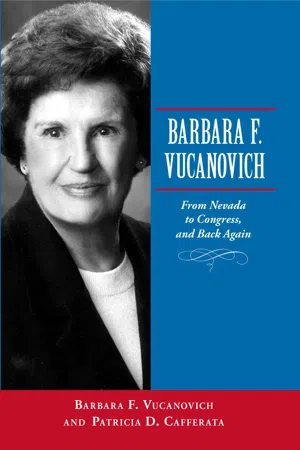
eBook - ePub
Barbara F. Vucanovich
From Nevada to Congress, and Back Again
- English
- ePUB (mobile friendly)
- Available on iOS & Android
eBook - ePub
Barbara F. Vucanovich
From Nevada to Congress, and Back Again
About this book
Information
Print ISBN
9780874179439
9780874176230
Subtopic
Political BiographiesPART I
Far from the House
CHAPTER ONE
Grandmothers and Grandfathers—Tough and Not So Tough
The arrival of Elisa Piper Cafferata, my first “grandbaby,” in May 1962, was as apolitical as it gets. I had no idea that one day I would be campaigning for Congress and calling myself a “tough grandmother” in television commercials. In fact, when Elisa joined our family, I still felt much more like a mother than a grandmother. My youngest child, Susie, was two and a half years old. Elisa’s birth was a defining moment, although I didn’t see it that way at the time. Little did I know that her birth, and those of her two siblings, Farrell and Reynolds, and fourteen cousins, would come to define my political persona twenty years later.
I was an “army brat.” After World War I, my parents were stationed in Louisville, Kentucky, where my oldest brother, Thomas Francis Farrell Jr., was born, in April 1920 at Camp Zachary Taylor. Another move brought the family to Camp Dix, New Jersey, where I was born on June 22, 1921.
I have no idea why my parents picked my name, Barbara. When I was growing up, my family called me “Bobby.” Later, I chose “Joan” as my confirmation name at age eleven or twelve. From then on, I was Barbara Joan Farrell until I married.
Shortly after my birth, the family moved to Camp Humphreys, now known as Fort Belvoir, Virginia, where the engineering school was located. We later moved to West Point, New York, where Dad taught engineering to the cadets at the United States Military Academy.
In 1926 we moved to Albany, and I started school at Vincentian, a Catholic school run by the Sisters of Mercy. They were tough women, and I didn’t like them very much. I was a maverick—always fighting with them over religion. I lasted there two years before my mother, deciding that I was a nonconformist, moved me to Miss Quinn’s Academy, a small Catholic school. Classes consisted of six to eight students in each grade. There were eight grades taught in four classrooms, and I skipped the fifth grade because I was the only student in it. From then on I was the youngest in all my classes.
My father had resigned from the regular army, entered the reserves and was appointed commissioner of canals and waterways for the State of New York by Governor Alfred E. Smith. He was subsequently chief engineer for the New York State Department of Public Works, with appointments from New York governors Franklin Delano Roosevelt and Herbert H. Lehman.
A registered Democrat, my father served in the New York State Democrat administrations, except when he was on active duty in the army, but he and my mother were never involved in regular party politics. In their day, Albany, the state capital, was controlled by the Democrat machine, so Democrats were appointed to state positions. Most everyone in town was a Democrat, including most of my parents’ friends. Dad was a Catholic, family-oriented, and fiscally conservative. He identified with the Democratic Party’s concern about the “little guy,” with compassion for the less fortunate. In later years, my father felt that the Democratic Party no longer represented his values and views, but he saw no reason to change parties.
I had no idea how well connected my father was politically, but I got an idea of his contacts in 1928, when I was seven years old and he took me to New York City to the Waldorf Astoria. Dad and I were dancing together when Governor Smith cut in to dance with me. Smith, a Democrat, was running against Republican Herbert Hoover for president. Of course, since my dad worked for Governor Smith, my parents were against Hoover, the first president I remember. Not long after Hoover was elected, the newspaper printed an insert about him with his picture on the front. I remember taking a pencil and poking holes in it, then gleefully showing it to my parents.
One morning in January of 1929, I was at home with the chicken pox. My mother was away from the house, so I was the first to learn that my grandfather Farrell had died of a stroke. I remember feeling totally devastated because I thought he was great, a wonderful man. I’ll always remember how hard it was to pick up our black candlestick-type telephone to call my dad at his office to tell him about his father. My father was always calm in the face of a crisis and always matter-of-fact. True to form, he reacted no differently to the news of my grandfather’s death than he would have to any other crisis. I never saw Dad give in to his grief; I think our family still carries on this tradition of stoicism even today.
I have many wonderful memories of my parents and grandparents while I was growing up. Every summer my mother would take my brother, Tommy, and me by train from Albany to Denver to spend a month visiting her mother and Granddaddy Buck. He was the commanding officer at Fitzsimmons Hospital in Denver, so they led a formal life. As the commandant’s wife, my grandmother was “at home” every Wednesday for ladies to come calling. On the front hall table rested a tray where the ladies left their calling cards, a tradition that today has been lost.
Mealtimes were formal, too, often consisting of several courses. Meals were announced with a round Chinese gong. Lunch and dinner always included a hot homemade soup. Granddaddy was a great tease with a wonderful sense of humor. He started many meals by asking who had stuck their gum under the table, and we were always surprised to be caught!
Granddaddy Buck had a driver for most of his career, and as a result he was not a good driver when he was on his own. Nonetheless, one summer in the 1930s Granddaddy drove his dark green Packard on a tour of the West with my father, Tommy, and me. I remember that he attached a swamp cooler to the car window, and we carried water for it in a canvas bag that we hung on the front of the car. We visited Yellowstone, Yosemite, the new Hoover Dam, and Las Vegas, my first trip to Nevada. What I remember most about the trip, aside from the swamp cooler, was how hot and dusty it was in Las Vegas. The town’s population was much less than ten thousand, and very few streets were even paved.
Often during the summer, too, we would drive to Rehoboth Beach, Delaware, from our home in Albany. Mother liked to swim in the ocean, so we would spend a month at the beach, at Mrs. Downs’s boardinghouse. Our rooms were on the second floor, and Tommy and I often got into a lot of trouble for staying up late listening to radio shows like The Goldbergs, Amos ’n Andy, and The Great Gildersleeve. During the day, slapping vinegar all over ourselves in hopes of getting a tan, we sometimes spied on the Catholic nuns at the local convent, who used a neighboring beach. We loved to watch them in their black swimming outfits and bloomers. I also remember watching Mrs. Downs wring the neck of a chicken she was preparing for dinner, an experience that ruined chicken for me for the rest of the summer.
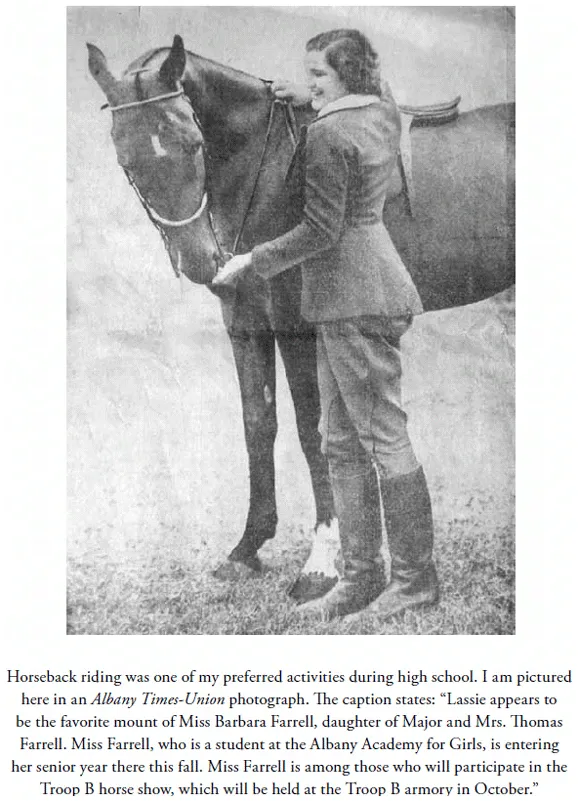
After I graduated from Miss Quinn’s, I attended high school at the Episcopalian Albany Academy for Girls, graduating at age sixteen. I was a B student, but I hated Latin and geometry. I flunked or barely passed both subjects and had to take them over again in college. At the academy, I learned to ride horseback and spent most Saturdays competing in horse shows. Gym class was problematic since I was too short for basketball and hated baseball—but I did love field hockey. The one class I’ll never forget was public speaking. We were not allowed to prepare. The teacher just called on us in class. The first time that happened I was paralyzed; I couldn’t and didn’t say a word—quite a start for a future politician.
I had just turned seventeen years old when Mother and Dad took me to Manhattanville College of the Sacred Heart in New York City. Manhattanville’s beautiful campus was located in Harlem, and we were not allowed to go out alone at night. During the day we walked from building to building to attend classes. Every afternoon the nuns joined us for tea served with cookies. The nuns were bright and interested in us. They were Madames of the Sacred Heart, so we called them “Mother” rather than “Sister.”
The first night I was there, a hurricane hit the city. There I was, in this old, old building, and my parents had just left. I was in the shower when the lights went out, and I couldn’t find my way to my room. I was terrified. All I wanted was to go home. My parents wisely did not let me come home every weekend. Ultimately, I survived the year and dealt with my homesickness. In the end, I actually liked the school.
I missed my family so much that I lasted at Manhattanville for only about one school year. When I returned to Albany, I attended St. Rose College for six months and a business college for a while. At the time, school wasn’t a love of mine. My interests ran to boys, dating, horses, and bridge.
Looking back, it’s no surprise that I married quite young. After getting through so many scrapes, I guess I felt like I could handle anything life sent my way. But marrying young helped shape me as a woman and, eventually, as a member of Congress. The person I became later in life was greatly influenced by my family heritage, my parents, my brothers and sister, my children, and my husbands.
Family Heritage
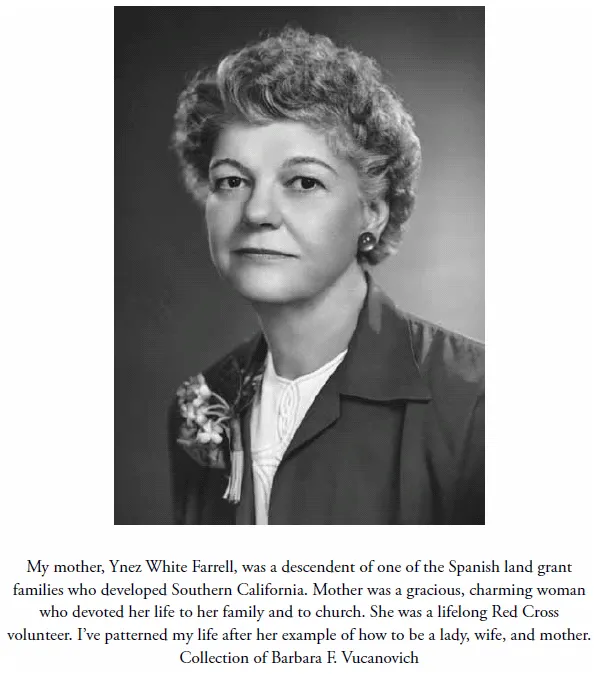
My mother’s family was Spanish through my grandmother, Maria Ynez Shorb White, and English through my grandfather, Stephen Stuart White, who died long before I was born. My mother, Maria Ynez White, was born in Southern California and when she was a girl they called her Ynezita (Little Ynez) to distinguish her from her mother, although for most of her life her name was shortened to simply Cita.
My mother was five feet four inches tall and never overweight in my memory. She kept her naturally curly hair short, but she hated gray hair. As she grew older, she dyed her hair almost black. Later, Mother let the natural gray show. Her eyes were like shoe buttons, so black you could not see the edges of her pupils. She was even-tempered and always calm, yet I do not remember her ever sitting still. She loved her garden and her yard, which was planted with peonies, roses, and hollyhocks.
My grandmother was a lovely woman, taller and slightly heavier than my mother. She wore her dark hair in the style of the day, and I enjoyed watching her comb it in a pompadour puffed up with a “rat.” Her eyebrows were thick and bushy (and perhaps that is why my mother plucked her own eyebrows down to a thin line).
Shopping with Grandmother was quite an expedition. She kept her money in a buttoned pocket in the leg of her bloomers, under a midcalf skirt or dress. I can still see her when she needed to make a purchase, modestly turning around and bending over to unbutton the secret pocket and retrieve her money.
Grandmother’s first ancestor to arrive in California was José Antonio Yorba, who came via Mexico from Villafranca, Spain, in 1769. José Antonio was a sergeant in the Gaspar de Portola expedition that escorted Father Junipero Serra when he established missions up and down the California coast. The family was later awarded a 65,512-acre land grant, Rancho Santiago de Santa Ana, along the banks of the Santa Ana River, by the king of Spain, in what is now Orange County. José Antonio’s third son, Don Bernardo Yorba, my mother’s great-great-grandfather, was given an additional 13,000 acres, known as Rancho Canon de Santa Ana, by the government of Mexico in 1834. The Yorba family was known throughout California for its hospitality. Don Bernardo build a hundred-room hacienda, called San Antonio, with a small church and a school, which remains today. The Yorba name is still prominent in Southern California, thanks to the Yorba Regional Park and other landmarks.
On another branch of my California family tree, my great-great-grandfather, Benjamin D. “Don Benito” Wilson, was the first county clerk of Los Angeles and the first mayor of Los Angeles, elected in 1851. He later served in the California State Senate. My great-grandfather, James de Barth Shorb, was elected Los Angeles County treasurer in 1892. They are the earliest recorded politicians in our family.
My grandmother Maria Ynez Shorb’s first husband, my grandfather Stephen White, was born in Maryland. He was descended from an old, established American family who once held land grants directly from Lord Baltimore. Some of my grandfather’s family members served in the American Revolution. Stephen, after graduating from Columbia University in 1885, was commissioned an assistant surgeon in the navy. He and Grandmother were married in 1894 at the Old Mission Church in San Gabriel, California.
Coincidentally, more than fifty years before I would live on Newlands Circle in Reno, my grandparents’ wedding presents included two silver dishes from Congressman Francis G. Newlands of Nevada and a crystal dish and fork from Congressman Newlands’s niece, Jessie. On my grandmother’s list of gifts, she wrote that the address for the Newlandses was in San Francisco, California. I was surprised to read that, since Newlands represented Nevada in Congress at the time of the wedding.
In her old age, Jessie Newlands lived in Reno, where the Newlands Mansion still stands today. When I moved to Reno in the 1940s, my mother gave me a letter of introduction to her—the way to be properly introduced to someone in polite society in those days. She was cordial, but I sensed that she wasn’t pleased that I was in Reno to get a divorce. A little more than a decade later, I moved into my house at 2 Newlands Circle in Reno.
Unfortunately, my grandparents’ marriage was not a long one. In 1899 Stephen White died of ptomaine poisoning while he was stationed in Alaska. His death left my grandmother with two small children: my mother, Cita, born in 1896, and my Aunt Ruth, born in 1898.
Grandmother and my great-grandmother, Sue Wilson Shorb, lived in Southern California with my mother and Ruth until about 1907, when they moved to San Francisco. A year later, my grandmother married Colonel Carroll Buck, an army physician. He actually raised my mother and her sister, and he was the only grandfather I knew. Granddaddy Buck’s military service took him to Washington, D.C., which is where my mother met my father, Thomas Francis Farrell, and where they were married, on July 23, 1917, at St. Dominic’s Catholic Church.

My father’s family was of strong Irish stock. My great-grandfather, Michael Farrell, was a schoolteacher who immigrated to America from Ireland around 1848 and became a farmer. My great-grandmother was Catherine Danahy, who was also Irish. Their only child was my grandfather, John J. Farrell.
Grandfather John Farrell was born and lived his entire life on the 200-acre family farm in Brunswick, New York, not far from Albany. I remember him as a tall, slender man who was kind and patient with me, leading me around the farm on a horse so I could ride, taking time to talk with me about the animals, and taking me down into the farm’s root cellar and explaining the vegetables and fruits stored there. Grandfather’s farm had an apple orchard and pigs, cows, and horses, in addition to the crops he grew. They must have had a lot of dairy cows, because Grandfather delivered milk for more than forty years.
He and his wife, Margaret Connolly Farrell, who died before I was born, had nine children. My dad was the fourth child in this sprawling Irish Catholic family. While growing up, all nine of the children worked on the farm and helped deliver milk, but none of them stayed on the farm as adults.
My father, Thomas Francis Farrell, was born in 1891 in Brunswick. Dad was almost six feet tall, with wonderful military posture, always straight and strong. Physically fit, he took a walk every night after dinner. His Irish complexion was ruddy, and he had freckles all over his arms and legs. He had a square Irish face with twinkling blue eyes and sandy-colored hair. His hands and feet were long and slender.
Tom, as he was called, graduated from Rensselaer Polytechnic Institute in 1912 with a degree in civil engineering. He worked on the Panama Canal from 1913 to 1916, then entered the army as a second lieutenant in November 1916. He and Mother were married just before he sailed for France in 1917. Dad came back from the war as a major and continued his military career from then off and on until the 1950s.
In February 1941 my father was recalled to active duty in preparation for World War II. He served in several different capacities during the war. In November 1943 he became the chief engineer in the China-Burma-India theater, supervising construction of the Lido Road, B-29 airfields, and the oil pipelines from Calcutta to China. He was promoted to brigadier general in January 1944. When Dad finally retired, his rank was major general.
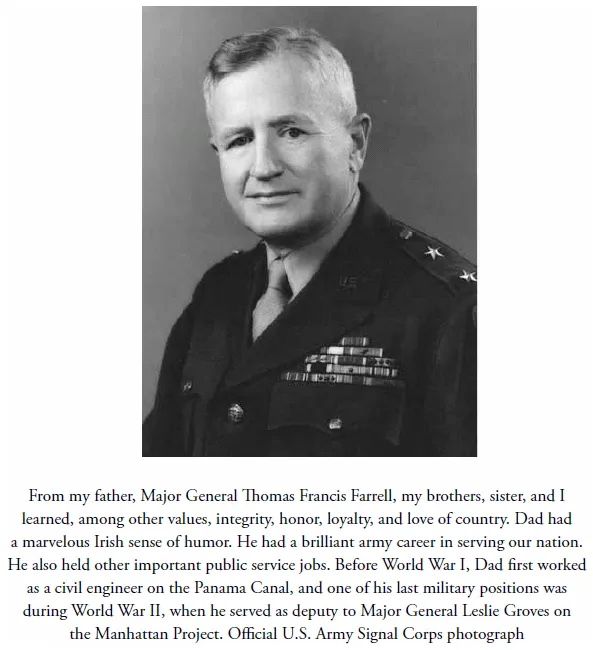
In January 1945 Dad was given his biggest job in World War II—perhaps the most important assignment of his life—when he became Major General Leslie Groves’s deputy on the atomic bomb project, codenamed “the Manhattan Project.” General Groves apparently selected my father as his deputy after careful consideration. According to letters I received after Dad’s death, Secretary of War Henry Stimson had grown increasingly nervous as the Manhattan Project progressed because only General Groves understood all aspects of the testing program.
Stimson feared what would happen if Groves suddenly died or couldn’t continue to manage the project for some reason, so he urged the general to appoint a deputy with whom he could share his knowledge. After my father joined Groves’s team, he and Groves made it a point never to be in the same place at the same time if there was any hint of danger present.
The Army Corps of Engineers was in charge of the Manhattan Project, with scientific direction provided by Dr. Robert Oppenheimer and his team. Work had been going on in secret for several years. The rush was on to end the war in the Pacific without an expensive and time-consuming full-scale invasion of mainland Japan—an invasion that would have cost tens of thousands of American lives.
In my father’s obituary in the New York Times on April 12, 1967, it was reported that when Dad arrived at Los Alamos National Laboratory in New Mexico, he walked into a classroom where Oppenheimer was lecturing to a group of highly trained atomic physicists. Oppenheimer dismissed th...
Table of contents
- Cover Page
- Title Page
- Copyright Page
- Dedication
- Contents
- List of Illustrations
- Preface
- Part I: Far from the House
- Part II: A Flamingo in the Barnyard of Politics
- Part III: Not Your Average Congressman
- Part IV: Back in the Great State of Nebraska
- Part V: Home Means Nevada
- List of Committee Assignments
- Index
Trusted by 375,005 students
Access to over 1.5 million titles for a fair monthly price.
Study more efficiently using our study tools.
Frequently asked questions
Yes, you can cancel anytime from the Subscription tab in your account settings on the Perlego website. Your subscription will stay active until the end of your current billing period. Learn how to cancel your subscription
No, books cannot be downloaded as external files, such as PDFs, for use outside of Perlego. However, you can download books within the Perlego app for offline reading on mobile or tablet. Learn how to download books offline
Perlego offers two plans: Essential and Complete
- Essential is ideal for learners and professionals who enjoy exploring a wide range of subjects. Access the Essential Library with 800,000+ trusted titles and best-sellers across business, personal growth, and the humanities. Includes unlimited reading time and Standard Read Aloud voice.
- Complete: Perfect for advanced learners and researchers needing full, unrestricted access. Unlock 1.5M+ books across hundreds of subjects, including academic and specialized titles. The Complete Plan also includes advanced features like Premium Read Aloud and Research Assistant.
We are an online textbook subscription service, where you can get access to an entire online library for less than the price of a single book per month. With over 1.5 million books across 990+ topics, we’ve got you covered! Learn about our mission
Look out for the read-aloud symbol on your next book to see if you can listen to it. The read-aloud tool reads text aloud for you, highlighting the text as it is being read. You can pause it, speed it up and slow it down. Learn more about Read Aloud
Yes! You can use the Perlego app on both iOS and Android devices to read anytime, anywhere — even offline. Perfect for commutes or when you’re on the go.
Please note we cannot support devices running on iOS 13 and Android 7 or earlier. Learn more about using the app
Please note we cannot support devices running on iOS 13 and Android 7 or earlier. Learn more about using the app
Yes, you can access Barbara F. Vucanovich by Barbara F. Vucanovich,Patricia D. Cafferata in PDF and/or ePUB format. We have over 1.5 million books available in our catalogue for you to explore.