![]()
Chapter 1 :
Steaming
into the
Abyss
Admiral Harry D. Felt became the most powerful American military leader west of San Francisco when he took charge of the Pacific Command (PACOM) in July 1958. The Navy flag officer oversaw all US military forces in the Asia-Pacific region for the next seven years. From his headquarters at Camp H. M. Smith overlooking the historic Pearl Harbor naval base in Hawaii, Felt commanded more than 900,000 soldiers, sailors, airmen, and Marines operating close to 7,000 aircraft and 500 warships and support vessels. CINCPAC’s subordinate commands included the US Pacific Fleet as well as major Army, Air Force, and Marine formations. The operational area for which he was responsible stretched from the US West Coast across the vast Pacific and into the Indian Ocean, and from the Aleutian Islands as far south as the Antarctic—an expanse of 85 million square miles. In addition to his military duties, Felt served as one of America’s most prominent diplomats in uniform. CINCPAC was the chief US military representative to the Southeast Asia Treaty Organization (SEATO) and to the allied governments of Japan, South Korea, Australia, New Zealand, and the Philippines.
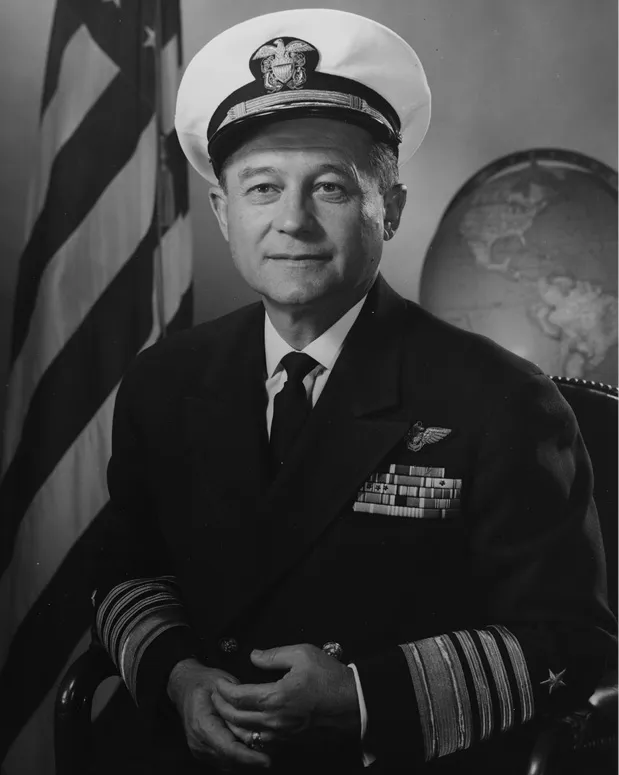
Admiral Harry D. Felt, in charge of the US Pacific Command from 1958 to 1964, opposed the employment of American naval and ground combat forces in Vietnam. Naval History and Heritage Command (NHHC) 80-G-1017094.
Born in Topeka, Kansas, on 21 June 1902, Don Felt moved with his family to the nation’s capital ten years later, settling near the Rock Creek Park neighborhood. He attended Central High School. His strong-willed mother worked to instill discipline and a love of education in the boy, but like many young men he showed more interest in playing games and hunting than academics. With the encouragement of his uncle, Senator William Thompson, and extra work at a prep school, however, in 1919 Felt entered the US Naval Academy. Other midshipmen remembered him for his positive attitude and “famous ear-
splitting grin.” His non-regulation, easygoing demeanor won him “a place among his classmates” but also earned him demerits for various infractions. Despite being nicknamed “shorty” and “shrimp,” short-statured Felt played intramural baseball for three years. He graduated in the respectable middle rank of the brigade of midshipmen and was commissioned Ensign in the US Navy in June 1923.
Bored with duty on board surface ships in the years after graduation, Don Felt “got the aviation bug.” He applied for and was accepted to flight training at Naval Air Station Pensacola, Florida. Kathryn Cowley, whom Felt met and wed there, later related that he had found his niche in the Navy in aviation and wanted little more after that than to “fly, fly, fly.”1 Felt excelled in various naval aviation billets in the late 1930s, and the outbreak of war in 1941 found him in command of a dive-bombing squadron operating from aircraft carrier Lexington (CV-2). By August 1942, Felt, now a commander, had been fleeted up to lead the air group of Saratoga (CV-3) and earned a Navy Cross and a Distinguished Flying Cross for his skillful and courageous combat performance against Japanese forces off Guadalcanal. He led an attack that sank the enemy aircraft carrier Ryujo. Felt capped his World War II combat experience in command of escort carrier Chenango (CVE-28) during the bloody fight for Okinawa against Japanese Kamikaze air attacks. For success in battle, Felt’s ship earned a Navy Unit Commendation, and he was awarded the Legion of Merit with Combat “V.”2
Felt’s assignment to a US military mission in Russia from March 1944 to February 1945 opened his eyes to the threat posed by communist ideology and Stalin’s USSR. During that time, he learned that his rooms were routinely “bugged” and that he was under constant surveillance by his hosts. Despite the World War II Allies’ endorsement of Soviet entry into the war against Japan at the Yalta Conference of February 1945, Felt intimated to his wife that he hoped “we don’t let the Russians in.”3 His worldview also broadened with attendance at the National War College and assignment as commander of the Navy’s small but diplomatically important Middle East Force. He met with numerous foreign dignitaries in the region and learned much about the local cultures. He joined the faculty at the Naval War College in Newport, Rhode Island, in the late 1940s and served into the early 1950s, and while there strengthened his understanding of political-military affairs. Felt’s responsibilities as deputy head of the Navy’s Strategic Plans Section during the Korean War exposed him not only to the service’s “big picture” but also to US foreign and national security policy.
Strengthening that education was his tutelage under the section’s head, Arleigh Burke, already known in the Navy as a strategic thinker and likely future Chief of Naval Operations. Felt related that “that was the beginning . . . of Burke and Felt working together as a team.”4 Burke, a Naval Academy classmate of Felt’s, also clearly valued their professional and personal connection. Soon after Burke took the reins of the Navy as Chief of Naval Operations in August 1955, he named Felt Commander Sixth Fleet, a three-star billet, but less than four months later decided he needed him back at the Pentagon as his
second-in-command or Vice Chief of Naval Operations (VCNO) with the rank of four-star admiral. That accelerated promotion clearly reflected Burke’s confidence in Felt’s abilities.5
Burke remembered that even though he and Don Felt “used to have a lot of big arguments,” his subordinate was “extremely loyal to the Navy [and] he had his nose to the grindstone.” Burke added that “it wasn’t pleasant [because] it isn’t pleasant to fight continuously with a good friend [but] it operated extremely well.”6 Indeed, the VCNO handled the day-to-day administration of the Navy so the CNO could concentrate on high-level global and national security issues. Like the executive officer of every command in the Navy, the VCNO was expected to be a no-nonsense enforcer of the commander’s will—and Felt did not disappoint.
Don Felt had a reputation throughout the Navy as a hard-ass, a demanding, irascible, and dictatorial perfectionist. Staff officers called to his Pentagon office would enter it trembling, expecting to be chewed out even for some minor infraction. Regarded by some as “mean as hell,” he was rumored to eat “admirals for breakfast, lunch, and dinner.” While acknowledging Felt’s caustic persona, Burke and many other flag officers considered him a top-notch leader who could be counted on to accomplish whatever mission he undertook. Lawson Ramage, who had earned the Medal of Honor for his submarine exploits in World War II, served under Felt in the Pentagon. He remembered that his boss would “really do his homework” by thoroughly mining relevant materials and discussing the pros and cons of a subject with trusted advisors before calling in a subordinate to execute an action. Ramage considered Don Felt a “great man.”7
Felt’s first direct experience with the belligerence of the Asian communist countries had occurred during his tour as the commander of a Seventh Fleet aircraft carrier task force in 1954. On 22 July, fighter planes of the People’s Republic of China (PRC) shot down a British Air Cathay airliner traveling between Bangkok and Hong Kong, killing eighteen civilian passengers and crew members. Rear Admiral Felt immediately ordered the launch of aircraft from carrier Philippine Sea (CV-47) to search for survivors. Suspecting that the Chinese might also attack his search planes, necessarily flying close to the water, Felt positioned the fighter cover high above the sea. On the 26th, when a pair of Chinese LA-7 fighters arrived as expected and dove on the American search planes, Felt’s AD Skyraiders shot down the attackers.8
The young admiral participated in the Taiwan Strait Crisis of 1954–1955 when Mao Zedong’s communist forces shelled the Chinese Nationalist island of Jinmen (Quemoy) and seized an island in the Dachen (Tachen) group. The Eisenhower administration supported the Chinese Nationalists and feared that the communists might also invade the large island of Taiwan, seat of Chiang Kai-shek’s Nationalist and pro-American government. Felt believed that because Mao was concerned that the United States might employ nuclear weapons in defense of its ally, in April 1955 the communist leader stopped the shelling and recommended negotiations to end the crisis. This experience convinced Felt that in the face of a determined US military stand, the Asian communists would invariably back down. He did not consider the possibility that Mao had no intention of invading Taiwan but was merely drawing international attention to his geopolitical grievances and galvanizing the Chinese people to stand up to the Americans in Asia.9
By the late 1950s, Don Felt and other US leaders concluded that the Asian communist countries would be more likely to work to undermine the non-communist governments of the region through insurgencies and guerrilla warfare than to conduct outright invasions. They understood that conventional French forces had been unable during the First Indochina War to defeat the guerrilla and unconventional tactics of Ho Chi Minh’s Vietnamese army. The communist leader had exploited control of the countryside to mount ceaseless surprise attacks on isolated outposts, eventually confining French forces to the lowlands around Hanoi and Haiphong.
US leaders searched for ways to oppose communist inroads in Asia without having to use nuclear weapons or even conventional forces. The ground war in Korea, fought much like World War II, had proven especially costly in terms of American lives, resources, and domestic support. Advocates for a change in US policy from stressing nuclear retaliation to a more flexible approach, exploiting the full range of measures available to the United States, included naval leaders. Burke, writing to Lord Louis Mountbatten, British First Sea Lord and Chief of Staff of the Royal Navy, suggested that “if we go too far on the megaton [nuclear] road we will, I think, have found that the free world will have been lost by erosion, and perhaps not even military erosion” (italics added).
Former Army Chief of Staff General Maxwell D. Taylor proved to be an especially influential advocate for a new flexible approach to US defense policy. He criticized the Eisenhower administration’s overemphasis on readiness for nuclear war, which he argued limited America’s options in international crises. In his 1960 book, The Uncertain Trumpet, the general contended that the United States should be able to fight communist aggression in Southeast Asia and elsewhere with military measures that did not risk global nuclear war. Taylor wanted the conventional forces of the military services strengthened so they could prevail in regional conflicts, “brushfire wars,” counterguerrilla campaigns, and counterinsurgencies. 11
Trouble in Laos
Arleigh Burke thought so highly of Don Felt’s leadership skills that he considered recommending his friend and chief subordinate to succeed him as Chief of Naval Operations when Burke expected to step down in 1958. But the Defense Reorganization Act of 1958 removed the CNO from the operational chain of command and empowered the regional commanders in chief, or “cincs,” so Burke wanted Felt in one of those newly empowered billets. Alarmed by what he considered the belligerence of the Asian communist nations, Burke wanted his man on the spot as the Pacific commander in chief. Burke considered Felt the “ideal man” for the CINCPAC billet.
W12hen Don Felt took the helm as Commander in Chief, Pacific, he took on major new responsibilities. Just the year before, the Joint Chiefs of Staff had disestablished the Army-led Far East Command, formerly headed by General Douglas MacArthur, and the Air Force-led Alaska Command, and transferred their area responsibilities to CINCPAC. Felt became responsible for military-to-military and diplomatic interaction with foreign officials from Japan in the north to Australia in the south and as far west as Pakistan. Furthermore, Felt had to oversee development of a new staff separate from that of the Commander in Chief, Pacific Fleet (CINCPACFLT). Previously, a Navy flag officer had been the “dual-hatted” head of both CINCPAC and CINCPACFLT. Burke had also recommended Felt for the job because he considered him tough enough and astute enough to handle challenges from the Army and the Air Force, which wanted one of their general officers to lead the joint-forces Pacific Command.
Fe13lt strongly endorsed Burke’s new approach to conflict resolution and de-emphasis on “massive retaliation.” After the Taiwan Strai...