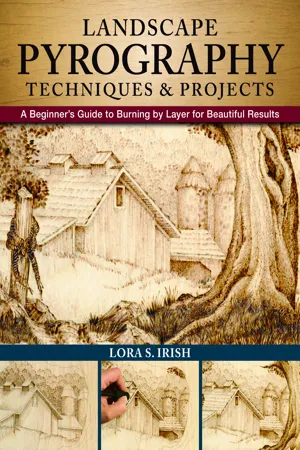
Learning pyrography has never been easier with this comprehensive guide. Nationally recognized artist and pyrographer Lora S. Irish reveals her easy-to-learn methods for working in layers to obtain stunning results. Lora introduces you to many different aspects of burning, and guides you through small practice patterns so you can discover and apply all the techniques. Learn about pen tips, temperature settings, fill patterns, and everything else you need to burn interesting, textured, lifelike landscapes.
Inside Landscape Pyrography Techniques & Projects you'll find:
• Complete guide to supplies, burning units, pen tips, pyrography media, safety, and more.
• How to create practice boards for pen tip strokes, texture fills, landscape features, and architectural elements.
• Four complete practice projects for a wide range of pyro techniques and effects.
• Step-by-step project for a rustic Mail Pouch Tobacco-style barn.
• Dozens of ready-to-use patterns for landscape scenes, with finished examples.
eBook - ePub
Landscape Pyrography Techniques & Projects
A Beginner's Guide to Burning by Layer for Beautiful Results
- 250 pages
- English
- ePUB (mobile friendly)
- Available on iOS & Android
eBook - ePub
Landscape Pyrography Techniques & Projects
A Beginner's Guide to Burning by Layer for Beautiful Results
About this book
Information
CHAPTER | Basic Supplies and Techniques |
A pyrography project is created using four basic elements: the burning unit, the pen tips, the medium on which you are working, and the pattern or design you will burn. There is also a host of important basic techniques, finishes, and tricks that you’ll want to know to maximize your skills and ensure your finished piece turns out just how you want it. We’ll cover pen tips in detail in a later chapter, but for now, it’s time to learn about all the basic supplies and techniques, starting with burning units.

Burning Units
There are three styles of burning units: one-temperature tools, rheostat-controlled tools, and variable-temperature tools. Which one you choose depends on both the depth of your interest in the craft and your budget.
ONE-TEMPERATURE UNITS
One-temperature burning units are very similar to soldering irons. The solid interchangeable tips are made from brass and screw into the front end of the burning unit. When this tool is plugged into the wall outlet, it heats to a single temperature: high. The most commonly used solid brass tip is called a universal tip. This is the tip shown on the burning unit below, and can be used for both fine line work and shading work. The other common solid tips that are available for this type of burning unit are the calligraphy tip, used for lettering, and the flow tip, used for large area shading.
A full range of tonal values can be burned using a one-temperature tool. Burn pale tones as the tool tip begins to heat; save the darkest tones for when the tool tip has reached its full heat capacity.
RHEOSTAT TOOLS
A rheostat burning unit has a rheostat on the power cord that allows you to fully control the temperature of the pen tip. A rheostat burning unit uses the same interchangeable brass tips as a one-temperature tool. The tonal values that you can see in the practice board below are worked by controlling the pressure of the tip on the wood, the speed of the stroke, and the density of the lines burned, and by adjusting the rheostat temperature setting.
The color tones that you burn using this type of burning unit are controlled by the texture pattern and speed at which you burn. Moving the tool slowly will create a black/brown line. If you speed up your movement, the line color will become paler.

Here you can see an inexpensive beginner’s pen, along with its attached rheostat for regulating the temperature.
VARIABLE-TEMPERATURE UNITS
Variable-temperature units have a thermostat base that can be set in a wide temperature range, from very cool at setting number 1 to extremely hot at setting number 10. Because this type of unit has such a wide range of temperatures, you will need to discover which settings are best for your projects. You can accurately set the tip temperature to easily reproduce consistent tonal values in your work. This high level of control ensures that the pen tip remains at a constant temperature as you work.
I use both the Colwood Detailer unit and the Optima 1 Dual unit on a regular basis, and highly recommend either unit as your mainstay burning unit. Both systems provide a wide, reliable temperature range. I tend to use only a small portion of their potential power, setting my temperature settings at 2-3 for pale tones, 3-4 for medium tones, and 5-6 for the darkest tones.
The Optima 1 Dual unit has a dual-pen system that allows you to have two burning tips ready for work at all times. A simple toggle switch lets you move from one pen to the next quickly. The pens for this unit have foam grips, which dramatically reduce the heat you feel during a long burning session. The temperature range of the thermostat is excellent and will give you total control over your tonal values.
The Colwood Detailer unit, with its single pen, has a wide range of temperature settings. Changing fixed-tip pens or changing tips on the interchangeable-tip pens is quick and easy. The temperature dial system responds quickly for fast tonal value changes. This particular unit can reach very hot temperatures; creating extreme black tones is simply a matter of turning up the heat. The cork handles are very comfortable and dramatically reduce the heat transfer from the tip to your hand.

Optima 1 Dual burning unit

Colwood Detailer burning unit
Cleaning Your Pen Tips
The best-burned strokes are made with a clean, bright tip. As you burn, the tips of your pens will begin to collect residue from the wood sap and carbon buildup from the burned wood. The tips can become so coated with carbon that they take on a black, crusted finish. That black carbon can even be transferred to your project and will appear as long, thin, dark gray streaks in the work. It also can cause your tip to lose heat or create uneven distribution of the heat to your tip.
I use two methods for cleaning my pen tips: emery cloth, and a woodcarving strop with aluminum or red oxide rouging compound. I also clean my tips frequently, long before the carbon buildup can become too intense. Before beginning to clean a pen tip, always unplug the burning unit and allow the pen to fully cool. A hot pen tip can burn both emery cloth and leather strops.
600-grit or finer emery cloth, which can be purchased at your local hardware store, can be used to clean badly encrusted tips. Fold the emery cloth to a size small enough to secure it with your fingers. Gently pull the tip of the pen over the cloth. Use as little pressure as possible as you clean the tip, to avoid distorting or bending the tip.
A leather or synthetic woodcarving strop, used to sharpen woodcarving tools, makes a wonderful cleaning board for any pen tip. Prepare the strop with a coating of either aluminum oxide powder or any fine-grit rouging compound. Pull the tip across the strop, using gentle pressure, until the tip is clean and bright.
After cleaning your pen tip using one of these methods, wipe it and the pen shaft with a clean, dry cloth to remove any remaining carbon particles.

Cleaning the carbon buildup from your pen tips allows you to create clean, crisp burned lines.
Burning Surfaces
Any natural surface can be used for pyrography, including wood, gourds, paper-mache, cotton and linen cloth, watercolor paper, and vegetable-tanned leather. Avoid any material that has been chemically treated or painted, because the high temperatures of the tool tips will release the chemical fumes of these materials during the burning process.
WOOD
Basswood and poplar are favorite woods for pyrographers. Both species have finely packed wood grain and a naturally pale white coloration, and both are commonly available in 1/8" (3mm) or thicker plywood sheets. The natural color of wood affects the color ranges that you will be able to see in your work. Naturally pale basswood, poplar, and birch will show a very wide range of pale-toned burns. Dark African mahogany and black walnut will not show burning until you reach mid-toned or dark-toned burns.
VEGETABLE-TANNED LEATHER
Vegetable-tanned, non-dyed leather is a favorite burning medium. Pyrography leather is available in large pieces, precut kits, and manufactured forms such as purses, book covers, and wallets. Leather offers the pyrographer a world of three-dimensional possibilities.
Leather comes in a variety of weights, from very lightweight 1-ounce leather, which is approximately 1/64" (0.4mm) thick, to 8-ounce leather at 1/8" (3mm) thick, and even heavier belt-weight leather that can be as thick as 1/4" (6mm).
Leather is also available in pre-dyed colors and suede textures, neither of which are recommended for burning: the chemicals used to create dyed leathers can produce toxic fumes during the burning process, and textured suede does not provide a smooth, uniform surface for clean, clear burned lines.

In this burning, worked on 8-ounce vegetable-tanned leather, the landscape structures are used as a pale background scene to provide the setting for an old truck and car.
GOURDS
Dried craft gourds make wonderful surfaces for your pyrography projects. Dried gourds, with their densely packed, woodlike fibers, provide an artist with interesting shapes for their pattern decoration. Easily cut with a craft knife or bench knife, a gourd can become a bowl, sand candle cup, vase, lamp, or, of course, delightful birdhouse. Use a dust mask when cleaning and cutting any dried craft gourd, because gourds often have fine powder residue surrounding the inner seed pod that can cause both skin and lung irritation.
ARTIST-QUALITY PAPERS
Artists use many styles of paper for their work in watercolors, marker illustration, pastels, and hand-pulled prints. The heavyweight, high-quality papers used for these arts are suitable for any pyrography pattern. You can find these papers with anything from a very smooth surface to a deeply toothed (or pebbly) texture. For pyrography, a smooth or lightly textured surface works best, since the pebbling can distort your lines as you burn. Paper is an interesting pyrography medium because you can easily color your designs with colored pencils, pastels, inks, and watercolors when you have finished burning.

Medium-textured, 140-pound watercolor paper is an inexpensive and extremely versatile medium for pyrography.
PAPER-MACHE AND CHIPBOARD
Both chipboard and paper-mache are made from shredded paper pulp. The pulp can be pressed into st...
Table of contents
- Cover
- Title
- Acknowledgments
- Copyright
- Introduction
- Contents
- Chapter 1 Basic Supplies and Techniques
- Chapter 2 All About Pen Tips
- Chapter 3 Creating Essential Practice Boards
- Chapter 4 Structure, Texture, and Weather Practice Boards
- Chapter 5 Practice Projects
- Chapter 6 Capstone Project: Advertising Barn
- Chapter 7 Patterns and Inspiration
- About the Author
- Safety Resources
- Index
Trusted by 375,005 students
Access to over 1.5 million titles for a fair monthly price.
Study more efficiently using our study tools.
Frequently asked questions
Yes, you can cancel anytime from the Subscription tab in your account settings on the Perlego website. Your subscription will stay active until the end of your current billing period. Learn how to cancel your subscription
No, books cannot be downloaded as external files, such as PDFs, for use outside of Perlego. However, you can download books within the Perlego app for offline reading on mobile or tablet. Learn how to download books offline
Perlego offers two plans: Essential and Complete
- Essential is ideal for learners and professionals who enjoy exploring a wide range of subjects. Access the Essential Library with 800,000+ trusted titles and best-sellers across business, personal growth, and the humanities. Includes unlimited reading time and Standard Read Aloud voice.
- Complete: Perfect for advanced learners and researchers needing full, unrestricted access. Unlock 1.5M+ books across hundreds of subjects, including academic and specialized titles. The Complete Plan also includes advanced features like Premium Read Aloud and Research Assistant.
We are an online textbook subscription service, where you can get access to an entire online library for less than the price of a single book per month. With over 1.5 million books across 990+ topics, we’ve got you covered! Learn about our mission
Look out for the read-aloud symbol on your next book to see if you can listen to it. The read-aloud tool reads text aloud for you, highlighting the text as it is being read. You can pause it, speed it up and slow it down. Learn more about Read Aloud
Yes! You can use the Perlego app on both iOS and Android devices to read anytime, anywhere — even offline. Perfect for commutes or when you’re on the go.
Please note we cannot support devices running on iOS 13 and Android 7 or earlier. Learn more about using the app
Please note we cannot support devices running on iOS 13 and Android 7 or earlier. Learn more about using the app
Yes, you can access Landscape Pyrography Techniques & Projects by Lora S. Irish in PDF and/or ePUB format, as well as other popular books in Technology & Engineering & Art General. We have over 1.5 million books available in our catalogue for you to explore.