Liberal regimes shape the ethical outlooks of their citizens, relentlessly influencing their most personal commitments over time. On such issues as abortion, homosexuality, and women's rights, many religious Americans feel pulled between their personal beliefs and their need, as good citizens, to support individual rights. These circumstances, argues John Tomasi, raise new and pressing questions: Is liberalism as successful as it hopes in avoiding the imposition of a single ethical doctrine on all of society? If liberals cannot prevent the spillover of public values into nonpublic domains, how accommodating of diversity can a liberal regime actually be? To what degree can a liberal society be a home even to the people whose viewpoints it was formally designed to include?
To meet these questions, Tomasi argues, the boundaries of political liberal theorizing must be redrawn. Political liberalism involves more than an account of justified state coercion and the norms of democratic deliberation. Political liberalism also implies a distinctive account of nonpublic social life, one in which successful human lives must be built across the interface of personal and public values. Tomasi proposes a theory of liberal nonpublic life. To live up to their own deepest commitments to toleration and mutual respect, liberals, he insists, must now rethink their conceptions of social justice, civic education, and citizenship itself. The result is a fresh look at liberal theory and what it means for a liberal society to function well.
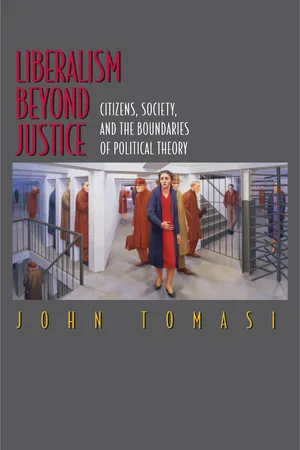
eBook - ePub
Liberalism Beyond Justice
Citizens, Society, and the Boundaries of Political Theory
- 184 pages
- English
- ePUB (mobile friendly)
- Available on iOS & Android
eBook - ePub
About this book
Information
Publisher
Princeton University PressYear
2021Print ISBN
9780691049694
9780691049687
eBook ISBN
9781400824212
Chapter One
POLITICAL LIBERALISM
MOTIVATIONAL FOUNDATIONS
Every political view includes a principle of legitimacy, a principle, that is, which explains when and why the exercise of political power is justified. To fully exposit a political view, it is not enough to simply set out an account of how people should order their public institutions, an account, that is, of social justice. Justification of state power should also include an account of the reasons the persons who live there have, or should have, for affirming those particular institutions. The principle of legitimacy provides that extra element.
Not surprisingly, there are as many rival principles of legitimacy as there are rival political views. Theocrats, for example, say the use of political power is justified in the end by otherworldly considerations, such as the salvation of citizens’ souls. Fascists have seen political power as justified by the needs of the state as an organic entity; communists, by the historic imperatives of a society’s economic development.
The liberal principle of legitimacy—like each of the others—reflects what its proponents believe is most important in human social life. For liberals, this is the idea that in the conditions of pluralism that mark modern societies, individual citizens must be recognized as the ultimate arbiters of what gives value to their own lives. Political power must be justifiable in principle to each of them. For liberals, the justification of social structures must be provided not in the unified terms of any single religious doctrine, story of nation, or all-encompassing economic theory. Rather, justification must proceed in terms of whatever questions citizens themselves think fit to ask. The liberal principle of legitimacy says that a system of social order is justified only if it is conducted on the basis of principles that citizens might be expected to endorse after asking their questions and considering the best answers the defenders of that social order might give.1
Political liberalism was born out of a crisis in this principle of legitimacy. The ambition underlying all versions of liberalism has long been to define the common good of political association in terms of a minimal moral conception—that is, a basic value or set of values that most citizens share despite even their many important differences.2 Political principles are neutral—and thus satisfy the liberal principle of legitimacy—insofar as they can be justified by reference to such shared values, without assuming the validity or truth of any particular (controversial) conception of the good life.
This liberal principle of legitimacy does not require that every person must agree with every particular rule, policy, or court decision that is enforced by the liberal state. Rather, the idea is that if many people agree to have some set of foundational principles regulate the basic structure of their society, including the processes by which particular policies and laws will be arrived at, then they affirm the use of political coercion even regarding the particular outcomes they dislike.
In the seminal formulations of Kant and Mill, the liberal commitment to state neutrality was justified ultimately by reference to a particular view of human moral nature—one championing autonomy (for Kant, a life lived according to rational will) or individualism (for Mill, an experimental attitude toward one’s projects). Both Kant and Mill, each for his own reasons and in his own way, affirmed the idea that the liberal state should not seek to impose any particular view of the good life on its citizens. Rather, these liberals argued that forms of life have their value to people because, and only when, individuals freely come to affirm those ways of life for themselves. Some contemporary liberals—Ronald Dworkin, Will Kymlicka, and Joseph Raz prominent among them—continue to defend liberal politics firmly within this tradition. These contemporary “ethical” liberals, and Raz in particular, have defended more expansive or even communitarian conceptions of autonomy—for example, conceptions of autonomy that give increasing place to the demands of a person’s history or (unchosen) social context of choice. But what liberal citizens are said to share, on all the many variants of this broad approach, is a commitment to the moral importance of individual choice-making rather than to any particular outcome of choice. It is upon this shared ideal of individualism that a liberal rights-based politics can be built.
However, many other liberal theorists have come to worry that even a broadened ideal of individualism is something on which people may reasonably disagree. Charles Larmore, for example, traces a Romantic movement from Herder to Alasdair MacIntyre and Michael Sandel in our day, one central strand of which has been a critique of precisely those moral ideals associated with Kant and Mill. In opposition to the traditional liberal emphasis on reflective individualism as a philosophy of life—the idea that people should always maintain a contingent allegiance, revisable on reflection, to their own view of the good life—thinkers in this Romantic tradition have stressed the values of belonging and custom.3 For these people, Larmore says, “such ways of life (shared customs, ties of place and language, and religious orthodoxies) shape the sense of value on the basis of which we make whatever choices we do.” These commitments reach to the foundations of people’s nature as moral beings. “They are so integral to our very conception of ourselves as moral beings that to imagine them as objects of choice would be to imagine ourselves as without any guiding sense of morality.”4 From this perspective of the nature of moral value, the individualistic philosophy of ethical liberalism has seemed bound to destroy the roots of morality itself.
Whatever in the end one might oneself come to think of this view of moral personality and value, many theorists have come to see that this is a view that many citizens of modern societies do hold. The Romantic ideal is as much a part of Western culture as the contrary ideals of autonomy and individuality described by Kant and Mill.5 For a growing number of contemporary theorists, these forms of enthusiasm for custom seem to be incompatible with any single ideal of moral personality on which liberal politics might be directly founded.
However, if any recognizably liberal ideal of individualism or autonomy is itself subject to irresolvable controversy, no such ideal can serve as the minimal moral conception on which liberal politics has long hoped to rely. Any liberal theory that is founded on a controversial view of moral personality would be overly restrictive, and in an illegitimating way. Many citizens will consistently object to the state coercively enforcing liberal strictures against them. For example, such citizens may object to judicial decisions protecting heretical or blasphemous speech in the name of personal freedom, or to decisions disallowing devotional Bible study in public schools based on a similar rationale. Crucially, such people will object not just to the particular rulings but to the justificatory foundation of the public decision-making system itself, a foundation made up of an autonomy-affirming philosophy of life that they themselves reject for moral reasons.6 If traditional versions of liberalism must invoke moral notions of autonomy or individualism that are incompatible with the ethical outlooks of many of these Romantic citizens, then the acceptance of Romanticism as a way of life undercuts the traditional justification of liberal politics.
John Rawls, who has given by far the most detailed account of political liberalism, sees the motivational foundations of this emerging version of liberalism just this way—though Rawls describes the crisis of legitimacy as arising internally to his own argument for justice as fairness. If state-backed coercion in the name of some set of principles of justice is to be justified, according to Rawls, it must be shown that those principles matter to citizens in a first-personal and moral way. Rawls calls this the test of stability.
In the third part of A Theory of Justice (henceforth Theory), Rawls describes how people who have once acquired a sense of justice could reasonably be expected to regard justice not just as a constraint on their actions but as a good in itself for them. “The desire to act justly and the desire to express our nature as free moral persons turn out to specify what is practically speaking the same desire.”7 Rawls was confident that this congruence would obtain because of the way the principles of justice were themselves derived. Those principles were derived from a device called the original position, a device that in Theory is sometimes described as representing an important fact about people: people’s true moral nature is to be free. A conception of justice derived from a particular view of human nature—if the view hit upon were true—could then reasonably be expected to be recognized by people as reflecting who they really are. Insofar as people desire to express their true moral nature, and thus avoid giving way to “the contingencies and accidents of the world,” they could be expected to see that acting according to those principles would be congruent with their own good.8 Coercive power exercised on the basis of principles derived that way could thus satisfy the liberal principle of legitimacy.
However, as Rawls came later to see, “Theory relies on a premise the realization of which its principles of justice rule out.”9 The premise is that all good citizens must converge on the particular view of human moral nature that the original position was said to model: the true moral nature of people lies in their capacity for freedom. But that particular view of human nature—as much as the individualism of Mill or Kant—is something on which many citizens of goodwill, and Romantic “citizens of faith” in particular, disagree. Indeed, disagreement about the true character of human moral nature is particularly likely in a society that gives central place to associative and deliberative liberties, the hallmarks of a liberal society. Liberal principles of justice support precisely the institutional conditions that undercut (or make unrealistic) the comprehensive form of justification upon which Rawls’s argument in Theory depended. Some citizens who grow up in a free society may reasonably be expected to ask questions that no reference to the individualist ideals of Kant or Mill (or to the modified conceptions of autonomy of Dworkin, Kymlicka, or Raz) can satisfy. And citizens may ask these questions while still very much wishing to take part in political association with (diverse) others on terms that all can accept. How might liberal forms of state coercion be justified to “politically reasonable” citizens such as these?
On the traditional or “comprehensive” liberal approach the hope has been to defend some suitably general liberal view about true human moral nature against critics by means of philosophical argumentation. The critics having been confronted and their beliefs about human moral nature shown to be false, philosophers could then use their own true view of moral personality as a shared moral basis for liberal politics. But accepting the fact of reasonable value pluralism requires that liberals now abandon all such philosophical ambitions. In conditions of institutional freedom, convergence on a single conception of human moral nature is unlikely, no matter how long or cleverly philosophers argue. A new trailhead must be considered: perhaps liberals should begin looking for the shared moral basis for liberal politics merely in the cluster of moral ideas that people in Western democracies already hold, however inchoately, regarding their political lives.
Political liberals, thus propose two major adjustments to the traditional liberal paradigm. First, political liberals recast their arguments for state neutrality as arguments that appeal only to people’s beliefs about politics itself. For example, Rawls recasts his basic argument for justice as fairness in Theory as a freestanding political conception of justice. Instead of reading the original position as representing any particular view about the true moral nature of persons, a reading that was strongly implied in the text of Theory, Rawls says that we should instead view that device—and his other arguments for justice as fairness in Theory—as based on the shared elements of the public life of a democratic culture. Rawls sets aside questions about the truth of the (various) foundations of those shared public elements. He emphasizes instead the formative role of liberal institutions in leading otherwise diverse people to share a common set of political ideas—central among them the shared idea that whatever their differences, all people in liberal societies should be respected as free and equal for political purposes.
This first adjustment, a change in the way the liberal conception of justice is justified, is known as the politicization of justice.10 The politicization of justice in turn forces many other changes and, in particular, calls for the development of a whole cluster of theoretical concepts that had not been needed by liberal philosophers before. These ideas are needed to show how a conception of justice constructed merely from people’s political views could meet the first-personal stability test I described above. After all, moral and religious convictions typically matter more to people then even their most basic political beliefs. So, people might accept principles justified in this political way as a general matter, and yet reject such principles whenever they conflicted with their own religious or comprehensive moral beliefs. To remedy this requires the second major adjustment of political liberalism: the addition to liberal theory of further stages of justification, stages concerned not with justice but with legitimacy.
If coercion in the name of some conception of justice is to be justified in a social world marked by reasonable value pluralism, liberals think that citizens must be able to affirm those shared political principles on the basis of their own views of what gives life its ultimate meaning and value. They must be able to embed the political conceptions within their own comprehensive conceptions of the good, and thus achieve “full individual justification.”
A Catholic, for example, might embed certain basic liberal political principles within her own comprehensive doctrine through the doctrine of free faith—a doctrine that is essential to the Catholic account of each person’s relation to Jesus Christ. She adopts core liberal principles out of her concern for her own Catholicity.11 Rather than thinking that philosophical argument must lead all reasonable persons to affirm liberal principles for the same set of moral reasons (the view suggested by Theory), political liberalism operates from the more modest hope that different groups may come to affirm some common set of principles for their own diverse sets of reasons.12 For example, an atheist might join the Catholic in affirming political protections of free faith, though do so purely out of concern for his own very different moral belief system. He is concerned, as an atheist, that he will be able to live his own life atheistically, even while sharing a social world with Catholics and others who personally reject his worldview.
If people who have achieved full individual justification in a plural society find that they do share a political conception of justice, then an “overlapping consensus” forms and an even further level of justification—“public justification by political society—has been achieved. In that event, the conditions of liberal legitimacy have been met.13 Political liberal theory has provided us with an argument for a particular conception of justice and an account of how it is possible that such a conception could be enforced legitimately even in a society that contains citizens of faith as well as autonomous individualists.
The general idea of a political conception of liberalism—while still in its infancy—has proven tremendously attractive and is rapidly gaining adherents.14 Political liberalism holds out the possibility of a form of politica...
Table of contents
- Cover Page
- Title Page
- Copyright Page
- Dedication
- Contents
- Acknowledgments
- Introduction
- Chapter One: Political Liberalism
- Chapter Two: The Boundaries of Political Theory
- Chapter Three: Liberal Nonpublic Reason
- Chapter Four: Citizenship: Justice or Well-Being?
- Chapter Five: The Formative Project
- Chapter Six: High Liberalism
- Conclusion
- Notes
- Bibliography
- Index
Trusted by 375,005 students
Access to over 1.5 million titles for a fair monthly price.
Study more efficiently using our study tools.
Frequently asked questions
Yes, you can cancel anytime from the Subscription tab in your account settings on the Perlego website. Your subscription will stay active until the end of your current billing period. Learn how to cancel your subscription
No, books cannot be downloaded as external files, such as PDFs, for use outside of Perlego. However, you can download books within the Perlego app for offline reading on mobile or tablet. Learn how to download books offline
Perlego offers two plans: Essential and Complete
- Essential is ideal for learners and professionals who enjoy exploring a wide range of subjects. Access the Essential Library with 800,000+ trusted titles and best-sellers across business, personal growth, and the humanities. Includes unlimited reading time and Standard Read Aloud voice.
- Complete: Perfect for advanced learners and researchers needing full, unrestricted access. Unlock 1.5M+ books across hundreds of subjects, including academic and specialized titles. The Complete Plan also includes advanced features like Premium Read Aloud and Research Assistant.
We are an online textbook subscription service, where you can get access to an entire online library for less than the price of a single book per month. With over 1.5 million books across 990+ topics, we’ve got you covered! Learn about our mission
Look out for the read-aloud symbol on your next book to see if you can listen to it. The read-aloud tool reads text aloud for you, highlighting the text as it is being read. You can pause it, speed it up and slow it down. Learn more about Read Aloud
Yes! You can use the Perlego app on both iOS and Android devices to read anytime, anywhere — even offline. Perfect for commutes or when you’re on the go.
Please note we cannot support devices running on iOS 13 and Android 7 or earlier. Learn more about using the app
Please note we cannot support devices running on iOS 13 and Android 7 or earlier. Learn more about using the app
Yes, you can access Liberalism Beyond Justice by John Tomasi in PDF and/or ePUB format, as well as other popular books in Politics & International Relations & Political History & Theory. We have over 1.5 million books available in our catalogue for you to explore.